






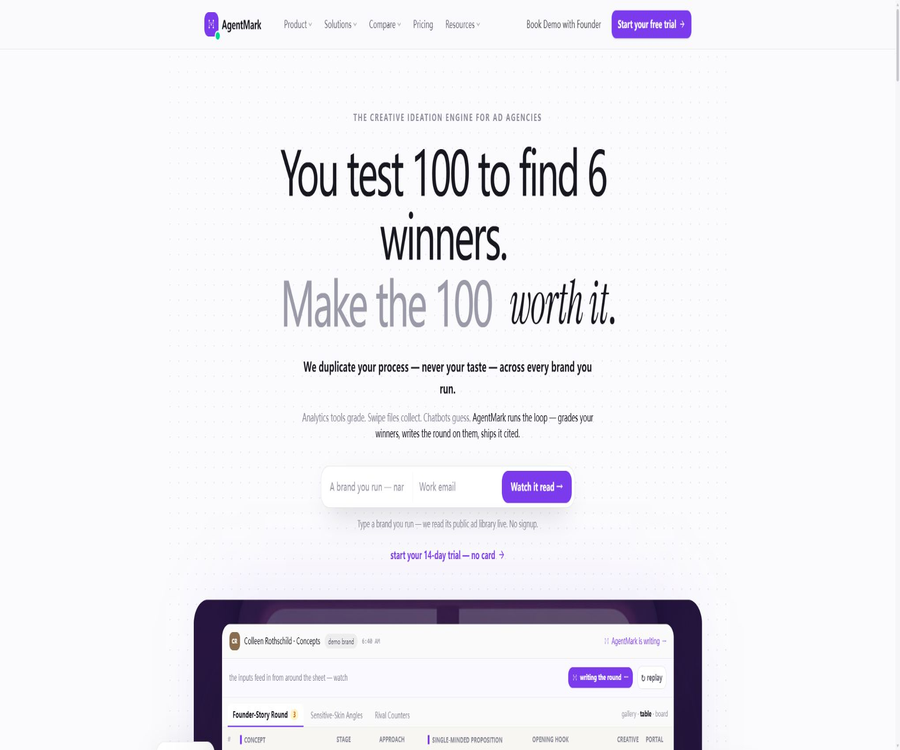
What is AgentMark?
AgentMark is an AI-based creative analysis and concept generation platform designed for advertising agencies and performance marketing teams, operated by Cactivate. It analyzes advertising accounts, brand information, competitors’ ads, and consumer research to create continuously updated creative workflows for each brand.
The platform insists that the content created must be based on specific criteria, rather than relying on generic chatbots to make guesses. It can only access advertising accounts; it does not modify budgets or publish ads directly. The final decisions regarding creativity and campaign execution remain with the team.
Core functions
- Classify and score advertising materials based on team-specific KPIs.
- Identifying winning, losing, and fatiguing ideas
- Extract the opening, tone, format, and advertising message from the material.
- Develop ad concepts based on winning elements, competitors, and research findings.
- Monitor weekly changes in competitors’ ads and creative approaches.
- Continuously study the issues and changing concerns of target buyers.
- Use Brand Brain to save the brand’s voice, products, and history.
- Generate customer reports that include data calculations and the sources cited.
- Deliver concepts and reports through a branded portal
- Ask questions to the Team Lead across multiple brands and consolidate progress updates.
Advertising creativity score
AgentMark reads the campaign data at the level of individual creative elements, and classifies them as successful, failed, or underperforming based on the KPI thresholds set by the team. The official examples use metrics such as ROAS, and set a minimum spending threshold to avoid misjudgments due to small sample sizes.
- Summarize performance based on creativity rather than just ad groups
- Evaluate using the team’s own KPIs and target values.
- Set a threshold for costs to prevent winners being determined based on small sample sizes
- Identify fatigue materials whose performance begins to decline.
- Combine AI vision to analyze hooks, tone, and content format.
- Use the winning pattern as evidence for the subsequent brief.
- Do not present historical victories as guarantees of future success.
Concept generation based on evidence
The team can generate a range of advertising concepts by analyzing performance patterns, competing products, and buyer research, and then apply their own brief templates to these concepts. Each concept comes with a Grounding Receipt, which makes it easy to track which data and materials were used as references.
- Extract reusable patterns from successful ideas
- Transform the shortcomings of competitors and buyer concerns into creative ideas.
- A single brief can generate a relatively large number of concepts.
- Output in the agent’s own field format and document structure.
- Multiple hooks and visual direction drafts are provided.
- Allow the strategy and creativity teams to modify and filter items on the dashboard.
- Only manually approved content is sent to the customer portal.
Competitor ad monitoring
AgentMark scans the public advertising materials of competitors on a weekly basis and groups them by creative aspects. It relies on available information such as the duration of the ads to carry out its analysis, and it does not fabricate data regarding the spending or conversion rates of competitors.
- Tracking newly appearing, long-lasting, and quickly removed ads
- Categorized by selling points, format, and narrative perspective.
- Identify the themes commonly used by multiple competitors.
- Identify creative gaps that the brand has not yet addressed.
- Add the patterns worth studying to Brief and Swipe File
- The team can set the opponents to be monitored as well as the conditions for alerts.
Buyer research
The platform can continuously examine various aspects related to the buyer personas and issues defined by the team, using multiple AI engines. Any changes that occur on a weekly basis are recorded and can serve as background information for new concepts.
- Create target buyer Personas for each brand.
- Define the issues and research areas to be continuously tracked.
- Observe changes in buyers’ expressions, concerns, and information needs
- Identify new signals that merit conversion into creative briefs
- Save the research findings in brand memory.
- Avoid treating AI-driven insights as genuine market research findings.
Brand Brain – Brand memory
Brand Brain stores the brand’s voice, products, KPIs, past decisions, and team information, and retrieves this data before each generation cycle. The retention period varies depending on the Starter, Professional, and Scale packages.
- Document the brand tone, prohibited expressions, and compliance requirements.
- Maintain products, SKUs, target audiences, and core messaging.
- Retain past concepts, reporting, and decision-making contexts
- Use team feedback to explain a specific brand style.
- Ensure continuity in the subsequent outputs of the same brand.
- Avoid cross-referencing of data between different agents or work areas.
Reports and Customer Portal
AgentMark can process data from advertising accounts and prepare analytical reports that are easy for clients to understand, with the relevant figures accompanied by explanations. Once edited and approved by the team, these reports and insights can be published on the branded customer portal.
- Generate monthly or periodic reports on creative performance.
- Explain what creative patterns are responsible for the changes in efficiency.
- List the directions for testing in the next phase and the data sources.
- Allow strategy specialists to modify the text and conclusions before publication.
- Archive concept books, reports, and historical decisions in one place
- Professional offers a portal and Portal Chat.
- Scale and Custom offer more comprehensive white-label capabilities.
Team Lead collaborates with multiple brands
Team Lead is used to pose questions across the entire portfolio of brands, and to assign those questions to the Account Manager Agents responsible for each brand. It is suitable for checking on the progress of deliveries, identifying unfinished tasks, or spotting common changes among multiple clients.
- Check concepts across brands and the status of report delivery
- Forward the issue to an Agent with context about that brand.
- View each assignment, response, and chain of evidence
- Go to a specific brand to proceed with one-on-one analysis.
- Reduce the time spent by the strategy manager on opening each account individually
- Preserve the ultimate control of customer communication by the human supervisor.
Supported advertising platforms
| Platform | Connection method | Primary uses | Permission features |
|---|---|---|---|
| Meta | Advertising account connection | Material presentation, creative analysis, and competitor information | Read-only |
| Advertising account connection | Analysis of delivery performance and creative patterns | Read-only | |
| TikTok | Advertising account connection | Analysis of creativity and presentation in short videos | Read-only |
| Microsoft | Advertising account connection | Analysis of search ad performance and creatives | Read-only |
| Public advertising materials | Brand or competitor research | Monitoring from the perspective of advertising and creative elements | Use only visible information. |
Applicable scenarios
- Advertising agencies prepare weekly creative reviews for multiple clients.
- The performance team generates the concepts for the next round of testing from the winning materials in bulk.
- Creative strategists analyze competitors and identify market gaps.
- The account manager prepares monthly reports based on data.
- The team continuously monitors ad fatigue and expands the testing pipeline.
- Conduct rapid research on potential customers through public advertisements during the proposal phase
- Agents use white-label portals to deliver concept books and reports to clients.
- Managers monitor delivery and research progress across multiple brands.
Which users are it suitable for
- Advertising agencies that manage multiple brands at the same time
- Performance marketing teams that need to continuously generate a large number of testing concepts
- Professionals responsible for creative analysis, strategy, and briefs
- Teams that wish to link advertising data with creative development
- Agencies that require a customer portal and white-label delivery
- A mature marketing organization that is capable of conducting its own audits and carrying out marketing campaigns.
AgentMark price
AgentMark charges based on the number of brands rather than on the number of team seats, and offers four tiers: Starter, Professional, Scale, and Custom. All of these tiers utilize the same mechanism for night-time data retrieval; the main differences lie in the number of brands, the amount of Credits available, the volume of output, the number of competing brands, memory capacity, and the ability to use a custom brand identity.
| Package | Monthly fee | Includes brand | Monthly Credits | Output for reference month |
|---|---|---|---|---|
| Starter | 250 dollars | 5, can be increased to 8 | 1,000 | About 50 concepts and 5 reports |
| Professional | 1,200 dollars | 15, can be increased to 25 | 3,000 | About 180 concepts and 15 reports |
| Scale | 4,000 dollars | 50 | 10,000 | About 540 concepts and 50 reports |
| Custom | Company quote request | 50 or more, with no limit | Customization | In accordance with the plan’s provisions |
Comparison of package features
| Functions | Starter | Professional | Scale | Custom |
|---|---|---|---|---|
| Number of competitors per brand | 4 | 6 | 10 | No restrictions |
| Brand memory | 90 days | 365 days | No restrictions | No restrictions |
| Advanced AI models | Not included | Includes | Includes | Includes |
| Customer Portal | Optional brand portal | Portal and chat | Complete white-labeling | Complete white-labeling |
| Unit price for additional credit purchases | $ | $ | $ | Customization |
| Corporate control | Foundation | Expansion | SSO, SOC 2, and IP allowlist | According to the enterprise’s needs |
Additional brand purchases and Credits
The Starter plan allows for an expansion to 8 brands at a cost of $60 per brand per month, while the Professional plan enables expansion to 25 brands at $80 per brand per month. Each additional brand comes with 200 Credits per month.
- A basic Brief costs 25 Credits.
- 5 Credits are consumed each time a new concept is generated.
- A single brief can generate up to 60 concepts.
- Nighttime background readings are not billed based on Credits.
- Additional Credits can be purchased in months with high usage.
- Monthly budgets should be established based on concepts, reports, and brand planning.
Free trial
AgentMark offers a 14-day free trial; the company states that no credit card is required, and it is possible to create the first set of conceptual designs before making any payments. Teams can also use existing ads to get a feel for the product and determine whether it is suitable for the target brand.
- First, test a brand that has stable delivery data.
- Verify that the account connection remains read-only.
- Configure actual KPIs and minimum spending thresholds.
- Check the consistency between the scoring and the team’s manual judgment.
- Generate a set of concepts and verify each basis.
- Record the Credits for the trial period and the actual deliverables.
Quick Start Tutorial
- Register for a 14-day trial and create an agent workspace.
- Select a representative brand and connect a read-only advertising account.
- Set the key KPIs, target values, and minimum spending thresholds.
- Add brand voice, products, Persona, and prohibited expressions.
- Add the competitors and research questions that need to be monitored.
- Check the initial ad rating and adjust the classification rules.
- Generate the first set of Briefs and concepts from the winning pattern.
- After manual review, it is published to the customer portal or exported.
Tutorial on creating creative briefs
- Choose a specific product, target audience, and marketing objectives.
- View recent Winning, Losing, and Fatiguing materials.
- Select a winning strategy that has sufficient funding and support to yield results.
- Add competitor analysis and buyer research as supplementary background.
- Select the agent’s own Brief template and output fields.
- Set the number of concepts and check the Credits consumption.
- Check each claim, hook, visual direction, and basis one by one.
- After being modified by the strategy and creativity team, it goes for customer approval.
Multi-brand launch tutorial
- Select a package based on the number of brands, the monthly volume of data, and the number of reports.
- Create isolated brand assets and portals for each customer.
- Standardize KPI definitions while retaining brand-specific thresholds.
- Connect to the advertising accounts in batches and verify read-only permissions.
- Specify the brand manager, reviewer, and permissions for publication.
- Establish a weekly scoring system, competitor research, and a schedule for briefs.
- Monitor Credits, delivery times, and customer adoption.
- Fix the low-quality rules and templates before expanding the brand.
Effect evaluation
| Indicators | Evaluation questions | Suggested method |
|---|---|---|
| Rating consistency rate | Does the classification of platforms meet the team’s standards? | Comparison with strategists’ blind evaluations |
| Concept adoption rate | How many of the generated concepts make it to the production stage? | Record filtering and reasons for rejection |
| Test win rate | The actual results of applying the concept in practice | Comparison with historical baseline |
| Brief cycle | Time from analysis to delivery | Compare the medians before and after going live |
| Based on accuracy | Does Receipt truly support this concept? | Manual random inspection in batches |
| Used by customers | Whether the portal content has been viewed and approved | Take feedback into account rather than focusing only on logins. |
| Unit cost of production | Valid outputs corresponding to subscriptions and Credits | Calculated based on the adopted concept. |
Data and Security
The official documentation states that advertising accounts are set to read-only mode, with isolation between different workspaces; customer data is not used for training models. Advanced solutions also include corporate controls such as SSO, SOC 2, and IP allowlists, and the exact scope of application should be confirmed at the time of purchase.
- Only the advertising accounts and brand ranges required for analysis are granted.
- Regularly check OAuth connections and the permissions of employees who have left the company.
- Do not upload customer or personal data for which you do not have permission to process.
- Limit who can view, edit, and publish customer content
- Review data, claims, and compliance wording before publishing on the portal.
- Export the required concepts and reports before canceling the service.
- Apply to delete workspace data as required by the contract.
Product advantages
- Link ad performance analysis directly to the creation of creative concepts
- Assess the performance of materials based on team KPIs rather than universal standards.
- Each concept is accompanied by supporting evidence, to facilitate review by strategists and clients.
- It covers both organic ads, competitors, and buyer research.
- Brand Brain can maintain brand voice and historical continuity.
- Charged by brand, with no additional fee for team seats.
- Read-only account connections reduce the risk of accidental changes to campaigns.
- The customer portal, reporting tools, and white-labeling capabilities are suitable for use by agents in delivering services.
Usage restrictions and precautions
- The Starter plan costs $250 per month and is intended for professional teams rather than individual users.
- The platform only provides analysis and concepts; it does not replace the actual creation and placement of advertisements.
- Past winning patterns do not guarantee that new concepts will continue to succeed in the future.
- Low costs, short time frames, or incorrect attributions can affect the quality of the ratings.
- The paid ads of competitors cannot provide accurate data on costs and conversion rates.
- Buyer research involves AI-driven insights, but it cannot replace direct user research.
- A large number of concepts and reports will quickly consume Credits.
- The team still needs to manually review facts, brand voice, and advertising compliance.
- At present, only a limited number of advertising platforms are explicitly listed; other channels need to be verified separately.
- The core platform is a closed-source commercial service; it is not possible to deploy a complete version of the product on one’s own.
GitHub and open source
The database includes the advertising creativity platform AgentMark; its official website domain ends with “ai”. No official open-source repository for this product was found. It is a commercial SaaS solution, with the account management, scoring, brand memory functions, content generation, and customer portal all provided by the hosting platform.
There is also a developer project with the same name, AgentMark; its official website ends with the “co” extension. This project provides agents, prompts, datasets, and evaluation tools, along with publicly available code. It is not the same product as the advertising agency software mentioned here, and the GitHub accounts or licensing information related to them cannot be used interchangeably.
| Name or component | Status | Explanation |
|---|---|---|
| AgentMark Advertising Creative Platform | Commercial closed-source | Subjects covered in this article |
| Advertising ratings and Brand Brain | Commercial hosting capabilities | The core source code is not made public. |
| Customer Portal and Team Lead | Commercial hosting capabilities | Included with the package |
| The developer with the same name is AgentMark | Different products | It cannot be used as the official GitHub for this article. |
| Official advertising product GitHub | Not verified. | Open source should not be mislabeled based on warehouses with the same name. |
Basic information
| field | Content |
|---|---|
| Tool name | AgentMark |
| Operator | Cactivate, Inc. |
| Tool type | AI platform for advertising creative analysis and concept generation |
| Primary users | Advertising agencies, creative strategy, and performance marketing teams |
| Supported platforms | Meta, Google, TikTok, and Microsoft |
| Connection permissions | Read-only for ad accounts |
| Price | Starting at $250 per month |
| Free trial | 14 days, no credit card required |
| Billing basis | Based on the number of brands and Credits, not on seats |
| Is it open source? | No, this advertising creative platform is a commercial, closed-source product. |
Recommendation score
4.5 / 5. AgentMark is suitable for agencies that need to manage multiple advertisers, have a stable process for testing creative ideas, and require traceability of client deliveries; its pricing, platform coverage, and credit system are better suited for professional teams, whereas the quality of the output still depends on account data and manual creative judgment.
Frequently Asked Questions
What is AgentMark mainly used for?
It analyzes the performance of advertising creatives, monitors changes in competitors and buyers, and generates advertising concepts and client reports backed by data.
Will AgentMark modify the advertising account?
No. According to the official guidelines, the account connection is set to read-only mode; the platform does not modify the costs nor carry out any campaigns directly.
Which advertising platforms is AgentMark compatible with?
Currently, the official list includes Meta, Google, TikTok, and Microsoft.
How much is AgentMark?
The Starter plan costs $250 per month, the Professional plan costs $1,200 per month, the Scale plan costs $4,000 per month, and a quote is required for the Custom plan.
Does AgentMark charge by seat?
There is no charge based on the number of seats; packages are differentiated by the number of brands that can be managed and by the number of Credits available, and team members can be invited to work together.
Is there a free trial for AgentMark?
There is a 14-day free trial, and the official site states that a credit card is not required.
How many Credits are required to generate a Brief?
The basic brief costs 25 Credits, and each additional concept costs 5 Credits; the final cost is determined in accordance with the account’s billing rules.
Can concepts created by AI surely win?
No guarantee can be provided. The platform offers recommendations based on past success patterns, but the actual results still need to be verified through production, deployment, and statistical analysis.
Is AgentMark open source?
This advertising-themed creative product is not open source; the open-source developer project with the same name available online is a different product.
Tools similar to AgentMark





 Guigong Network Security Registration No. 45132202000164