






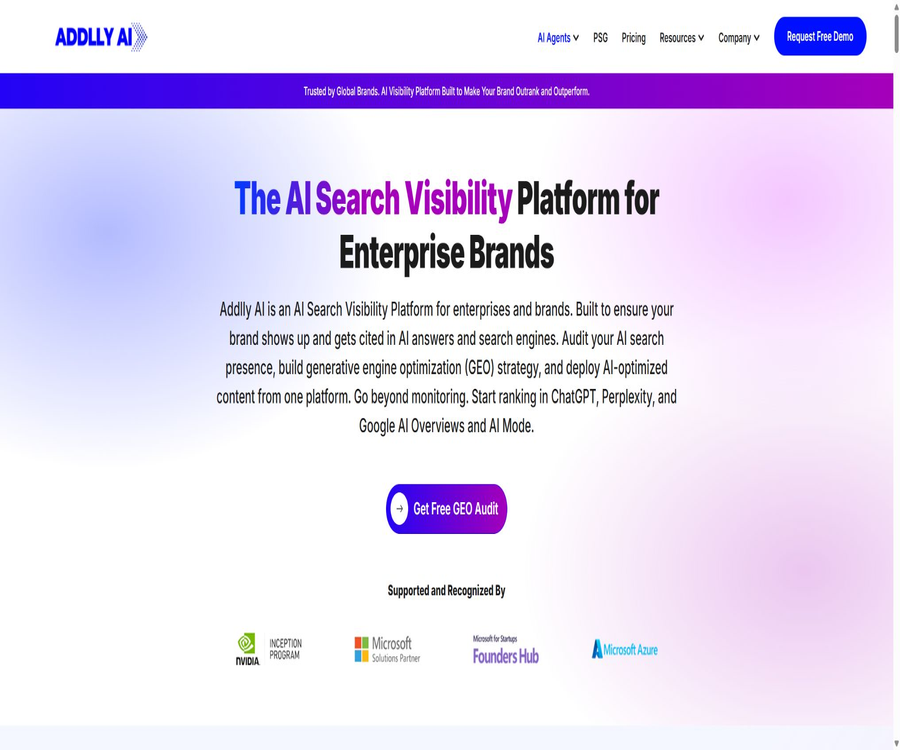
What is Addlly AI?
Addlly AI is an AI platform designed for corporate brands, aimed at enhancing search visibility and optimizing generative engines. It helps teams determine whether their brand appears in responses provided by ChatGPT, Gemini, Claude, Perplexity, and Google AI Overviews, and enables them to develop and implement content optimization strategies based on that information.
The platform initially focused on using AI to generate marketing content as its main selling point, but now its official focus has shifted to GEOs. The current workflow includes baseline audits, evidence collection through citations, competitive analysis, action recommendations, content creation, continuous monitoring, and expansion into multiple markets.
Current location change
Old reviews often described Addlly AI as a tool for generating content for blogs, social media, and emails, highlighting its low cost for self-service subscriptions. The current website offers enterprise-level packages, which involve a comprehensive GEO audit for each project, followed by options for ongoing monitoring and content optimization.
| Comparison items | Impressions of early products | Current official positioning |
|---|---|---|
| Core goal | Generate marketing content in bulk | Increase the brand’s visibility in AI-generated answers and search results |
| Primary users | Individual marketers and small to medium-sized teams | Corporate brand, cross-market content, and growth team |
| Working method | Select a template and generate copy. | Audit, planning, execution, and continuous monitoring |
| Key indicators | Number of contents and basic SEO score | AI Visibility Score, citations, volume, and sentiment |
| Price patterns | Low-cost self-subscription in old data | One-time audit plus monthly corporate services |
| Procurement method | Online registration | Demonstrations, requirement identification, and customization scope |
Main functions
- Audit the presence of the brand on various AI search and answering platforms.
- Track the sources where brands, products, and competitors are cited.
- Calculate AI visibility, Share of Voice, and sentiment metrics.
- Design brand-related queries, topic clusters, and regional test sets.
- Identify the content, entities, and knowledge gaps in AI-generated answers.
- Generate GEO implementation recommendations with clear priorities.
- Create SEO and GEO content that matches the brand’s tone.
- Optimize blogs, product detail pages, structured data, and FAQ content.
- Continuously monitor changes in different models, markets, and languages.
- Provide training, implementation, or fully managed services for enterprises.
GEO baseline audit
All current collaborations begin with a comprehensive GEO audit. The team first establishes a baseline for the brand in AI search, identifies the issues that may arise regarding the brand, determines which competitors hold certain references, and sees how generative platforms describe the brand.
- Complete the initial setup of the dashboard and AI agents.
- Design strategic queries and topic clusters.
- Run unified tests on the selected model.
- Analyze the brand’s appearance frequency, ranking position, and context of the responses.
- Track which web pages and media sources the AI answer cites.
- Compare the citation shares and sentiment of competitors.
- Generate AI Visibility Score and Share of Voice.
- Provide recommendation reports and implementation strategies.
AI search visibility monitoring
The ongoing campaign repeats the predefined set of queries, enabling the team to observe trends in visibility as models, content, and market conditions change. The metrics shown here are based on sample monitoring results and do not represent every response that all users see.
- View the occurrence rate by query, topic, product, and market.
- Compare the responses of different models to the same brand-related issue.
- Track the Share of Voice for brands and competitors.
- Observe the changes in positive, neutral, and negative descriptions.
- Identify newly appearing or disappearing citation sources.
- Record the trends of metrics before and after optimization.
- Adjust the query clusters to meet new user requirements.
- Manual review and resampling are reserved for abnormal fluctuations.
Citation for evidence collection
Citation Forensics is used to answer the question of \"why does a model cite others instead of us\". It analyzes the websites cited, the type of content involved, and competing brands, thereby helping teams identify more specific opportunities for content creation and distribution.
- List the sources actually used in the model’s response.
- Distinguish between owned websites, media, communities, and third-party pages.
- Check the topics that competitors frequently cite.
- Insufficient recognition of brand authority signals and entity explanations.
- Identify the content that needs to be updated, expanded, or created.
- Convert the citation opportunities into actionable content plans.
- Avoid mistaking correlation for a definite causal relationship.
Competitors and sentiment analysis
- Compare the frequency of a brand and its competitors appearing in the same searches.
- Analyze the context in which a brand is recommended, compared, or ignored.
- Track the level of competition in terms of products, features, and the market.
- Identify negative, outdated, or inaccurate brand descriptions.
- Identify the impact of third-party sources on model understanding.
- Compare emotional differences by model and region.
- Refer high-risk reputation issues to public relations and legal departments for review.
GEO strategies and implementation recommendations
The platform converts the audit findings into actions with specific priorities, rather than merely providing a ranking dashboard. The recommendations may involve updates to existing pages, new content, product data, structured markup, knowledge signals, and external dissemination.
- Prioritize fixing the key content gaps that affect brand understanding.
- Establish theme and entity coverage that is aligned with business objectives.
- Updated outdated facts, product names, and brand descriptions.
- Add clear, citable definitions, data, and Q&A.
- Optimize the page structure and Schema tags.
- Plan the product details page, blog, and third-party content.
- Sort tasks by impact, cost, and difficulty of implementation.
- Changes are verified through repeated monitoring, rather than fixed rankings being promised.
Brand-trained AI agents
The agents of Addlly AI can operate based on the brand’s tone, existing blogs, social media content, and marketing objectives. The company emphasizes the Zero Prompt workflow, which reduces the burden on teams of having to repeatedly create complex prompt texts.
- Import the brand’s tone, terminology, and prohibited expressions.
- Create context using brand content and product materials.
- Configure different agents for GEO audits, SEO, content, and product pages.
- It is executed through a fixed workflow rather than starting from a blank prompt each time.
- Enable different markets and teams to reuse unified brand guidelines.
- Include quality checks and manual approval before publishing.
- Brand training does not mean that the model will never deviate from the rules.
Content creation capability
- Create SEO and GEO-optimized blogs.
- Create social media posts and event copy.
- Create press releases, briefings, and email content.
- Convert PDF materials into article drafts.
- Generate multilingual and localized versions.
- Expand on the missing topics related to the audit findings.
- Customize video scripts and Reddit and Quora bots as part of enterprise solutions.
- Maintain the brand’s tone and add SEO meta information.
- Verify facts, citations, copyright, and regional compliance before publication.
Product details page agent
The PDP AI Agent is designed for e-commerce and product websites, and it can generate all the main components of a product page in one go. The Pro and Enterprise versions also incorporate product-level reference auditing as well as PDP optimization into the GEO workflow.
- Generate product titles, descriptions, features, and benefits.
- Create SEO titles, descriptions, and keywords to support the content.
- Add common questions to improve clarity.
- Generate schema suggestions for Product, FAQPage, BreadcrumbList, and others.
- Batch processing is carried out by combining product data and the brand’s tone.
- Adjust the structure to improve visibility in Google and AI searches.
- Check the price, inventory, specifications, and regulatory statements before publishing.
Multilingual and multi-market
- Create different query clusters by country, region, and language.
- Compare the AI visibility of the same brand in multiple markets.
- Generate localized content tailored to local search behavior.
- Maintain core brand consistency across different markets.
- Identify local competitors and cite sources.
- Enterprise supports expansion across multiple brands and markets.
- Expanding into new markets or brands usually requires additional costs.
- Machine localization still requires review in local languages and regulations.
Multi-model architecture
For Basic and Pro versions, any 5 AI search or generative platforms can be selected; the Enterprise version allows for tracking an unlimited number of models. The developers also describe enterprise-level features such as multi-model orchestration, quality control, and failure recovery mechanisms.
- Compare multiple AI platforms on the same query set.
- Reduce the bias resulting from optimization focused solely on a single model.
- Call the appropriate model depending on the task.
- Use caching and tokens to optimize control costs.
- Configure an alternative path when the model is unavailable.
- Changes in model version can affect the results; it is therefore necessary to keep track of the time and version details.
- Cross-model scoring should employ consistent sampling and statistical methods.
Appropriate use cases
- Consumer brand monitoring to see if the product appears in purchase recommendations.
- SaaS companies focus on tracking feature categories and conducting comparisons with competitors.
- E-commerce brands optimize product pages and Q&A sections in bulk.
- Multinational companies compare brand perceptions in different markets.
- The PR team monitors the brand sentiment generated by the response systems.
- The content team selects topics based on the citation gaps.
- The SEO team integrated traditional search with GEO into the same plan.
- The agency establishes a baseline of visibility for multiple clients.
Which teams are suitable?
- Companies that have a clear definition of their brand, products, and competitors.
- Teams that need to monitor the growth of AI search results across different models.
- A marketing department that has the capability to continuously create and update high-quality content.
- Organizations that wish to link GEO audits with content delivery.
- Companies that require governance for multiple languages, markets, or brands.
- Buyers willing to invest at least a few thousand dollars to launch long-term projects.
- Teams that need enterprise security, training, and implementation support.
Which users are not suitable for it
- Individual creators who only want to produce an article occasionally.
- Small websites with budgets that are not sufficient to cover audits and ongoing monthly fees.
- Early projects that lack brand data, a content team, and implementation resources.
- Buyers who wish to ensure a fixed ranking in all AI responses.
- Only SEO users who need traditional keyword ranking tracking.
- Individual users who require complete self-service and no pre-sales communication.
- Organizations that wish to host a fully open-source platform on their own.
GEO Audit Launch Tutorial
- Identify the brand, products, market, language, and key competitors.
- Collect customers’ actual questions, search terms, and purchase decision scenarios.
- Design query clusters and select models together with the Addlly team.
- Import brand assets, tone, product data, and existing content.
- Run a baseline audit and manually check representative answers.
- Review the AI Visibility Score, citations, volume, and sentiment.
- Assign the recommendations to the SEO, content, product, PR, and technical teams.
- After setting the retesting frequency and success criteria, continuous monitoring begins.
Content optimization tutorial
- Select a high-value content gap from the citation evidence.
- Identify the target problem, user intent, and existing competitive sources.
- Prepare reliable facts, data, product information, and expert opinions.
- Use brand agents to generate structured drafts or suggestions for page updates.
- The editor checks for accuracy, originality, tone, and compliance.
- Add clear titles, FAQs, entity relationships, and structured data.
- After publishing, ensure that the page is crawlable, loads smoothly, and has proper internal links.
- Compare changes in citation and visibility across subsequent monitoring periods.
Methods for interpreting indicators
- The AI Visibility Score is used to compare the overall frequency of occurrences in sampled queries.
- Share of Voice reflects the proportion of responses for a brand in comparison to its competitors.
- Citation Presence indicates whether a brand or website serves as a source for the answer.
- Sentiment reflects the described tendency and does not equate to the actual attitudes of consumers.
- The metrics must record the model, region, query, and sampling time simultaneously.
- A fluctuation may stem from model randomness or version updates.
- The commercial value should be assessed by taking into account website traffic, leads, conversions, and brand research.
Price structure
Addlly AI currently employs a \"two-stage\" pricing structure: a one-time fee is paid for the GEO audit, after which ongoing monitoring and content optimization can be purchased as needed. All amounts are quoted in dollars, and the final figures will be determined after discussing the requirements.
| Plan | First GEO audit | Recurring monthly fee | Main scope |
|---|---|---|---|
| Basic | Starting at $1,500 | $ | Up to 200 total queries, 5 models, and 10 optimization articles per month |
| Pro | Starting from $4,000 | $ | Up to 1,000 total queries, 5 models, 25 pieces of content per month, and product-level auditing. |
| Enterprise | Customization | Customization | No restrictions on models; multiple markets, multiple brands, custom agents, and dedicated teams |
Comparison of package features
| Functions | Basic | Pro | Enterprise |
|---|---|---|---|
| Model coverage | Choose any 5. | Choose any 5. | Fully customizable, with no limits on models |
| Number of audit queries | Up to 200 total queries. | Up to 1,000 total queries | More than 300 iterations per model; customization available |
| Product page audit | Not included | Included, up to 5. | Included and expandable |
| Monthly optimization content | 10 articles | 25 articles | More than 25 articles per market or brand |
| Market | 1 | 1 unit, available for additional purchase | Multiple markets and multiple brands |
| Usage mode | Self-service | Transfer after training | Self-management or fully managed service |
| Support | Priority support | Dedicated account team and customized service levels |
Prices for additional services
| Additional items | Reference starting price | Explanation |
|---|---|---|
| Team training and empowerment | Starting at $1,500 per time | Pro can be purchased additionally; enterprise solutions are configured based on scope. |
| Additional markets or brands | Starting at $2,500 per month per person | Used to add regions, languages, or separate brands |
| Fully managed service | Starting at $2,000 per month | Audit, content, implementation, and continuous optimization |
| Additional query volume | Customized to order | Expand prompt coverage and enable detailed analysis |
| Custom content agent | Custom quote | Videos, communities, and other business formats |
| Singapore PSG support | Apply based on eligibility | The subsidy is not an automatic discount; it must comply with the project rules. |
It is necessary to confirm before making a purchase.
- Is the total number of queries calculated as a sum across all models, or is it calculated separately for each model?
- The boundaries of baseline auditing, monthly monitoring, and content delivery.
- The selected model, region, language, and sampling frequency.
- The length, format, and degree of manual editing corresponding to the number of content items.
- Whether product pages, structured data, and release implementation are included.
- Add the unit price for new markets, brands, models, and query volumes.
- Training, full management, account support, and service levels.
- Ways to export data, dashboards, and reports after the contract ends.
Security and corporate governance
- The official website states that the platform meets the requirements of SOC 2 Type II and ISO 27001.
- Enterprise solutions allow for the configuration of identities, roles, audit logs, and backups.
- Officials state that customer data will not be used to train third-party models.
- When using multiple models, it is still necessary to clarify the data processing processes of each supplier.
- Brand information, unreleased products, and customer data should be accessed in accordance with their sensitivity levels.
- The privacy, advertising, and consumer protection requirements in different markets need to be assessed separately.
- All generated content and automatic suggestions must undergo manual approval.
- When making a purchase, request the most recent audit report and data processing agreement.
Product advantages
- Place AI visibility monitoring and content execution on the same platform.
- Supports multi-model, competitor, citation, and sentiment analysis.
- Starting with the baseline audit, the project scope and priorities become clearer.
- The brand-trained agent reduces repeated prompts and tone fluctuations.
- Covers blogs, product pages, social media, and various types of corporate content.
- It supports expansion across multiple languages, markets, and brands.
- You can choose self-management, training handover, or full management.
- It offers enterprise security certification and dedicated support options.
Usage restrictions and precautions
- The price is clearly aimed at businesses, and it is not suitable for individuals or websites with limited budgets.
- AI responses are random, and the monitoring results are merely sample snapshots.
- GEO is still changing rapidly, and there is no fixed ranking guarantee for optimization methods.
- The platform’s own case studies and marketing data should be verified in conjunction with independent metrics.
- Brand agents may still produce factually incorrect or non-compliant statements.
- The amount of content does not equate to authority or actual business results.
- Adding new markets, brands, and hosting services will significantly increase costs.
- The features of the older version and the price information from third parties may be outdated.
- Companies need to make long-term investments in editing, technology, products, and public relations efforts.
GitHub and the open-source status
During this verification, no GitHub repository was found that could be confirmed as belonging to Addlly AI and representing a fully self-hostable platform. The list of AI SEO tools listed in the search results are provided by third parties only, and cannot be regarded as official open-source projects.
| Project | Status | Explanation |
|---|---|---|
| Addlly AI platform | Closed-source enterprise SaaS | Auditing, agents, content, and reports are managed by the authorities. |
| Official complete source code | No findings were detected. | Unconfirmed self-hosted repositories |
| Develop interfaces | Enterprise integration capability | The ability to connect to systems such as CRM and CMS does not mean it is open source. |
| Third-party GitHub list | Unofficial | Only the product name and a brief description are included. |
| Private deployment | Confirm according to the enterprise plan. | Ask about the cloud environment, as well as how data is stored and isolated. |
Basic information
| field | Content |
|---|---|
| Tool name | Addlly AI |
| Company | Addlly AI Pte Ltd |
| Headquarters background | Singapore |
| Tool type | AI search visibility, GEO auditing, and enterprise content platforms |
| Primary users | Corporate brand, marketing, SEO, content, and growth teams |
| Key indicators | AI Visibility Score, Share of Voice, Citations, and Sentiment |
| Price pattern | One-time audit along with monthly monitoring and content optimization |
| Security certification | The official website shows SOC 2 Type II and ISO 27001. |
| Is it open source? | No |
Recommendation score
4.4 / 5. Addlly AI integrates GEO benchmark auditing, evidence collection through citations, strategy development, brand content creation, and continuous monitoring into a cohesive corporate process – making it suitable for brands operating in multiple markets. However, the initial investment is high, the metrics are affected by the randomness of the models, and the actual outcomes depend on the quality of the content as well as the coordination between different teams.
Frequently Asked Questions
What is Addlly AI mainly used for?
It audits a brand’s visibility, citations, competitive presence, and sentiment in various AI search and generative response contexts, and helps teams optimize GEO content.
Is Addlly AI still an AI writing tool?
The blog, product pages, and marketing content tools are still available, but the core focus has now shifted to enhancing enterprise AI search visibility and the GEO platform.
Which AI platforms are supported?
For Basic and Pro, you can choose any 5 platforms; the official examples include ChatGPT, Gemini, Claude, Perplexity, and Google AI Overviews.
Is it necessary to conduct a GEO audit first?
Yes, currently every partnership begins with a comprehensive baseline audit, after which it can be decided whether to opt for ongoing monitoring and optimization.
How much is Addlly AI?
The Basic audit service starts at $1,500, with a monthly subscription fee of $750; the Pro audit service starts at $4,000, with a monthly subscription fee of $2,500; the Enterprise version is available on custom terms.
Is it possible to purchase an audit only once?
Yes, after completing the baseline audit and providing recommendations, the team can decide whether to proceed with monthly monitoring, content optimization, or a fully managed service.
Is multi-market support available?
Enterprise is designed for multiple markets and brands; the cost for additional markets or brands starts at $2,500 per month.
Can GEO ensure that it will be cited by AI?
No, the platform can improve the clarity of content, as well as enhance the capabilities for detecting authoritative signals, but the models, indexes, and citation behaviors are not under complete control by the brand.
Will the data be used to train models?
The official website states that customer data will not be used to train third-party models; companies should still review the data processing agreements and the actual model supply chains.
Is Addlly AI open source?
It is not an open-source platform; no official complete source code or publicly available self-hosted version was found this time.
Tools similar to Addlly AI





 Guigong Network Security Registration No. 45132202000164