






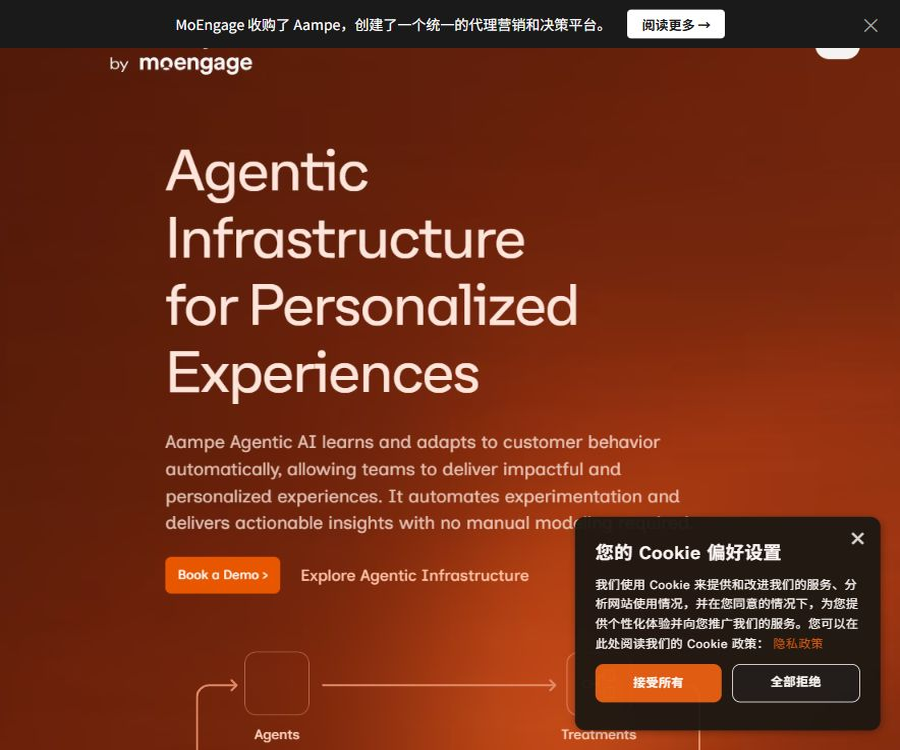
What is Aampe?
Aampe is an intelligent decision-making platform designed for customer experience and lifecycle marketing teams. It maintains a separate learning agent for each user, which continuously determines what to send, when to send it, how often to send it, and through which channels to deliver it, based on the user’s behavior and feedback.
The platform is typically built on top of existing customer data platforms and messaging tools, and it does not require companies to replace their current CRM systems, push notification services, email, or SMS systems. The team is responsible for linking event data to the various delivery channels, setting business objectives, and providing the content needed; Aampe handles ongoing experimentation and optimization at an individual level.
Aampe’s core philosophy
- A single user has one learning agent, rather than a set of agents that cover the entire cohort.
- Continuous learning through actual interactions, rather than relying solely on static profiles.
- At the same time, optimize the content, timing, frequency, channels, and target audience.
- Measure the causal increment using control experiments, rather than relying solely on click correlations.
- Maintain manual boundaries such as brand, compliance, frequency control, and audience eligibility.
- Make decisions based on the existing messaging infrastructure, rather than forcing a replacement of the messaging platform.
Main functions
- Inclusion of all events: Application and customer behavior events are imported for learning purposes.
- User attributes: Use language, region, membership, and other attributes to restrict eligibility.
- Goal management: Select optimization goals such as purchasing, subscribing, retention, or feature adoption.
- Message tagging: Add labels to the content’s topic, tone, value proposition, and call to action.
- Individual agent: Continuously updates preferences based on each user’s responses.
- Sending decisions: Optimize message content, timing, frequency, and channels.
- Event triggering: Decisions are made after actions such as adding items to the cart, browsing, subscribing, and other activities take place.
- Recommendation systems: Use catalogs of products, articles, courses, or services to provide personalized recommendations.
- Advanced insights: Analyze timing, psychological motivations, event trends, and conversion correlations.
- Interfaces and exports: Sharing decisions, recommendations, and metrics with external platforms.
One agent per user
Traditional marketing automation first places users into specific groups and predefined marketing journeys, then sends messages to them according to fixed rules. Aampe allows each agent to update their decisions based on the user’s behavior and the results of experiments; as a result, two people in the same group may receive different messages, at different times and with different frequencies.
- Observe user events, attributes, and reactions to past messages.
- Select the most appropriate message next from the allowed contents.
- Use established and effective strategies in a balanced manner, while also exploring new ones.
- Judgments are continuously updated based on changes in user behavior.
- Avoid treating a single click as a permanent preference.
- Optimize individually within business objectives and security constraints.
Shift from itinerary planning to continuous decision-making
| Comparison items | Aampe intelligent agent decision-making | Traditional user journey |
|---|---|---|
| basic unit | A continuous learning agent for each user | Grouping and predefined processes |
| Path | Selection is based on the dynamics of each behavior. | Advance by node and rule. |
| Optimize the rhythm | Continuous updates after interaction | A manual review is conducted after the event ends. |
| Content | Individual selection from the labeled content | Specify a template for journey nodes |
| Time and frequency | Based on user learning | Set uniformly according to rules or groups |
| Teamwork | Create diverse content and define boundaries. | Maintaining a large number of branches and activities |
Event data
Aampe can be connected to application events, user attributes, and message results. The provider states that all application events can be imported onto the platform, with no additional charges based on the number of events; however, details regarding contracts, storage, and data scope still need to be confirmed at the time of purchase.
- Conversion events: checkout start, purchase completion, subscription, and renewal.
- Intended actions: browsing products, adding items to the shopping cart, and completing courses.
- Message events: delivery, opening, clicking, and unsubscribing.
- Event discovery: search, filtering, categorized browsing, and content viewing.
- Usage behaviors: logging in, feature adoption, sessions, and duration of stay.
- Events should use a stable user identifier, accurate timing, and consistent fields.
User attributes and eligibility control
- Language and time zone are used to select the message content and the timing of delivery.
- Countries, cities, and regions are used for localization and regulatory constraints.
- Memberships, subscriptions, and account status are used to determine message eligibility.
- Devices and notification tokens are used to determine the available channels.
- Life cycle, value, and preferences can serve as insights and constraints.
- Sensitive attributes should be used as little as possible to prevent discrimination and unfair targeting.
- The user cancellation rate, silent period, and frequency control rules must be higher than the optimization targets.
Message content labeling
Aampe asks the team to provide a sufficient variety of messages, using tags to describe the topic, tone, and value proposition. The agent learns, based on user reactions, which combinations of tags are more suitable for individual users, rather than conducting an A/B test only between two versions of a message.
- Topics: Discounts, Education, Features, Recommendations, or Reminders.
- Value proposition: cost savings, convenience, achievement, discovery, or security.
- Tone: Direct, friendly, humorous, professional, or urgent.
- Actions: Purchase, Return, Complete, View, or Renew.
- Content tags should be clear and consistent, to prevent learning fragmentation caused by synonyms.
- The copy still needs to be reviewed by the brand, legal, and regional teams.
Time and frequency optimization
The platform learns, based on each user’s responses, when and how often to reach out to them. The goal is not to send more messages, but rather to find a balance between the value of the messages sent and the risks of causing fatigue, leading to unsubscribes, and user loss.
- Learn about the user’s active periods throughout the day and the week.
- Distinguish the performance of different contents at different times.
- Adjust the frequency automatically based on recent responses.
- Avoid having all users share the same fixed sending rhythm.
- Comply with silent periods, channel restrictions, and global frequency control.
- Monitor unsubscribes, notification closures, and negative behaviors to prevent excessive click optimization.
Channel optimization
- Push notifications: ideal for providing timely reminders and guiding users’ actions within the app.
- Email: Suitable for longer texts, transaction information, and educational content.
- SMS: Suitable for tasks that require quick delivery, but it involves higher costs and licensing requirements.
- Within the app or other connected channels: Available depending on the existing technology stack.
- Agents can learn about how different users respond to various channels.
- All channels must share the status regarding cancellation, frequency control, and message priority.
Event trigger message
- After registration, the introductory guidance is adjusted based on actual behavior.
- After adding it to the shopping cart, select an appropriate time and method for retrieval.
- After browsing products or content, it recommends the next related item.
- The use of a feature for the first time encourages its further adoption.
- Send alerts when the subscription expires, or when there are changes in inventory or prices.
- The event is merely an opportunity to trigger something; it is still the agent that decides whether, when, and what to send.
Recommendation system
Aampe can be integrated with products, articles, courses, videos, services, or inventory lists, and it inserts recommendation results into messages and product interfaces. The system generates personalized recommendations by taking into account user behavior, relationships between items, and past purchasing history.
- Recommendations for products that have been discontinued and related alternatives.
- Browse similar products or content after abandoning a search.
- New products, price reductions, restock alerts, and low inventory notifications.
- Distribution of blogs, courses, videos, and other content.
- The cooling period is used to prevent the same item from being recommended repeatedly in a short time frame.
- Recommended content must have a consistent identifier, name, price, and a deep link.
- Catalog changes should be synchronized in real time or on a regular basis to prevent the sending of outdated products.
Advanced Insights
- Timing Insights: Analyze what content generates the most responses at what times.
- User Frequency: Determine the appropriate frequency of engagement for different users.
- Psychographics: Inferring motivations and value preferences based on the content of the annotations.
- Cross Selling: Recommending products by combining catalogs with consumption patterns.
- Messaging Audit: Check whether the existing tone and value proposition align with user motivations.
- Retention Correlations: Identifying functional behaviors related to retention or churn.
- Conversion Correlations: Identify events related to purchases or subscriptions.
Insight is not equivalent to causation.
Event trends and correlations can help formulate hypotheses regarding products and marketing strategies, but they cannot automatically prove that a certain feature is responsible for increased user retention or purchases. Teams should conduct controlled experiments, take into account the business context, and rely on long-term metrics to verify such assumptions.
- Distinguish between behavioral relevance, predictive capacity, and causal increment.
- Avoid focusing only on clicks while ignoring revenue, retention, and cancellations.
- Examine the differences in distribution among new and existing users, as well as across different regions and channels.
- Retain a control group and baseline for key strategies.
- Assess whether short-term improvements come at the expense of the long-term customer experience.
Access method
Aampe reads event, user, and CMS data through APIs, streaming, or batch connectors, and then uses the company’s existing messaging channels to send this data. According to the manufacturer, establishing connections for most technical stacks can take between 15 minutes and 1 hour, but complete data validation and deployment usually require more time.
| Connection type | Function | Common data |
|---|---|---|
| CDP or data platform | Provides user events and attributes. | Click, purchase, search, subscribe, and user status |
| CRM or messaging platform | Actually send the message and receive the response. | Push, email, SMS, delivery, and clicks |
| Data warehouse | Provide data from one party in batches or continuously | Historical events, transactions, and analysis tables |
| CMS or product catalog | Provides recommendable real-time content | Products, prices, inventory, articles, and deep links |
| Aampe interface | Import data or export decisions and metrics | Recommendations, user scores, and message performance |
Supported technology stack
According to the official documentation, it is possible to connect with 20 common messaging partners, and custom integrations are also supported. The list of available partners may change; therefore, it is necessary to verify each one based on the CDP, CRM, push notification, email, and warehouse solutions that are currently in use by the company.
- Customer engagement and messaging platforms such as Braze and CleverTap.
- Mobile notification infrastructure such as Firebase and Apple Push Services.
- Customer data platforms such as Segment.
- Cloud data warehouses, object storage, and batch files.
- Catalog of goods, content, and services.
- Connect to platforms that are not pre-configured through custom interfaces.
Which teams are suitable?
- B2C applications with a large number of users and frequent events.
- Marketing teams whose lifecycle is slowed down by numerous groupings, campaigns, and A/B testing.
- A CRM team that needs to make unified decisions regarding push notifications, emails, and text messages.
- Product teams that aim to increase retention, repeat purchases, subscriptions, and the adoption of features.
- Companies that have mature CDPs, data warehouses, and messaging platforms.
- Businesses with large catalogs of products or content that require individual recommendations.
- Growth teams that place emphasis on continuous experimentation and causal incremental measurement.
Typical use cases
- Adjust the onboarding messages dynamically based on new users’ behavior.
- Select the optimal time and content to re-engage users who abandoned their purchases.
- Adjust or change the outreach strategies for users who are at risk of churning.
- Recommend different products, courses, articles, or videos to each user.
- Decide on promotional, educational, or functional messages based on individual preferences.
- Control the frequency of messages to reduce notification fatigue and unsubscribing.
- Choose the most suitable channel among push notifications, emails, and text messages.
- Identify product events related to conversion and retention.
Aampe Connection Tutorial
- Define a clear business goal, such as purchase, subscription, retention, or feature adoption.
- Connect to CDP or a data warehouse to provide stable user identifiers, events, and attributes.
- Connect to existing CRM systems, push notification services, email, or SMS delivery platforms.
- Configure conversion events, compliance restrictions, silent periods, and global frequency control.
- Create diverse messages and use unified tags to describe the topic, tone, and value.
- First, enable agent experiments on a small scale with a limited number of users and in specific scenarios.
- Verify the increase through a control group and long-term metrics, then gradually expand the channels and targets.
Tutorial for integrating recommendation systems
- Organize the product or content catalog to ensure that the labels, names, and links remain stable.
- Add prices, categories, inventory, promotions, and other attributes based on use cases.
- In behavior events, the identifier of the item being viewed, added to the cart, purchased, or consumed is passed in.
- Select cloud storage, batch file, or interface synchronization directory.
- Set filters and cooling periods for abandoned purchases, views, new products, or content recommendations.
- Use test users to verify recommendations, links, prices, and inventory.
- After going live, measure clicks, conversions, diversity, and long-term user value.
Price and purchase methods
As of this verification, Aampe’s official website does not disclose any fixed monthly fees, tiered pricing based on the number of users, or packages tailored to the volume of messages sent; it only provides options for scheduling demonstrations and seeking corporate consultations. The actual pricing may depend on factors such as the number of active monthly users, the number of events, the messaging channels used, the specific use cases, data integration needs, and the level of support required.
| Plan or cost item | Price status | Confirmation is needed. |
|---|---|---|
| Aampe platform | Custom quotes for businesses | Monthly active users, number of agents, and optimization objectives |
| Event data | Officials state that all events can be imported without any additional charges based on the number of events. | The scope of storage, retention, and fair use as specified in the contract |
| Message sending | It is usually handled by existing CPaaS or CRM solutions. | Fees for email, push notification, and SMS service providers |
| Data and message integration | Confirm per the plan | Standard connectors, custom interfaces, and implementation support |
| CMS recommendation system | Confirm per the plan | Directory size, synchronization frequency, and recommended use cases |
| Professional services | Confirm by project | Data validation, experimental design, training, and continuous optimization |
It needs to be confirmed before purchasing.
- Is the pricing based on monthly active users, contacts, the volume of messages, or business results?
- There is no limit on the number of events; historical recharges and long-term storage are included.
- Which CDPs, CRMs, messaging platforms, warehouses, and CMS are supported?
- Whether agent decisions can be derived and how they can be used in other channels.
- Whether implementation, data cleaning, experimental design, and customer success services are included.
- Are message providers and SMS fees completely separate?
- Methods for exporting data, tags, insights, and decision records after the contract ends.
Product advantages
- Individual users, rather than groups, are taken as the basic unit for continuous learning.
- At the same time, optimize the content, timing, frequency, channels, and target audience.
- It is not necessary to set up a large number of fixed routes first in order to start experimenting.
- It is positioned on top of the existing technology stack, thereby reducing the barriers to replacing the messaging platform.
- The full event stream, user attributes, and CMS directory can be used.
- Gain insights into timing, motivation, retention, and conversion from message execution.
- Recommendation systems cover a variety of categories such as products, articles, courses, and services.
Usage restrictions and precautions
- The official website does not disclose the prices, making it difficult for the team to estimate the costs before seeking consultation.
- Continuous, accurate event and message data that can be linked to users is required.
- One agent per user represents an abstraction of decision-making; it is not equivalent to an independent, general-purpose large model instance.
- Automatic optimization may focus on short-term clicks; it is necessary to take into account long-term value as well as negative indicators.
- Excessive personalization or frequent testing can lead to issues related to privacy, fatigue, and trust.
- Inferences such as psychological motives may be inaccurate and should not be used as a basis for determining high impact status.
- Messages are still sent by external platforms, and the overall stability depends on multiple systems.
- Complex organizations still require content provision, approval processes, data governance, and experimental capabilities.
Privacy, security, and fairness
- Only the events and user attributes necessary to achieve the goal are connected.
- Avoid using sensitive attributes for opaque differential pricing or exclusion.
- Comply with user consent, unsubscribe, deletion, and data access requests.
- Apply the principle of least privilege to messaging platform and data warehouse credentials.
- Set special rules such as silent periods, frequency control, and regulations for minors.
- Regularly compare the results and negative impacts across different regions, genders, and user groups.
- Retain audit records of decisions, messages, experiments, and manual changes.
Effect evaluation indicators
- Incremental purchases, subscriptions, renewals, and revenue.
- Long-term retention, activity, and functional adoption.
- Message delivery, opening, clicking, and subsequent actions.
- Frequency of messages sent per user and channel costs.
- Unsubscribe, turn off notifications, complaints, and churn.
- Recommendations cover coverage, diversity, and catalog usage.
- The true increase compared to the control group, rather than a simple change before and after.
GitHub and the open-source status
During this verification, no GitHub organization that can be confirmed as belonging to Aampe, no complete source code for the platform, and no public agent models were found. The Project with the name Agent Messaging Protocol, which appeared in the search results, has no connection to Aampe’s customer experience platform.
| Project | Status | Explanation |
|---|---|---|
| Aampe platform | Closed-source enterprise SaaS | Agent decision-making, experimentation, and insights are managed by the official team. |
| Developer documentation | Public | Provides instructions for data, CMS, messaging, and interface integration. |
| Aampe interface | Enterprise integration capability | Having open interfaces does not mean that the platform’s source code is also available. |
| Official GitHub | Not confirmed | Similar names or AMP protocol projects should not be regarded as official. |
| Self-hosted version | No findings were detected. | For requirements related to data residency or private deployment, please consult directly. |
Basic information
| field | Content |
|---|---|
| Tool name | Aampe |
| Tool type | Customer Experience Agent and Lifecycle Marketing Decision Platform |
| Primary users | CRM, lifecycle marketing, growth, and product teams |
| Core competencies | Optimization of content, timing, frequency, channels, and recommended individuals |
| Data source | Events, user attributes, message results, and CMS directories |
| Sending method | Connect to existing CRM, CPaaS, and messaging channels |
| Price pattern | Custom quotes for businesses |
| Is it open source? | No |
Recommendation score
4.5 / 5. Aampe replaces numerous static journeys with individual agents and ongoing experiments; it is suitable for B2C teams that have ample data and large volumes of messages. However, its pricing is not transparent, and its effectiveness depends heavily on the quality of the events, the diversity of the content, the design of the experiments, as well as strict policies regarding privacy and frequency control.
Frequently Asked Questions
What does Aampe do mainly?
It tracks each user’s learning content, duration, frequency, channels, and recommendation preferences, helping companies to optimize messages throughout the customer lifecycle.
Will Aampe replace the existing CRM?
Usually not; it operates on top of existing data and messaging systems, reading behaviors from CDP and utilizing existing channels to send messages.
Is it necessary to create a user journey first?
It’s not necessary; the authorities emphasize that there is no need to pre-set fixed routes, as the agent can continuously learn from actual messages and user reactions.
Does every user really have an AI agent?
This represents an abstraction of individual-level learning and decision-making; it indicates that each user has preferences that are continuously updated, and it does not mean that each person has access to a separate, universal large model.
Which channels are supported?
It can be connected to push notifications, email, SMS, and other existing messaging channels; the specific support available depends on the enterprise’s technology stack and integration capabilities.
Can you recommend products and content?
Yes, a CMS directory can contain products, articles, courses, videos, or services, and it supports abandoned purchases, browsing, as well as personalized recommendations.
How much is Aampe?
The official website does not list any fixed packages; a demonstration must be scheduled first, and a quote is provided based on the user, data, channels, use cases, and scope of implementation.
Is it necessary to install an SDK to connect?
Officials state that for many use cases, there is no need to introduce new client SDKs; connections can be established using the existing CDP, repository, CRM, and messaging credentials.
How to measure the effectiveness of Aampe?
A control group should be established, while monitoring incremental conversion, retention, revenue, cancellations, complaints, and message costs.
Is Aampe open source?
It is not an open-source platform; nor has a complete set of source codes available on official GitHub or that can be self-hosted been confirmed this time.
Tools similar to Aampe





 Guigong Network Security Registration No. 45132202000164