






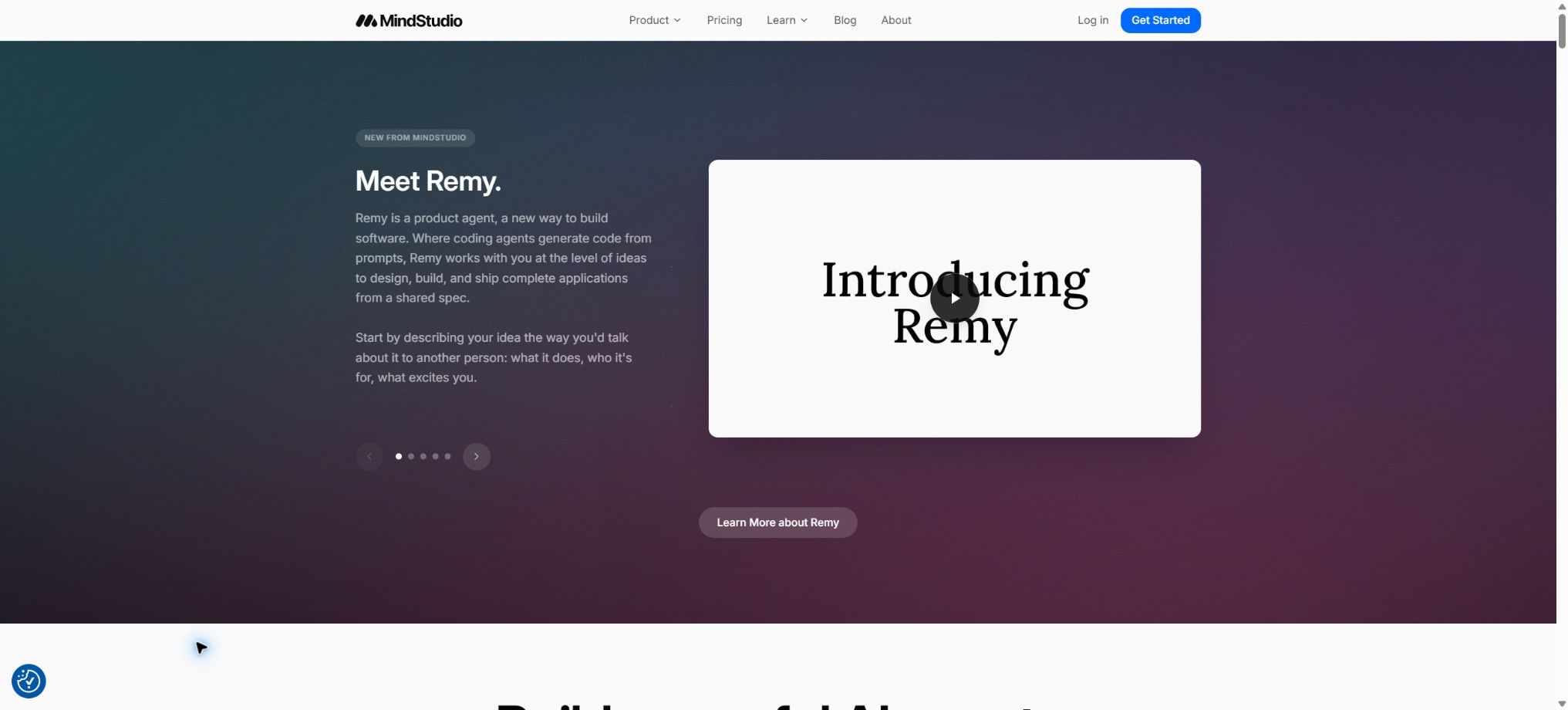
What is MindStudio?
MindStudio is a visual platform used for building, testing, and deploying AI Agents. Users can combine prompts, models, conditions, data sources, functions, and third-party connectors using a workflow canvas, eliminating the need to develop model calls and backend services from scratch.
It is more akin to a workflow development environment designed for AI tasks, rather than a single chatbot. An Agent can read information step by step, extract data, invoke various models, perform external operations, and produce structured results.
Main functions of MindStudio
- Use visual Blocks to orchestrate multi-step AI workflows;
- More than 200 models and services can be connected through the Service Router;
- Select different text, image, or media models at various steps of the same process;
- Upload files and create Data Sources that can be used for workflow queries;
- Run Python or JavaScript custom functions to extend the processing logic;
- Connects business applications with tools such as Webhooks, Zapier, Make, and n8n;
- Publish the Agent as a web application, API, email, or scheduled task;
- Inspect the workflow using a debugger, execution records, and cost information;
- Provides templates, browser extensions, Remixing, and team workspaces;
- It supports using custom model keys, as well as enterprise-hosted solutions and custom domain names.
Visual workflow editor
Automation Canvas displays the Blocks that make up a workflow, showing how they are executed in sequence; it is useful for breaking down complex tasks into steps such as input, evaluation, generation, transformation, and delivery. Variables can be passed between different Blocks, so that the output of one step becomes the input for the next step.
The platform offers a large number of built-in blocks, and it also allows for the use of branches, loops, error handling, as well as custom code. The no-code approach lowers the barrier to getting started, but a stable production process still requires an understanding of data types, permissions, retry mechanisms for failures, and boundary conditions.
Multi-model and Service Router
MindStudio enables unified access to text, image, visual, and video models from providers such as OpenAI, Anthropic, Google, Meta, and Mistral. Users do not need to configure keys separately for each service; they can either use their own API keys or self-hosted models that incorporate compatible interfaces.
Each AI Block can replace the default model; thus, for classification tasks a model with lower costs can be used, while more powerful models can be employed for complex analyses. The list of models and their prices are updated frequently, so it is necessary to check the current pricing information before deployment.
Data sources and knowledge retrieval
Data Sources is used for storing files and domain-related information; workflows can retrieve relevant data and pass the results to the model. It is suitable for internal knowledge querying, document analysis, policy retrieval, and content generation based on such information.
Search results do not constitute a guarantee of accuracy; factors such as document segmentation, update frequency, and the way questions are phrased can affect the answers. For critical processes, it is necessary to include fields indicating the source of information, and regression tests should be conducted after any updates to the knowledge base.
Functions, Connectors, and Agent Skills
Custom functions allow Python or JavaScript to be executed within a workflow, for data transformation, calculations, and the invocation of external interfaces. Connectors and Agent Skills further enable workflows to scrape web pages, send emails, process media, or interact with business applications.
The official Agent Skills Plugin is designed for agent environments such as Claude Code, offering a single SDK through which access to a wide range of functions can be obtained. Any action that involves external writing operations must include approval processes, parameter validation, and strict permission controls; models should not be granted broad account permissions.
Comparison of deployment methods
| Deployment method | Trigger method | Suitable scenarios | Precautions |
|---|---|---|---|
| Web application | The user opens the hosted page. | Forms, research tools, content generators | Set access permissions and determine who will bear the costs |
| Scheduled Agent | Daily, weekly, or custom schedule | Monitoring, daily reports, data cleaning, and reminders | Control of time zone, repeated execution, and failure alerts |
| Email trigger | Forward or send to the specified email address | Email summaries, meeting preparation, and ticket categorization | Prevent sensitive emails from being processed incorrectly |
| Webhook | External systems send HTTP requests. | Event-driven automation and application integration | Verify signatures, origins, and replay requests |
| API | Application call workflow | Product features, backend tasks, and batch processing | Manage keys, timeouts, concurrency, and costs |
| Browser extensions | Run manually on the current webpage | Web page summarization, extraction, research, and content rewriting | Confirm the scope of data access on the page |
Price of MindStudio
The subscription for the MindStudio platform and the usage of AI models are calculated separately. The platform packages determine the number of agents, the number of times they can be used, as well as various collaborative and enterprise-related functions, while model and media services are charged additionally based on the actual amount of usage.
| Package | Monthly price | Annual price | Primary interests |
|---|---|---|---|
| Free | $ | $ | 1 agent, 1,000 runs per month, access to over 200 models, built-in API key, learning materials |
| Individual | $ | That’s equivalent to 16 dollars per month. | No restrictions on agents or number of executions; Service Router, built-in keys, Slack community. |
| Business | Custom quote | Custom quote | Team workspaces, unlimited collaborators, fine-grained permissions, SSO, auditing, budgeting, SLAs, and self-hosting |
The annual price is calculated based on the current \"20% discount\" offered on the official website, and it is billed on an annual basis. The features related to packages, integration, public publishing, and past subscription rights may have been adjusted; therefore, the latest list of available functions displayed in the account should be taken as the reference at the time of purchase.
How is the cost for using the model calculated?
| Cost type | Calculation method | Control method |
|---|---|---|
| Text model | Charging is usually done separately for input and output tokens. | Limit the context, output length, and select an appropriate model. |
| Image and Media Models | Charging is based on the number of times it is generated, size, duration, or the supplier’s pricing. | First, use a low-cost preview, then generate high-quality results. |
| Service Router | Officials state that the price is set based on the underlying costs, with no additional markup. | View the detailed costs for each run |
| Built-in API Key | Charging is done directly to the user’s account by the model provider. | Set budget and rate limits in the supplier’s backend. |
| Public Agent | It is possible to specify that the requester or the owner of the agent shall bear the usage costs. | Restrict anonymous access and set budget alerts. |
The term “no limit on the number of executions” refers to the limitations imposed by the platform on its operations; it does not mean that the underlying models are free to use. A workflow that involves multiple models, as well as search and media processing steps, can incur various costs with each execution.
MindStudio Usage Tutorial
Create the first AI Agent
- Register an account and start with a blank Agent or an official template;
- Specify the input, desired output, permissible actions, and failure conditions.
- Add prompt, model, variable, and result output Blocks to the canvas;
- Select the appropriate model for each step and set the output length;
- Run the debugger using multiple sets of normal and abnormal examples;
- After confirming the costs and permissions, it is released as a private web application.
Build a workflow with a knowledge base
- Organize files that are authorized, contain accurate information, and have clear versions;
- Create a Data Source and upload the data;
- Add a step to query the data source within the process;
- Pass the search results along with the question to the response model;
- It is required to output information on reference fields, unknown items, and confidence levels.
- After updating the document, retest the high-frequency and edge cases.
Integrate with existing systems via API
- Generate dedicated API keys in the workspace and restrict access to them;
- Release the tested Agent and record the application identifier;
- Define the startup variables, output variables, and callback handling methods;
- The workflow execution interface is called from the server side, so the keys are not exposed on the frontend.
- Handle timeout, duplicate requests, failed retries, and cost fields;
- Add logging, budget alerts, and manual rollback procedures.
Which users are it suitable for
- Operations team: content creation, data organization, and periodic reporting;
- Marketing staff: Monitoring of competitors, research, acquisition of leads, and creation of personalized content;
- Researchers: Web and document extraction, multi-model analysis, and knowledge question answering;
- Customer service team: ticket categorization, draft responses, and knowledge base assistant;
- Developer: Use AI workflows as APIs or background tasks;
- Consulting and agency services: Quickly setting up dedicated agents for clients;
- Enterprise IT: Unified model entry point, budgeting, permissions, and self-hosting policies.
The advantages of MindStudio
- Multiple models, workflows, deployment, and monitoring are all integrated in one platform;
- The visual editor is user-friendly for people who are not developers;
- It supports mixing different models within a single process;
- It also offers built-in routing as well as its own API Key.
- There are various deployment methods available: web pages, scheduled tasks, emails, Webhooks, and APIs;
- Python, JavaScript, and connectors retain room for expansion;
- The Free plan is sufficient to test a lightweight agent.
Usage restrictions and precautions
- Platform subscriptions do not include costs for unlimited models, and the expenses associated with complex processes can increase rapidly.
- Changes in third-party models, connectors, and web pages can cause workflow failures;
- The absence of coding does not mean that testing is unnecessary; branch structures, variables, and exceptions still require proper system design.
- Model outputs may contain factual errors, format inconsistencies, and unsafe operation recommendations;
- Public anonymous agents may charge usage fees to the owner’s account;
- The benefits associated with different packages and their integration may change.
- High-risk transactions must retain manual review and an override mechanism.
Safety and privacy
The official pricing page clearly states that user data will not be used for model training. Business also offers SSO, audit logs, budgeting, usage limits, alerts, and custom contracts. Enterprises can also control the models that are allowed to be used, and choose to use their own models or deploy them in a self-hosted manner.
- Do not store unnecessary sensitive information in prompts, logs, and variables;
- Third-party connectors are granted only the minimum permissions required to complete the task;
- API keys should be stored on the server side and rotated regularly;
- Require manual approval before sending emails, updating databases, and modifying CRM records;
- Set authentication, budget, and rate limits for public Agents;
- Before making a purchase, verify the data area, retention period, and the supplier’s sub-processors.
API, GitHub, and open-source information
The MindStudio API allows programs to execute published workflows, with the possibility of passing in startup variables, workflow names, and callback addresses. The official documentation also provides options for integration with Node.js, custom functions, as well as development methods such as Webhooks and MCP.
The official GitHub organization has made projects such as mindstudio-agent available, which include Agent Skills plugins, SDKs, and command-line tools. The fact that these plugins are open source does not mean that the MindStudio visualization platform, as well as its cloud routing and hosting services, are also open source.
Frequently Asked Questions
Is MindStudio free?
The Free plan costs $0 and includes 1 Agent as well as 1,000 executions per month. Actual usage of model and media services may still result in additional charges.
How much is the Individual package?
The official figure shown is $20 per month; when paid annually, this amounts to $16 per month. This plan allows for an unlimited number of agents and platform usage sessions, but it does not exempt the user from the costs associated with the models.
Do I need to prepare the model API key myself?
Not necessarily; the Service Router can be connected to over 200 different models, and it also supports the use of one’s own supplier keys. If a key is provided by the user, the related costs are covered by the supplier’s account.
Can an Agent be integrated into a website or application?
It can be deployed through hosted web pages, APIs, Webhooks, or embedding, but the specific deployment options depend on the current plan. For production use, server-side keys and access control should be employed.
Is MindStudio open source?
The core platform is not a fully open-source product; the manufacturer only makes some SDKs, plugins, and tools available to the public. Huawei’s project with the same name, MindStudio, is not the same platform as this product.
Tools similar to MindStudio





 Guigong Network Security Registration No. 45132202000164