






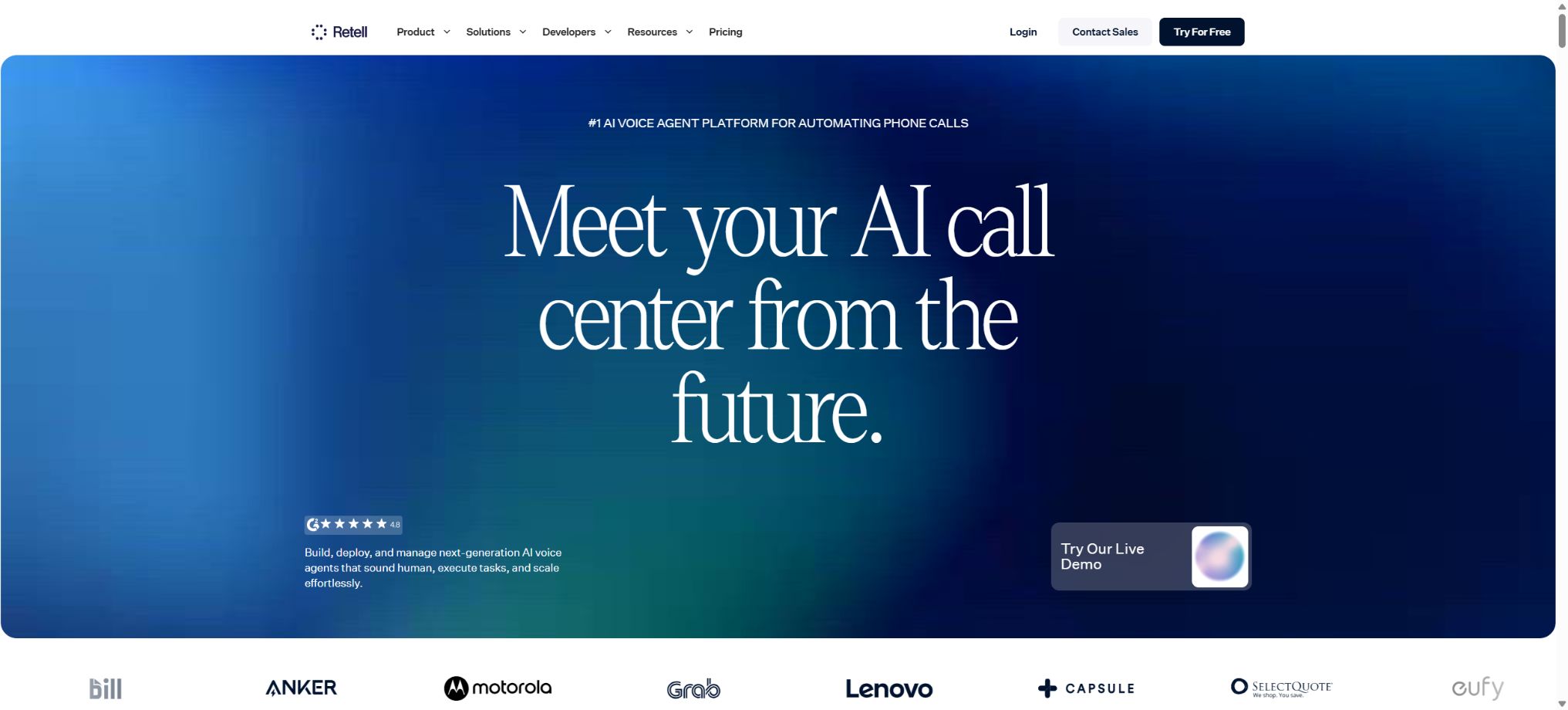
What is Retell AI?
Retell AI is an AI voice and chatbot platform designed for developers and enterprises. It connects large language models, speech recognition, speech synthesis, telephone lines, and business tools to create automated assistants that can make calls or engage in online conversations.
Users can either design fixed workflows through a visual Conversation Flow or use prompt-driven LLM Agents to handle open-ended conversations. The platform also offers features for call management, testing, deployment, monitoring, and post-call analysis, making it suitable for scaling from prototypes to full-scale operations quickly.
Main functions of Retell AI
- Create AI Voice Agents to handle incoming and outgoing calls;
- Create an AI Chat Agent to provide automated responses via text channels;
- Use Conversation Flow to visualize and arrange nodes, branches, and transitions;
- Configure the LLM Agent using prompts, a knowledge base, and custom functions;
- Connect to Twilio, Telnyx, your own SIP lines, or platform-hosted numbers;
- It offers Webhooks, REST APIs, as well as the capability to integrate custom large models;
- Save recordings, transcriptions, delay data, and call logs for analysis after calls;
- The performance of agents is evaluated through simulation tests and AI-based quality analysis on a batch basis.
Voice agents and telephone capabilities
Retell AI supports the purchase and linking of phone numbers, and it also allows companies to use their own carrier lines. The AI agent can answer calls, make batch or individual outbound calls, and transfer calls to human agents when certain conditions are met.
Real-time conversations handle interruptions, pauses, background noise, and response delays in a comprehensive manner. Developers can also update the status of the agent during the call, trigger tools, or end the call according to business rules.
Conversation Flow and LLM Agent
Conversation Flow is suitable for businesses where tasks such as scheduling appointments, verifying identities, and collecting information have well-defined steps. For each node, it is possible to set the conversation content, conditional transitions, function calls, and manual transfers, which makes it easier to review the key processes.
LLM Agents are more suitable for handling questions that require diverse expressions from the user and answers that take context into account. Teams can configure global prompts, language settings, voice options, models, knowledge bases, and fallback rules; they can also release different versions of these agents while keeping a record of the changes made.
Knowledge base, tools, and business integration
A knowledge base can provide agents with information on products, policies, and common questions. When it comes to data related to inventory, orders, calendars, or CRM systems, external systems can be accessed through functions and Webhooks, rather than the model having to generate answers from scratch.
- Check the status of customers, orders, policies, or tickets;
- Read available booking times and create, modify, or cancel bookings;
- Collect information on potential customers and enter it into the CRM;
- Send text messages, emails, or follow-up tasks according to the rules;
- Transfer complex, sensitive, or low-confidence issues to human agents.
Testing, analysis, and quality management
The platform keeps track of the results of calls, the transcribed text, the costs involved, and the delays at each stage, which helps in identifying issues related to models or speech synthesis. After a call, structured data, classification results, and custom metrics can be extracted through analysis.
Simulation tests allow multiple simulated users to converse with the agent under predefined scenarios, in order to examine boundary conditions, prompt regression, and tool usage. Even after the system goes live, it is still necessary to conduct random checks of actual conversations; reliance solely on automated scoring is not sufficient.
In what scenarios is Retell AI suitable?
| Scene | Tasks that can be accomplished | Configuration priorities |
|---|---|---|
| Customer service | Answer common questions, check orders, create tickets and transfer to human agents | Knowledge base accuracy, authentication, and fallback mechanisms |
| Appointments and Reminders | Reservation, date change, cancellation, confirmation, and expiration reminder | Calendar tools, time zones, recurring confirmations |
| Sales leads | Filter intentions, gather requirements, and arrange follow-up discussions | Marketing consent, CRM fields, and manual takeover |
| Survey follow-up | Satisfaction surveys, service follow-ups, and result classification | Question order, handling of refused responses, and data minimization |
| Medical administration | Routing of non-diagnostic appointments, reminders, and basic information | Privacy, Authorization, and Prohibitions on Medical Judgments |
| Finance and Insurance | Basic consultations, material reminders, and circuit-related matters | Authentication, compliance messaging, and prohibited decisions |
Retell AI price
Retell AI operates on a model that combines pay-as-you-go pricing with enterprise customization; new accounts receive a $10 credit for free. The cost per minute for voice intelligents is between $0.07 and $0.31, with the actual total price depending on the large models, voice capabilities, telephone functions, and any additional features.
| Plan | Public price | Primary interests | Suitable for users |
|---|---|---|---|
| Pay as you go | Voice agents cost between $0.07 and $0.31 per minute; chat agents start at $0.002 per message. | $ | Developers, startup teams, and scale-out businesses |
| Enterprise | Contact sales for customization | High concurrency or unlimited concurrency, RBAC, SSO, dedicated stable servers, custom protocols, account managers, and 24/7 support access. | Large-scale calls, strict governance, and procurement compliance requirements |
20 concurrent connections represent the free capacity offered under the pay-as-you-go plan; more concurrent connections can be added as needed. Enterprise-level services, dedicated support, and contract terms may incur additional fees, with the final details determined by the dashboard and the sales quotation.
How are the costs of voice calls calculated?
| Billing component | Official public reference price | Explanation |
|---|---|---|
| Retell voice infrastructure | $ | Real-time voice orchestration, call processing, and basic platform costs |
| Common text-to-speech synthesis | $ | Options for voice output include Retell, MiniMax, Fish, Cartesia, and OpenAI. |
| ElevenLabs voice | $ | Use the corresponding rate when selecting this voice service provider. |
| Large language models | Charged based on the selected model | Different models have different pricing; the Fast Tier is usually charged at 1.5 times the price of the standard model. |
| Built-in phone line | Retell side: $0 per minute | The operator will still charge separately for the number and call costs. |
| Hosted phone lines | Based on real-time price per route | Fees for services such as Twilio or Telnyx are calculated based on the current location and type of number. |
| Optional enhancement capabilities | Accumulated by minute | Features such as knowledge bases, noise reduction, security safeguards, PII removal, and AI-based quality inspection can increase costs. |
In the example provided by the official calculator, the total cost per minute for a setup that uses its own telephone line is $0.11; of this amount, $0.04 goes to the large model, $0.055 to the infrastructure, and $0.015 to voice synthesis. This figure does not represent a fixed price for all agents.
Retell AI Usage Guide
Create the first phone bot
- Register an account and create a new Voice Agent, choosing either Conversation Flow or LLM Agent.
- Set the role, objectives, first sentence, language, voice, and the range of business tasks that can be processed;
- Add knowledge bases, functions, manual transfer options, and rules for handling exceptions;
- On the testing interface, simulate normal issues, interruptions, silence, and incorrect inputs;
- Bind a platform number or an existing phone line, and then release the verified version;
- Launch with a low data volume to view the transcription, costs, latency, and reasons for failures.
Connect to the business system
- Package order queries, calendar functions, and CRM operations as service interfaces with controlled access rights.
- Define function names, parameters, return values, and invocation conditions within the agent;
- Configure Webhooks to receive events such as call start, call end, and analysis results;
- Perform a second verification of key fields such as identity, amount, address, and date;
- Use a test account to verify timeouts, duplicate calls, and failures of external services;
- Limit the permissions of the tools and keep audit logs, while gradually granting access to the actual data.
Control quality and cost
- First, establish clear evaluation criteria for successful calls, transfers to a human agent, rejections, and failures;
- Create test sets that cover various accents, noises, abnormal requests, and attack scenarios;
- Use simulation tests to compare the old and new versions, in order to avoid releasing the updated version directly on a large scale;
- View the detailed costs per minute for the model, voice, calls, and additional features;
- Randomly check the actual recordings and their transcriptions, and make adjustments to the knowledge base, prompts, and tool settings;
- Set limits for usage, concurrency, and anomaly alerts, and regularly remove unnecessary data.
The advantages of Retell AI
- Voice, chat, calls, testing, and analysis are all integrated in one platform;
- It also provides visualized workflows and open LLM agents;
- It supports built-in phone service providers, SIP, as well as various voice provider models;
- APIs, Webhooks, and function tools are suitable for integrating into existing business systems;
- Call logs, delay analysis, and simulation tests are useful for continuous optimization;
- It starts with a free quota and 20 concurrent connections, making it suitable for small-scale testing.
Usage restrictions and precautions
- The publicly displayed minimum price per minute does not represent the total cost, as fees for models, calls, and additional services are added on top of it.
- Speech recognition and models may mishear, give incorrect answers, or fail to operate the tools properly;
- In high-risk areas such as healthcare, law, and finance, agents cannot be allowed to make professional decisions on their own;
- Outbound marketing, automatic dialing, recording, and text messaging must comply with the laws of the user’s region.
- Authentication and least-privilege control must be implemented before connecting orders, payments, and CRM systems;
- After the knowledge base is updated, retesting is required to avoid referencing outdated policies.
- Prices, models, and available regions may change; always refer to the real-time information in the console.
Security, Privacy, and Compliance
The official solutions include, among other things, security barriers, PII processing options, the ability to choose whether recording or transcription is to be carried out, options for customizing data retention policies, as well as HIPAA-related features. The enterprise version offers additional governance options such as customized MSA, DPA, or BAA agreements, RBAC, SSO, and dedicated, stable servers.
- State your identity to the AI at the start of the call, and obtain permission for recording in accordance with applicable laws;
- Collect only the data necessary to complete the task, and avoid verbally providing sensitive credentials in their entirety;
- Set clear retention periods for transcription, recording, and analysis of fields;
- Server-side validation of function parameters is required; the direct output from the model cannot be trusted.
- Establish audit processes for deletion, export, permission changes, and manual takeover.
Whether a certain regulatory requirement is met depends on the contract, configuration, region, and actual workflow; it cannot be determined solely based on the compliance labels listed on the product page. Before handling regulated data officially, the legal and security teams must review the agreements and data flows.
API, SDK, and open-source information
Retell AI offers REST APIs and Webhooks for creating and managing agents, phones, numbers, knowledge bases, as well as call results. It also provides TypeScript and Python server-side SDKs along with JavaScript web client SDKs, to facilitate integration in backend systems or web applications.
The official GitHub organization has made available projects such as the TypeScript SDK, Python SDK, and Web Client SDK. The fact that these SDKs can be used under an open-source license does not mean that Retell AI’s core voice platform, console, and hosting services are also open-source products.
Frequently Asked Questions
Is Retell AI free?
New accounts receive a free credit of $10 for use in creating prototypes and conducting tests. Once this credit is used up, charges are applied based on the actual number of voice minutes, messages sent, and components utilized.
How much does it cost to use Retell AI for one minute?
The official stated price range for voice intelligent agents is $0.07 to $0.31 per minute. The actual cost is determined by factors such as infrastructure, voice technology, large-scale models, telephone lines, and additional features.
How many concurrent calls are supported?
The pay-as-you-go plan includes 20 free concurrent connections; additional connections can be obtained by requesting an upgrade. For large-scale use cases or special stability requirements, enterprise-level solutions can be discussed.
Can I use my own Twilio or SIP?
Yes, the platform supports connection using both the operator’s own services and SIP connections. Retell does not charge any fees for using the customer’s own phone lines, but the operator will still charge a fee separately.
Is Retell AI open source?
The core platform is not an open-source product. The official GitHub site provides several SDKs, and developers can integrate them in accordance with the licenses associated with each repository.
Tools similar to Retell AI





 Guigong Network Security Registration No. 45132202000164