






What is Langflow?
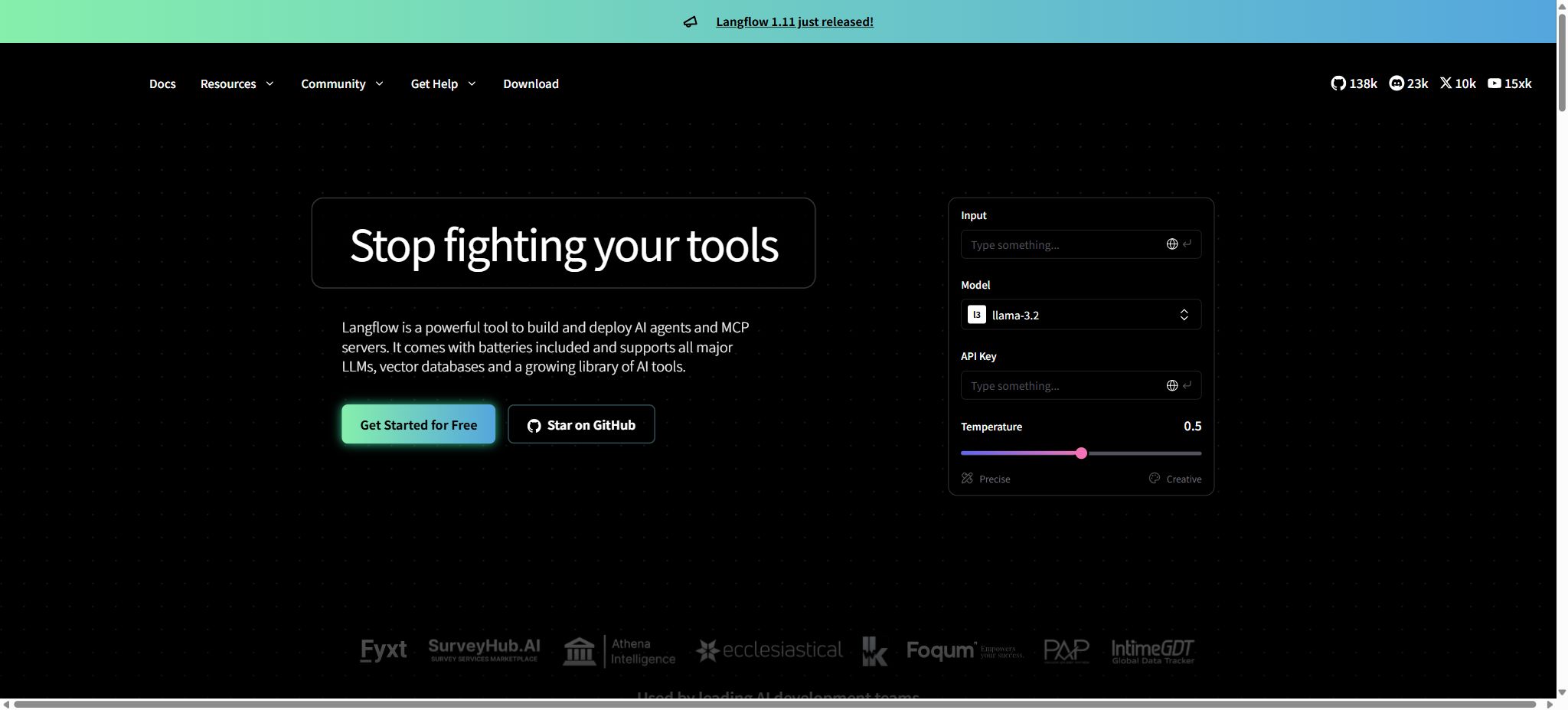
Langflow is an open-source, low-code tool for building AI applications and agent workflows. Developers can drag and drop large language models, prompts, agents, tools, vector databases, document processing components, as well as input/output and memory elements onto a visual canvas; they can define data flows by connecting these elements together, and then test the resulting processes, share them, or invoke them via APIs.
It is not tied to any specific model or vector database, and it is suitable for quickly creating chatbots, RAG-based document question-answering systems, content generation tools, research assistants, multi-agent collaboration frameworks, as well as MCP tool services. Langflow is more of a visual development environment rather than a ready-to-use chat application for end-users.
To put it into production, it is still necessary to handle model keys, databases, authentication, monitoring, and server maintenance.
Core functions of Langflow
Visual Flow orchestration
Each component is responsible for a specific function: for example, receiving chat inputs, invoking models, generating embeddings, retrieving vectors, executing tools, or producing results. By connecting the input and output endpoints of these components, a Flow can be created; each component can also be run separately to verify its dependencies and data flow.
The authorities also provide templates such as Agent and RAG, to facilitate modifications starting from runnable examples.
AI Agents and Multi-Agent Systems
The Agent component uses a large model as its inference engine; it decides whether to invoke tools based on instructions and the current input, and then formulates the final response. Any Langflow component that supports Tool Mode can be connected to the Agent’s Tools port, and another Agent can also serve as a tool, thereby enabling role differentiation and multi-agent workflows.
The actual outcome depends on the capabilities of the model tools, the prompts provided, the descriptions of those tools, and the boundaries of permissions.
RAG and knowledge base
Langflow allows for the combination of components for document loading, parsing, segmentation, embedding, vector storage, retrieval, and answering, thereby enabling the creation of RAG applications based on private data. It offers support for configurable vector database backends as well as long-term semantic memory in the form of a Knowledge Base and a Memory Base.
For document Q&A, recall rate, citation accuracy, permission isolation, and data update strategies should still be evaluated.
MCP client and server
Langflow supports both MCP Client and MCP Server. The MCP Tools component enables connection to external MCP services, making those tools available for use by Agents.
Conversely, a Flow that meets the requirements can also be exposed as an MCP Tool.
A project can function as a single MCP Server, with the enabled processes serving as tools that can be invoked by compatible clients.
The name and description of the tool must be clear; otherwise, the model might choose the wrong tool. For MCP tools that are capable of executing scripts, accessing files, databases, or external networks, it is also necessary to set minimum permissions, time limits, audit mechanisms, and input validation rules.
Models, databases, and integration with third parties
The component ecosystem includes a variety of model providers, embedding services, vector databases, data sources, and external tools. The new version also introduces extension bundles, which allow certain component providers to be released as independently versionable Python packages.
If components are missing after the upgrade, install the corresponding extension packages as indicated by the error messages, and check the compatibility of the saved processes.
API and application embedding
Once the flow has been created, it can be invoked using the Langflow API from Python, JavaScript, or other applications. The production architecture allows for a separation between the visual IDE and the interface-less runtime: the development environment is responsible for creating and testing flows, while the production runtime provides only the backend API, thereby reducing unnecessary interfaces and potential attack vectors.
For large-scale deployment, an external PostgreSQL should generally be used, rather than the default SQLite.
Custom components
Developers can use Python to create custom components or package extensions, in order to integrate internal APIs, business logic, and data sources into the canvas. Custom code has the ability to be executed; in multi-user environments, permissions for creation and editing should be restricted, third-party components need to be reviewed, and it is important to avoid including keys directly in Flow export files.
Comparison of Langflow versions and costs
The core components of Langflow are licensed under the MIT license, allowing free installation, modification, and commercial use. Currently, the official offerings focus on open-source self-hosted versions, desktop applications, as well as a production-ready runtime environment.
The software itself does not charge any licensing fees based on the number of users or the processes used, but the model APIs, vector databases, cloud servers, and maintenance services incur separate costs.
| Usage method | Software price | Main features | Additional costs or restrictions |
|---|---|---|---|
| Langflow Desktop | Free | Standalone apps for Windows and macOS that reduce dependencies and simplify upgrades, ideal for local learning and prototyping. | The desktop version does not include certain server-side features such as Shareable Playground and Voice Mode. |
| Python / Docker self-hosting | Free and open source | A fully visualized IDE and API that allows for control over data and dependencies. | Costs for servers, databases, model invocation, security, and maintenance must be borne. |
| Production Runtime | Free and open source | Interface-less backend that provides APIs based on specific processes; suitable for production environments and independent scaling. | It is necessary to set up production infrastructure, external PostgreSQL, as well as monitoring and access control mechanisms. |
| Third-party cloud templates | Langflow is free | It can be deployed in environments such as Railway, GCP, and Kubernetes. | Charging is based on the resources provided by third-party cloud service providers; the price is not fixed by Langflow. |
The OpenAI, Anthropic, Google, vector databases, or other external services used to create Flow typically require their own API keys, and charging is based on the rates set by these services. The fact that Langflow is free does not mean that the entire AI application comes at no cost.
How to install Langflow
| Method | Suitable for users | Main requirements |
|---|---|---|
| Desktop | Beginners, local prototypes | Windows installation package; macOS 13 or later. Some Windows dependencies may require C++ Build Tools |
| Docker | Isolated operation, server deployment | Docker environment, persistent storage, strong administrator passwords, and port/reverse proxy configuration |
| Python packages | Developers who need to control dependencies | Python 3.10 to 3.14, uv; a minimum of a dual-core processor and 2GB of memory is required, with multi-core processors and at least 4GB of memory being recommended. |
| Kubernetes | Team and production system | Clusters, external databases, persistence, Ingress, key management, monitoring, and scaling solutions |
Langflow usage tutorial
- Complete installation:Beginners can start with Desktop, while development servers can use Docker or Python packages.
- Create new Flow:Start with templates such as Simple Agent and Vector Store RAG, and run the default configuration first to understand the data flow.
- Configuration model:Select the model provider, save the API Key in the secure configuration, and set the model, temperature, and output limits.
- Connection components:Include Chat Input, Agent, tools, and Chat Output; the RAG process also requires document parsing, Embedding, and a vector database.
- Testing and debugging:Run each component one by one, and check the input and output types, tool parameters, search results, as well as the records of Agent calls.
- Services provided:Expose the processes via API, Share, or MCP Server, and then migrate the production environment to a separate Runtime.
- Enhance security:Disable unnecessary anonymous access, use strong passwords, apply the principle of least privilege, implement network isolation and key management, and install security updates promptly.
Langflow usage tutorial
Create reusable professional workflows
- Choose business processes with a high frequency of repetition and clear rules;
- Draw the paths for triggering, decision-making, execution, and rollback;
- Break down visual Flow orchestration, AI Agents, multi-agent systems, RAG, and knowledge bases into reusable modules;
- Set log settings, budgets, timeout values, and permission limits;
- Assign a responsible person to randomly check the results and handle the failed queues;
- Review application permissions, business rules, and actual costs on a monthly basis;
Which users are it suitable for
- Developers who wish to learn about and test Agents, RAG, and MCP in a visual manner;
- Teams that need to rapidly develop prototypes for internal knowledge bases, customer service, and research assistance;
- AI engineers who need to integrate multiple models, tools, databases, and internal APIs;
- Organizations that wish to manage things on their own, having control over the data, the runtime environment, and the code used for expansion;
- Product teams that need to convert the visual prototype into an API or a product for production use.
Advantages and precautions
- The advantages of Langflow are its open-source nature, model neutrality, modular design, and fast visual feedback. The same Flow can serve as a prototype, or it can be integrated with other systems via APIs or MCP.
- The MIT license also facilitates further development by companies;
- However, low-code does not mean that engineering skills are not required;
- Production systems still need to handle concurrency, queues, database backups, version migration, monitoring, costs, prompt injection, and tool misuse.
- Flow and custom components may perform operations with high permissions, so the default development instance cannot be exposed to the public internet directly.
- Before upgrading, back up the database and processes, and read the security fixes and migration instructions for that version.
Frequently Asked Questions
Is Langflow free?
The core software of Langflow is available freely and openly, with no license fees required. However, model APIs, cloud servers, databases, and other third-party services may incur costs.
Does Langflow support local deployment?
It is supported – it can run locally via desktop applications, Python packages, or Docker, and it can also be deployed on remote servers and Kubernetes.
Can Langflow be used to set up an MCP server?
Yes. The enabled Flow can be made available as an MCP tool for compatible clients, and Langflow itself can connect to external MCP Servers and pass the tools on to Agents.
What is the relationship between Langflow and LangChain?
Both are used for the development of AI applications, but Langflow offers independent visual components, a runtime environment, and APIs. Users do not need to write LangChain code directly, nor are they confined to a single model or vector database.
Is Langflow open source?
It is open source; the official GitHub repository uses the MIT license. Third-party models, databases, and integration services are governed by their respective terms.
Tools similar to Langflow




 Guigong Network Security Registration No. 45132202000164