






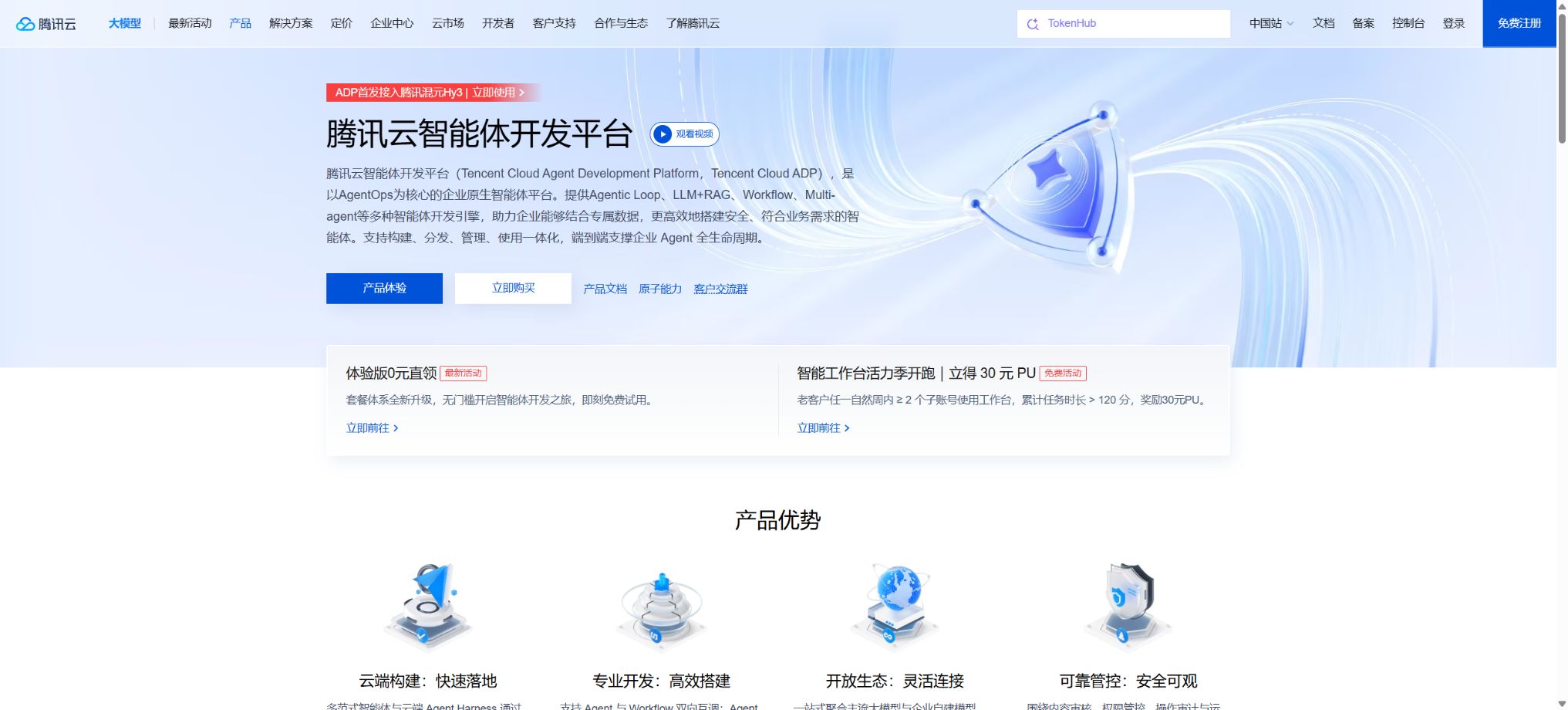
What is Tencent Cloud’s Agent Development Platform ADP?
Tencent Cloud Agent Development Platform ADP is a one-stop platform provided by Tencent Cloud for enterprises and developers to develop, deploy, and manage AI agents; its English name is Tencent Cloud Agent Development Platform.
It brings large models, prompts, workflows, knowledge bases, connectors, Skills, cloud sandboxes, debugging and evaluation tools, deployment channels, and enterprise governance together in a single console, enabling teams to move from prototype testing to production deployment.
ADP is not just a tool for creating chatbots; it also offers various other solutions such as standard agents, Multi-Agent systems, single-workflow approaches, Agent Harness, and intelligent workbenches. It can be used for handling knowledge-based queries, customer service, marketing tasks, data analysis, content creation, complex research projects, and long-duration tasks.
Creating intelligent agents with natural language
Users can describe objectives, roles, inputs, outputs, and business rules in natural language; the platform then generates drafts of agents or workflows, after which models, tools, knowledge bases, and deployment methods can be configured. For business professionals who are not familiar with coding, this approach enables rapid concept validation.
The development team can then continue to adjust nodes, parameters, authentication, and error handling.
The automatically generated prompts and workflows still require manual testing. In cases involving orders, healthcare, finance, or internal approvals, it is necessary to establish boundary conditions, implement manual handoffs, and carry out permission checks; the prototype cannot be used directly as a production system.
Standard mode and Multi-Agent
The standard mode is suitable for a single agent to carry out tasks such as asking questions, using tools, and retrieving information within a clear set of guidelines. The Multi-Agent mode allows the main agent to assign multiple sub-agents based on specific intentions; for example, tasks like pre-sales consultation, after-sales support, provision of product information, and data retrieval can be assigned to different sub-agents, who then work together to provide responses.
Multi-agent systems are not necessarily superior to single-agent systems. The more agents there are, the higher the costs associated with call chains, delays, tokens, and error resolution.
For simple knowledge quizzes, the standard mode is preferred; the Multi-Agent approach is used only when the task truly requires division of labor, routing, or multi-stage collaboration.
Visual workflow
Workflows are composed of node connection models, conditional judgments, variables, knowledge retrieval, code, connectors, and external interfaces; they are suitable for businesses that require stable procedures and structured outputs. Agents can invoke workflows, and workflows can in turn invoke agents, thereby combining open-ended reasoning with deterministic processes.
Workflows are suitable for handling forms, generating reports, classifying leads, extracting contract information, querying databases, and performing content review. Before going live, it is necessary to address abnormal scenarios such as null values, timeouts, failures of third-party interfaces, duplicate submissions, and sensitive data.
Agent Harness and cloud sandbox
The platform offers cloud-based Agent Harness and secure sandboxes, which enable agents to execute code, process files, and carry out long-running tasks in an isolated environment. Such long tasks can continue to run in the cloud without the need for the user to keep the browser open, making them suitable for research, data processing, document organization, and development assistance.
Allowing agents to execute code increases security risks. Companies should restrict network access, file permissions, keys, execution time, and the tools that can be used, while also keeping track of their activities, in order to prevent the generated code from directly accessing production databases or critical accounts.
Corporate Skills and Connectors
Skills are used to encapsulate reusable professional capabilities, while connectors enable agents to access search engines, documents, databases, office systems, and third-party services. Teams can turn business rules, procedural steps, and tool calls into skills that can be reused across various applications.
When skills are in use, models, connectors, tools, and knowledge bases are invoked, and the costs are calculated based on actual usage. Third-party connectors may incur additional fees from their respective providers; therefore, it is necessary to check both the costs associated with the platform and those related to external systems when making a purchase.
Model Plaza and custom models
ADP supports models such as Tencent Hunyuan, DeepSeek, GLM, Kimi, and Qwen, and the list of available versions will be updated as the platform evolves. The enterprise version allows for the integration of custom models, facilitating unified management of model services developed in-house or obtained from other sources.
Different models vary in terms of inference speed, context handling, tool invocation capabilities, cost, and content security. For production applications, it is necessary to create evaluation sets that use real-world business scenarios to assess accuracy, latency, and costs, rather than relying solely on model rankings.
Knowledge base type
The platform’s knowledge base can manage documents such as PDF, DOCX, and TXT, as well as web content, question-answer pairs, and database data. The knowledge base within an application is typically used for that specific application, whereas the platform-level knowledge base facilitates reuse by multiple agents.
After the data is updated, it is necessary to reprocess the knowledge and republish the relevant applications in order to ensure that the online version contains the latest information.
A knowledge base cannot automatically address issues related to the quality of the data. Before uploading, it is necessary to remove duplicate, outdated, and conflicting files, set permissions for departments and individuals, and specify the effective dates for policies, prices, and product descriptions.
Regular RAG and Agentic RAG
General knowledge retrieval is suitable for questions whose answers can be obtained directly from a small number of document snippets. Knowledge retrieval agents that use Agentic RAG can first analyze the question, then carry out multiple rounds of retrieval, filtering, computation, or cross-document integration; this approach is more appropriate for complex research tasks, table data, and database queries.
The official knowledge retrieval agent can combine tools such as knowledge retrieval responses, targeted knowledge Q&A, Text2SQL, a calculator, a code interpreter, and SQL execution. It offers greater flexibility for complex searches, but this also increases the number of calls, response time, and the risk of errors occurring.
Text2SQL and data analysis
Leveraging database knowledge and Text2SQL capabilities, users can query business data using natural language, which is suitable for operational reports, sales analysis, and customer service statistics. Code interpreters and calculators can further handle aggregation, calculations, and the organization of results.
To generate SQL automatically, it is necessary to use read-only accounts, approved data sources, and query restrictions in order to prevent updates, deletions, or full-table scans. When dealing with personal information and business secrets, it is also important to control the fields that are returned and to keep audit logs.
Debugging, evaluation, and execution trajectory
The platform offers capabilities for application debugging, monitoring of node operation status, model invocation, and evaluation of performance, which assist developers in identifying issues related to prompts, search functions, tools, or workflows. In the production phase, data reports can be used to monitor model usage, invocation failures, and the overall performance of the applications.
It is recommended to prepare test sets consisting of normal questions, boundary cases, aggressive inputs, and sensitive content for each application, and to carry out regression tests after any changes are made to the model or knowledge base. It is not possible to determine whether an agent is stable based on just a few rounds of manual interaction.
Publication and API integration
Once debugging is complete, the application can be released as a web page, embedded in business pages, or integrated into existing systems via APIs. Developers can use Tencent Cloud’s APIs, SDKs, and related authentication mechanisms to manage these calls, while enterprises can incorporate such intelligent agents into their customer service, office management, marketing, and internal platforms.
Production keys should be stored in a server-side key management system; they must not be included in frontend code or published in public repositories. Interfaces need to have mechanisms for rate limiting, timeout handling, retry operations, idempotency, content security, and cost monitoring.
Enterprise permissions, security, and auditing
ADP offers capabilities for workspace management, member collaboration, role-based permissions, content security, operation auditing, and application governance. The Enterprise version supports larger workspaces as well as a greater number of members and applications, and it allows for more comprehensive security policies to be configured.
The capabilities of a platform cannot replace a company’s own systems for data classification, authorization, approval processes, and compliance measures. Before uploading customer information, contracts, code, or internal documents, it is necessary to determine the purpose of using that data, who will have access to it, how long it will be stored, and what the plan is for removing it once it is no longer needed.
Tencent Cloud ADP Usage Guide
Complete a basic task.
- In Tencent Cloud ADP, specify the trigger conditions, input data, and desired actions.
- Connect to the required application using a test account and grant only the minimum necessary permissions;
- Configure natural language for creating agents, as well as standard patterns and Multi-Agent; map fields on a per-item basis.
- Add branch handling, failure management, retry options, and manual approval;
- Run with a small amount of test data and check the output at each step;
- Enable the official process only after confirming that there are no duplicate writes or abnormal charges.
Create reusable professional workflows
- Choose business processes with a high frequency of repetition and clear rules;
- Draw the paths for triggering, decision-making, execution, and rollback;
- Break down the creation of intelligent agents from natural language, standard patterns, Multi-Agent systems, and visual workflows into reusable modules;
- Set log settings, budgets, timeout values, and permission limits;
- Assign a responsible person to randomly check the results and handle the failed queues;
- Review application permissions, business rules, and actual costs on a monthly basis;
Applicable scenarios
- Use corporate data to create knowledge bases, customer service systems, and employee assistants;
- Automatically process forms, documents, reports, and marketing content through workflows;
- Use Multi-Agent to break down complex business processes and specialized roles;
- Conduct cross-document research and database analysis using Agentic RAG;
- Let cloud agents execute code, handle files, and carry out long-running tasks;
- Integrate large model applications into existing websites, apps, or internal systems via APIs.
Price and version comparison
| Package or version | Prices, quotas, and core benefits |
|---|---|
| Free version and requirements to activate it | To use ADP, it is first necessary to complete the real-name verification process for individual or corporate accounts on Tencent Cloud. Starting from January 16, 2026, users who create a main account for the first time can manually obtain a free version of the service according to the instructions; this free version is valid for one month. Once it expires, it cannot be restored, and if continued use is desired, it is necessary to purchase a Skill Plan, the Professional version, or the Enterprise version. The free version includes 15,000 PU per month, up to 50 applications, 1 GB of knowledge base space, 1 workspace, and 3 members per workspace; it also supports standard mode, Multi-Agent mode, and single-workflow mode. The free benefits, available models, and requirements for obtaining them may change, so please refer to the console for the most up-to-date information. |
| Subscription plans and PU billing | ADP currently adopts a prepaid model based on monthly or annual subscriptions to its platform, with additional packages available for purchase. The available plans are Skill Plan, Professional Edition, and Enterprise Edition; each of these plans includes PU resources, a certain amount of storage space in the knowledge base, as well as various functional benefits. The PU count is reset every month and is not carried over to the following month. 1 PU is equivalent to 0.001 RMB. The official PU resource packages cost 10 yuan for 10,000 PU, 100 yuan for 100,000 PU, 1,000 yuan for 1 million PU, and 10,000 yuan for 10 million PU, with a validity period of 12 months. These resource packages cannot be used on their own; they must be used in conjunction with a valid Skill Plan, Professional Edition, or Enterprise Edition plan. |
| Differences in package resources | The Skill Plan includes 89,000 PU per month and is designed primarily for use with intelligent workbenches and various skills; it does not support the creation and deployment of regular applications. The Professional version offers 150,000 PU per month, up to 100 applications, a knowledge base of 100GB, and 3 storage spaces. The Enterprise version provides 3,000,000 PU per month, up to 1,000 applications by default, a knowledge base of 2TB, and 1,000 storage spaces by default; it also supports custom models and long-term memory storage. Upgrades to higher versions are possible, but downgrades are not. The specific subscription prices, promotional discounts, and benefits are displayed dynamically, and the details should be checked on Tencent Cloud’s billing page at the time of purchase. |
| Dedicated concurrency pricing | The Professional and Enterprise versions allow for the purchase of dedicated concurrent slots; a fee is charged based on the number of concurrent sessions when using the respective VIP models, with no additional Token charges applied. In the examples given, DeepSeek-V3.2 costs 9600 yuan per month for 1 concurrent session and 46800 yuan per month for 5 concurrent sessions; youtu-mrc-pro costs 55000 yuan per month per concurrent session, while youtu-intent-pro and youtu-agent both cost 17000 yuan per month per concurrent session. Dedicated concurrent slots are suitable for production environments where calls are stable and the concurrent demand is well-defined. For applications with low usage frequency or significant fluctuations, it is more flexible to use PU credits on a pay-as-you-go basis. |
Free version and requirements to activate it
To use ADP, it is first necessary to complete the real-name verification process for individual or corporate accounts on Tencent Cloud. Starting from January 16, 2026, users who create a main account for the product for the first time can manually obtain a free version of the service according to the instructions; this free version is valid for one month.
It cannot be restored after it expires; to continue using it, you must purchase a Skill Plan, the Professional version, or the Enterprise version.
The free version currently provides 15,000 PU per month, up to 50 applications, 1 GB of knowledge base storage, 1 workspace, and 3 members per workspace; it also supports standard mode, Multi-Agent mode, and single-workflow mode. The free benefits, available models, and requirements for obtaining them may change, and the details are subject to those specified in the console.
Subscription plans and PU billing
Currently, ADP uses a prepaid model based on monthly or annual subscriptions to its platform, with optional add-on packages available. The available plans are Skill Plan, Professional Edition, and Enterprise Edition; each plan includes PU resources, a certain amount of storage for knowledge bases, as well as various functional benefits.
The package PU is reset on a monthly basis and is not carried over to the following month.
1 PU is equivalent to 0.001 RMB. The official PU resource packages currently cost 10 yuan for 10,000 PU, 100 yuan for 100,000 PU, 1,000 yuan for 1 million PU, and 10,000 yuan for 10 million PU; the validity period of these packages is 12 months.
Resource packs cannot be used on their own; they must be used in conjunction with a valid Skill Plan, as well as a Professional or Enterprise plan.
Differences in package resources
The Skill Plan includes 89,000 PU per month and is designed primarily for use with smart workbenches and various skills; it does not support the creation and deployment of regular applications. The Professional version offers 150,000 PU per month, up to 100 applications, a 100GB knowledge base, and 3 storage spaces.
The Enterprise version includes 3,000,000 PU per month, a maximum of 1,000 applications by default, a 2TB knowledge base as well as 1,000 spaces by default; it also supports custom models and long-term memory.
The package can be upgraded to a higher version, but not downgraded. The specific subscription prices, promotional discounts, and benefits are displayed dynamically; the information on the Tencent Cloud payment page should be taken as the reference at the time of purchase.
Dedicated concurrency pricing
The Professional and Enterprise versions allow users to purchase dedicated concurrency quotas for the models they use; a fee is charged based on the number of concurrent sessions, with no additional Token costs. For example, DeepSeek-V3.2 costs 9600 yuan per month for 1 concurrent session and 46800 yuan per month for 5 concurrent sessions; youtu-mrc-pro costs 55000 yuan per month per concurrent session, while youtu-intent-pro and youtu-agent both cost 17000 yuan per month per concurrent session.
Dedicated concurrency is suitable for production applications with stable call patterns and well-defined concurrency requirements. For applications with low frequency of calls or significant fluctuations, it is more flexible to use PU-based billing first.
Fees for models, tools, and platform services
Models consume PU resources based on the amount of input, output, and cached tokens, and the cost per model varies. For example, the DeepSeek-V4-Flash model, when purchased directly from the manufacturer, costs 1 yuan per million tokens for input and 2 yuan per million tokens for output.
DeepSeek-V4-Pro, supplied directly by the manufacturer: 3 yuan for input and 6 yuan per million tokens for output.
Web parsing, document parsing, AI search, voice, images, videos, and medical tools all have separate pricing categories.
The Intelligent Workbench and Claw mode tasks will be charged based on the actual time they are in use, starting from July 1, 2026. The time spent waiting for a user’s response is not included in the billing, but any period of less than 1 minute is counted as 1 minute. The models, Skills, connectors, tools, and knowledge bases used within these tasks are subject to additional charging.
Knowledge base storage and expiration risks
The knowledge base storage is deducted first from the package capacity, and then from the package’s PU and prepaid PU resources. When a package expires, there are not enough PU resources, and the amount of knowledge stored exceeds the limits set for that package, the excess knowledge becomes invalid after 7 days, and it may be automatically deleted after 180 days.
Companies should set up reminders for capacity and expiration, and keep backups of the original files and configuration settings; they must not rely on cloud-based knowledge bases as the only source of storage.
Independently deployed on the cloud
Companies that require a higher level of environmental isolation can apply for a standalone standard version license for cloud deployment; the current price is 800,000 yuan per year. This license supports up to 500 applications, 500 spaces, and 2,000 users. Its validity period starts from the moment it is activated, and the download link is valid for a limited time only.
Independent deployment does not mean purchasing the source code outright; it also requires the provision of cloud servers, networking infrastructure, security measures, models, and operational resources. Refunds are subject to conditions such as whether the license is activated, its current usage status, and the 15-day rule following purchase – it is therefore necessary to review the contract and relevant terms before making a purchase.
GitHub and the open-source status
Tencent Cloud’s ADP platform, console, and complete server components are not open-source projects; there is no publicly available complete set of source codes that can be used for self-deployment. Tencent Cloud has released projects such as CubeSandbox, TencentDB-Agent-Memory, Octop, and general cloud SDKs on GitHub, which can be utilized for Agent sandboxes, memory management, or cloud service integration.
These open-source infrastructure solutions and SDKs are not equivalent to the source code of the ADP platform, nor can a commercial platform be created merely by using the relevant repositories. Teams that need a proprietary solution should opt for the official deployment options or combine open-source components on their own.
Product advantages
- Unified development of agents, workflows, Multi-Agent systems, and knowledge bases;
- Supports Agentic RAG, Text2SQL, and code interpreters;
- Offers cloud sandboxes, long-running tasks, Skills, and a connector ecosystem;
- It covers the entire process from modeling, debugging, evaluation, deployment to operation;
- It offers capabilities for enterprise space management, permission control, content security, and auditing.
- It can be purchased based on subscription, PU, dedicated concurrency, or standalone deployment.
Restrictions and Precautions
- ADP offers a wide range of functions and billing elements, and the total cost may include package fees, model tokens, knowledge base storage, connectors, tools, task duration, dedicated concurrency capacity, and external cloud resources.
- Before making a purchase, it is necessary to estimate the monthly cost based on the actual amount of requests and set up alerts;
- Agents may produce incorrect answers, make unauthorized calls, and generate unsafe code;
- Medical, legal, financial, and decision-making scenarios require manual review;
- Databases and external systems must be granted only the minimum necessary permissions, and after any updates to the knowledge base, those updates need to be republished along with regression testing.
Frequently Asked Questions
Is Tencent Cloud ADP free?
New users can receive a one-month free trial version, which includes 15,000 PU and basic development resources; after that period expires, they will need to purchase the Skill Plan, Professional version, or Enterprise version.
How much is 1 PU?
Currently, 1 PU is equivalent to 0.001 yuan, and a package containing 10,000 PU costs 10 yuan. The number of PU within a package is reset on a monthly basis, while any additional packages purchased are valid for 12 months.
Does ADP support knowledge bases and RAG?
It supports documents, web pages, Q&A pairs, and database knowledge, and offers both conventional search capabilities as well as intelligent Agentic RAG knowledge retrieval agents.
Is it possible to build a Multi-Agent system?
Yes. The free version, professional version, and enterprise version all support the Multi-Agent mode, while Skill Plan is focused on workbenches and skills; it does not support the creation and deployment of regular applications.
Does Tencent Cloud ADP have APIs?
Yes. The application can be integrated with existing systems through APIs and Tencent Cloud SDKs, and it also supports workflows, connectors, as well as calls to external services.
Is Tencent Cloud ADP open source?
The platform itself is not open source. Tencent Cloud offers open-source projects such as CubeSandbox, but they do not represent the complete source code of ADP.
Can it be deployed privately?
It is possible to purchase a standalone standard version license for deployment in the cloud; the current cost is 800,000 yuan per year. It is still necessary to arrange the corresponding cloud resources and infrastructure for operation and maintenance.
Tools similar to the Tencent Cloud Agent Development Platform





 Guigong Network Security Registration No. 45132202000164