






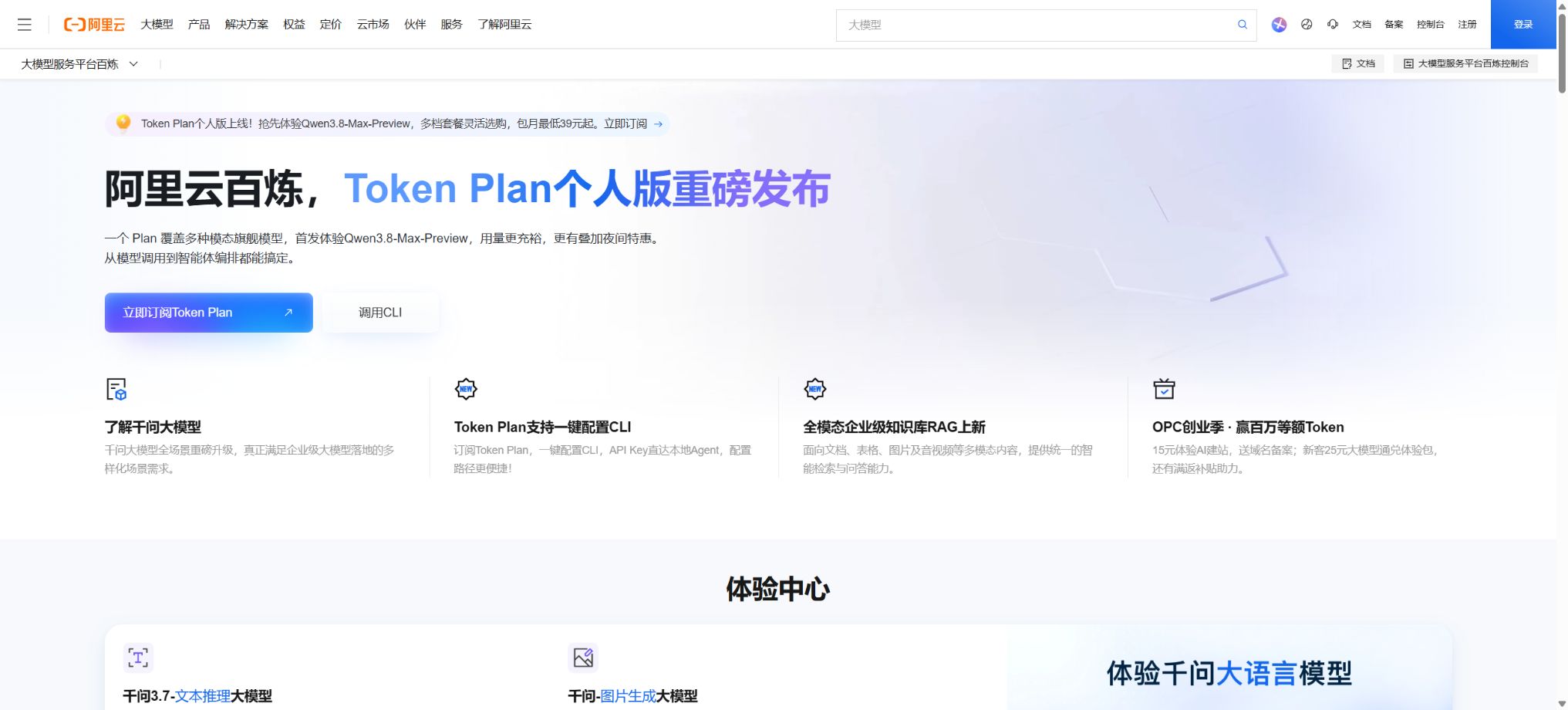
What is Alibaba Cloud BaiLian?
Alibaba Cloud Model Studio, whose English name is Alibaba Cloud Model Studio, is a one-stop platform provided by Alibaba Cloud for the development of large-scale models and the creation of AI applications. Developers can select models such as Tongyi Qianwen as well as third-party models within a single console, obtain API keys, test prompts, build knowledge bases, create agents and workflows, and deploy their applications on their own web sites, mobile devices, and business systems.
Bailian is not the Qianwen app designed for chatting with ordinary users, nor is it a single model. Tongyi Qianwen is a family of models developed by Alibaba Cloud, while Bailian is a cloud platform that offers services such as model invocation, RAG, Agents, tools, optimization, evaluation, monitoring, and enterprise governance.
Model services
1. Tongyi Qianwen text and reasoning model
The platform offers various tiers such as Max, Plus, and Flash, as well as models designed for coding, mathematics, translation, handling long texts, and performing complex reasoning tasks. Users can choose between fixed versions or the \"Latest\" variant, depending on factors such as quality, context, latency, and price.
Latest takes advantage of the improved model capabilities that come with platform upgrades, allowing for quick acquisition of new features, but the output may change. Production systems should prefer to use fixed versions and carry out regression tests, while also paying attention to any announcements regarding the discontinuation or migration of certain models.
2. Multimodal and generative models
Bailian encompasses models for visual understanding, image generation and editing, video generation, speech recognition, speech synthesis, real-time audio and video processing, Embedding, and Reranking. It can handle text, images, audio, video, and documents, and it is also able to combine different models to create podcasts, visual question-answering systems, and digital avatars.
The billing unit for multimodal models can be tokens, seconds, characters, or image/video specifications. Resolution, duration, concurrency, and whether thinking time is enabled all affect the cost; it is not possible to estimate the cost of all tasks using the pricing of text models.
3. Third-party models
In addition to Qianwen, Model Plaza also offers services based on DeepSeek, GLM, Kimi, MiniMax, as well as some open-source models. The platform provides unified account management and monitoring, but each model has different regional availability, free usage quotas, context limits, content policies, and pricing.
4. OpenAI-compatible interface
Bailian offers OpenAI-compatible interfaces; it is possible to use OpenAI’s official SDKs for Python, Node.js, Java, Go, etc., as well as the official DashScope Python and Java SDKs. When migrating existing applications, it is usually necessary to replace the API addresses, keys, and model IDs, and to verify the parameters related to tool calls, images, streaming data, and structured outputs.
Three application development patterns
1. Agent 2.0
The new version of the agent is driven by natural language prompts; it can understand user intentions, plan actions autonomously, and make use of knowledge bases, memories, skills, MCP, and plugins. It is suitable for open-ended customer service, knowledge-based Q&A, task assistance, travel planning, and multi-turn interactions.
The higher the autonomy of an agent, the more difficult it is to predict its execution path. When dealing with orders, payments, transmissions, deletions, and internal data, it is necessary to establish a whitelist of allowed tools, implement parameter validation, set up appropriate permissions, and require manual approval; relying solely on prompt instructions is not sufficient to prevent unauthorized actions.
2. Visualizing workflows
Workflows ensure a fixed execution order through nodes, and they allow for the combination of large models, intent classification, knowledge bases, document parsing, code, APIs, function computing, decision-making mechanisms, parallel processing, loops, variables, agents, and sub-processes. They are suitable for tasks that require consistent and reliable execution, such as report generation, order processing, approval procedures, data annotation, and content review.
Workflows support debugging and session variables; they can also be deployed as real-time audio and video conversation applications, and integrated with Web, iOS, and Android using H5 or audio/video SDKs. Models, knowledge bases, and cloud services that are invoked through these workflows incur separate costs.
3. High-code applications
High-code applications are designed for professional developers; they enable the use of Python to build AI backends, integrate with MCPs, data connectors, as well as existing agent/workflow components, and allow for one-click deployment to cloud environments. They are suitable for use with proprietary algorithms, complex dependencies, and deep system integrations.
The code is executed with elevated permissions; it is necessary to fix dependencies, scan for vulnerabilities, restrict network access and credentials, and establish operational rules for handling timeouts, scaling, as well as logs and exceptions.
RAG knowledge base
Knowledge of documents, tables, images, and audio/video content
The BaiLian knowledge base supports functions such as document search, data querying, image-based Q&A, and audio/video search; it can import data from local files, OSS, web pages, and other data sources. Document parsing is supported for PDF, DOC, DOCX, WPS, PPT, PPTX, Markdown, TXT, and Excel, while rich-text documents allow for the interpretation of illustrations and charts through large models.
Different types of knowledge bases cannot be selected together within the same database, but the new Agent 2.0 version allows multiple knowledge bases to be linked and called as standard tools. Workflows can specify knowledge bases in a fixed or dynamic manner, with separate settings for TopK and retrieval parameters.
Search and rearrangement
The knowledge base breaks down documents into chunks, vectors them, and creates indexes; during retrieval, semantic matching, keywords, reordering, and metadata filtering can be used. The hit test is employed to view the retrieved fragments, and API parameters take precedence over console settings.
Increasing TopK can improve coverage, but it also increases the number of input tokens and noise in the model. The team needs to evaluate slicing, vector models, thresholds, and reordering using real-world problems; the key answers still need to be checked against the original text.
Knowledge base SDK
In addition to use within the BaiLian application, external applications can also leverage the knowledge base retrieval capabilities through the BaiLian SDK. This allows the RAG results to be passed on to custom model orchestration systems or other agents; however, it is still necessary to manage the business space, knowledge base IDs, as well as authentication and rate limiting mechanisms.
Memory, Skills, Plugins, and MCP
The memory database is used to store users’ preferences and long-term information, enabling the agent to maintain its personalized characteristics across different sessions. Skills are sets of capabilities that can be added to an agent; the official skills cover common tasks such as file processing.
The plugins include a code interpreter, calculator, image generation tools, search functions, QR code generation, and GitHub search capabilities; custom APIs are also supported.
MCP enables agents to call services such as Amap, databases, internal services, and third-party tools; high-code applications can also expand their data access capabilities through MCP.
The descriptions and parameters of the tools are left to the model for decision-making; the server must verify identity, scope, and business conditions in order to prevent prompt injection.
Model tuning and evaluation
Bailian offers capabilities such as Prompt management, model evaluation, and supervised fine-tuning; it allows users to use their own data to compare basic models with the optimized versions. Application evaluation assesses the performance of agents and workflows from aspects such as the final responses, knowledge retrieval, and tool execution.
Fine-tuning is suitable for learning formats, styles, and task patterns, but not for frequent updates to facts; RAG should be used for real-time private knowledge.
The training data must be authorized and have its sensitive information removed; moreover, a split between training and validation sets is necessary to prevent the retention of private data and overfitting.
Deployment, APIs, and Monitoring
Agents and workflows can be integrated through API calls or shared pages; model services can also be accessed via DashScope and OpenAI-compatible interfaces. The platform offers features such as call statistics, tokens, success rates, latency, application logs, trace monitoring, and permission management.
API Keys should be stored on the server side, and isolated according to business areas and RAM permissions. Features such as rate limiting, budget alerts, log anonymization, retry of failed attempts, and key rotation should be implemented; the master account keys must not be placed in browsers or public repositories.
Price and version comparison
| Package or version | Prices, quotas, and core benefits |
|---|---|
| Model price | The BaiLian models are billed on a pay-as-you-go basis by default; text models have separate pricing for input and output tokens, while images, videos, audio, vectors, and rearrangements use their own units of measurement. Some models apply tiered pricing based on the length of the input tokens, with the entire request being charged at the price corresponding to its respective tier. As of the latest verification, the fixed version of Qianwen 3.7 Max in the Beijing region of North China has a cost of 12 yuan per million input tokens and 36 yuan per million output tokens, with 1 million tokens available free of charge. This free quota is valid for 90 days starting from the later of the dates when BaiLian is activated, the model is released, or the application is approved; such a quota may not be available in other regions. For models that support batch processing, input and output are typically charged at 50% of the real-time inference price. There is a separate price for context caching: creating an explicit cache costs 125% of the standard input price, while a hit results in a charge of 10%; the batch and caching discounts cannot apply simultaneously. Prices vary greatly depending on the different Qianwen tiers and third-party models, and there may also be promotional offers available through the console. It is not correct to list only one price for “BaiLian per million tokens”. |
| Knowledge base price | The knowledge base is billed on a pay-as-you-go basis, with charges calculated on an hourly basis. The creation page shows that the standard version costs 0.03 yuan per hour, while the premium version costs 0.2 yuan per hour; in addition, there may be costs associated with storage, parsing, embedding, retrieval, reranking, and the use of tokens from larger models. Even when the knowledge base is not in use, charges can still apply if it remains active for a certain period of time. Resources that are no longer needed after testing should be deleted or disabled promptly, and budgets and alerts should be set up in the billing center. |
| Free trial and subscription plans | The Alibaba Cloud AI trial offer currently promotes the use of BaiLian to access more than 100 million tokens from large-scale models; however, real-name verification is required, and the service must be activated through designated trial centers. There are also restrictions related to the first trial attempt, the account type, and the validity period of specific models. The quota provided under this offer does not constitute a permanent right for all accounts. BaiLian also offers subscription services such as CodingPlan and TokenPlan, whose model ranges, automatic renewal options, and fair usage policies are separate from those of pay-as-you-go APIs. It is advisable to check the current package details before making a purchase, and such subscription quotas should not be used for unsupported regular APIs or for commercial resale purposes. |
Model price
The BaiLian model is billed on a pay-as-you-go basis by default; text models typically have separate costs for input and output tokens, while images, videos, audio, vectors, and reordering all use their own respective measurement units.
Some models apply tiered pricing based on the length of the tokens entered in a single request, with the price for the entire request being determined by the tier to which it falls.
As of this verification, for the Beijing region in North China, the reference prices for the Qianwen 3.7 Max fixed version are 12 yuan per million tokens for input and 36 yuan per million tokens for output; in addition, 1 million tokens are provided free of charge. This free quota is valid for 90 days starting from the later of the dates on which BaiLian is activated, the model is released, or the application is approved, and it may not be available in other regions.
For models that support batch processing, the input and output data are typically charged at 50% of the price associated with real-time inference. There is a separate pricing structure for context caching: creating an explicit cache costs 125% of the standard input price, while a hit from such a cache incurs a charge of 10%.
Batch and cache discounts cannot apply simultaneously.
The prices vary significantly depending on the different Qianwen tiers and third-party models, and there may also be promotional offers available in the console. The catalog should not list only the price per million tokens for a particular model; rather, the actual cost should be calculated based on the model ID, location, input length, output length, caching requirements, and batch processing factors.
Knowledge base price
The knowledge base is billed on a pay-as-you-go basis, with costs calculated on an hourly basis. The creation page shows that the standard version costs 0.03 yuan per hour, while the premium version costs 0.2 yuan per hour; in addition, there may be costs associated with storage, parsing, Embedding, retrieval, Reranking, and the use of tokens from larger downstream models.
Even if the knowledge base is not in use, charges may still be applied based on the duration of operation of the relevant services. Resources that are no longer needed after testing should be deleted or disabled promptly, and budgets and alerts should be set up in the cost management system.
Free trial and subscription plans
The Alibaba Cloud AI trial offer currently promotes the use of BaiLian to access more than 100 million tokens from large-scale models; however, real-name verification is required, and the access must be obtained through designated trial centers. There are also restrictions related to the first attempt at use, the account type, and the validity period of specific models. The quota provided as part of this offer does not constitute a permanent right for all accounts.
Bailian also offers subscription services such as CodingPlan and TokenPlan; the scope of their models, as well as their auto-renewal features and fair usage policies, are separate from those of the pay-per-use APIs. It is necessary to check the current package before making a purchase, and one should not use the subscription quota for regular APIs that are not supported or for commercial resale purposes.
GitHub and the open-source status
Alibaba Cloud maintains on GitHub the DashScope SDK, API examples, and projects related to the Yuanqi Qianwen model; the weights of some of these models as well as certain tools are licensed under Apache 2.0 or other respective licenses. Developers can also use OpenAI’s official open-source SDK to access compatible interfaces.
The BaiLian cloud platform, the managed knowledge base, the application console, and the business model services are not open-source software that can be deployed privately. Just because a certain Qwen model or SDK is open-source does not mean that all models, data, and services available within BaiLian are subject to the same licensing terms; it is necessary to check each one individually before using them in commercial purposes.
Data security and region
According to the official statements, the data transmitted during the creation of applications or the training of models is encrypted. The platform also provides RAM, dedicated workspace, logging capabilities, as well as enterprise-level cloud security features.
Models, free usage quotas, and functional capabilities may vary across different regions; there are also differences in the features available on the international site and the Chinese site.
Encrypted transmission does not mean that data can be uploaded without any restrictions. Companies should examine the service agreements, rules regarding data retention, its use for training purposes, cross-border data transfers, as well as requirements related to personal information and industry regulations; they should also apply the principle of minimum permissions and data anonymization to knowledge bases, training datasets, and logs.
Alibaba Cloud BaiLian Usage Guide
Complete a basic task.
- Register for Alibaba Cloud BaiLian and create an API Key intended solely for use in a testing environment;
- Select a model based on input type, context, quality, speed, and price;
- First, invoke the model service to submit a minimal request and check the returned structure;
- Then use the three application construction patterns to test stream output, parameter handling, and exception responses;
- Record Tokens, number of calls, latency, error rate, and cost per call;
- Move the key to the server-side key manager before integrating it into the actual application;
Create reusable professional workflows
- Different keys and quotas are used for development, testing, and production environments;
- A representative evaluation set is established based on model services, the three application development patterns, and RAG knowledge bases;
- Set timeout, concurrency, retry, throttling, and budget limits;
- Perform checks on the output regarding facts, security, format, and sensitive information;
- Monitor changes in model version, price, latency, and failure rate;
- Prepare plans for downgrading the model, implementing circuit breaking, and taking manual control;
Which users is it suitable for?
- Developers who call the Tongyi Qianwen API as well as APIs of domestic and international models;
- Use zero-code agents to quickly create teams for customer service, knowledge assistants, and task helpers;
- Companies that need to visualize workflows in order to implement fixed business processes;
- Engineers who wish to deploy complex AI backends using Python’s high-level syntax;
- Organization of a RAG knowledge base that includes documents, images, tables, as well as audio and video content;
- Customers who place importance on Alibaba Cloud’s permissions, monitoring, registration requirements, and enterprise service systems.
Product advantages
- The entire Tongyi Qianwen series, along with third-party models, are integrated together;
- The compatible interfaces between DashScope and OpenAI reduce the costs associated with migration;
- Agents, workflows, and high-code solutions have different levels of complexity in terms of development requirements;
- Complete set of knowledge base, memory, skills, plugins, and MCP capabilities;
- Model tuning, evaluation, monitoring, and permissions form a closed loop;
- It supports batch processing, caching, and multi-level model optimization to reduce costs.
Restrictions and Precautions
- There are numerous features and billing elements related to processing, and the model token represents only a part of the total cost; knowledge bases, parsing, rearrangement, tools, code execution, and other cloud services require separate costing.
- The free quota, events, and the Latest model may change;
- Agents may exhibit hallucinations, incorrect invocation of tools, and unpredictable behaviors.
- Workflows can also become invalid due to updates in nodes, interfaces, or models.
- Production applications must have a fixed version, undergo evaluation, require manual confirmation, include security audits, and allow for rollback;
Frequently Asked Questions
Is Alibaba Cloud BaiLian free?
Eligible models are available at no cost as part of a free quota or through trial programs; however, actual usage of these models, as well as access to knowledge bases and cloud resources, is charged on a pay-as-you-go basis. The free quota usually has a validity period of 90 days.
How much is Qianwen 3.7 Max?
For the current fixed version in Beijing, the reference price is 12 yuan for input and 36 yuan per million tokens for output; the price varies depending on the specific model, the amount of context data, the batch size, and caching usage.
How much is the Bai Lian knowledge base?
The standard version costs 0.03 yuan per hour, while the premium version starts at 0.2 yuan per hour; in addition, actual costs for tasks such as parsing, vector processing, retrieval, reordering, and invoking large models must also be taken into account.
Is OpenAI SDK supported?
Supported. It is possible to use the OpenAI multilingual SDK to call compatible interfaces, or you can also use the official DashScope Python and Java SDKs.
Can Bai Lian be deployed privately?
Bailian is a hosting platform provided by Alibaba Cloud; it is not equivalent to open-source, self-hosted software. For enterprise-specific or hybrid cloud needs, it is necessary to consult Alibaba Cloud for solutions, taking into account factors such as PAI, dedicated clouds, and local model deployment.
Is Alibaba Cloud BaiLian open source?
The platform itself is not open source; some of the Qwen models, as well as the DashScope SDK and related tools, are open source. The licenses for these components must be checked separately, and they do not represent all the services provided by the platform.
Tools similar to Alibaba Cloud BaiLian





 Guigong Network Security Registration No. 45132202000164