






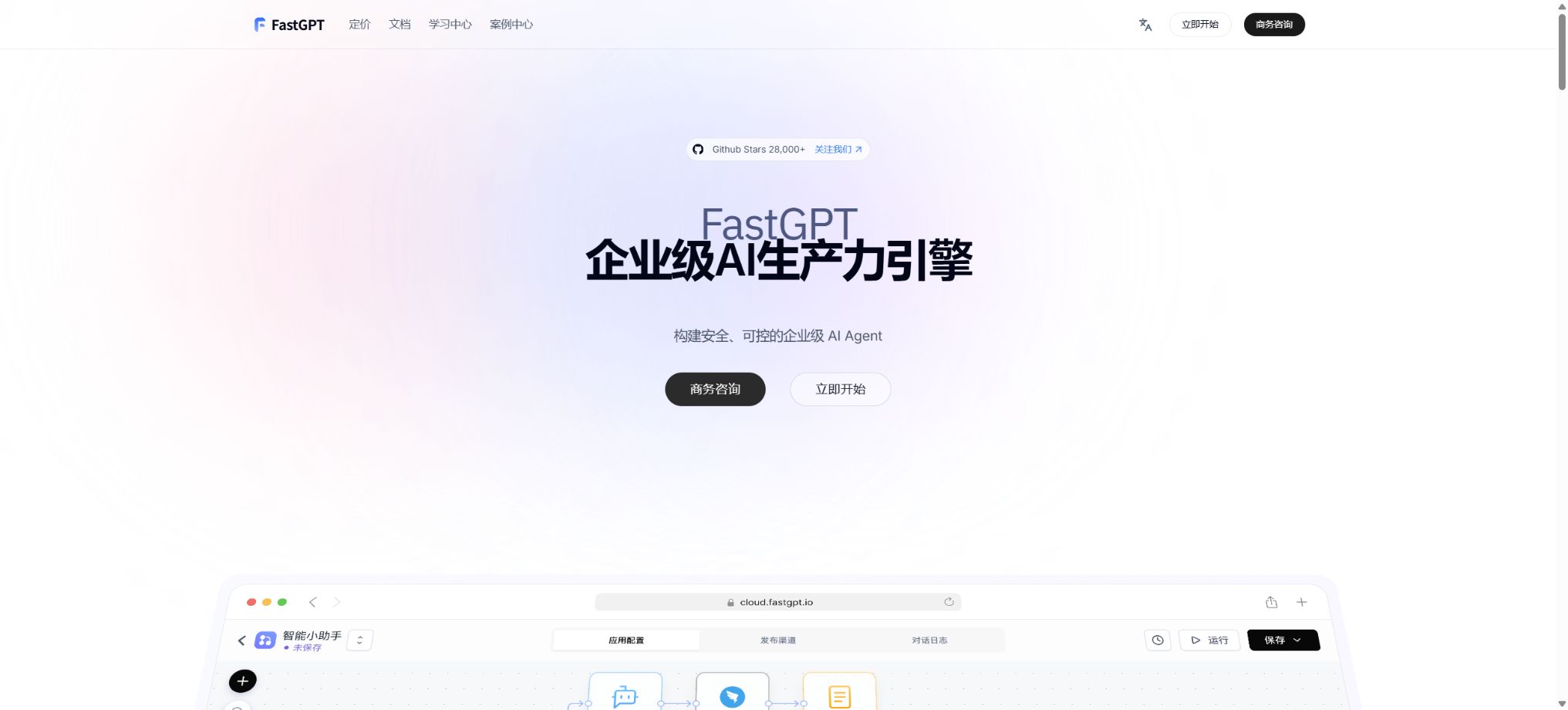
What is FastGPT?
FastGPT is a platform for creating agents aimed at handling queries related to knowledge bases as well as complex AI applications; it is maintained by the Labring team. It offers ready-to-use functions for document processing, RAG retrieval, model invocation, visual workflow management, as well as the ability to publish plugins and applications. Users can develop enterprise knowledge assistants, intelligent customer service systems, content review tools, data analysis solutions, and business automation applications without having to develop vector databases and chat interfaces from scratch.
FastGPT is not a basic large model; it serves to connect models, knowledge bases, and external tools. The quality of its responses depends on the language model, vector model, reordering model that are used, as well as on the quality of the data and the design of the workflow.
Users can use the official cloud services directly, or they can deploy the community version on their own servers using Docker or Sealos.
Four types of application capabilities
1. Conversational Agent
The dialogue Agent is used for general Q&A, writing, translation, and role-based assistance. The creator can select a model, define system prompts, variables, opening phrases, user inputs, and multi-turn context, after which it can be delivered through shared links, APIs, or embedding.
It is suitable for simple assistants that do not rely on proprietary materials.
2. Knowledge base Q&A
The knowledge base agent first retrieves relevant sections from the uploaded materials, and then uses those sections to enable the model to provide answers. The official quick-start guide presents it as a solution to the question of \"what sources should be used to find answers,\" and it is suitable for answering questions related to policies, product manuals, legal documents, courses, and after-sales documentation.
3. Fixed workflow
Workflows define the order of execution through visual nodes, combining AI conversations, knowledge retrieval, conditional judgments, HTTP requests, code, variables, user interactions, and plugins. They are suitable for tasks that involve clear business steps such as rewriting content after review, form collection, categorized routing, and database queries.
4. Agent V2
Agent V2 is designed for open-ended tasks; it is the model itself that plans the actions, selects the necessary Skills and tools, and carries out these actions in a repetitive manner – such as reading files, analyzing data, or calling various services. It is more flexible than fixed workflows, but its outcomes are less predictable. Therefore, it is necessary to set limits on tool usage, the number of iterations allowed, cost thresholds, and points where human intervention is required.
Knowledge base and RAG
Document import and data processing
FastGPT supports files in formats such as TXT, Markdown, HTML, PDF, DOCX, PPTX, CSV, and XLSX. It also allows for manual input, direct segmentation, import of question-answer pairs, reading from URLs, or access to third-party file systems through API libraries. Once the data is stored, it is parsed, divided into chunks, and vectorized; users can modify or delete specific chunks.
Scanning PDFs, complex tables, images with text, page headers and footers, as well as content that spans multiple pages, may result in incomplete parsing. Before building a knowledge base, it is necessary to remove duplicate versions, standardize the hierarchy of headings, and retain the original files; one should not assume that the knowledge can be retrieved accurately just because an upload was successful.
Mixed retrieval and rearrangement
The knowledge base supports vector retrieval, full-text retrieval, hybrid retrieval, and reordering, and it allows for the reuse and combination of data from multiple knowledge bases. Vector search is effective for expressions with similar meanings, while full-text search is suitable for product codes, proper nouns, and exact keywords.
The rearrangement model assigns a second score to the candidate segments, helping to include more relevant content in the prompt.
The number of searches performed, the similarity threshold, the length of the segments, and the way in which those segments are rearranged all affect accuracy, latency, and the cost associated with tokens. Teams should use real-world problems to create evaluation sets, in order to determine whether the correct segments are retrieved and whether the model provides answers based on those segments.
Websites and third-party knowledge bases
The commercial version and cloud services support website synchronization, regular synchronization with third-party knowledge bases, as well as enhancements to image knowledge bases and indexes. The API library enables external systems to utilize designated interfaces for file browsing and downloading; users can select the materials they want to import within the FastGPT interface, without having to download all files manually first.
Visual workflow
The workflow receives issues and variables from the starting node; subsequent nodes can include AI-driven conversations, database searches, text processing, decision-making, loops, HTTP requests, code execution, tool calls, file parsing, and predefined responses. The inputs to these nodes can refer to the outputs of previous nodes, and the debugging mode allows one to view the execution path, time taken, variables, and any errors that occur.
Workflows can be released as chat applications or packaged as plugins for use by other Agents. For production processes, it is necessary to implement mechanisms for handling timeouts, retries, empty results, exceptions in external interfaces, and model rejections, in order to prevent the entire workflow from becoming unresponsive due to the failure of a single node.
Skills, Plugins, and MCP
FastGPT supports the orchestration of Agent Skills; these Skills are used to organize specialized instructions, files, and tools into reusable capabilities. The plugin system offers functionality for HTTP, RPA, knowledge retrieval, and custom business operations, and it also enables hot updates for system tools, RAG modules, and Agent Loops.
The new version also offers AI capabilities for assisting in the creation of workflows, skills, and plugins.
Bidirectional MCP means that FastGPT can both invoke MCP tools and provide its capabilities to compatible clients. MCP, code, and HTTP nodes may be used to read files, connect to internal networks, or modify business data; it is necessary to use credentials with the minimum required permissions, restrict outbound addresses, log parameters, and prevent prompt injection from user documents from causing the tool to exceed its authorized limits.
Model integration
FastGPT enables access to OpenAI protocol-compatible models as well as a variety of models provided by domestic and international suppliers through its model proxy layer; it supports the configuration of language, vector, reordering, speech, and multimodal models. The AI Proxy project can also be used for model aggregation and load balancing.
Different models can handle tasks such as dialogue management, vectorization of knowledge bases, problem optimization, and tool planning, each on its own.
The community self-hosted version does not include any quota for commercial use. Using the public API requires payment to the provider, while private models need GPUs, inference services, and maintenance support.
After changing the vector model, it is usually necessary to rebuild the vectors; the old indices cannot be used directly.
Application release and OpenAPI
Applications can be shared through login-free sharing windows, iframe embedding, or API integration. The chat interface of FastGPT is compatible with the OpenAI API; existing OpenAI clients generally only need to have their Base URL, API Key, and model identifier updated in order to use it.
The OpenAPI of the system also enables operations such as managing application chats, uploading data to the knowledge base, and conducting search tests. The API Key inherits the permissions that the current account has within the team; not all backend interfaces are accessible.
The key should be stored on the server, with mechanisms for rate limiting, rotation, and revocation in place; it must not be included in public web pages.
The business version and cloud services include features such as third-party publishing via Feishu and WeChat Official Accounts, security settings, operation logs, and application evaluation. For public applications, considerations are required regarding identity verification, content moderation, sensitive data, misuse by bots, and model costs.
Team and Operations
The platform offers team spaces, permissions, model logs, conversation records, user feedback, and data annotation. The commercial version also includes a management dashboard, multi-tenant and billing capabilities, SSO, custom branding, model content review, as well as more comprehensive operation logs.
Some features vary between the cloud service version, the community edition, and the commercial edition; therefore, it is necessary to check the version comparison table carefully when making a choice.
Private deployment
The community version supports deployment using Docker Compose, as well as one-click deployment via Sealos Cloud. The core services rely on the Next.js/Node.js ecosystem; in addition, components such as MongoDB, PostgreSQL vector databases, model proxies, and object storage are usually required.
The specific architecture varies depending on the version configuration.
The default password for the account used for quick official deployment is publicly available, and it must be changed upon the first startup. In a production environment, it is necessary to set up a proper access domain name, use HTTPS, implement persistent storage, carry out database backups, use object storage, as well as establish logging and monitoring mechanisms.
Before upgrading, it is necessary to read the release notes; for example, the new version may alter the required environment variables, the method of index synchronization, and the way files are downloaded, and directly replacing the image could lead to failure when trying to start the system.
Price
Official cloud services
FastGPT’s cloud services in China currently offer the following monthly subscription plans; the annual plan is available at a rate equivalent to 10 months’ cost, and the terms and conditions are as specified on the purchase page.
| Package or version | Prices, quotas, and core benefits |
|---|---|
| Free version | 0 yuan per month: 100 AI points, 600 database indexes, 1 team member, 10 Agents, 3 databases, conversation records retained for 30 days, and 30 QPM. The official cloud service FastGPT offers the following monthly subscription plans in China; the annual plan is available at a price equivalent to 10 months’ worth of service. The terms and conditions are as specified on the purchase page: Free version: 0 yuan per month, 100 AI points, 600 database indexes, 1 team member, 10 Agents, 3 databases, conversation records retained for 30 days, and 30 QPM. |
| Community version | The community self-hosted version is available for free download and self-deployment; however, the user is responsible for handling the servers, databases, object storage, bandwidth, model APIs, as well as backup and maintenance tasks. |
AI credits are used for invoking models on the platform; the knowledge base indexing is calculated based on the number of segments, while QPM represents the number of issues per minute. The model multiplication factors, resource packages, validity periods, and excess usage rules may change, so it is necessary to estimate the actual cost using the console.
Community Self-Hosted Version
The community version of the code can be downloaded for free and deployed by users themselves, but the responsibility for servers, databases, object storage, bandwidth, model APIs, as well as backup and maintenance lies with the users. “Free and open source” does not mean zero cost, nor does it imply that it is possible to operate similar SaaS services without being bound by any licenses.
Business version
The Business version builds on the Community version by adding commercial images and licenses, and it includes SaaS commercial licensing, assistance with the first deployment, as well as priority ticket handling. The current public price is:
- Sealos single-node fully managed service:10,000 yuan per month, for a minimum of 3 months, or 120,000 yuan per year, including 8 cores and 32 GB of resources; additional resources are charged separately.
- Sealos multi-node fully managed service:22,000 yuan per month, for a minimum of 3 months, or 264,000 yuan per year, including 32 cores and 128 GB of storage; additional resources are charged separately.
- Self-hosted Business Edition:Contact sales for a quote, which includes support for upgrading to 6 different versions; delivery is usually within 14 days.
- Technical services:Custom development, maintenance, migration, and third-party integration cost between 2,000 and 3,000 yuan per person-day.
\"6 version upgrades supported\" refers to the number of times official assistance is provided for upgrades, and it does not mean that the software will stop working once this limit is reached. Commercial versions cannot be modified on their own, while some community versions allow for further development.
For future upgrades after Fork, the merging of code must be handled by the customer themselves.
GitHub and licenses
The official FastGPT repository is maintained by labring, and it is developed primarily using TypeScript. The project undergoes frequent updates; as of the latest check, the most recent stable version available on GitHub is 4.15.4, released on July 24, 2026.
During deployment, continue to check for any updates or fixes.
The code is licensed under the FastGPT Open Source License, rather than MIT, Apache, or GPL. The official summary states that it is permissible to use it in commercial applications as a backend service, but it is not allowed to provide FastGPT SaaS services without authorization.
Any commercial service that is used without proper commercial authorization must retain the relevant copyright information.
When it is necessary to remove copyright restrictions, provide the service as SaaS, or obtain full commercial rights, a commercial license must be purchased.
Security and data
With private deployment, the database and files are located in one’s own environment; however, when external models are used, issues, knowledge fragments, and files are still sent to the model provider. For sensitive operations, it is necessary to examine the provider’s policies regarding data retention, training, location, and compliance, and where appropriate, use local models and apply data anonymization techniques.
Sharing links, iframes, OpenAPI, plugins, and HTTP nodes increase the attack surface. It is necessary to implement SSO or authentication mechanisms, apply the principle of least privilege for team members, use a whitelist of allowed domain names, impose restrictions on file types, limit API usage, mask logs, rotate keys, and back up databases; in addition, dependencies and images should be upgraded regularly.
FastGPT Usage Guide
Complete a basic task.
- Clarify the issue, time frame, location, source priority, and output format;
- In FastGPT, upload materials for which you have permission to use, or enter search queries;
- First, a framework is established using four types of application capabilities, and then evidence is added through knowledge bases and RAG.
- It is necessary to distinguish between factual information from the source, the author’s opinions, and AI-generated conclusions.
- Check each item for dates, numbers, the original location, and any conflicting evidence;
- The conclusions are manually revised, the verification time is recorded, and then they are published;
Create reusable professional workflows
- Break down complex topics into four categories of questions: background, data, comparison, and conclusions;
- Combining these four types of application capabilities, knowledge bases, RAG, and visual workflows creates a fixed set of research steps.
- Give priority to using the official website, research papers, regulatory documents, and raw data;
- A second person is assigned to review conclusions that are considered high-risk;
- Save queries, evidence, versions, and unresolved issues;
- Re-run after the data changes and update the conclusions;
Which users is it suitable for?
- Form a team to develop internal corporate systems, as well as knowledge assistants for products and after-sales support;
- Developers who wish to use visual workflows to connect models, data, and business APIs;
- Companies that need an OpenAI-compatible interface to integrate quickly with existing systems;
- Organizations that wish to carry out private deployments and have control over their databases and knowledge documents;
- Users who need Agent V2, Skills, plugins, and MCP to carry out open tasks;
- Large or medium-sized teams that require hosting, SSO, multi-tenancy, auditing, and commercial licensing.
Product advantages
- The knowledge base, workflows, and Agent V2 cover everything from fixed Q&A to autonomous tasks;
- It supports mixed retrieval, rearrangement, multiple knowledge bases, and Chunk editing;
- Complete support for workflows, plugins, Skills, and bidirectional MCP extensions;
- Compatible with the OpenAI API, enabling easy integration into existing applications;
- It also offers cloud services, community self-hosting options, and commercial hosting solutions;
- Chinese documents benefit from a well-developed ecosystem of domestic models and office platforms.
Restrictions and Precautions
- FastGPT reduces the barriers to developing AI applications, but tasks such as cleaning up knowledge bases, performing retrieval and evaluation, managing model costs, ensuring security permissions, and handling production operations still require specialized efforts.
- The visualization of the process becomes more complex as the number of nodes increases, so it is necessary to implement proper version control and regression testing.
- The FastGPTOpenSourceLicense imposes clear restrictions on SaaS services and copyright ownership; it does not allow the assumption that content made available on GitHub can be used for commercial purposes in a closed-source manner without any restrictions.
- There may be differences in features between the community version and the commercial version, and the resources and prices of cloud packages can change; it is necessary to check the current page before making purchases or carrying out deployments.
Frequently Asked Questions
Is FastGPT free?
Cloud services offer a free version at no cost; the community version can be hosted freely, but the costs for servers and models have to be covered by the user.
Charges apply for the Business version, hosting services, and advanced enterprise features.
How much does the FastGPT cloud service cost?
The basic version currently costs 99 yuan per month, the advanced version 599 yuan per month; when paid annually, the price is that of 10 months’ worth for an entire year. The free version costs 0 yuan, and the custom version is available upon request for a quote.
Can FastGPT be deployed in a private environment?
Yes. The community version supports deployment using Docker Compose and Sealos, while the commercial version offers self-hosted options as well as fully managed Sealos deployment.
Does FastGPT support APIs?
It supports chat interfaces compatible with OpenAI, as well as OpenAPI systems for testing applications, knowledge bases, and search functions.
Can FastGPT be used for commercial purposes?
It can be used as a backend service under the FastGPT Open Source License while retaining copyright rights; however, FastGPT SaaS cannot be provided without authorization. For full commercial use or to remove copyright restrictions, a commercial license must be purchased.
What are the differences between FastGPT and MaxKB, Dify?
All three can be used to create knowledge bases and AI workflows. FastGPT stands out for its support of RAG in Chinese, compatibility with OpenAI, plugin-based workflows, and Agent V2.
The final decision should be based on the data source, permissions, nodes, operation and maintenance aspects, as well as certification tests.
Tools similar to FastGPT





 Guigong Network Security Registration No. 45132202000164