






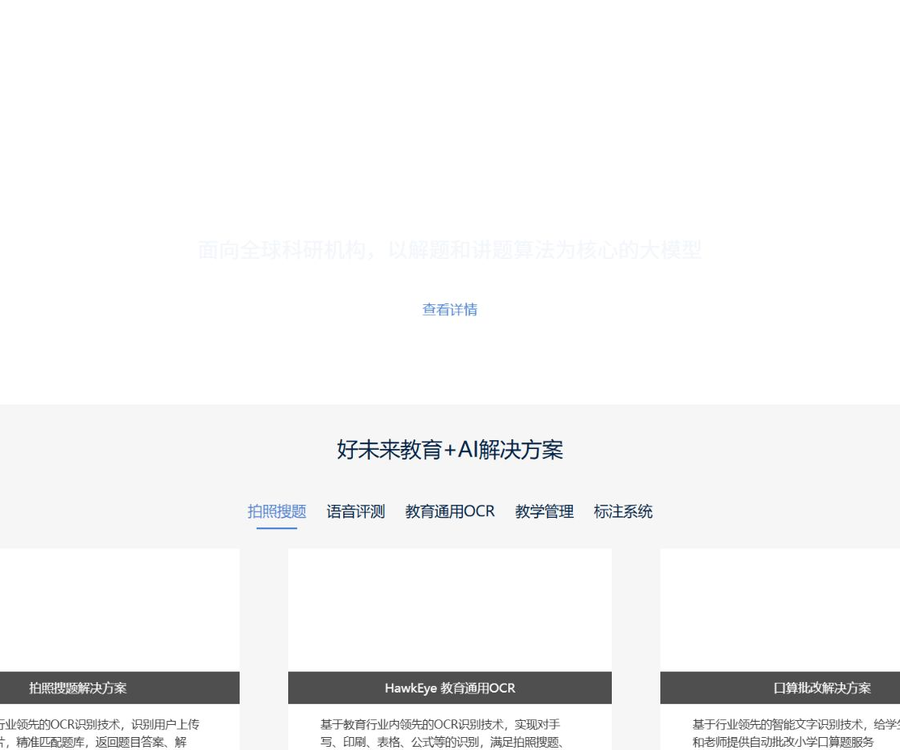
Good Future AI Open Platform
It offers cutting-edge AI capabilities and solutions to facilitate the intelligent development of education.
Tags:AI learning websitesWhat is the Good Future AI Open Platform?
The Good Future AI Open Platform offers algorithms, APIs, and solutions tailored for educational contexts to schools and developers.
The platform is operated by Beijing Century Good Future Education Technology Co., Ltd., and it covers text, voice, images, as well as teaching analysis.
Overview of Openness Capabilities
| Ability categories | Representative function | Main scenarios |
|---|---|---|
| Large education models | Jiuzhang Large Model | Research on Mathematical Problem Solving and Problem Explanation |
| Educational OCR | Recognition of printing, handwriting, tables, and formulas | Digitalization of assignments and exams |
| Intelligent grading | Oral calculation grading and note assessment | Practice feedback |
| Voice capabilities | Recognition, synthesis, and spoken language evaluation | Language learning |
| Visual analysis | Detection of faces, human bodies, gestures, and clothing | Classroom and teaching interaction |
| Teaching management | Quality assessment and teaching analysis | Teacher development and curriculum evaluation |
| Data annotation | Vegas annotation system | Education data generation |
Jiuzhang Large Model
The JiuZhang large model is centered on algorithms for solving and explaining mathematical problems, and it is designed for use in educational research and learning contexts.
- It supports solving mathematical problems.
- Generate an explanatory process tailored for learners.
- It can be tested at the dedicated testing entry point.
- Complex proofs and calculations require manual verification.
- It cannot directly replace a teacher’s judgment in teaching.
Educational OCR
Educational OCR is designed for books, homework assignments, and exams; it identifies the text, formulas, tables, and structure within the pages.
- It supports the recognition of printed and handwritten text.
- Extract formula and table content.
- Analyze the positions of diagrams, titles, and text.
- Automatically splits the questions in a test paper.
- Identify markings of correction and assist in analysis.
- Blurred images and complex formulas require manual verification.
Taking photos of questions for searching answers and correcting them
Photo question search can identify the question and match it to the question bank, providing solutions, explanatory videos, similar questions, and relevant knowledge points.
- It is suitable for developing products for learning and homework assistance.
- Oral calculation grading is intended for elementary school math exercises.
- The scope of the question bank affects the recall efficiency.
- Similar questions are not necessarily the same as the original ones.
- The answers and explanations should retain the teacher’s verification process.
Speech recognition and evaluation
The platform offers voice transcription, real-time recognition, speech synthesis, as well as assessment of spoken Chinese and English.
- It supports the transcription of audio files.
- It supports real-time and short sentence speech recognition.
- Provides generic and personalized text-to-speech synthesis.
- Evaluate Mandarin and English pronunciation.
- It supports the evaluation of children’s recitation of poems.
- Accents and differences in equipment can affect the scores.
Teaching quality and classroom analysis
The teaching management framework extracts indicators from classroom questions and answers, voice, gestures, and the teaching process.
- Live classes allow for real-time interactive feedback.
- Lesson analysis assists in lesson preparation and refinement.
- The assessment of teaching quality generates multi-dimensional indicators.
- Content moderation covers text, images, as well as audio and video.
- Anomaly detection in classrooms should avoid excessive monitoring.
- Automatic metrics cannot replace a comprehensive assessment of teaching.
Tutorial for Using the Good Future AI Open Platform
- Register and log in to your account on the open platform.
- Go to the console to create an application.
- Select the educational AI capability that needs to be invoked.
- View the request documentation corresponding to the capability.
- Obtain the application signature and authentication parameters.
- Construct requests in the testing environment.
- Choose between the HTTP or WebSocket protocol.
- Upload compliant and minimized test data.
- Handle successful, failed, and throttling responses.
- Add a manual review process for the results.
- Apply for production concurrency and business services.
- Monitor the error rate and data security after going live.
API protocols and authentication
- The standard interfaces support HTTP and HTTPS.
- Real-time capabilities can be implemented using WS or WSS.
- The maximum size of a WebSocket message is 64KB.
- Application signatures are used to request identity verification.
- Keys cannot be written to the browser’s frontend.
- In a production environment, keys should be rotated and their permissions restricted.
Price and usage quota
The official website offers options for registration and free use, but it does not disclose a fixed schedule for the free quota or the price per additional unit.
| Usage method | Public price | Explanation |
|---|---|---|
| Account registration | Free | Applications can be created to experience these open capabilities. |
| Basic API experience | The free quota is not specified. | Subject to the real-time quotas displayed in the console. |
| High-concurrency production calls | Consultation and quotation | Determined based on capabilities and business scale |
| Industry solutions | Consultation and quotation | Confirm based on the scope of deployment and customization. |
The information above was verified on August 30, 2026; quotas, unit prices, concurrency levels, and service scope are subject to what is specified in the console or in the contract.
Datasets and knowledge systems
The platform provides certain educational datasets as well as a labeling system for primary school math concepts, to facilitate research and product development.
- Check the data usage terms before downloading.
- Distinguish between public downloads and requests for acquisition.
- Check whether commercial use is permitted.
- Anonymized data must not be re-identified.
- The training results still require bias assessment.
- Record the data source version when publishing the model.
GitHub and the boundaries of open source
The official technology team of Good Future has made some of its projects available to the public, and the Chinese pre-trained model for educational purposes, Edu-BERT, is one of them.
- Each warehouse uses its own license.
- Open-source models are not the same as open-source platforms.
- The JiuZhang large model cannot therefore be labeled as open source.
- The dataset license and the code license need to be checked separately.
- Third-party warehouses with the same name do not represent the official Good Future brand.
Privacy and protection of minors
The education interface may handle assignments, audio, photos, and classroom data, which may contain information related to minors.
- Only collect the data necessary to implement the functionality.
- Obtain the guardian’s consent as required by law.
- Do not use real student data to test the interface.
- Remove identifiers such as name and student ID before uploading.
- Restrict the permissions of teachers, developers, and suppliers.
- Set retention periods and deletion mechanisms.
Accuracy and teaching risks
- Mathematical answers may contain errors in reasoning or calculation.
- OCR may miss words, insert incorrect words, or misclassify questions.
- The oral assessment score may be affected by accent and equipment.
- Classroom metrics cannot fully reflect the quality of teaching.
- Content moderation may involve errors in judgment as well as omissions.
- Decisions with a high impact must be confirmed by the teacher.
Which users are it suitable for
- Product and technology teams for developing educational applications.
- Schools and institutions that need to digitize their assignments.
- Developers who create products for oral language learning.
- Research teams working on large educational models.
- Managers who need classroom and teaching analysis.
- A project team responsible for labeling educational data.
Product advantages
- The capabilities are designed for real-world educational scenarios.
- It covers OCR, speech, vision, and teaching analysis.
- API documentation and console access are provided.
- It supports both real-time and non-real-time calling protocols.
- It possesses educational dataset and knowledge system resources.
- Provide industry solutions and partnership consulting.
Usage restrictions and precautions
- The unified public prices and quotas are not yet complete.
- Some capabilities require an application to be used in production.
- Model results cannot replace the teacher’s judgment.
- Student and classroom data need to be strictly protected.
- A single open-source repository does not mean that the entire platform is open source.
- Stress and compliance tests must be completed before going live.
Frequently Asked Questions
What capabilities does the Good Future AI Open Platform offer?
It mainly includes large education models, OCR, photo-based question searching, speech evaluation, classroom analysis, and content moderation.
Can the Good Future AI Open Platform be used for free?
The official website offers free registration and a trial option; the specific limits and any additional fees are indicated on the real-time page in the control panel.
How do developers call the platform API?
After registration, create an application, select the required capabilities, obtain the signature authentication parameters, and then send requests in accordance with the corresponding interface documentation.
Which interface protocols does the platform support?
It supports HTTP and HTTPS, as well as WS and WSS; note that WebSocket requests are subject to a 64KB message size limit.
What is the main purpose of the JiuZhang large model?
It focuses on solving and explaining mathematical problems, and is designed for educational research and learning purposes; the results still require manual verification.
Is the Good Future AI Open Platform an open-source project?
The platform itself cannot be considered open source; the developers have made available only certain separate projects and resources such as Edu-BERT.
What privacy issues should be considered when using education APIs?
The collection of student data should be minimized; necessary approvals must be obtained, and measures such as data anonymization, access control, and periodic deletion should be implemented.
Tools similar to the Good Future AI Open Platform

 Guigong Network Security Registration No. 45132202000164