






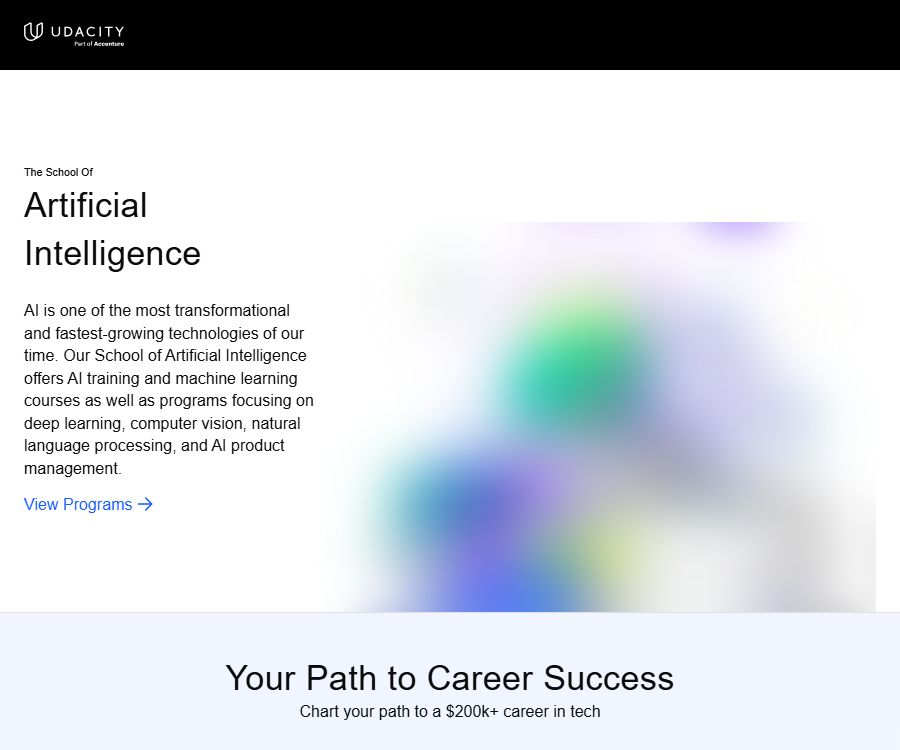
Udacity AI Academy
Udacity’s School of AI, ranging from beginner to advanced levels
Tags:AI learning websitesWhat is the Udacity AI Academy?
Udacity AI Academy is the artificial intelligence curriculum offered as part of Udacity’s online learning platform; it is designed for those who wish to learn Python, machine learning, deep learning, generative AI, agents, and industry-specific applications in a structured manner. It provides courses, Nanodegree programs, and career development paths, rather than AI tools that can directly generate text or images.
Udacity is now part of Accenture’s digital education business, but the platform’s services, account terms, and data governance rules remain in accordance with Udacity’s current regulations. The course catalog is updated regularly; therefore, it is important to check the version of each course, the estimated time required to complete it, any prerequisite requirements, and the associated payment details when selecting courses.
What problems can the AI Academy solve?
- It organizes the sequence of AI learning for learners who lack a roadmap, based on job roles and difficulty level.
- Through programming exercises, Notebooks, and projects, algorithmic concepts are transformed into functional works.
- Through project reviews and feedback, issues in the code, model evaluation, and engineering implementation are identified.
- Helping working developers acquire skills in generative AI, machine learning engineering, or cloud deployment.
- Learning outcomes are documented through project completion and certificates of completing courses, but no employment or salary guarantees are provided.
Main course areas
| Direction | Representative courses | Main inputs and exercises | Possible outcomes | Suitable for beginners |
|---|---|---|---|---|
| Fundamentals of AI programming | AI Programming with Python | Practice with Python, NumPy, Pandas, linear algebra, and PyTorch | Notebook, classification programs, and basic neural network projects | Beginners |
| Machine learning | Machine learning paths with TensorFlow or PyTorch | Structured data, feature engineering, supervised and unsupervised learning | Training, evaluating, and interpreting machine learning models | Those with basic knowledge of Python |
| Deep learning | Deep Learning | Images, text, sequence data, and neural network code | Practice with CNN, RNN, Transformer, GAN, or diffusion models | Intermediate learners |
| AI specialization | Computer Vision, NLP, Deep Reinforcement Learning | Images, language, environmental conditions, and reward signals | Specialized tasks such as detection, text processing, and agent strategies | Those with a foundation in machine learning |
| Generative and agent-based AI | Generative AI, Agentic AI, Claude engineering courses | Tips, data retrieval, tool interfaces, and workflow code | Generative applications, retrieval systems, or executable agent projects | Developers and AI engineers |
| Cloud-based machine learning | AWS Machine Learning Engineer | Datasets, cloud resources, training jobs, and deployment configurations | End-to-end training, deployment, and monitoring process | Intermediate engineering personnel |
Course difficulty and estimated study time
The AI Academy offers content at beginner, intermediate, and advanced levels; it is not possible to determine whether a course is suitable merely by looking at its title. The number of hours indicated in the curriculum serves as a guide to the scope of the content, but it does not represent the time it will take for each individual to complete the course.
| Course examples | Catalog difficulty level | Estimated study hours for the page | Tips for selecting courses |
|---|---|---|---|
| AI Programming with Python | Primary | About 52 hours | Suitable as an entry point for programming and neural networks |
| Introduction to Machine Learning | Intermediate | About 49 hours | Python and basic mathematics are required. |
| Deep Learning | Intermediate | About 50 hours | Time must be allocated for model training and debugging. |
| Computer Vision | Advanced | About 37 hours | Suitable for those with a background in deep learning. |
| Natural Language Processing | Advanced | About 53 hours | Involves sequences, embeddings, and language models |
| Deep Reinforcement Learning | Advanced | About 83 hours | The algorithms, experiments, and environmental debugging require a high level of effort. |
Courses may be updated, replaced, or have their credit hours recalculated; the actual schedule should be based on the current course page after logging in. Learners should also set aside time for setting up the environment, reading additional materials, revising projects, and organizing their work.
How project-based learning works
- The course content explains concepts through videos, text, quizzes, and coding exercises.
- Projects usually require the submission of code, Notebooks, model results, reports, or presentations.
- Proposals that have the right to project review will receive feedback; if they are not approved, they can be revised based on those comments.
- Upon completing all the required components of a qualifying program, one can obtain a certificate for that course or Nanodegree.
- Project files can be organized into a personal portfolio, but the keys, private data, and restricted materials must be removed when displaying it.
A complete learning process
- First, select the target position, such as a machine learning engineer, a deep learning engineer, or an AI specialist.
- Check the course difficulty, prerequisite knowledge, software environment, estimated study time, and whether project reviews are included.
- Complete the conceptual courses and small exercises, and run the code locally or in the course workspace.
- Prepare the data according to the project instructions, implement the model, evaluate the results, and submit the required documents.
- Read the review comments, fix the parts that do not meet the scoring criteria, and submit again.
- After completing all the required tasks, a certificate of completion will be issued, and the parts that can be made public will be included in the portfolio.
Learning input and output
| Phase | Users need to provide it. | Platform or course outputs | Precautions |
|---|---|---|---|
| Register for courses | Account, learning objectives, and payment information | Course access and learning panel | Prices and promotions vary by account and region. |
| Environmental configuration | Computer, browser, Python, or cloud account | Practice environment and project description | Some cloud services may incur additional fees. |
| Course exercises | Code, answers, and experimental results | Test feedback and results | Data for which no usage rights exist must not be submitted. |
| Project review | Complete project files and instructions | Scores and personalized feedback | Whether it is included depends on the plan and project. |
| Complete the project | By completing all required courses | Certificates of approval for the projects and relevant materials of the works | A certificate is not a guarantee of educational attainment or professional qualifications. |
Free courses, subscriptions, and enterprise plans
The AI Academy catalog still offers some free courses, but these free options do not equate to the benefits associated with the paid All Access package, such as course reviews, mentorship, career services, and certificates. On any page that indicates a free or trial option, it is necessary to verify the specific courses available, the user requirements, and the terms related to automatic renewal.
| Package or version | Price | Billing cycle | Core benefits or quota | Suitable for users |
|---|---|---|---|---|
| Free AI courses | Free | No subscription or adherence to course rules is required. | Access to the designated free content is available; course review, certificates, and support must be confirmed on a per-course basis. | Experience content and those focusing on building a foundation |
| All Access monthly plan | 249 dollars | Automatic monthly renewal | Courses, Nanodegrees, projects, feedback, career services, and certificates of completion | Individuals who need to learn in a flexible manner |
| All Access for four months | 846 dollars | Payment is due in advance for the first four months, after which it becomes monthly. | As with the monthly payment plan, the initial payment is calculated for four months. | Those who plan to complete projects sequentially |
| Team | Contact sales | Contract or annual payment | For 2 or more people, skill analysis panel, onboarding support, and flexible invoicing | Medium-sized team |
| Enterprise | Custom quote | Contractual agreement | Organizational-level content, learning management, analysis, and support | Large organizations |
Taxes, currencies, payment methods, regional prices, personalized discounts, and available purchase options may vary. The final amount, renewal rates, and benefits shall be as indicated on the account settlement page.
The trial is not permanently free.
The current verifiable seven-day trial is part of the promotion for the Agentic AI Nanodegree program, available to eligible users; it does not mean that all AI courses offer such a trial period. If it is not canceled before the end of the trial period, it will automatically convert into an All Access monthly subscription, as specified on the payment page during registration.
- Each person and each account can typically use this promotional trial only once.
- The trial is applicable only to specific projects and cannot, of course, be extended to the entire directory.
- Qualifications, duration of the offer, and applicable discounts may change.
- Before starting the trial period, you should save the settlement amount and the date of the next deduction.
Cancellation and refund policies
- Go to the Subscriptions and Billing page in account settings, select Cancel, and confirm.
- Perform the operation at least one day before the next settlement date to avoid incurring fees for the subsequent period.
- After cancellation, it is usually usable until the end of the currently paid period, with no proportional refund for the remaining days.
- If it falls within the refund period for a first-time purchase, the cancellation must be completed and a refund request submitted within that time frame.
- Retain confirmation of cancellation, payment receipts, and records of refund processing.
| Purchase type | General refund window | Rules outside the window | Special reminder |
|---|---|---|---|
| First subscription or a single Nanodegree | Within 7 days of the initial purchase | Refunds are generally not provided. | For residents of the EU, the initial purchase period is usually 14 days. |
| Tech Discovery Pack | Within 24 hours after the initial purchase | Refunds are generally not provided. | Residents of the EU are subject to a 14-day period as well as certain usage conditions. |
| Monthly subscription | According to the initial purchase rules | No refund is given for unused months, of course. | Upon expiration, it will switch to monthly automatic renewal. |
| Registration fee for AI master’s program | No refund | No refund | Separate from the ongoing subscription fee |
Each student is typically allowed only one refund; re-purchasing does not entitle them to another refund period. Legal requirements, partner programs, and special promotions may have different rules.
Differences between the AI Master’s program and the Nanodegree
Udacity is a private online education provider and not an accredited university that issues degrees on its own. The regular Nanodegree programs are certificates related to professional skills; the AI Master’s program offers courses through the Udacity Institute of AI and Technology, with Woolf being responsible for accreditation and the awarding of degrees.
| Project | Nanodegree or course | Master’s in AI |
|---|---|---|
| Properties | Vocational skill training and project certificates | Official master’s degree pathway |
| Learning structure | Single theme or set of job skills | Core modules, electives, and seven Capstone projects |
| Scale | Usually, it’s several dozen to nearly a hundred hours. | About 2,250 class hours, usually 18 to 24 months |
| Granting entity | Udacity course certificate | Woolf confers degrees |
| Costs | All Access subscription or specific purchase | A one-time registration fee of $199 plus a recurring subscription fee. |
| Recognition judgment | To be assessed by the employer themselves. | It is necessary to confirm with the recipient according to country, school, and purpose. |
The cost for a master’s program is $249 per month; over approximately 19 months the total cost comes to around $5,000. However, the actual amount depends on the speed at which the program is completed, the subscription price, taxes, and any deductions available for existing courses. The one-time registration fee is non-refundable, and it is necessary to ensure that one knows how credits will be recorded before suspending the subscription.
Check this before applying for a master’s degree in AI.
- Whether the requirements regarding age, English proficiency, programming skills, mathematical and statistical knowledge, as well as educational background or experience are met.
- It is unclear whether credits from the Nanodegree program can be transferred, and whether additional reading or assessments are required.
- Whether Woolf degrees and ECTS credits are accepted by the target school, employer, or regulatory authorities.
- Rules regarding subscription interruptions, course updates, graduation deadlines, and the acquisition of transcripts.
- Registration fees, ongoing subscription costs, taxes, and the expenses associated with any cloud computing resources that may be used.
Support for platforms and mobile devices
| Platform | Current status | Available methods | Restrictions |
|---|---|---|---|
| Desktop browser | Main learning platforms | Courses, exercises, project submissions, and account management | Code projects may require a local environment or third-party cloud services. |
| Mobile browser | Accessible | View class content and learning progress | Programming, Notebooks, and large-scale projects are not suitable to be completed solely on a smartphone. |
| Native iOS apps | Support has been discontinued. | Downloads are no longer available. | Old applications have not been supported since 2019. |
| Native Android apps | Support has been discontinued. | Downloads are no longer available. | A mobile browser should be used instead. |
The language of the courses, the subtitles, and the extent of localization vary from one program to another; English is usually the primary language used in technical courses. Learners who speak Chinese should check the language in which the course is taught, the subtitles, the details of the program, and the support languages available before making a purchase.
API, SDK, and GitHub open-source status
Udacity’s AI Academy is a learning platform; it does not offer a unified API for model inference aimed at users, nor does it provide general product SDKs for integrating the course platform into business systems. The courses may cover third-party APIs, cloud platform SDKs, or proxy frameworks, but this does not mean that Udacity itself provides inference services.
- Udacity operates authenticated GitHub organizations that provide public course exercises, examples, and project starter code.
- Courses such as AI Programming with Python, Deep Learning, and Deep Reinforcement Learning have corresponding public repositories.
- Some warehouses use the MIT license, while others may employ different licenses or no license at all.
- Before using the code, it is necessary to review the LICENSE, third-party dependencies, and dataset terms for each repository.
- The availability of public practice repositories does not mean that the Udacity platform, course videos, assessment systems, or all teaching materials are open source.
Content copyright and commercial usage boundaries
The platform grants only limited, non-transferable access rights necessary to participate in the courses. Only those educational materials that are explicitly marked do fall under the specified Creative Commons license; the entire course catalog cannot be considered as something that can be freely copied or used for commercial training purposes.
- Courses cannot be resold, access rights cannot be leased, and protected teaching materials cannot be copied in bulk.
- Using the course content for paid instruction, in-house corporate training, or commercial support may exceed the scope of the non-commercial license.
- Before making your portfolio public, you should distinguish between your own code, course templates, restricted answers, and third-party data.
- Users retain the rights to their uploaded content, while granting the platform a broad, long-term, and sublicensable license to use it.
- Projects that involve customer, employer, or research data must first be anonymized and the necessary approvals obtained.
Privacy, security, and data retention
The platform may handle account contact information, payment transactions, demographic data, application materials, progress in learning, project submissions, forum content, as well as information regarding devices and usage. When access is provided through corporate sponsorship, the employer or other sponsoring organization may also have control over some of the learning data or receive it.
- Learner data is primarily processed in the United States; users outside the country should assess the requirements for data transfer.
- The compliance guidelines for businesses mention in-transit and static encryption, but this does not eliminate the risk of account breaches.
- Learning records may be retained until the platform receives a valid deletion request, so as to enable verification of completion status in the future.
- Deleting an account or its data may result in the loss of course progress, grades, and the ability to verify certificates.
- Forums and public profiles are not private spaces; ID numbers, health information, or business secrets should not be uploaded there.
- Cloud keys, tokens, internal datasets, or any information that can identify individuals must not be included in the project configuration.
Safe practices for submitting projects
- A separate code repository and virtual environment are created for the course, without reusing the keys from the production system.
- Use sample data, synthetic data, or authorized and anonymized datasets.
- Place the key in an environment variable or an ignore file, and check the history before submitting.
- Only upload the files required for scoring, and remove any identity and internal path information from the logs.
- Before making the portfolio public, check again the constraints on course answers, data licenses, and employer confidentiality obligations.
Which users are it suitable for
- Beginners in Python or AI who need a structured approach and project feedback.
- Developers who are preparing to pursue careers in machine learning, deep learning, or generative AI.
- Working professionals who wish to enhance their portfolio with runnable projects.
- Organizations that require team skill analysis, standardized curricula, and learning management.
- Applicants for an AI master’s degree who are willing to have their educational qualifications verified and to invest time in this process over the long term.
It is not very suitable for which types of needs
- Teams that only want to use a single model API to carry out business generation tasks.
- Users who wish to complete numerous programming projects offline using native mobile applications.
- Learners who require instruction in Chinese, fixed local prices, or unified subtitles.
- Those who see certificates as a guarantee for employment, promotion, visas, or academic certification.
- Those who are unable to allocate funds for project practice and subscriptions, and who simply want to watch videos quickly.
True advantages
- The pathway covers a wide range of topics, from Python basics to advanced specialized topics and agent engineering.
- Projects, scoring criteria, and feedback are more effective at assessing mastery than simply watching videos.
- The courses are developed in collaboration with cloud service providers and technology companies, with an emphasis on engineering tools and real-world work processes.
- All Access allows you to adjust your focus of study across different courses during the subscription period.
- Public course codes facilitate local replication, but the license must be determined on a per-repository basis.
Capabilities boundaries and limitations
- The cataloging time is only an estimate; debugging, repairs, and making up for deficiencies can significantly extend the timeline.
- Courses cannot keep up with the rapid updates of various models and frameworks, so learners still need to read the current documentation.
- A project certificate is not an academic degree, and whether a master’s degree in AI is recognized locally also depends on the institution that accepts it.
- With automatic renewal, the subscription may switch to a monthly payment plan after the multi-month plan expires.
- Course projects cannot replace safety, performance, compliance, and real-user verification in production systems.
- The update status, dependencies, and licenses of public code repositories are not consistent.
Frequently Asked Questions
Is the Udacity AI Academy an AI generation tool?
No. It is an online artificial intelligence training program that generates learning records, programming projects, evaluation feedback, and certificates of completion for completed courses.
Are there any free courses at the Udacity AI Academy?
Yes, the catalog lists several free AI courses; however, it is necessary to check each course individually to determine whether certificates, project reviews, mentorship, and career services are included.
How much is All Access currently?
The monthly price for individual users is $249, while prepaying for four months costs $846. The actual amount may vary depending on the region, taxes, promotions, and payment methods used.
Is the 7-day trial available for all courses?
It cannot be understood in that way. The current seven-day trial, which is verifiable, is available to eligible users of the Agentic AI Nanodegree program; its scope and eligibility are subject to the terms of the promotion.
Can I continue learning after cancellation?
It can generally be used until the end of the current paid period, after which access to the subscribed content is no longer available. The remaining days are usually not refunded on a proportional basis.
Is a Nanodegree a formal degree?
No, Nanodegree is a project-based professional certification program offered by Udacity. A formal master’s degree in AI is awarded by Woolf, and its recognition still needs to be verified depending on the specific use case.
Is it possible to learn using only a smartphone?
Mobile browsers can be used to view class content, but the official native application no longer provides support for this. Programming, Notebooks, cloud configuration, and large-scale projects are better suited for computers.
Does the Udacity AI Academy provide APIs?
There is no unified AI inference API available for users. Courses may cover third-party APIs and SDKs, but those are part of the learning material, not Udacity’s model services.
Does GitHub’s open source code mean that the entire course is open source?
It’s not the case. Public repositories usually contain only code for practice, examples, or as a starting point for projects; the licenses applied to each repository need to be checked separately, and neither the platform nor all the teaching materials are made available under an open-source license as a whole.
Can a course certificate guarantee a job?
No. The certificate can prove that the requirements have been met, but the outcome of the recruitment process also depends on the quality of the project, fundamental skills, experience, communication abilities, and the local market conditions.
How to add a FAQ Schema
This page already contains the visible Q&A content; the publishing system can read each question along with its corresponding answer, thereby generating structured data of the FAQPage type. Such structured data should be output using templates or from the backend, and script code should not be inserted directly into the text fields of this page.
- Each question is mapped to a Question entry, whose name uses the text of the question as it appears on the page.
- Each answer is mapped to acceptedAnswer, and its content must match the answer visible on the page.
- After changes to prices, trials, and course offerings, the available FAQs and structured data should be updated simultaneously.
- Questions and answers that are not actually displayed on the page should be added only in the structured data.
How to add a FAQ Schema
The common questions on this page are presented using hierarchical headings, with the answers visible right next to the corresponding paragraphs; this allows the website to generate structured FAQ data on the server side.
Structured data should be consistent with the content visible on the page; it should not include undisclosed prices, features, platforms, accuracy levels, APIs, or data policies.
Summary
The Udacity AI Academy is suitable for those who wish to learn about artificial intelligence through courses, coding exercises, real-world projects, and a feedback system; it is not intended for teams looking for ready-to-use model interfaces. Before making a choice, it is important to check the prerequisites, course versions, project benefits, subscription renewal terms, refund policies, limitations on mobile use, and the nature of the certificates offered.
Master’s degrees in AI, Nanodegree programs, free courses, and public GitHub repositories represent different products and licensing levels; they cannot replace one another. By defining a learning path based on the target job position, controlling the duration of subscriptions, protecting project data, and checking the licenses for each repository, it is possible to reduce learning costs and compliance risks.
Tools similar to those of the Udacity AI Academy

 Guigong Network Security Registration No. 45132202000164