






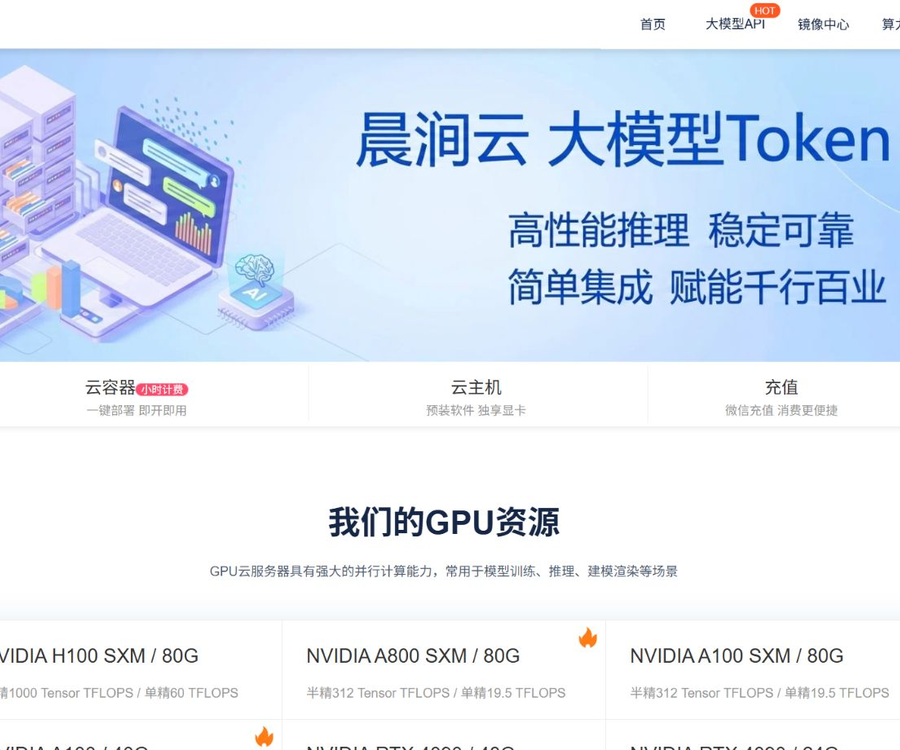
Morningside Clouds
A specialized cloud platform focused on high-performance GPU computing services, with the core philosophy of \"efficient computing power and easy access to AI.\" It offers end-to-end computing solutions for various enterprises and developers, covering tasks such as model training, inference, and modeling and rendering, and this is made possible by its extensive resources...
Tags:AI learning websitesWhat is Chenjian Cloud?
Chenjian Cloud is a computing platform that offers GPU computing power leasing, cloud containers, cloud servers, as well as APIs for large models.
It is primarily designed for AI training, model inference, scientific computing, 3D rendering, and generative AI applications.
Main services
- Rent different models of NVIDIA GPUs as needed.
- Create a lightweight Ubuntu cloud container.
- Rent Windows, Ubuntu, or CentOS cloud servers.
- Select the image pre-installed with deep learning and AI applications.
- Connect to the instance via JupyterLab, SSH, or WebUI.
- Dynamic discounts are available based on week, month, number of GPUs, and configuration.
- Call the large-model APIs of multiple manufacturers.
- Apply for complete systems, multi-card solutions, and enterprise customization services.
Which GPUs are supported?
The official website currently displays data center cards and consumer-grade high-performance graphics cards.
- NVIDIA H100 SXM 80GB.
- NVIDIA A800 SXM 80GB.
- NVIDIA A100 80GB and 40GB.
- RTX 4090: 48GB and 24GB.
- RTX 3090 24GB.
- RTX 3080 20GB.
- RTX 3060 12GB.
The specific inventory, video memory, nodes, and available quantities change in real time; the information shown on the instance creation page is the authoritative one.
The difference between cloud containers and cloud hosts
| Project | Cloud containers | Cloud hosting |
|---|---|---|
| Operating system | Based primarily on Ubuntu | Windows, Ubuntu, CentOS |
| Connection method | SSH, JupyterLab, Application WebUI | SSH, Remote Desktop, WebUI |
| Billing | Some GPUs support automatic renewal on an hourly basis. | Rent by day, week, month, etc. |
| Environment | Lightweight and flexible image switching | Exclusive access to a full operating system |
| Suitable scenarios | Training, inference, Notebooks, and service deployment | Graphical interface, fixed environment, and long-term tasks |
Features of cloud containers
Cloud containers are suitable for developers who are familiar with the Linux command line and need to switch between different frameworks and images quickly.
- The system drive has a fixed capacity and comes pre-installed with certain services.
- Data disks come with a basic amount of free storage by default.
- The data disk can be scaled out as needed.
- Resetting the image will clear the system drive.
- The content of the data disk is usually retained when the image is reset.
- After an instance is taken offline, the disk is retained by default for one week.
Features of cloud servers
Cloud hosts offer a dedicated operating system, making them suitable for tasks that require a remote desktop or a fixed environment.
- It is compatible with the Windows 10 environment.
- Multiple Ubuntu versions are supported.
- It supports the CentOS operating system.
- For a single card, different CPU and memory specifications can be selected.
- Multi-card instances have their supporting resources increased based on the number of cards.
- The default disk and retention period are determined by the creation page.
Pre-installed environments and images
The platform offers a variety of deep learning frameworks, model tools, and images of generative AI applications.
- PyTorch and TensorFlow.
- CUDA, cuDNN, and the Anaconda environment.
- ComfyUI and Stable Diffusion.
- LLaMA Factory and vLLM.
- Ollama and Open WebUI.
- Whisper – text-to-speech conversion.
- YOLO, GROMACS, and LAMMPS.
- Flux and other image generation workflows.
The mirror version will be updated; it is necessary to check the compatibility of CUDA, drivers, Python, and frameworks before creation.
Morning Gully Cloud Usage Tutorial
- Register an account and complete the identity verification required by the platform.
- Clarify the scenarios for training, inference, rendering, or application deployment.
- Select the GPU model based on video memory and computational precision.
- Compare the system and billing methods of cloud containers versus cloud hosts.
- Select the number of CPUs, memory, disks, and GPUs.
- Confirm the hourly, daily, weekly, or monthly rental fee.
- Select a system or pre-installed image that is compatible with the project.
- Create an instance and wait for its status to change to running.
- Log in via SSH, Remote Desktop, JupyterLab, or WebUI.
- Upload the code and data and verify the GPU environment.
- Run tasks while monitoring video memory, disk space, and balance.
- After the task is completed, back up the data and stop or release the instance.
How are GPU instances billed?
The price for renting a GPU is not a fixed figure; it is determined based on the combination of resources and the duration of the rental.
| Charging factors | Impact | Verify the location |
|---|---|---|
| GPU model and quantity | Decide on the main cost factor related to computing power | Create Instance Page |
| CPU and memory specifications | High-performance configurations come at a higher cost. | Instance specifications |
| System drive and data drive | Scaling up will increase storage costs. | Disk configuration |
| Nodes and inventory | Prices may vary across different resource pools. | Computing power market |
| Rental duration | Discounts may be available on weekly and monthly rentals. | Billing method |
| Number of cards | There may be additional discounts for four-card and eight-card options. | Order page |
As of August 30, 2026, the specific amount related to GPUs will be determined based on the final order after the real-time configuration is completed.
Automatic renewal on an hourly basis
Some cloud container GPUs support hourly billing, with automatic renewal as long as there is sufficient balance.
- The cost for the first hour is deducted at the time of creation.
- Thereafter, the cost for the next hour is deducted every hour.
- The cost includes resources such as GPU, CPU, memory, and disk.
- The instance will be automatically shut down when the balance is insufficient.
- When it is not in use, the instance must be stopped manually from the console.
- After active termination, the current lease period will be reset to zero.
Weekly and monthly rentals, as well as discounts for multiple cards
- A weekly discount is available for rentals longer than one week.
- A monthly discount is available for leases lasting more than one month.
- Monthly discounts are usually higher than weekly discounts.
- There may be a quantity discount for single-instance configurations with four or eight cards.
- The multi-card discount can be combined with the duration discount.
- Memberships, coupons, and promotions can also continue to be added on top of each other.
Discounts and promotions are time-limited; before making the payment, it is necessary to check the original price, the discounts applied, and the final amount due.
Large model API
Chenjian Cloud also has a model API market that offers, in a unified manner, dialogue, tooling, and visual models from various manufacturers.
The following shows the price per million Tokens as displayed on the official pricing page as of August 30, 2026.
| Model | Input price | Output price | Page discount |
|---|---|---|---|
| gpt-5.3-codex | 2.45 yuan | 19.60 yuan | Official price: 50% off |
| Claude Opus 4.6 | 21 yuan | 105 yuan | Official price: 40% off |
| DeepSeek R1 0528 | 3.20 yuan | 12.80 yuan | Official price: 20% discount |
| Gemini 3.1 Pro Preview | 4.20 yuan | 25.20 yuan | Official price: 30% off |
| GLM 5.1 | 4.80 yuan | 19.20 yuan | Official price: 20% discount |
| Kimi K2.5 | 3.20 yuan | 16.80 yuan | Official price: 20% discount |
| MiniMax M2.7 | 1.68 yuan | 6.72 yuan | Official price: 20% discount |
| Qwen 3.6 Plus | 1.80 yuan | 10.80 yuan | Official price: 10% discount |
The model’s availability, name, discounts, and unit prices change frequently; it is necessary to refer to the API console before making any calls.
How to choose a model API
- The encoding task compares the code model with the context length.
- Complex reasoning compares accuracy, latency, and output cost.
- The visual task recognition model supports image input.
- The tool call confirmation interface specifies the format and functional capabilities.
- Batch tasks calculate input and output tokens simultaneously.
- Preview models should not be used directly for critical production tasks.
Precautions for API integration
- Create a separate token from the official console.
- Do not write tokens to the web frontend or public repositories.
- Different keys are used for the testing and production environments.
- Set thresholds for balance, rate, and abnormal calls to trigger alerts.
- Check the interface compatibility format and model ID.
- Conduct quality and cost regression tests before switching models.
Top-up and refunds
Chenjianyun uses a prepaid billing system; charges continue to be deducted even when no actions are taken, as long as resources are being used continuously.
| Project | Rules |
|---|---|
| Refundable balance | Total historical top-ups minus total historical purchases |
| Free gift with top-up | The refund is calculated based on the actual amount paid before the gift was given. |
| Amount with invoices issued | Non-refundable |
| Online instance | Continuous use of resources can still incur costs. |
| Offline payment | Time is needed for the funds to arrive and to be verified. |
Before applying for a refund, it is necessary to stop using the resources, back up the data, and check the invoices as well as the records of actual expenses.
Disk and data retention
The system drives, data drives, and retention periods after decommissioning vary among different products.
- After a cloud container is discontinued, the disk is usually retained for one week.
- The documentation for cloud servers indicates that a default retention period of 15 days applies.
- Resetting the image may erase the system drive.
- It is necessary to download the critical data before releasing or stopping an instance.
- Expanding disks and extending retention may incur additional costs.
- Data that is deleted after expiration cannot usually be recovered.
Security configuration recommendations
- Only the external network ports necessary for business operations are opened.
- Log in using a strong password and SSH key.
- Do not save API keys in plain text within the Notebook.
- Regularly update the system and apply security patches.
- The training data is encrypted and backed up according to its sensitivity level.
- Public network services are configured with authentication, rate limiting, and access logging.
Mining of virtual currencies is strictly prohibited.
The platform explicitly prohibits the use of cloud servers, containers, and other computing resources for any form of cryptocurrency mining.
- It is not allowed to install or run mining programs and scripts.
- It is not allowed to circumvent the platform’s detection of abnormal computing power.
- The account shall not be subletted or allowed to be used by third parties for mining.
- Violations may result in a temporary suspension or permanent ban of the account.
- The platform may freeze the balance and charge a penalty fee.
- Clues related to possible illegal activities may be transferred to the relevant authorities.
Open-source status
As of the time of verification, no official open-source repository for the complete version of the Chenjian Cloud platform was found.
Open-source projects such as ComfyUI and Ollama provided in the image come with their own licenses; this does not mean that they are part of the Chenjian Cloud open-source portfolio.
- The images provided by the platform fall under the category of computing power and environment services.
- Users must still comply with the licenses of the software contained within the image.
- There may be separate commercial restrictions on model weights.
- API compatibility with open formats does not mean that the server side is open source.
Which users are it suitable for
- Algorithm engineers who train and fine-tune models.
- The development team that runs the large-model inference services.
- Creators who use ComfyUI and Stable Diffusion.
- Universities and research institutions that conduct scientific computing.
- AI startup teams that need short-term multi-GPU computing power.
- Developers who wish to make unified calls to multiple model APIs.
Product advantages
- Covers data center cards and various consumer-grade GPUs.
- Cloud containers and cloud servers cater to different operating habits.
- Pre-installed with common AI frameworks and application images.
- Hourly, weekly, monthly, and multi-card billing are more flexible.
- It offers large-model APIs as well as enterprise-level solutions.
- The official documentation covers the deployment and operation processes.
Usage restrictions and precautions
- GPU prices vary depending on configuration, inventory, and promotions.
- Hourly billing is automatically renewed when there is sufficient balance.
- Stopping an instance may void the remaining rental period.
- Data after being taken offline is retained for only a limited time.
- The prices of model APIs and the list of models change quite frequently.
- The platform strictly prohibits any form of virtual currency mining.
- It has not been confirmed that the entire Morning Brook Cloud platform is open source.
Frequently Asked Questions
What services does Chenjianyun mainly provide?
It offers GPU cloud containers, cloud servers, AI images pre-installed, whole-machine rentals, as well as APIs for large models from various manufacturers.
Which GPUs are supported by Chenjianyun?
The official website lists models such as H100, A800, A100, RTX 4090, 3090, 3080, and 3060.
How much does it cost to rent Cloud GPU from Chenjian?
The price is dynamically calculated based on the GPU, CPU, memory, disk, number of nodes, number of cards, and rental period, as indicated on the order page.
What is the difference between cloud containers and cloud servers?
Cloud containers are lighter in weight and support hourly billing, while cloud servers offer complete, dedicated operating system environments such as Windows.
How long are the data retained after an instance is stopped?
Cloud containers are typically retained for one week; the documentation on cloud servers indicates around 15 days, with the rules specified on the instance page being the final authority.
Can Chenjian Cloud be used for mining?
No, the platform explicitly prohibits cryptocurrency mining; violations may result in service suspension, freezing of balances, and liability for breach of contract.
Is Chenjianyun an open-source platform?
No official open-source repository for the complete platform was found; the open-source software contained within the images does not imply that the platform itself is open-source.
Tools similar to Chenjianyun

 Guigong Network Security Registration No. 45132202000164