






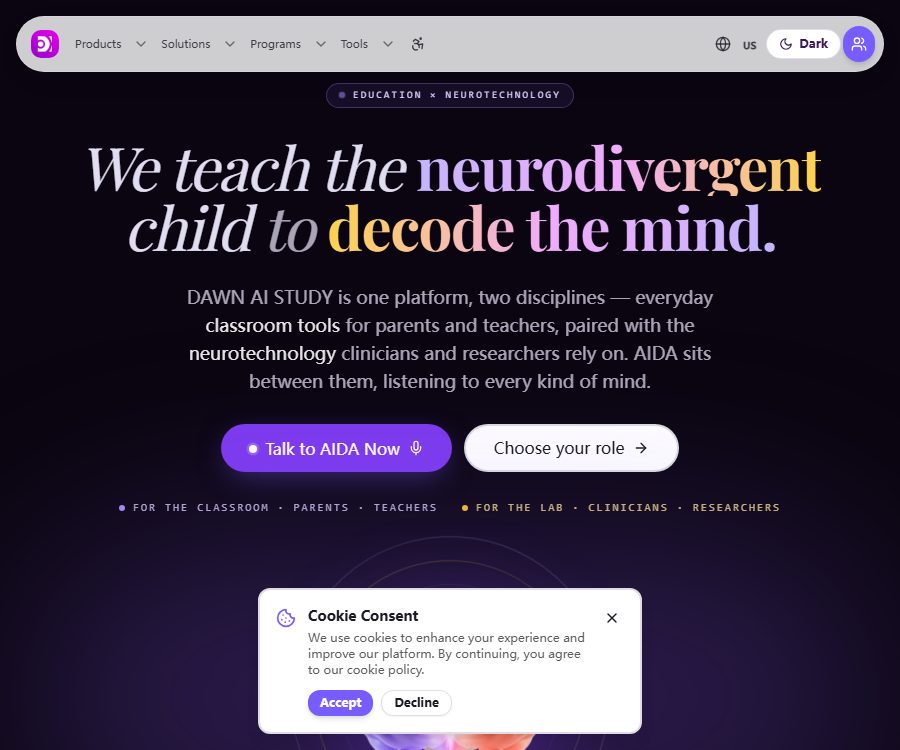
DAWN AI STUDY
DAWN AI STUDY: makes it more efficient and simpler for AI to learn and work.
Tags:AI learning websitesWhat is DAWN AI STUDY?
DAWN AI STUDY is a neuro-inclusive education and screening platform operated by DAWN Holdings Inc., intended for learners, parents, teachers, schools, clinical teams, and researchers. Its core agent, AIDA, uses its proprietary DAWN-NFM model to transform information gathered from family settings, classrooms, and clinical observations into actionable learning support resources.
AIDA is a screening and decision-support tool, not a medical or psychological diagnostic service. The risk levels generated, the NeuroProfile results, and the recommendations all carry a degree of uncertainty; therefore, when making decisions related to diagnosis, educational placement, employment, or legal matters, they must be reviewed by qualified professionals.
The main functions of AIDA
- Multimodal observation: It takes in speech and prosody, textual descriptions, visual observations, behavior logs, cognitive tasks, and psychometric results, in order to analyze learning performance from multiple perspectives.
- NeuroProfile: It analyzes cognitive strengths, attention patterns, learning rhythms, emotions, and patterns of engagement, and provides recommendations regarding visual, auditory, or hands-on learning methods.
- Support for early screening: It helps to identify signs related to reading, attention, social communication, sensory processing, and executive functions, but it does not provide diagnostic conclusions that can replace professional evaluations.
- Ongoing support: Through daily reminders, emotional check-ins, behavior tracking, and periodic insights, a single screening is transformed into a long-term support program.
- Role-based outcomes: The same observation can generate recommendations for parental actions, classroom strategies for teachers, views on school interventions, and structured snapshots for clinical professionals.
What can different roles do?
| Characters | Main tools | Typical results |
|---|---|---|
| Parents or guardians | Short dialogue screening, child records, behavior logs, AI support for parents, and family planning | Basic or comprehensive NeuroProfile, weekly reminders, shareable reports |
| Teacher | Three-tier curriculum plan, AIDA collaborative teachers, learner roster, IEP or 504 draft | Standard, adjusted, and enhanced version of the curriculum, classroom support suggestions, and information for parents |
| school | Batch rosters, management console, classroom heat maps, and inclusivity metrics | Class-crossing intervention views, trends, and project-level reports |
| Clinical staff | Screening, session records, SOAP, reports, multi-disciplinary consultations, and consent management | Clinical support documents, FHIR exports, PHI audit records |
| Developer | AIDA API, sandbox, text or multimodal calls, and webhooks | Evaluation, archival reasoning, content adaptation, and integration of voice capabilities |
How to carry out a screening and support process
- Choose a role such as parent, teacher, clinical professional, or another, register an account, and complete the setup of the identity or permissions corresponding to that role.
- When used by minors, consent must be given by parents, guardians, schools, or healthcare professionals; children under 13 can only use it through supervised accounts or schools that have signed data protection agreements.
- Age, academic performance, attention, communication skills, sensory abilities, emotions, and daily routines can be described using voice, text, or available visual methods; cognitive or psychological assessment tasks can also be carried out.
- Read the NeuroProfile, strengths, challenges, support levels, and learning recommendations generated by AIDA, and switch to a parent, teacher, or clinical perspective to view different interpretations.
- High-risk signals are reviewed by qualified educators or clinical professionals, who then decide whether to adjust classroom strategies, continue monitoring, or refer the case for a formal assessment.
- Changes are continuously recorded through behavior logs, mood checks, weekly reports, and sharing permissions; the support plan is regularly updated, and data access that is no longer needed is revoked.
Parents and Teachers Package
| Package or version | Price | Billing cycle | Core benefits or quota | Suitable for users |
|---|---|---|---|---|
| Spark | 2,000 Nigerian Naira | Monthly | 1 child, basic profile, 20 AIDA messages per month, weekly reminders | The family experiencing it for the first time |
| Care | 4,500 Nigerian Naira | Monthly | 1 child, complete profile in PDF format, parental accompaniment, up to 12 assessments and 12 reports | Parents who provide ongoing support to a child |
| Care+ Family | 9,900 Nigerian Naira | Monthly | Up to 4 children, all Care features, family planning, priority response; up to 50 assessments and reports. | Families with multiple children |
| Teacher Free | Free | Long-term free quota | 1 classroom, up to 15 learners, 5 lesson plans per month, 20 collaborative messages per day | Trial for a single teacher |
| Teacher Pro | 4,500 naira or 45,000 naira | Monthly or annually | Single classroom with no limit on the number of learners; three-tier course plan, report export, and synchronization between parents and the LMS | Class teachers who are used frequently |
| Teacher Plus | 9,000 naira or 90,000 naira | Monthly or annually | Up to 3 classes, brand reports, and creator store features, including Pro capabilities | Tutors, micro-schools, and teachers for multiple classes |
Clinical, API, and institutional solutions
| Package or version | Price | Billing cycle | Core benefits or quota | Suitable for users |
|---|---|---|---|---|
| Clinician Solo Starter | 29 dollars | Monthly | 1 seat, up to 25 active cases, basic AI tools, and 20 AIDA reports | Independent clinical professionals |
| Practice Pro | 79 dollars | Monthly | 1 seat, no limit on active cases, diagnostic workstation, FHIR, PHI auditing, and 100 reports | Private practitioners |
| Clinic Team | 199 dollars | Monthly | 3 basic seats, team collaboration, role-based permissions, white labeling, and 500 reports | Clinics and health centers |
| API Free | Free | Monthly limit | 1,000 text mode calls, sandbox, and community support | Prototype developer |
| API Growth | 49 dollars | Monthly | 100,000 calls, full modal support, webhook functionality, priority support, and a 99.9% availability guarantee | Product Integration Team |
| Schools, hospitals, and enterprises | Custom quote | In accordance with the contract | Batch seats, SSO, integration with EHR or LMS, local deployment options, training and service levels | Institutions and high-capacity projects |
The platform displays the currencies based on the region; users in Africa usually pay in Nigerian naira, while in other regions the dollar may be used as the payment currency. Taxes, conversion rates, and local payment methods can vary. Subscriptions are renewed automatically, and any changes related to upgrades, downgrades, proportional billing, or cancellation must be confirmed again on the account summary page.
Rules for free access, funding, and refunds
- In addition to the free access provided for teachers and developers, parents can start with a short free screening or a 5-minute conversation; the specific tools and number of sessions available depend on the current benefits associated with their account.
- Low-income families that meet the criteria can apply for Sponsored Seats through their partners, while researchers and those working in public policy also have access via application processes or limited access programs.
- Paid features can be acquired through subscriptions or by using points, with payments processed by Paystack or local payment service providers; if a payment fails, access to those features may be reduced to the free version.
- The terms state that refunds will be processed on a case-by-case basis within 14 days of purchase, and this does not constitute an unconditional guarantee of refund; prior to submitting a request, it is necessary to keep the payment records and specify the unused amount as well as the issues involved.
- Cancellation must be completed by the next renewal date; whether access to paid services is lost immediately, whether billing is done on a proportional basis, and how unused credits are handled are all specified on the account page.
Privacy, child data, and security
- The platform collects children’s names, ages, genders, answers to assessments, parents’ contact information and general location, as well as teachers’ identities, classroom details, course materials, and learner records.
- Learners may submit audio clips, text, feedback on expressions, and preferences related to accessibility; the device used, browser, web address, region, language, and session duration are also recorded.
- Minors require the consent of a guardian, school, or healthcare professional; the privacy policy specifies that two verification steps are required – using a guardian’s email address and submitting a digital declaration – before any child data is collected.
- Users retain ownership of the files, notes, observations, recordings, and screening data they upload; without an explicit and revocable choice to participate, such content will not be used for training DAWN-NFM.
- The platform states that AES-256 is used for static data, TLS 1.3 is employed for data transmission, and multi-factor authentication, role-based access control, row-level security, as well as access logs for clinical records are in use.
- The SOC 2 Type II assessment is still in progress, and the security page states clearly that these controls are based on the operator’s own statements rather than independent verification; when a contractual guarantee is required, it is necessary to obtain a data processing agreement, business partner agreements, and a list of subcontractors.
Data saving and deletion
| Data type or status | Public saving rules | Actions that users can take |
|---|---|---|
| Active account data | Retained for 5 years from the last activity | It is possible to request access, correction, restriction, export, or premature deletion. |
| Inactive accounts | Deleted after 12 months of inactivity | Confirm the reports and records that need to be saved before deletion. |
| Guardian consent record | Retain for 7 years | The consent for subsequent processing can be withdrawn, but the legal records need not be deleted immediately. |
| Camera behavior observation | If you choose to join, the page states that videos will not be saved. | You can exit at any time and switch to text, voice, or other methods. |
Language, Platform, and Integration
- The platform uses a web-based workspace as its main entry point, and it has been designed to work well on mobile devices, in environments with limited data connectivity, via messaging channels, and for synchronization after being offline.
- The page lists local language options such as Yoruba, Igbo, Hausa, Swahili, and Zulu, and also emphasizes accessibility features such as voice input, text reading aloud, keyboard navigation, and reduced motion.
- The teacher plan includes synchronization with Google Classroom, Teams, Canvas, and Moodle; the clinical and institutional plans may involve FHIR, EHR, SSO, and local deployment.
- The privacy policy covers mobile applications, but it was not confirmed that there is a separate listing page for such applications on the operator’s App Store or Google Play.
API and open-source status
AIDA API offers free and Growth packages that include capabilities for document inference, content adaptation, as well as text, voice, and multi-modal processing; however, the available information regarding the full set of endpoints, SDKs, and licensing details is not sufficient at present. DAWN-NFM, the platform’s code, and related brand assets are all proprietary, and no official GitHub repository or open-source version has been found.
Suitable for users and typical use cases
- Parents: Organize long-term, cross-scenario observations of their children’s learning, and obtain structured records that facilitate communication with schools or professionals.
- Teacher: Rewrite the same teaching objectives into courses with varying levels of support, and provide learners with suggestions for adapting to the classroom environment.
- Schools and non-profit organizations: Manage screening, support, and aggregation metrics for multiple classes or projects, while controlling the visibility range.
- Clinical team: Assists with data collection and observation, document preparation, and inter-role communication, but cannot use the model’s outputs as a direct basis for diagnosis.
- Developers: Integrate neural inclusivity assessment and content adaptation capabilities into education, health, or human resources-related products, and take responsibility for application-layer security as well as manual review.
Frequently Asked Questions
Can AIDA diagnose ADHD, dyslexia, or autism?
No, AIDA only provides screening signals, information organization, and decision support. A formal diagnosis must be made by qualified professionals based on a comprehensive assessment.
Can children register and use it on their own?
Those under 18 years of age require the consent of their parents, guardians, schools, or clinical staff, as well as supervised care in accordance with relevant regulations. Children under 13 can only use the service through an adult’s supervising account or at schools that have signed data protection agreements.
Will the uploaded data be used to train the model?
The terms state that content will only be used for training DAWN-NFM if the user explicitly chooses to do so and that choice can be revoked; users should still avoid submitting data belonging to third parties for whom they do not have legitimate permission.
Is the free version suitable for long-term use?
The free version allows users to carry out basic screenings, use single-classroom setups or API sandboxes, but there are limits on the number of children, the number of course plans, as well as on messages and the number of calls that can be made. For long-term tracking or institutional collaboration, a subscription or funding application is usually required.
Does DAWN AI STUDY have an API?
Yes, the free plan provides 1,000 text processing requests per month, while the Growth plan offers 100,000 such requests along with multimodal capabilities. Full access to the APIs, data areas, and production services can be checked in the developer account.
Have SOC 2 and HIPAA certifications been obtained?
The page indicates that SOC 2 Type II is in progress, and the clinical version is described as HIPAA compliant; it should not be stated as having completed certification. Before handling protected health information, the relevant agreements must be signed and the organization’s own compliance assessment must be carried out.
Summary
DAWN AI STUDY is characterized by its integration of neural diversity screening, family support, differentiated teaching methods, and clinical collaboration within a role-based platform. Its value depends on consistent and compliant data recording as well as professional review; AI-generated outputs cannot replace diagnoses or decisions regarding a child’s educational path.
Tools similar to DAWN AI STUDY
 Guigong Network Security Registration No. 45132202000164