






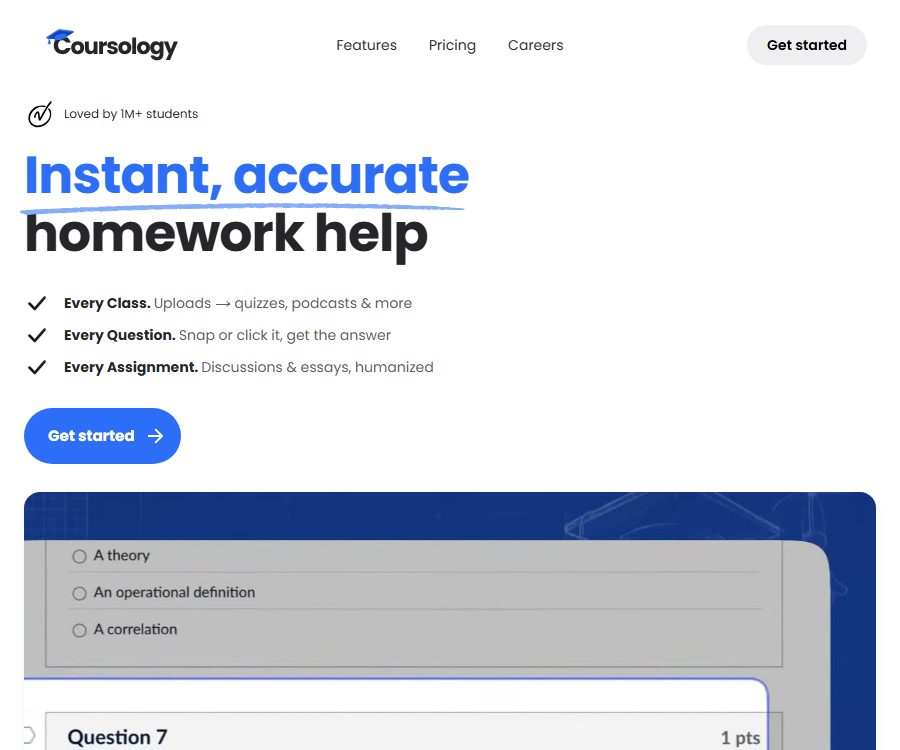
Coursology
Coursology: makes it easier and more efficient for AI to learn and work.
Tags:AI learning websitesWhat is Coursology?
Coursology is an AI-based learning platform developed by Coursology LLC, designed for students who need to understand course materials, organize lectures, practice relevant concepts, and find ideas for assignments.
The products are available for web use, as Chrome extensions, as well as for iPhone and Android; they bring together functions such as photo-based question searching, Q&A related to course materials, transcription of recordings, quizzes, flashcards, podcasts, and essay editing under one account.
Main functions
Taking photos, taking screenshots, and solving problems with text
- On mobile devices, it is possible to take photos of questions related to subjects such as mathematics, biology, chemistry, geometry, physics, and history, and the system will provide the answers along with step-by-step explanations.
- Chrome extensions support three methods of capture: buttons, area screenshots, and text selection; they allow answer pop-ups to appear on web pages so that further questions can be asked.
- The absence of charts, formulas, blurry photos, and problem conditions reduces the quality of identification and reasoning; it is necessary to check the original problem and each step before submitting answers.
Upload course materials
- The training set can accept files in TXT, DOC, DOCX, PDF, MP3, and MP4 formats; it is also possible to include public web pages, YouTube content, or recordings of live courses.
- The maximum size for a single document is 50 MB; once the files are uploaded, they can be converted into chatbots, interactive quizzes, flashcards, and smart notes.
- Only textbooks, lecture notes, and recordings that you have the right to use should be uploaded; classroom recordings must also comply with the school’s policies, local laws, and the consent of the participants.
Course Q&A and learning tools
- Ask Your Materials allows you to ask questions based on the content uploaded, and the responses are more likely to be relevant to the specific course materials compared to regular conversations.
- Quizzes offer practice and immediate feedback; flashcards are suitable for memorizing terms, while mind maps help to visualize the hierarchy and relationships between concepts.
- AI Podcasts can convert data into audible content, and the mobile version allows for offline listening after downloading.
Lecture recordings and notes
- AI Notetaker can record lectures and produce transcripts as well as organized notes, which are useful for reviewing the course structure and key points.
- Audio transcription is handled by third-party voice services, and accents, noise, multiple speakers talking at the same time, and technical terms can lead to errors.
- Creating notes cannot replace attending the lectures in person or checking the original recordings; when it comes to the topics covered in the exams, it is necessary to compare them with the materials provided by the instructor.
Editing of papers and discussion posts
- The editor can create discussion posts or drafts of papers, automatically complete the next sentence, and continue to make revisions in accordance with the writing requirements.
- Users can upload PDF, DOC, or DOCX files they have created as style examples, so that new drafts better reflect their personal style.
- The search and citation feature allows users to find materials that can be used as references for the selected arguments, supporting formats such as MLA, APA, Chicago, IEEE, and Harvard.
Humanizer and AI detection
- Humanizer rewrites the AI draft and shows a score indicating its naturalness or the results of the analysis; the user can then review the revised version before deciding whether to adopt it.
- Any statement indicating “passing the test” does not guarantee a consistent result when using GPTZero, Turnitin, or other detection systems.
- Using the rewriting feature to conceal unauthorized help with assignments or to circumvent course rules can constitute academic misconduct and result in disciplinary action by the school.
Input and output
| Functions | Enter | Output | Suitable for tasks |
|---|---|---|---|
| Search for questions on mobile | Camera photos or images | Answer and step-by-step explanation | Check the approach to the exercises |
| Browser extensions | Issues with screenshots, selecting text, or pages | Answers, explanations, and follow-up questions | Review of web-based courses and online assignments |
| Data training set | Documents, audio and video files, web pages, or video content | Chats, quizzes, flashcards, and notes | Chapter review and practice before exams |
| Lecture notes | Real-time or recorded audio | Transcription, summaries, and study notes | Class Review |
| Writing editor | Topic requirements, drafts, materials, and style examples | Discussion threads, papers, completions, and citations | Writing assistance and formatting |
Usage process
- Register an account and choose a website, a Chrome extension, or a mobile app; first, confirm the scope of AI use permitted by your school.
- Take a photo of a question, or create a learning set and upload course materials, web pages, videos, or recordings.
- Check the questions, files, and course context identified by the system, and avoid using answers directly when the necessary conditions are not met.
- Learn using Q&A, quizzes, flashcards, podcasts, or note-taking functions, and then explain the key steps in your own words.
- In the writing task, first read the original material; using drafts, suggestions for completion, and citations, verify one by one whether each citation truly supports the argument.
- Before submission, complete checks for facts, calculations, citations, academic integrity, and personal expression, and keep track of your learning process.
Suitable for users and scenarios
- High school and university students: Understanding practice questions, preparing for tests, and reviewing course materials.
- Those who need lecture notes: Convert lecture recordings into transcripts, summaries, and review-ready notes.
- Visual learners: Organize concepts through flashcards, quizzes, and mind maps.
- Students in the writing course: organize discussion posts and essay structures, find citations, and check the wording.
- Mobile learning users: Take photos of questions on their smartphones, continue with quizzes, and synchronize learning materials.
Price packages
Coursology Pro currently offers monthly and annual subscription options, both of which grant access to all features. The so-called “unlimited” access is still subject to a daily fair use limit; the specific value for that limit has not yet been disclosed.
| Package or version | Price | Billing cycle | Core benefits or quota | Suitable for users |
|---|---|---|---|---|
| App download | Free download and installation | None | Includes in-app purchases; a free installation does not mean that all features will remain free forever. | View application and account entry points |
| Pro monthly plan | 24.99 dollars | Automatic monthly renewal | All features; subject to an undisclosed daily fair use limit. | For short-term or single-semester use |
| Pro annual plan | 149.99 US dollars | Automatic renewal every year | The page costs 12.50 USD per month; all features are available; subject to fair use policies. | Need for continuous learning |
In-app purchases for the iPhone may also show options for weekly or annual payments, as well as different prices depending on the seller; prices can vary based on region and promotions. It is necessary to check the total amount that will be deducted, the payment frequency, and the platform through which the subscription is managed before making a purchase.
Renewal, cancellation, and refunds
- Subscriptions are automatically renewed by default, and it is necessary to cancel them before the end of the current billing cycle; the cancellation takes effect at the end of that cycle.
- The terms state that no refunds are available for any purchases, and the help center does not offer account refunds either; therefore, if a purchase is made by mistake, it should not be assumed that the money can be refunded.
- Subscriptions purchased through Apple or Google channels usually need to be managed in the respective store, while those purchased via a website are handled through the account.
- The presentation of monthly and annual pricing is different; although the annual plan page shows the average monthly price, in reality a fee of $149.99 may be charged upfront for the entire year.
Platform comparison
| Platform | Key capabilities | Input method | Precautions |
|---|---|---|---|
| Web page | Learning set, Q&A, writing, podcasts, and learning tools | Files, links, recordings, and text | An account and an internet connection are required. |
| Chrome extensions | Page issue detection, step-by-step answers, and discussion posts for assistance | Screenshot, selected text, and page content | Some websites may block the use of extensions. |
| iPhone | Take photos to solve problems, chat, record notes and synchronize. | Cameras, pictures, audio, and text | The prices for in-app purchases may differ from those on the website. |
| Android | Solve problems by taking photos, chat, and record notes | Cameras, pictures, audio, and text | The frequency of updates to store pages can vary. |
Model, API, and open-source status
- The AI service providers listed in the privacy policy include OpenAI, Anthropic, Amazon Bedrock, and Cohere; AssemblyAI is used for speech transcription.
- This only indicates the service providers to which the data may be sent; it does not mean that a specific model is used for every request. The exact models, routing methods, and versions are not yet made public.
- No public APIs, SDKs, official code repositories, or open-source licenses intended for developers were found.
- Chrome extensions and mobile apps represent the official clients, but the fact that these clients can be installed does not mean that their source code is available; Coursology should therefore be considered a closed-source hosting service.
Privacy and data processing
- Extended functions may handle selected text, screenshots, identified questions and discussion content, chat messages, uploaded files, audio, as well as generated results.
- AI service providers receive the content needed to complete the request, while AssemblyAI takes care of transcribing the audio recordings; the servers and files are primarily hosted on Google Cloud, Firebase, and Vercel in the United States.
- The additional details state that no complete browsing history or key press records are collected, and banking and financial websites are excluded; it is also mentioned that the extension only reads content on the course discussion pages where the user has activated this feature.
- Extended data is not used for personalized advertising, nor is it shared with advertising networks; the website itself can use analysis, marketing, and advertising cookies.
- Data is retained depending on its intended use or legal requirements; users can request access to it, request corrections or deletions, ask that its processing be restricted, or have it transferred. However, the specific duration for which course materials are stored is not yet available publicly.
- Encryption, access control, and other measures are used for transmission and storage, but no online service can guarantee absolute data security.
Content rights and academic integrity
- The platform’s content and trademarks are licensed only for personal, non-commercial use; additional permission is required for commercial training, bulk use by organizations, or redistribution.
- The course material instructions state that the uploaded content is intended solely as a learning tool for the users themselves and will not be sold; however, the terms grant the platform the right to use, store, display, copy, and distribute the quizzes and answers to assignments, and it may also be used in search functions available to the public.
- Do not upload confidential test questions, unpublished research, materials containing personal information about students, or textbooks that cannot be copied. Also, ensure that the handling of sensitive data is proper before using such content.
- The terms prohibit cheating, academic misconduct, and other improper behaviors, and require compliance with the rules of the learning management system and the school.
- The answers, citations, and test results provided by Coursology may be incorrect; students remain responsible for the content they submit, the accuracy of their citations, and any academic consequences that arise.
- The service is intended for users who are at least 13 years old; minors require permission from their parents or guardians and must be under their direct supervision.
Frequently Asked Questions
Can Coursology be used to take photos of problems and solve them directly?
Yes. iPhone and Android apps can capture questions and generate answers along with step-by-step explanations; however, image recognition or the verification of question details still requires manual checking.
What course materials can be uploaded?
TXT, DOC, DOCX, PDF, MP3, and MP4 are supported; public web pages, YouTube content, or course recordings can also be added. The maximum size for a single document is 50 MB.
Is Coursology free?
The app can be downloaded and installed for free, but full functionality is available through a Pro subscription. The current monthly fee is 24.99 dollars, while the annual fee amounts to 149.99 dollars.
Is there really no limit to such unlimited use?
No. The fair use policies for Pro and Write include daily limits; the platform may temporarily reduce the speed of or restrict access to accounts that consistently exceed these limits, though the specific figures have not been made public yet.
Can it be used to pass exams or write homework on someone’s behalf?
It should not be used in this way. The terms prohibit cheating and academic misconduct, and users must also comply with the specific rules set by the school, teachers, and the learning platform.
Does Coursology offer an API or open-source code?
No public APIs, SDKs, official code repositories, or open-source licenses have been found; the existing web pages, extensions, and mobile applications are all closed-source service clients.
Tools similar to Coursology

 Guigong Network Security Registration No. 45132202000164