






Compass AI
Compass AI – makes it easier and more efficient for AI to learn and work.
Tags:AI learning websitesWhat is Compass AI?
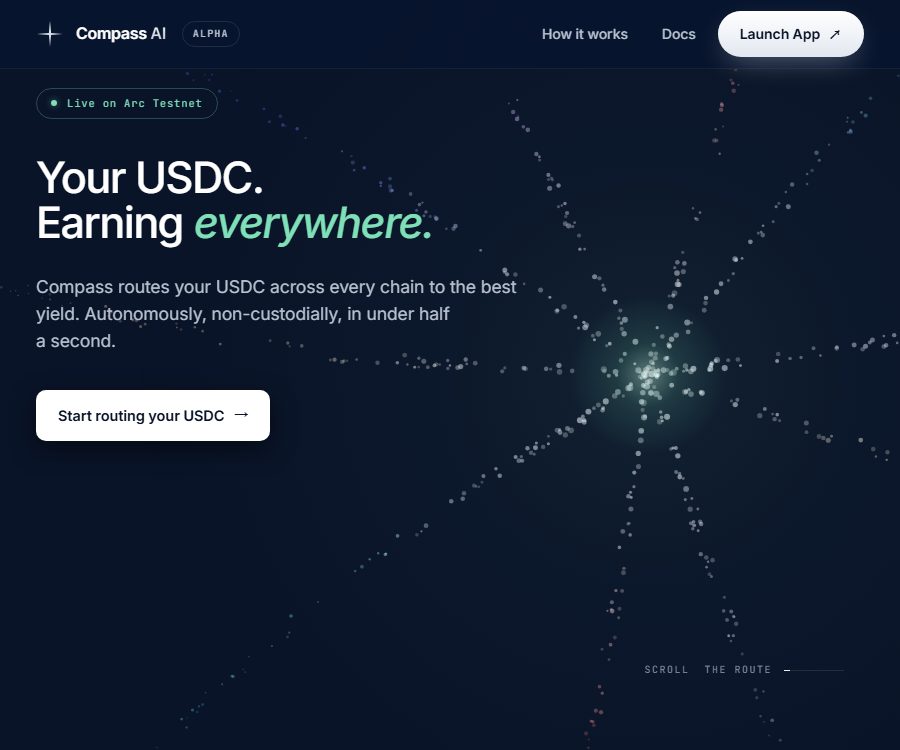
Compass AI is an unmanaged USDC yield routing experiment that operates on the Arc test network; its goal is to automatically adjust the location of funds within the parameters set by the user, including the chosen blockchain, protocol, risk level, and maximum amount. The user retains ownership of their wallet, while the agent carries out the permitted actions using a restricted session key, and it is not possible to transfer funds to any arbitrary address.
It is not a corporate financial analysis software with the same name, nor is it a robot that enables large language models to trade freely. The chat model merely converts natural language into structured plans; continuous monitoring, performance comparison, rule checking, and routing decisions are carried out by deterministic code.
Current status and important reminders
| Project | Current status | How should it be understood? |
|---|---|---|
| Internet | Arc Testnet | Only test coins are used; there is no real monetary value. |
| Main network | Not yet available online | The timeline follows the Arc mainnet schedule; no specific date has been given. |
| Contract audit | Not yet completed | The security model is a design goal, not an audit conclusion. |
| Multiple routing paths | The document is incomplete. | The marketing page presents the vision for multiple chains, but the list of supported chains shows that only the Arc test network is indicated as being available. |
| Protocol support | There are still items to be added to the list. | The status of deployment for platforms such as Aave, Morpho, Pendle, etc. is not yet confirmed. |
| Actual return | Not applicable | The test network interest rates and page examples do not reflect the returns that can be obtained. |
The technical documentation refers to the list of supported features as the basis for making decisions, and this list still includes various items with pending dates, chains, protocols, and risk scores. When using it, only those features that are available in the actual interface and can be tested on the test network should be considered usable; it is not possible to assume that mainnet or cross-chain capabilities are already available based on the animations on the home page.
Main functions
Natural language generation of routing plans
- Users can specify the amount, target chain, or target protocol in the chat interface; for example, they can deposit a small amount of test USDC into a lending platform that permits such deposits.
- Large language models only interpret intentions, ask for any missing information, and generate plans in a fixed structure; they do not sign transactions directly, broadcast them, or decide on ongoing rebalancing.
- The chain, protocol, and action fields are subject to allowed value restrictions; amounts are expressed as integers in microunits, and any plan involving fund transfers must be confirmed by the user.
- The system will also verify the balance, the amount entered, and the actual configuration; if corrections are made repeatedly and it still doesn’t work, it will request clarification rather than making assumptions on its own.
Rules on the chain and permission boundaries
- Users set a risk level ranging from 1 to 10, and the proxy can only select locations with a risk score that is not higher than that level.
- The protocol whitelist is configured based on the combination of protocol and chain; the chain whitelist allows funds to be transferred only to networks approved by the user.
- The maximum amount per route and the daily cumulative limit set constraints on the USDC that an agent can schedule; any plan that violates these limits will be rejected before it is executed.
- Rules can only be modified by the owner’s wallet; the session key of an agent cannot be used to expand the allowlist, increase limits, or change ownership.
Deterministic return assessment and rebalancing
- The global scheduler wakes up the evaluator for a specific account whenever there are changes in the revenue data, account status, or cross-chain intentions, rather than performing polling at fixed intervals.
- The Rust evaluator checks the current position, balance, rules, and earnings, and suggests a new route, maintains the existing one, or determines that no compliant route exists.
- The same input should produce the same output, which facilitates the replay of decisions; large language models are not involved in this high-frequency decision-making process.
- If there is an issue with the chain or indexer, the design specifies that operation should be paused or restarted, rather than continuing to send new routes when the status is unclear.
Smart accounts and owner withdrawals
- During the first connection, smart accounts based on EIP-2535 Diamond will be deployed on the Arc test network; other supported chains can also be deployed at the same address as needed.
- Agents can supply or withdraw positions under the whitelist protocol, and they can also initiate permitted cross-chain USDC transactions via Circle Gateway.
- Only the owner’s address has the authority to withdraw funds; the agent cannot transfer the money to another address, nor can they prevent the owner from withdrawing it.
- The upgrade permissions related to multi-signature control allow for the addition of new function selectors only; they cannot be used to replace the core security, ownership, and withdrawal logic. Users can revoke such upgrade permissions.
Audit Trail and Activities Panel
- Each evaluation generates a structured record that includes the reason for triggering it, the account status, a snapshot of earnings, potential routes, rule checks, and the results of execution.
- Evaluations for execution, rejection, and no action taken are all recorded, and users can view them in the timeline, individual position history, and rejection plan views.
- On-chain transactions can be verified independently using a block browser, but the complete record of the reasoning process is stored in Compass’ backend database; it is not encrypted and anchored on the chain.
- Records from the test network phase are said to be stored indefinitely, and account owners can export them in JSON format; the retention period for records on the main network has not yet been determined.
How do AI and deterministic code divide the tasks?
| Components | Responsible for content | Not responsible for the content. | Primary control |
|---|---|---|---|
| Chat agent | Understand instructions, ask for additional information, and produce a structured plan. | No signing, no continuous monitoring, no bypassing of rules | Fixed fields, entity verification, and amount validation |
| Scheduler | Evaluation is carried out based on earnings, accounts, and cross-chain events. | No decision has been made regarding the specific route. | Event-driven and pending intent protection |
| Rust evaluator | Compare compliant locations and propose routes. | It does not cause side effects directly. | Pure functions and reproducible inputs |
| Policy engine | Check risks, allowlists, and amount limits. | Do not modify user rules. | Off-chain verification and additional on-chain constraints |
| Session key | Sign agreements for limited-scoped calls | Withdrawals or the expansion of privileges cannot be carried out arbitrarily. | Contract-level functions and quota permissions |
| Owner’s wallet | Set rules, approve plans, and manage withdrawal and revocation permissions | Not controlled by the agent | Private key and owner signature |
Tutorial for using the test network
- Prepare a MetaMask, Rabby, or compatible EVM wallet; use only dedicated testing wallets, and do not reuse the main wallet in which real assets are stored.
- Open the test network app and connect your wallet; follow the instructions to add Arc Testnet, then verify the network name as well as the actions displayed in the wallet window.
- When using it for the first time, deploy the Diamond smart account and verify that the wallet address of the owner displayed is different from the address of the smart account.
- Apply for Arc Testnet USDC from the test coin faucet, and enter the receiving address as the smart account address – do not use a regular wallet address.
- Set the risk level, allowlists for chains and protocols, as well as the maximum amount per transaction and per day; then sign to embed these rules in the contract on the test network.
- Enter a small test amount and specify the goal in the chat box, check the chain, protocol, amount, and expected interest rate as planned, and then approve it manually.
- In the activity panel, verify the hash of each transaction, perform rule checks, and check the final position; also test the functions for pausing operations, exporting records, and making full withdrawals.
The document examples state that the entire process can usually be completed within one second, but the test network’s RPC, indexers, Gateway, and target protocols can all cause delays. When an operation is in the pending state, it should not be approved again; instead, it is necessary to first check the activity logs and transactions on the chain.
Input, output, and suitable use cases
| Enter | Processing | Output | Suitable scenarios |
|---|---|---|---|
| Natural language commands | Parse amounts, chains, protocols, and actions | Structured plan to be confirmed | Understanding agent interactions and plan verification |
| Risk level and allowlist | Chain-based policy checking | Allow or deny routes | Test programmable funding permissions |
| Test USDC | Smart accounts and protocol calls | Test network position and transaction records | Arc, Gateway, and account abstraction experiments |
| Revenue and account events | Deterministic reevaluation | Decisions on rebalancing, maintaining, or suspending | Study event-driven proxy architectures |
| Historical evaluation records | Export and Replay | JSON audit trail | Debugging rules and decision review |
- DeFi developers can study smart accounts, session keys, Circle Gateway, and the deployment of the same address across different chains.
- Researchers in agent systems can compare the hierarchical design in which “chatting is responsible for intent, while deterministic code is responsible for execution”.
- Security engineers can verify the implementation of the allowlist, amount limits, owner withdrawals, and revocable upgrade permissions.
- Ordinary users can only use it as a learning tool for testing purposes; it is not suitable for investing real money or aiming for stable returns.
Prices and fees
Compass AI does not disclose any information regarding subscription fees, platform charges, revenue sharing, Gas subsidies, or mainnet protocol fees. The current test network uses test USDC that has no real-world value; therefore, the concept of \"free added value\" mentioned in the database cannot be interpreted as indicating that the mainnet version will offer a free service.
| Package or version | Price | Billing cycle | Core benefits or quota | Suitable for users |
|---|---|---|---|---|
| Arc test network | Not yet made public | Not applicable | Connect the wallet, deploy test smart accounts, and use test USDC to verify the process. | Developers and research users |
| Main network version | Not yet made public | Not yet available online | The launch time, network, protocol, as well as costs and limits have not been determined yet. | Not available at the moment |
| Enterprise or API solutions | Not yet made public | Not yet made public | There are no formal business plans, service levels, or call quotas. | Teams waiting for official documents |
Even if no subscription fees are charged in the future, transactions on the blockchain, cross-chain operations, protocol calls, and slippage can still give rise to costs and risks. Any costs associated with the mainnet should be determined based on the transaction previews, contract details, and settlement guidelines available at that time.
Open source, APIs, and developer resources
| Project | Public status | Language | Licenses and instructions |
|---|---|---|---|
| Smart contracts | Public | Solidity | The warehouse is marked MIT and contains Compass contracts. |
| Frontend | Public | TypeScript | The warehouse is marked as MIT, but the hosting services and brand are not made available as a result. |
| Backend evaluator | Public | Rust | The warehouse is marked MIT and is used for multi-chain USDC routing. |
| Reference return agent | Public | Solidity is the main one. | The warehouse label MIT is a simplified example; it does not represent the complete product. |
| Document repository | Public | MDX | The warehouse does not indicate any license, so it cannot be assumed that reuse is permitted by default. |
| Public API or SDK | Not confirmed yet | Not yet made public | The document mentions trajectory queries, but there are no stable interfaces, authentication mechanisms, or version commitments. |
Multiple core code repositories are made public and labeled with MIT, indicating that the code can be used, modified, and distributed under the terms of that license. It does not guarantee that the test network deployment will be exactly consistent with the code, nor does it cover third-party agreements, Circle Gateway, trademarks, hosted data, or future mainnet services.
Security, privacy, and financial risks
- The contract has not yet been audited; there may be implementation flaws in the Diamond facet, session keys, upgrade permissions, CREATE2 deployment, and cross-chain processes.
- The non-custodial approach only addresses ownership and the design of withdrawal processes; it does not eliminate the risks associated with smart contracts, stablecoins, cross-chain systems, target protocols, oracles, and private keys.
- Chat-based transactions can still contain semantic errors; users must verify the chain, protocol, amount, and authorization. The policy engine serves as an additional layer of protection, but it does not eliminate the need for verification.
- Wallet addresses, transactions, and holding activities are public data on the blockchain; smart accounts cannot be considered anonymous accounts.
- The chat system records the user’s inputs and the structured outcomes, with a comprehensive assessment of the entire conversation stored in the backend database; do not include any mnemonics, private keys, or sensitive personal information in those inputs.
- Currently, no valid terms of service, privacy policy, legal entity, data deletion procedure, or scope of responsibility can be found; therefore, isolated wallets and non-sensitive data should be used during testing.
- The owner should first test suspending, revoking session keys, removing upgrade permissions, and performing all withdrawals, before assessing whether the security model is suitable for their risk tolerance.
Main limitations
- It is currently suitable only for the Arc test network; the test coins, sample annualization rates, and simulated returns cannot be applied to the real market.
- There is still a great deal of content that needs to be added to the documentation on chains and protocols; the networks such as Base, Solana, and Arbitrum listed on the home page cannot be considered as already operational.
- The protocol risk score is assigned manually by the team; the scoring methodology, frequency of updates, and mechanisms for dealing with conflicts of interest have not yet been made fully public.
- Deterministic assessment can only conduct comparisons within existing data, adapters, and rules; it cannot identify unaddressed risks, nor can it predict hacker attacks or divergence.
- The audit trails from the backend are not encrypted and anchored to the blockchain; records of rejections and no-action situations still rely on the operator to maintain them properly.
- The main network time, audit agencies, insurance options, customer service, fees, refund policies, and corporate support are not yet available publicly.
Frequently Asked Questions
Can Compass AI now be used with real USDC?
No. This document clearly indicates that it is the Arc test network; test coins are used there, which have no practical value, and the date for the launch of the main network has not yet been determined.
Will the chat model directly control the funds?
It does not sign or broadcast transactions directly; it merely organizes the user’s instructions into structured plans. These plans are then subject to rule checks, user confirmation, and constraints imposed by contract permissions.
Is there no risk associated with Compass AI when it is not hosted?
No. Non-hosted solutions do not eliminate contract vulnerabilities, cross-chain failures, stablecoin depegging, protocol attacks, improper authorizations, and private key leaks; moreover, the current contracts have not yet been audited.
Which chains and protocols are already supported?
Currently, only the Arc Testnet is listed as being available; the other chains and protocols are still marked as pending. The actual options available for use and the results of test transactions should be taken into account, rather than relying on the information presented on marketing pages.
Is Compass AI an open-source project?
The authorities have made available the frontend, the Rust backend, Solidity contracts, as well as simplified reference applications; the relevant code repositories are labeled under the MIT license. Hosting services, trademarks, third-party agreements, and documentation without a license are not included automatically.
Is it necessary to pay to use Compass AI?
There are currently no public subscription or pricing plans available, and the test network does not imply that the main network will be free in the future. Costs related to Gas usage, cross-chain transactions, protocols, and the platform itself will have to wait for official details on pricing.
Tools similar to Compass AI
 Guigong Network Security Registration No. 45132202000164