






PAI
PAI makes it possible for AI to learn and work more efficiently and simply.
Tags:AI learning websitesWhat is PAI?
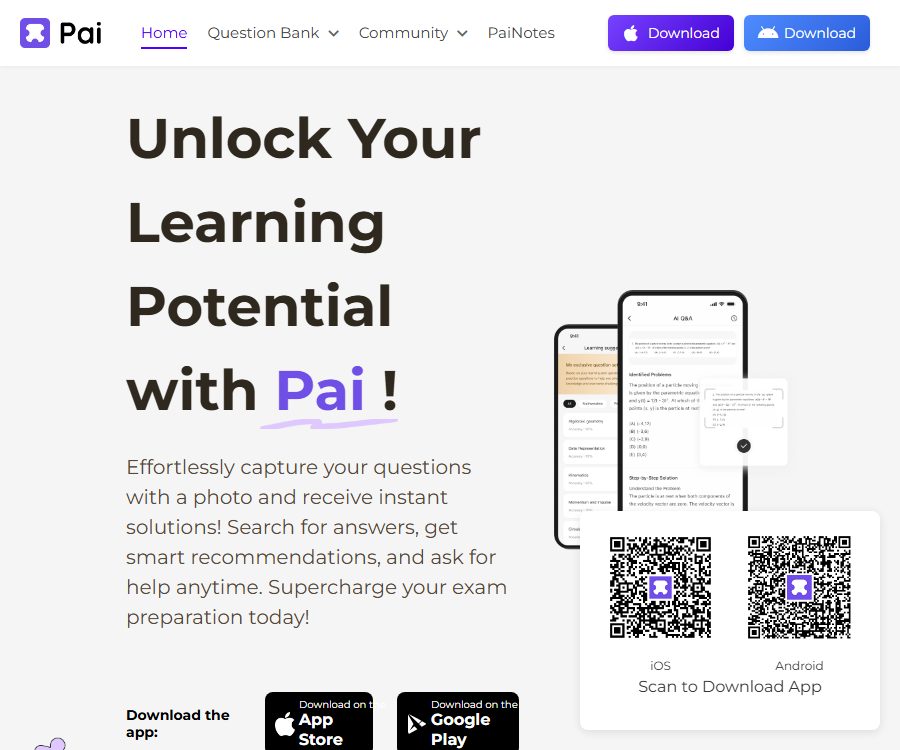
PAI is an AI-based application designed to assist students following international curricula with their homework and exam preparation; its full name as displayed in the app store is Pai: AP/Alevel AI Homework Helper. Users can take photos of questions to get answers, as well as browse question banks and carry out personalized practice exercises.
It covers mainly curriculum systems such as AP, A-Level, IB, IGCSE, CIE, and DSE; it has no connection with shopping, logistics, or corporate AI products that share the same name. The application is provided by the Singaporean company PERSONAL ASSISTANT INTELLIGENCE PTE. LTD.
A one-sentence summary
PAI is a mobile AI learning assistant that supports solving problems by taking photos, providing step-by-step explanations, and offering practice with real questions from international courses.
Main functions
Solve problems by taking photos
After students take photos of their assignments or test questions with their smartphones, AI identifies the questions and generates answers along with explanations. Clear framing, complete question statements, and accurate formulas enhance the quality of recognition.
Step-by-step explanation
The application emphasizes providing a step-by-step process rather than just the final answer. Students should verify formulas, units, and reasoning step by step, avoiding copying incorrect steps directly into their assignments.
International curriculum question bank
The official website claims to offer more than 200,000 real exam questions covering various international curricula and examination systems. The question bank can be browsed by AP, IGCSE, CIE, AS and A-Level, IB, and DSE.
Personalized practice
The system recommends daily exercises based on the student’s progress and areas of weakness, to help them focus their training. These recommendations serve only as suggestions for practice and cannot replace the school’s curriculum plan.
24/7 AI Q&A
Students can ask the AI at any time for explanations of concepts, step-by-step guidance, and learning suggestions. In cases related to examination policies, course changes, and official grading, the rules set by the examination authorities and the school shall prevail.
Community and learning content
The website offers categories such as exam preparation, university applications, and campus life; users can post questions and comments. Publicly available content can be seen by other users and search engines, and it should not contain personal information or sensitive data related to schools.
PaiNotes connection
The PAI official website links to PaiNotes, and its privacy policy and terms of service are also hosted under the PaiNotes domain. Users should read through the rules regarding accounts, content, and data that may be shared between these two services.
Supported curriculum systems
| Courses or exams | Primary uses | Usage suggestions |
|---|---|---|
| AP | Practice for American college prep courses | Check the year and question types according to the subject outline. |
| AS and A-Level | International high school curricula and exams | Confirm the examination board and subject code |
| IB | International Baccalaureate Programme | Distinguish between SL, HL, and the current curriculum. |
| IGCSE | International secondary school curriculum | Check the exam board, test type, and calculator rules. |
| CIE | Content of Cambridge International Exams | Filter by test paper code and exam season |
| DSE | Hong Kong Secondary School Diploma Examination | Practice using the official scoring criteria. |
Which users are it suitable for
- Students taking AP, A-Level, and IB courses.
- Students preparing for the IGCSE, CIE, or DSE exams.
- Students who need to take photos to identify math and science problems.
- For users who wish to arrange daily exercises based on their weak areas.
- Students from international schools who need a Chinese-English interface.
- Parents and teachers can be used to assist in assessment, but they should not replace formal teaching.
Member price
As of August 24, 2026, the App Store in the United States lists these apps as available for free download, with monthly and annual automatic renewal memberships offered. Prices may vary depending on the country, store, and tax jurisdiction; the final amount and trial terms are specified on the purchase page.
| Plan | Reference price | Cycle | Member benefits | Renewal |
|---|---|---|---|---|
| Free to use | $ | No fixed cycle | It can be downloaded; the specific number of free downloads is not disclosed. | Not applicable |
| Monthly membership | $ | 1 month | Unlimited use of AI-driven search and personalized learning suggestions | Automatic renewal |
| Annual Membership | $ | 1 year | Unlimited use of AI-driven search and personalized learning suggestions | Automatic renewal |
The annual membership costs approximately $5 per month, which is less than the cost of paying monthly on a continuous basis. To find out whether all the question banks, community courses, the number of images available, and other features are included, it is necessary to check the subscription page within the app.
Automatic renewal rules
- The charge is deducted from the Apple account after the purchase is confirmed.
- Charging for the next cycle may take place within 24 hours before the expiration date.
- Automatic renewal must be turned off at least 24 hours before the end of the current period.
- After cancellation, it can usually be used until the end of the paid period.
- Eligibility for a refund is determined by the app store’s rules and applicable laws.
Tutorial for solving problems using photos
- Download the app and register an account if necessary.
- Choose the correct grade level, course, and examination system.
- Place the question in a well-lit area.
- Record the question stem, charts, options, and formulas in their entirety.
- Remove irrelevant content, but do not omit the conditions of the question.
- Wait for the AI to recognize it and read the step-by-step explanation.
- Recalculate the key steps and units by yourself.
- Provide clear images or textual explanations for incorrect results.
- Include the relevant knowledge points in subsequent exercises, rather than simply copying the answers.
Improve recognition accuracy
- Keep the lens parallel to the paper surface to avoid trapezoidal distortion.
- Use the original image to avoid repeated compression by messaging apps.
- Keep the handwritten content clear, and distinguish between digits, letters, and subscripts.
- Long titles are filmed separately, but the question numbers and associated conditions are retained.
- Charts should include coordinates, scales, a legend, and units.
- After the formula is identified, each element is checked for negative signs, square roots, and exponents.
Exam preparation workflow
- Create a study plan based on the examination board and subject codes.
- First, complete a set of real exam questions and note down the concepts you do not know or got wrong.
- Use PAI to view the step-by-step explanation and repeat it in your own words.
- Receive daily personalized exercises to address weak areas.
- Every week, complete the same type of real exam questions again under time limits.
- Check the step scores and keywords against the official scoring criteria.
- Only the current syllabus and the permitted calculator rules may be used before the exam.
How to determine whether an AI response is reliable
- First, check whether the question recognition is complete.
- Check the formulas, units, symbols, and significant figures.
- Check the results using substitution, estimation, or reverse calculation.
- Analyze why the other options are incorrect for multiple-choice questions.
- Cross-verify with textbooks, teacher’s answers, or official scoring guidelines.
- When a contradiction is detected, do not repeatedly try to prompt the AI to give the desired answer.
Product advantages
- You can start just by taking a photo; it’s convenient to use on mobile devices.
- It is designed for international courses and exams, rather than general Q&A.
- The question bank is large in size, and it provides step-by-step explanations.
- Personalized exercises allow for targeted training of weak areas.
- English and Simplified Chinese are supported.
- Versions for iPhone and Android are also available.
- The monthly and annual membership prices are relatively clear.
Usage restrictions and precautions
- AI may misidentify questions, formulas, charts, and handwritten content.
- Promoting the accuracy of answers cannot replace checking each question individually.
- The question bank may contain older syllabi, as well as versions from different examination boards or different test formats.
- The latest version of iOS shown in the app store has an update date of April 2025.
- The specific number of free uses and the associated restrictions are not publicly specified.
- Community content may be made available to other users and search services.
- The privacy policy permits the use of interactive data to improve machine learning techniques.
- Students must abide by the school’s rules regarding AI, homework, and integrity in examinations.
Academic integrity
PAI is suitable for understanding steps, identifying gaps in knowledge, and practicing; it should not be used to complete assignments that need to be submitted independently by students. Whether its use is permitted in exams, quizzes, and supervised activities depends on the rules set by the school and the examination authorities.
- Try independently first, then check the AI suggestions.
- Rewrite the problem-solving approach in your own words.
- Keep the calculation process and submit not just the final answer.
- Disclose the use of AI assistance as required.
- Do not upload the content of ongoing confidential exams.
- When a teacher notices something abnormal, they should be able to explain their reasoning.
Privacy and student data
The privacy policy states that the service may collect usernames, grade level, passwords, photos, posts, comments, chat messages, purchase information, contacts, device details, IP addresses, approximate location, usage patterns, and search history. Some of this data can be collected even without registration.
The policy also states that interactive data and usage data can be used to train and improve machine learning models and algorithms. Students should not upload their names, school identification documents, addresses, photos of classmates, or complete exam papers containing personal identifiers.
Privacy Risk List
- Cover the name, student ID, school, and teacher information before taking photos.
- Turn off unnecessary permissions for contacts and locations.
- When posting in the community, do not reveal the class schedule or daily itinerary.
- Remove the location data and device metadata from the photos.
- Minors should have their parents read the policy and subscription rules.
- Save the necessary study records before applying to delete the account.
- Do not use the app as a storage space for confidential documents.
License for uploaded content
The terms of service grant a broad global license for the text, questions, answers, photos, and data uploaded by users, to be used for providing, developing, and promoting services and similar products. The terms also allow such content to be made available to other users in a searchable format, within certain limits.
Therefore, users can only upload materials for which they have the right to submit them; in particular, they should not upload copyrighted textbooks, paid question banks, or unpublished exam papers in bulk. School and teacher-related materials also require authorization.
Platform support
| Platform | Current situation |
|---|---|
| iPhone | Supported; iOS 13.0 or higher is required. |
| iPad | Not marked as a dedicated iPad app |
| macOS | The app store label indicates that it has not been verified. |
| Android | The official website provides a download link for Google Play. |
| Web question bank | Access to course listings and question banks is available. |
| Language | English, Simplified Chinese |
API and open-source status
PAI does not provide public developer APIs, SDKs, or official GitHub repositories; therefore it cannot be used for automated batch solving of problems or for private deployment. The fact that the online question bank is accessible does not mean that automatic data extraction is allowed.
The product is a commercial mobile application, and its source code as well as the model weights are not made public. Users should not consider GitHub projects with the same name or other PAI applications to be the official open-source versions.
Basic information
| Project | Content |
|---|---|
| Product name | PAI |
| Application name | Pai: AP/Alevel AIHomeWorkHelper |
| Development company | PERSONAL ASSISTANT INTELLIGENCE PTE. LTD. |
| Tool type | AI homework assistance, photo-based problem solving, and a database of questions for international courses |
| Price pattern | Free download and installation; automatic membership renewal |
| Minimum membership level | $ |
| Supported platforms | Question banks for iPhone, Android, and the web |
| API | Not yet made public |
| Is it open source? | No |
| Recommendation score | 4.0 points |
Frequently Asked Questions
Can PAI be used for free?
The application can be downloaded for free, but the official website and stores do not specify the exact number of free uses. Unlimited AI searches and personalized recommendations are part of the benefits available to members.
How much is the membership?
In the United States, the iOS version costs $6.99 per month and $59.99 per year. Prices and taxes in other regions are determined by the local stores.
Which exams are supported by PAI?
The question bank on the official website covers AP, AS and A-Level, IB, IGCSE, CIE, and DSE. When using it, it is necessary to confirm the examination board, subject code, and syllabus year.
Are AI answers always correct?
Not necessarily; both photo recognition and reasoning can lead to errors. Math, science, and formal exam questions should be checked against textbooks or grading criteria.
Can minors use it?
The terms require an age of at least 13; if the individual has not reached the local age of majority, their parents or guardians must read the rules and give their consent. Parents should also check the subscription and privacy settings.
Is PAI open-source software?
No, the company does not make the product’s source code, model weights, or developer APIs available to the public. It is a commercial learning application.
Summary
PAI is suitable for students following international curricula; it enables them to take photos of problems, learn the step-by-step solutions, and work on areas where they are weak. Its advantages lie in its comprehensive coverage of course content and its usability on mobile devices. Students still need to verify the AI-generated answers, uphold academic integrity, and handle carefully any photos of problems, community content, as well as automatic renewal of membership subscriptions.
Tools similar to PAI

 Guigong Network Security Registration No. 45132202000164