






Learning About
Learning About – helps AI make work more efficient and simpler.
Tags:AI learning websitesWhat is Learn About?
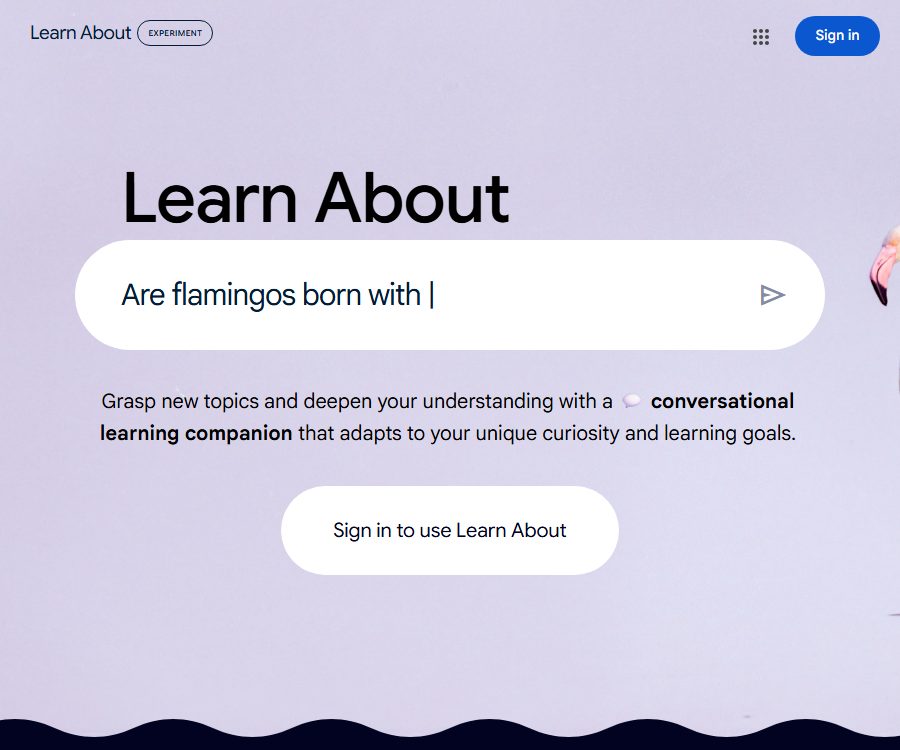
Learn About is an interactive AI-based learning experiment launched by Google, aimed at helping users understand new topics and explore them further based on their own curiosity. It emphasizes learning science and interactive guidance, rather than providing only brief answers once and for all.
The name in the database is “Learning About”, while the current official product name is “Learn About”. It should be distinguished from Gemini’s Guided Learning, NotebookLM, and the earlier LearnLM experimental models when in use.
A one-sentence summary
Learn About is a Google AI learning companion designed for students and lifelong learners; it breaks down concepts through continuous conversations to help users achieve a deeper understanding.
Core functions
Interactive concept explanation
Users can ask questions in natural language about topics they are interested in, and Learn About will provide explanations related to those questions while allowing further inquiries. It is suitable for getting started with unfamiliar concepts, as well as for understanding the relationships between various knowledge points.
- The direction and depth of the explanation can be adjusted according to the user’s questions.
- It supports multiple rounds of dialogue, facilitating a gradual progression from basic concepts to details.
- Suitable for open topics such as science, humanities, vocational skills, and general knowledge.
- The answers are generated by generative AI; key facts still need to be verified in textbooks or authoritative sources.
Science-oriented learning
Google describes Learn About as a learning companion guided by the principles of learning science, with goals such as facilitating knowledge acquisition, long-term memory formation, and sustained curiosity. The actual effectiveness still depends on whether users actively ask questions, repeat information, and practice.
Personalized exploration
The tool organizes the subsequent content based on the current conversation and learning objectives, rather than forcing all users to follow a fixed curriculum. It is more akin to an adaptive exploration tool, and it is not equivalent to online courses that come with a complete set of teaching materials and examination certifications.
Follow-up questions and connections to knowledge
Users can request additional examples, comparisons of similar concepts, explanations of causal relationships, or alternative ways of expressing things. Through successive questions, fragmented issues can be organized into a more coherent knowledge structure.
Visualization and supplementary materials
The learning experience may incorporate images, relevant content, and structured knowledge cards to aid in understanding complex topics. The way in which these elements are presented varies depending on the questions, region, account, and version of the experiment; therefore, it is not guaranteed that the same components will be available each time.
Self-directed learning across topics
Learn About is not limited to a single subject area; it can be used to explore topics such as geology, history, technology, art, or personal interests. For those who need a structured course schedule, assignment grading, or official certificates, it can only serve as a supplementary tool.
Differences from other Google learning tools
| Tools | Main materials | Primary use | Suitable scenarios |
|---|---|---|---|
| Learn About | User questions and the knowledge of AI organizations | Explore unfamiliar topics and gradually understand concepts. | Open autonomous learning |
| NotebookLM | Materials uploaded or specified by the user | Based on summaries of personal materials, Q&A, and the creation of learning content | Course materials and research projects |
| Gemini Guided Learning | Conversations, files, and Gemini capabilities | Learn in an guided manner within Gemini. | Users who are already accustomed to using Gemini |
| Google Search learning feature | Websites and search results | Find facts, tutorials, and learning resources | Fast retrieval and cross-validation |
| LearnLM | Developer model experiments | Researching and developing AI capabilities for education. | Developers and research in educational technology |
Usage tutorial
- Log in to the Learn About experiment page using a qualifying Google personal account.
- Enter a specific learning goal, such as understanding a certain scientific phenomenon or establishing a basic framework in a particular field.
- First, read the overall explanation, then mark the terms, causal relationships, and key steps that are not understood.
- Continue to ask for examples, analogies, counterexamples, timelines, or step-by-step explanations in order to gradually narrow down the question.
- Restate the conclusions in your own words, and have the tool identify any concepts that may have been overlooked.
- Return to textbooks, papers, courses, or materials from authoritative sources to verify the important facts.
- Organize the final notes and questions that need review; do not submit the AI-generated responses as official assignments.
Which users are it suitable for
- Students who wish to quickly understand unfamiliar topics and establish a basic framework of knowledge.
- Self-learners who need to break down complex concepts into simpler explanations.
- To foster lifelong learners who cultivate curiosity and a learning path through continuous questioning.
- Teachers and parents who prepare courses, discussion questions, or introductory materials for learning.
- Content creators who need to clarify terminology and define the scope of the issues before conducting formal research.
Product advantages
- Ask questions in natural language to lower the barrier to entering unfamiliar fields.
- It emphasizes understanding and exploration, rather than merely providing isolated answers.
- It is possible to keep asking questions around the same theme and adjust the depth of the explanation as needed.
- Backed by Google’s expertise in learning research and generative AI.
- The website is easy to use; no specialized software for learning is required.
Restrictions and Precautions
- Learn About is still an experimental product; its entry point, features, availability by region, and account requirements may change.
- The generated content may contain factual errors, oversimplifications, omissions, and fabricated details.
- It cannot replace teachers, textbooks, specialized courses, practical training, and formal academic guidance.
- When making decisions in areas such as medicine, law, finance, and security, one cannot rely on learning assistants to provide conclusions.
- The quality of explanations for different languages and niche topics may be inconsistent.
- School assignments and exams must comply with the rules set by teachers and institutions regarding the use of generative AI.
Price and usage conditions
The price information was verified on August 24, 2026; the current entry for learning about these experiments does not show separate subscription prices or paid plans. Users need to log in using a Google account, and the actual availability depends on the account type, age, location, language, and the scope of access to the experiments.
| Version or condition | Price | Primary interests | Restrictions |
|---|---|---|---|
| Learn About web page experiments | Independent costs are not shown. | Dialogic learning and thematic exploration | A Google account is required, and the applicable conditions must be met. |
| Google AI paid plans | It is not equivalent to the Learn About package. | May include other Gemini and storage benefits. | It is not possible to draw conclusions regarding the exclusive benefits of Learn About based on this. |
| Services for educational institutions | Separate from the Learn About experiment | Workspace or Gemini’s educational capabilities | Determined by school administrators and institutional contracts. |
The experimental product may see changes to its eligibility in the future, may be integrated into other Google products, or may stop being available. It is necessary to refer to the actual page after logging in before using it; it is not recommended to purchase additional Google subscriptions just for access to a single experimental feature.
Privacy and data
To use Learn About, a Google account is required; the platform may process user inquiries, conversations, account details, device information, and usage data, and it is subject to Google’s privacy and terms of service. Users should not enter identification documents, health records, internal school information, unpublished research, or other sensitive data.
Teachers and parents should pay attention to the account requirements for minors, school policies, and data protection regulations. Whether deleting conversations, turning off activity logs, or closing accounts can affect all the stored data depends on the account control page and the applicable policies.
Supported platforms
| Platform | Support status | Primary uses | Notes |
|---|---|---|---|
| Desktop web version | Support | Comprehensive conversational learning | Primary mode of use |
| Mobile browser | May support | Light questioning and reading | Availability depends on the region and page adaptation. |
| Independent iOS app | Not confirmed | There is no separate “Learn About” app. | Do not confuse it with the Gemini app. |
| Independent Android app | Not confirmed | There is no separate “Learn About” app. | It may be accessible via a web page. |
| School management console | Not disclosed | The experimental entry point is not part of the standard teaching management system. | The eligibility for institutional accounts must be confirmed separately. |
API, SDK, and open-source status
To date, no public API or dedicated SDK has been found for the Learn About product, nor has it been confirmed that the source code for its web application is available. Developers cannot use the experimental interface intended for ordinary users as a model service that can be integrated into their own products.
Google once provided the LearnLM experimental model and integrated related learning research into Gemini, but LearnLM and Learn About are not the same product. Whether the interfaces developed for Gemini offer educational capabilities must be determined separately, based on the current models and terms of the developer platform.
Basic information
| Project | Content |
|---|---|
| Product name | Learn About |
| Old database name | Learning About |
| Development company | |
| Tool type | Conversational AI learning assistant |
| Price pattern | No separate pricing is displayed at the moment. |
| Is login required? | A Google account is required. |
| Whether API is provided | Not disclosed |
| Is it open source? | No |
| Main platforms | Web page version |
Recommendation score
It has a rating of 4.2 points and is suitable as a learning aid for understanding unfamiliar topics and prompting further questions. The experience it offers focuses on the learning process, but limitations such as access requirements, product stability, and answer accuracy prevent it from being used for formal teaching purposes.
Frequently Asked Questions
Is Learn About free?
The current experiment page does not display separate prices or dedicated subscription plans. Access to it depends on the Google account, region, and the conditions under which the experiment is available.
Is it the same as Gemini?
It’s not exactly the same – Learn About is a experimental experience designed for learning and exploration. Gemini, on the other hand, is a more general AI assistant that also comes with a Guided Learning mode.
Can I upload my own course materials?
The current public page does not clearly state that file uploading is supported by all accounts. When it comes to learning related to personal profiles, NotebookLM is usually a tool with a more specific purpose.
Can the answer be used directly for the assignment?
It is not recommended to submit directly, as the generated content may be incorrect or fail to meet the course requirements. It is necessary to verify the facts, express ideas independently, and comply with the school’s regulations regarding AI.
Is Chinese supported?
The usability of the language in experiments may vary depending on the account and region. Even if it is possible to enter text in Chinese, the quality of responses can differ across different fields.
Is there a mobile app for Learn About?
At present, there is no standalone application confirmed; the main access point is the web page. Do not consider Gemini or other Google educational applications as clients for Learn About.
Is an API provided?
At present, there are no public APIs or SDKs specifically designed for Learn About. If developers wish to create AI applications for educational purposes, they should look at Google’s current developer model services.
Is Learn About an open-source project?
No, the web-based product does not have complete, publicly verifiable source code. Google’s other research codes do not indicate that this particular product is open source.
Summary
Learn About helps users explore knowledge through dialogue and science-based learning; it is suitable for getting started, asking further questions, and establishing connections between concepts. It remains an experimental learning tool, and its best use is in conjunction with textbooks, courses, and reliable materials, rather than as a replacement for formal education.
Similar to the Learning About tool
 Guigong Network Security Registration No. 45132202000164