






Almeta ML
Almeta ML: an intelligent tool focused on AI learning.
Tags:AI learning websitesWhat is Almeta ML?
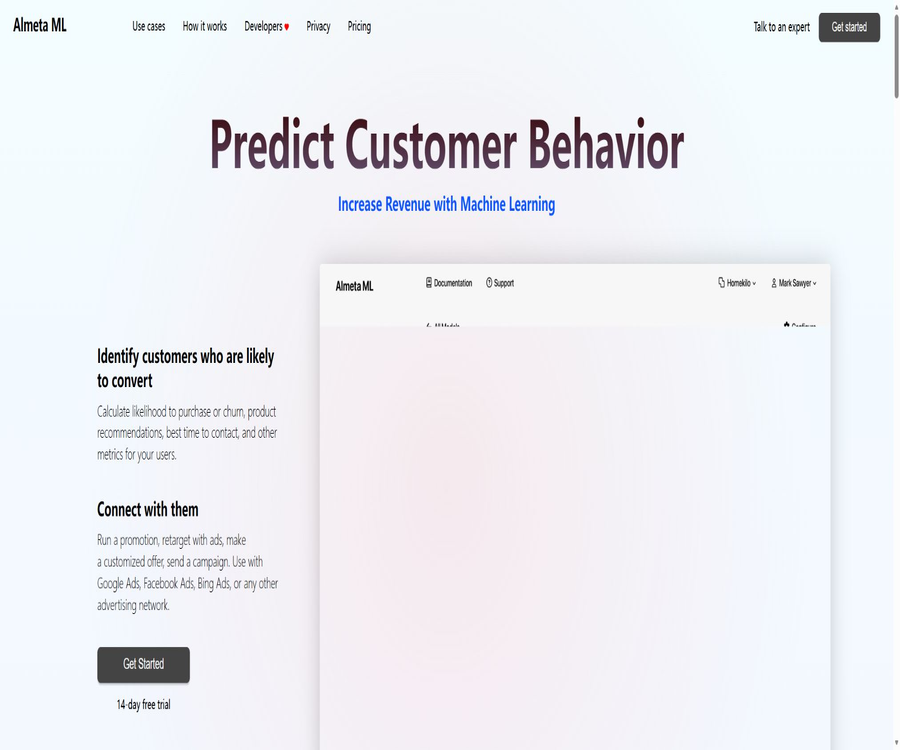
Almeta ML is a platform for predicting customer behavior, designed for e-commerce businesses, SaaS companies, content websites, and marketing teams. It analyzes events such as users’ browsing, clicking, adding items to carts, and making purchases on a website, in order to determine purchase likelihood, risk of customer churn, recommendation suggestions, customer value, and the optimal time to reach out to them.
The focus of this platform is not on creating marketing copy, but rather on transforming machine learning predictions into metrics that can be used for targeting advertising audiences, sending emails, personalizing web pages, and following up on sales. Users can import events via lightweight Web Tags, APIs, or integrations, and send the resulting calculations to the target systems.
Core functions
- Predict the probability that a user will complete a specific action.
- Identify customers who may purchase or churn.
- Generate personalized recommendations for products and services.
- Predict revenue, profits, and customer lifetime value.
- Calculate the optimal time to send messages to each customer.
- Provide real-time scoring and sorting of sales leads.
- Synchronize the prediction results to advertising and email platforms.
- Perform model calculations on the server or in the browser.
- Extend the process through APIs, Webhooks, and frontend events.
Purchase intention prediction
Purchase intent models analyze the current session, past behaviors, and the behavior patterns of other customers to determine the probability that a particular user will make a purchase. Marketers can use this information to identify those with high intent, those who need incentives, and those for whom it is not worthwhile to increase bidding at this time.
Tendency toward custom actions
- Predict whether the user will complete the purchase.
- Predict whether the email subscription will be canceled.
- Determine whether to watch more than half of the videos.
- Predict whether the online course can be completed.
- Determine whether to finish reading an article.
- Predict whether the user is about to close the page.
- Build propensity models around custom business events.
Churn prediction
The platform can identify customers who might stop making purchases, cancel their subscriptions, or reduce their level of activity, and then initiate campaigns to retain them. The definition of customer churn must be in line with the business cycle; otherwise, the model may mistakenly label regular customers who make purchases infrequently as high-risk users.
Product recommendations
Almeta ML generates real-time recommendations based on data such as browsing history, searches, shopping carts, inventory levels, prices, location, profits, and promotions. It can be used to suggest similar products, offer cross-selling suggestions, enable intelligent add-to-cart options, and identify the next best deal.
- Recommend relevant products based on browsing history.
- Generate pairing suggestions based on the contents of the shopping cart.
- Filter the results by inventory and delivery location.
- Include profit margin in the recommendation ranking.
- Adjust recommendations in real time based on the current session.
- Select the next best offer for different users.
- Update the results after price or inventory changes.
Predictions for revenue, profit, and LTV
The platform can predict the revenue, profit, and lifetime value that customers are likely to generate, which helps in identifying high-value customer groups and optimizing the budget allocated for acquiring new customers. These predictions are based on historical data, return rates, discounts, costs, and assumptions regarding customer retention; they cannot be equated directly with the actual revenue generated.
Sending time optimization
Send Time Optimization determines the time when messages are most likely to be opened for each customer, and this can be applied to emails, notifications, and other communication channels. Teams should set limits on the frequency of deliveries, consider time zones, and identify periods of low activity, in order to avoid optimizing only the open rate at the expense of causing annoyance or leading to unsubscrictions.
Clue scoring
Almeta ML can dynamically assess the likelihood of converting leads based on interactions, demographic characteristics, and historical behavior, allowing sales teams to focus their efforts on candidates with the highest potential. The scores generated by the model should be combined with feedback from sales staff, so as to avoid ignoring new customer groups that may not have much information available about them but could still be valuable.
Advertising audience
Users can create ad audiences based on purchasing tendencies, churn risk, product interests, or predicted value, and send them to platforms such as Google, Meta, Bing, and TikTok. Before synchronizing the audiences, it is necessary to check the policies of the advertising platforms, obtain user consent, and comply with regional privacy regulations.
- Increase the remarketing priority for highly interested users.
- Exclude traffic that has already been purchased or is of low value.
- Create segmented audiences based on different product interests.
- Create recovery ads targeting customers at risk of churning.
- Adjust the advertising budget based on the predicted value.
- Use the model results as labels or custom variables.
Email marketing
Predictive metrics can be used to select the target audience for emails, determine the content of the messages, decide on the offers to include, and pick the optimal time for sending them. The platform can deliver these results to email service providers through built-in connections or by exporting lists, but the actual sending of emails, the management of templates, and handling unsubscriptions remain the responsibility of the respective systems.
Page personalization
The website can adjust the order of products, offers, content, or search results once it receives real-time predictions. Personalization rules should specify a default experience as well as fallback options in case of delays, so as to prevent the page from remaining blank due to model or network failures.
Next best action
The team can combine the results of multiple models to determine the next best action or the next best offer; for example, offering free shipping to customers with high intent, or providing assistance to those at risk of churning. Discount strategies should also take into account gross profit, inventory levels, and fairness, rather than focusing solely on short-term conversions.
Event data
Events form the basis for the platform to train models and generate predictions; each event represents an action performed by a user on the website. Common events include browsing content, viewing products, adding items to the shopping cart, starting the checkout process, making purchases, adding items to favorites, and submitting comments.
| Event category | Example | Supported predictions |
|---|---|---|
| Browse events | View pages, content, or products | Interests, purchasing tendencies, and content completion rate |
| Interactive events | Click, search, add to favorites | Product preferences and engagement |
| E-commerce events | Add to cart, check out, pay, and purchase | Conversion, recommendations, and revenue |
| Retention event | Log in, renew, cancel, or unsubscribe | Customer churn and customer value |
| Custom events | Completing courses, watching videos, etc. | Tendencies in actions specific to a particular business |
Web Tag
Almeta ML offers a lightweight Web Tag that supports asynchronous loading; its size is around 3KB after compression, and it can be installed using tools such as Google Tag Manager. It is used to capture specific events, generate predictions, and trigger callbacks or JavaScript events in the browser.
Server and browser computing
The model can be processed on the server, or specific predictions can be generated directly in the browser. Browser-based processing is suitable for providing immediate responses to actions such as leaving a page, while the server-based approach is better suited for centralized management and use across different channels.
API and Webhook
The platform provides APIs for importing events and retrieving results, with Bearer Tokens being used for authentication. Webhooks, Lambda, and Cloudflare Workers enable the integration of predictions into custom systems or serverless workflows.
- Upload behavior data through the Events API.
- Trigger model computation from the backend.
- Results are received and forwarded via Webhook.
- Use Lambda to execute custom processing logic.
- Expand the process at the edge using Cloudflare Workers.
- Write the predictions back to CDP, CRM, or e-commerce systems.
Data objectives and integration
The prediction results can be sent to advertising platforms, email services, e-commerce systems, CDPs, and custom applications. The available built-in connections and fields may vary; it is necessary to verify bidirectional synchronization, latency, retry mechanisms in case of failures, and the logic for deleting data before implementation.
Real-time processing
Once an event occurs, Almeta ML can update customer characteristics in real time and generate predictions, thereby allowing the pages or offers available in the current session to change immediately. Under high traffic levels, it is necessary to test throughput, latency, and timeout values to prevent predictions from interfering with the core purchasing process.
Model accuracy
Official statements indicate that the quality of predictions depends on the quantity and quality of the input data; generally, useful insights regarding purchasing tendencies can be obtained after collecting several thousand key events. Any accuracy figures must be evaluated based on an independent test set, a specific time frame, and the associated business costs.
Cold start
When a new website or product lacks sufficient historical data, the model faces the challenge of cold startup. The team can first track key events such as browsing, product views, adding items to the cart, checking out, and making purchases, and then introduce more specialized models as the amount of data increases.
Which users are it suitable for
- E-commerce teams that wish to improve the ROAS of their ads.
- Online stores that require real-time product recommendations.
- SaaS companies that wish to identify churn risks in advance.
- Sales and marketing teams that require dynamic lead scoring.
- Operators who wish to optimize the timing of email sending.
- Development teams that have event data and need low-code ML capabilities.
- Companies that need to write the predictions back into CDP or advertising systems.
Typical use cases
- Predict the probability of the visitor making a purchase during this session.
- Generate cross-selling recommendations for the shopping cart.
- Display appropriate prompts when the user is about to leave.
- Identify the risk of churn among subscribed customers.
- Select the email sending time for different customers.
- Adjust the retargeting budget based on predicted value.
- Create ad audiences based on product interests.
- Have sales reach out first to leads with a high conversion rate.
It’s not very suitable for which situations
- Companies that do not have any website event or customer behavior data.
- Only a content team that creates advertising copy is needed.
- Websites with very low monthly traffic that are unable to accumulate a sufficient number of events.
- Tracking scenarios for which the necessary user consent cannot be obtained.
- Companies that hope to rely entirely on models to automatically determine customer treatment.
- Developers who require a fully open-source core platform.
- Small shops that only need simple, static recommendation rules.
Start using the tutorial
- Create an account and start a 14-day free trial.
- List business objectives such as purchases, churn, or interactions.
- Select the minimum set of events that need to be collected.
- Data can be accessed through Web Tags, APIs, or integrations.
- Check the event name, user ID, and amount fields.
- Select a built-in prediction model.
- Set the target for result output and conduct verification at a low volume.
- Compare the business results of the prediction group and the control group.
Tutorial on purchase propensity models
- Confirm the purchase event and conversion window.
- Track product views, adds to cart, checkout, and purchases.
- Accumulate sufficient and continuous data on real-world behavior.
- Deploy the purchase propensity model and view the score distribution.
- Create audiences based on high, medium, and low intent.
- Implement different marketing strategies for various target groups.
- Use incremental experiments to determine the actual improvement.
Product recommendation tutorial
- Synchronize product IDs, categories, prices, and inventory.
- Connect to browsing, searching, adding to cart, and purchasing events.
- Select the recommended location and default content.
- Define inventory, profit, and promotion business rules.
- Deploy recommended models and limit response time.
- Evaluation is carried out using click-through rate, conversion rate, and gross profit.
- Regularly check for excessive repetition and popularity bias.
Advertising Audience Tutorial
- Identify the customer segments that you wish to improve or exclude.
- Select the appropriate prediction value and score threshold.
- Connect to the advertising account that is authorized for use.
- Establish synchronization of the audience and update frequency.
- Check whether the user agrees to the platform’s policies.
- Establish a experimental group and a control group.
- Evaluate conversion, costs, revenue, and incremental effects.
Expert installation service
If the team does not wish to carry out the setup itself, the vendor offers a one-time service costing 500 dollars, which includes installing the Web Tag, tracking events on relevant websites, activating machine learning models, and generating real-time predictive metrics that can be used for marketing purposes.
Privacy design
By default, Almeta ML collects only the events selected by the user; it does not track all user information by default. The Web Tag can use a random customer identifier stored in local storage, or it can be provided with an existing customer identifier from the customer’s system.
- Cookies are not used by default.
- The customer selects the specific events to track.
- By default, no personal identification information is required.
- Random customer numbers can be used.
- Additional user data is included only when the customer configures it actively.
- It allows for the export of business data at any time.
Privacy and compliance considerations
The absence of cookies and the default refusal to collect personal information do not automatically exempt companies from their privacy obligations; events, device identifiers, and behavioral profiles can still constitute personal data. Companies need to assess the requirements related to notification, consent, deletion, advertising targets, and cross-border data transfer in accordance with local laws.
No supplier lock-in
The official website states that users can export data at any time, either through integration or via Webhooks. When carrying out a migration, it is also necessary to verify whether the models, features, historical predictions, audience rules, and data format can be recreated on another platform.
Corporate capabilities
- Supports SAML single sign-on.
- Provides advanced roles and access permissions.
- You can choose between hosted or on-premises deployment.
- Batch pricing is available.
- It includes options for expert installation and expedited support.
- Custom workflows can be established in conjunction with existing data platforms.
Price packages
The official website shows the monthly price calculated on an annual basis; paying annually entitles the user to two extra months of service. Each package includes a 14-day trial period. All usage amounts are calculated on a monthly basis, and additional processing power and models can be purchased if needed beyond that amount.
| Package | Price | Model calculation | Event | Data storage |
|---|---|---|---|---|
| Basic | The annual fee is equivalent to $99 per month. | 10,000 times per month | 100,000 items per month | 60 days |
| Standard | The annual fee is equivalent to $399 per month. | 100,000 times per month | 1,000,000 items per month | 90 days |
| Enterprise | Quotation for bulk customization | By scale | By scale | In accordance with the contract |
| Expert installation | $ | It does not fall within the usage quota. | Complete the configuration of tags and events. | Not applicable |
Excess usage
| Excess items | Price | Explanation |
|---|---|---|
| Additional model calculations | $ | The model is run and returns the prediction results. |
| Additional events | $ | Imported customer behavior data |
| Annual payment discount | Two months free of charge | Payment is required in advance on an annual basis. |
| Free trial | 14 days | It can be canceled at any time. |
How to distinguish between events and computations
Events represent the customer behavior data that is fed into a model, such as browsing and purchases; model calculations refer to the execution of a model to generate a prediction. A single user can generate multiple events, and multiple model calculations can be triggered within one session – both of these quantities need to be estimated separately.
APIs and developer capabilities
The development documentation provides information on the event format, API authentication, event interfaces, target audiences, and basic concepts. Teams can use Bearer Tokens to call these interfaces, and they can utilize the Web Tag prediction results as JavaScript events or variables in the frontend.
GitHub and the open-source status
No complete prediction platform provided by Almeta ML, nor any GitHub repository containing the core models of this system, has been found. It is a closed-source SaaS and enterprise software; the availability of example Web Tags and API documentation does not mean that the model codes and server-side code are open source.
Product advantages
- Focus on real-time prediction of customer behavior that enables immediate action.
- Covers purchase, churn, referrals, LTV, and send time.
- The results can be used to personalize ads, emails, and websites.
- It also supports Web Tags, APIs, and common integrations.
- The model can be executed on a server or in a browser.
- Web Tags are lightweight and utilize asynchronous loading.
- Prices, quotas, and any excess usage are made public.
- It supports data export, local deployment, and enterprise-level permissions.
Usage restrictions
- The quality of predictions depends heavily on the number of events and the quality of the data.
- Websites with low traffic may face difficulties during the cold start phase for an extended period of time.
- Behavioral prediction and advertising targeting involve privacy compliance.
- An increase in correlation does not equate to a genuine incremental effect.
- Model scores cannot replace judgment in marketing and sales.
- The custom model feature is still marked as upcoming.
- The monthly prices shown on an annual basis can easily be confused with the actual payment cycle.
- The core platform and models are not open source.
Basic information
| Project | Content |
|---|---|
| Tool name | Almeta ML |
| Tool type | Real-time customer behavior prediction and marketing machine learning platform |
| Core competencies | Trends, churn, recommendations, value, sending time, and lead scoring |
| Primary users | E-commerce, SaaS, marketing, sales, and development teams |
| Access method | Web Tags, APIs, Integrations, and Data Import |
| Deployment method | For hosting services, companies can inquire about on-premises deployment. |
| Price pattern | 14-day trial, usage plans, and enterprise pricing |
| Whether API is provided | Yes |
| Is it open source? | No |
Recommendation score
The comprehensive recommendation score is 4.4 out of 5 points. Almeta ML is suitable for teams that already have stable data on website events and wish to use predictions directly in marketing activities; however, it is necessary to conduct comparative experiments prior to purchase to verify the additional benefits and ensure compliance with privacy regulations.
Frequently Asked Questions
What is Almeta ML mainly used for?
It predicts purchases, churn, recommendations, customer value, and the optimal timing for engagement in real time, based on website behavior.
Is it necessary to know machine learning?
Using built-in models eliminates the need to train code manually, but event design, result evaluation, and business experimentation still require professional judgment.
How soon will the prediction be available?
Results can begin to appear a few hours after an event is recorded, and the quality of predictions generally continues to improve as more data becomes available.
Will it slow down the website?
The official Web Tag is approximately 3KB after compression and is loaded asynchronously; nevertheless, its performance should be tested on the actual website.
How much is Almeta ML?
The Basic plan costs $99 per month when paid annually, the Standard plan costs $399, while the enterprise version is priced based on usage.
Is a free trial available?
All packages come with a 14-day free trial that can be canceled.
Is API support available?
It supports Events API, Bearer Token authentication, Webhooks, and calls via front-end Web Tags.
Are cookies used by default?
By default, Cookies are not used; instead, a random local identifier or the customer’s own user ID can be employed.
Is Almeta ML open source?
The core forecasting platform and models are not open source; it is a commercial SaaS and enterprise service.
Tools similar to Almeta ML

 Guigong Network Security Registration No. 45132202000164