






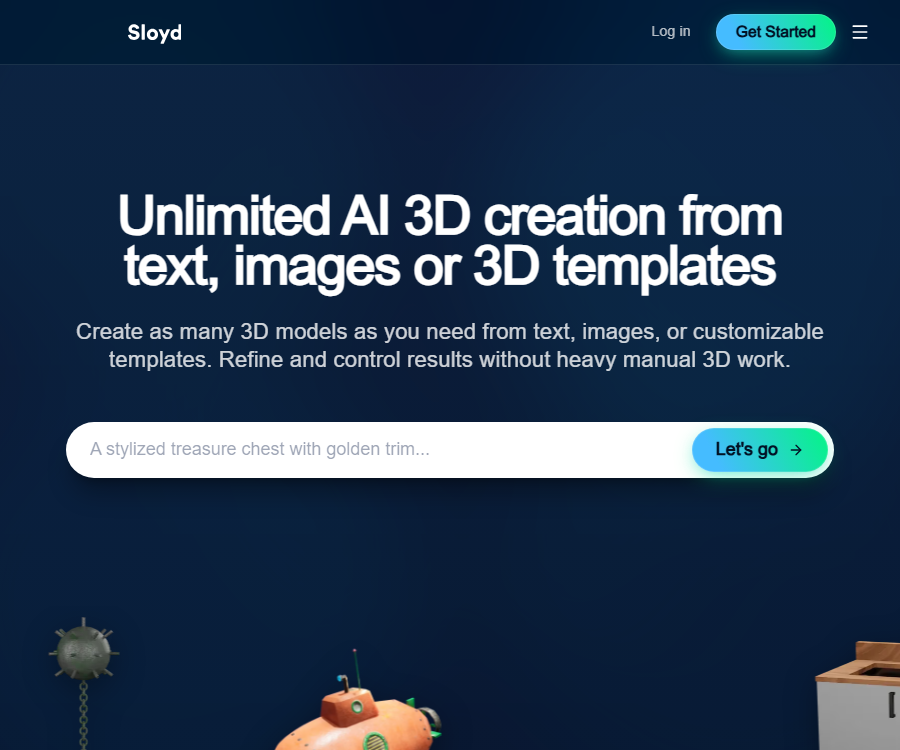
Sloyd translation site
As a 3D modeling tool, Sloyd utilizes its parameter generator and machine learning technologies to provide users with an efficient and user-friendly platform for creating and customizing 3D assets.
Tags:Common AI image toolsWhat is Sloyd?
Sloyd is an AI 3D generation platform designed for game development, design, e-commerce visualization, and content creation. It can convert text, individual images, or multiple views of the same object into 3D models with geometry and textures, and it also provides parameterizable templates that users can adjust directly.
The old name in the database included “translation site”, but the core function of this product is the creation and editing of 3D assets, rather than providing language translation services. Web applications, developer APIs, and plugins for professional software constitute its main modes of use.
Main functions
| Functions | Received input | The resulting outcome | Suitable for tasks |
|---|---|---|---|
| Text to 3D generation | Natural language asset description | 3D draft with geometry and textures | Concept validation, level filling, and rapid prototyping |
| Generate 3D from a single image | A clear photo of the front side of an object | 3D model reconstructed based on visual features | Product display, prop creation, and reference reconstruction |
| Generate 3D from multiple images | Multiple angles of the same object | Models that provide more information about shapes | Assets with complex shapes and a need for a relatively complete contour |
| Parameterized template | Pre-set parameters such as categories, sizes, and components | Custom models with controllable structure | Game assets with batch variations and consistent style |
| Textures and artistic styles | Models, text instructions, or style settings | Regenerated materials and textures up to 4K resolution | Unify the artistic style and improve the representation of close-ups. |
| Automatic binding and animation | 3D models suitable for characterization | Bone binding and AI animation results | Character preview, game and short video production |
How to choose text, images, and templates
- Only when creative descriptions are available can a 3D model be generated in text form for quick exploration of the design.
- When there are existing product images, concept diagrams, or photos of the actual product, single-image mode makes it easier to preserve the visual features.
- When it is possible to capture images from the front, side, and back, the multi-image mode provides more detailed context regarding the shape, but it consumes more web endpoints.
- When it is necessary to precisely adjust the length, width, or components, or to generate similar assets repeatedly, parametric templates make it easier to maintain structural stability.
- When the original image has a complex background, the subject is obscured, or the angles from which it was captured are inconsistent, the reconstructed result may still exhibit missing areas, overlaps, and incorrect textures.
Generate 3D models from prompts
- Log in to the web application and create a new task.
- Select the text generation mode and use one sentence to describe the object’s category, shape, material, and style.
- After generating the draft, rotate it to examine the front, side, back, and bottom structures.
- Adjust the prompt, template parameters, target number of faces, topology, and texture settings.
- Split components as needed, regenerate textures, or carry out automatic binding and animation.
- Select the export format based on the target software, and check the proportions, materials, and collisions in the modeling or game engine.
Prompt words should be used to describe the visible shape of an object, rather than merely stating its abstract purpose. Including details such as \"low-poly wooden chest, metal edges, removable lid, cartoon style\" helps in providing clearer guidance; it is generally easier to work with such specifics than simply saying \"create a nice game item.\"
Practical process for generating 3D images
- Prepare images with a complete subject, clear outlines, and minimal background interference.
- For single-image tasks, angles that can highlight the main shapes are preferred; for multi-image tasks, consistency in objects, lighting, and scale is maintained.
- Choose whether to generate a texture, and set the target number of faces as well as the topology—triangular or quadrilateral—based on the intended use.
- After it is generated, check the thin sheets, transparent components, symmetrical structures, as well as the bottom and back surfaces.
- Fix anomalies by regenerating, splitting components, or using external modeling software.
- Export and verify it in the final renderer, engine, or printing slice software.
Multiple images do not guarantee accurate dimensions or compliance with manufacturing tolerances. In cases involving industrial design, medicine, architectural dimensions, and load-bearing components, professional measurement and modeling processes should be used for verification.
Geometry, topology, and texture control
- The number of model faces can be set according to the intended use, allowing a trade-off between real-time performance and level of detail.
- The API allows requests for triangular or quadrilateral faces; quadrilateral faces are generally more convenient for subsequent editing, while triangular faces are more in line with common real-time rendering pipelines.
- It can generate UVs and textures, with a resolution of up to 4K available for suitable tasks.
- Breaking down components makes it easier to set individual materials, animations, or interactions, but this is a feature that comes at an extra cost in terms of usage points.
- A very high number of polygons allows for the retention of more details, but it also increases the file size, loading time, and the costs associated with subsequent optimization.
- Topologies generated by AI may not meet the professional requirements for deformation animations, Boolean operations, or surface subdivision; manual editing is still necessary for the key elements.
Export format and uses
| Format | Main features | Common uses | Use reminders |
|---|---|---|---|
| GLB | Models, materials, and textures can be packaged. | Web display, real-time preview, and game engine | Check whether the target platform supports material channels. |
| FBX | Common exchange formats for professional software and engines | Animation, Maya, Unity, and Unreal workflows | Check the coordinate axes, units, skeletons, and texture paths. |
| OBJ | Simple structure and wide compatibility | Static model exchange and post-editing | Materials and textures usually require accompanying files. |
| STL | Focus on preserving the surface geometry. | Personal 3D printing and slicing | Do not save regular textures; check for completeness and wall thickness before printing. |
| USD | Suitable for exchanges in complex scenarios | Some professional content production pipelines | The actual availability is subject to the current export interface. |
Plugins and professional software workflows
Sloyd offers plugins or integration tools for Blender, Maya, Unity, Unreal, Godot, and Roblox, which allow models created on the web to be imported into scenes. Although these plugins can be downloaded, this does not mean that their source code is open source, nor does it imply that users with free accounts have full access to all functions.
- Confirm that the current subscription includes access to the plugins, and download the plugin corresponding to the software version.
- Enable the plugin according to the installation method provided by the target software, and complete the account connection.
- Generate and adjust the model on the web page, then choose to send it to the target scenario.
- Check units, scale, materials, collisions, skeletons, and performance budget in professional software.
- Continue to complete the manual topology, lighting, animation, or engine configuration.
Web-based plugins are a feature that is currently available; the dynamic generation of such plugins during game execution is still in the testing phase. Developers should not treat these features in the testing stage as fully functional interfaces that are already available for use.
Web-based price plans
| Package or version | Price | Billing cycle | Core benefits or quota | Suitable for users |
|---|---|---|---|---|
| Guest | 0 dollars | Free for a long time | Once a day: AI-driven 3D generation, download of community models, customization of templates within the browser, export in GLB and OBJ formats; for personal use only. | Experience features and non-commercial practitioners |
| Plus | 15 dollars | On a monthly basis | Unlimited generation is subject to fair use rules: 50 points per month, 2 parallel tasks, 1 custom art style, as well as support for plugins and commercial digital uses. | Independent developers, designers, and small teams |
| Plus annual plan | 150 dollars, which is equivalent to 12.50 dollars per month. | Prepayment on an annual basis | Plus benefits: the page indicates a 20% savings compared to monthly payment. | Individuals and teams in continuous use |
| Pro | 50 dollars | On a monthly basis | Unlimited generation, subject to fair use rules: 350 points per month, 5 parallel tasks, unlimited custom art styles, priority queue and support, resale rights in accordance with the terms. | Studios, asset creators, and frequent users |
| Pro annual plan | $ | Prepayment on an annual basis | With the Pro plan, the page indicates a 20% savings compared to the monthly payment option. | High-frequency Production and Commercial Assets Team |
Subscription prices, taxes, currencies, and benefits may vary depending on the region, account, and settlement cycle; the actual details are shown on the settlement page. “ Unlimited generation” is still subject to restrictions related to fair use, queue priorities, parallel tasks, and the point system.
Number of web endpoints feature
| Functions | Single-point score | Uses | Precautions |
|---|---|---|---|
| Split components | 20 | Break the model down into components that can be processed separately. | For complex results, it is still necessary to check the component boundaries. |
| Text rotation animation | 30 | Generate actions based on text. | It is necessary to check the bones, as well as the interconnections and circular links. |
| Video rotation animation | 30 | Generating animations from action videos | The shooting angle and obstructions can affect the results. |
| Generate 3D from multiple images | 20 | Enhance the shape context from multiple angles | The images should show the same object with a consistent appearance. |
| Ultra-high polygon count | 5 | Generate high-detail models with up to approximately 500,000 faces. | It will increase the costs of processing and rendering. |
Commercial use, resale, and 3D printing
| Usage method | Guest | Plus | Pro |
|---|---|---|---|
| Personal, non-commercial projects | Allow | Allow | Allow |
| Commercial digital projects | Not allowed | Allow | Allow |
| Reselling on material markets or asset stores | Not allowed | Not allowed | Allowed when the conditions are met |
| The model is used for AI training. | Not allowed | Not allowed | It is necessary to get in touch for confirmation. |
| Personal 3D printing | Allow | Allow | Allow |
| Sales of physical printed materials | A separate license is required. | A separate license is required. | A separate license is required. |
Paid commercial licenses cover the use of digital models in projects, but they do not automatically include the right to sell the 3D-printed products. If you plan to sell the printed items, you need to contact Sloyd first to obtain the appropriate custom license.
Users can modify the generated models within the scope of their permissions, and professional service providers can deliver the results containing Sloyd models directly to clients. The images uploaded must not violate anyone’s copyright, trademark, portrait rights, or other rights.
What can APIs do?
The Sloyd API enables the integration of 3D content created from text, single images, or multiple images into various products; developers can specify the desired number of faces, whether the topology should be based on triangles or quadrilaterals, as well as the texture resolution. The quota associated with this API is independent of the subscription plans and credit amounts for web applications.
- Text generation enables end-users to describe assets within the application.
- Single-image generation enables quick creation of images suitable for products, items, and conceptual designs.
- Multi-image generation is suitable for applications that need to capture a single object from multiple angles.
- It is possible to request models with or without textures, and to choose between quality and cost.
- Multiple named keys can be created, and they can be revoked separately for different applications or environments.
- It supports checking the balance and automatic top-ups, which helps to reduce the risk of production tasks being interrupted due to insufficient balance.
API integration steps
- Log in to the Developer Console using a Sloyd account.
- Bind a valid payment method, purchase prepaid API credits, and enable access.
- Create a named key to securely store the one-time client key.
- Store the credentials on the server; do not include the keys in the web interface, in public code, or in client installation packages.
- Select text, a single image, or multiple images for input, and set the texture, topology, and target number of faces.
- Send a generation request; once the model’s results are obtained, they are written into one’s own storage and processing pipeline.
- Track point consumption, failure status, and task retries; rotate or revoke keys separately for each application environment.
API price
| Package or version | Price | Billing cycle | Core benefits or quota | Suitable for users |
|---|---|---|---|---|
| API points | 1 dollar buys 75 points | Consumed based on the prepaid balance | Used for generating text, single images, and multiple images; automatic top-up can be enabled. | Developers who need to integrate 3D-generated content |
| Minimum order amount for API trial | 12 dollars | One-time upfront payment | 900 points are available for use in developing and testing workflows. | Prototype testing and integration assessment |
| Bulk purchasing | Custom quote | Prepayment | A large number of points can be used to qualify for tiered discounts. | Products with high usage volumes and enterprises |
Single API usage
| Generation options | Points | Explanation | Cost impact |
|---|---|---|---|
| Single image, without texture | 10 | Generate basic geometric models | Base cost |
| Single image, with texture | 20 | Generate geometry and textures | It is 10 points higher than those without texture. |
| Text input | Add 5 | Generate directly using the prompt. | 叠加在基础任务上 |
| Multiple image input | Add 10 | Multiple visual angles are provided. | 叠加在基础任务上 |
| quadrilateral surface topology | Add 5 | Request results for the quadrilateral face. | 叠加在基础任务上 |
| 5 million faces or more | Add 10 | Request high-polygon-count output. | 叠加在基础任务上 |
Combined options result in an accumulation of points; for example, textures, multiple images, quadrilateral faces, and high polygon counts can all contribute to increasing the cost of a single request. Developers should calculate the average consumption using representative samples before launching the service, and they should set up alerts for low balances as well as limits on the number of requests that can be made.
API, plugins, and open-source status
- Sloyd provides commercial APIs, a developer console, and documentation for public access.
- Plugins can be connected to various modeling software and game engines, but the fact that they can be downloaded does not mean they are open source.
- It has not yet been confirmed whether there is a public code repository or an open-source license for the core 3D generation platform.
- It has not yet been confirmed whether the official SDK or plugin code is licensed under an open-source license that permits free redistribution.
- The content generated using the API is still subject to the account plan, content rights, and terms of service.
Supported platforms
| Platform or channel | Current status | Primary uses | Restrictions |
|---|---|---|---|
| Web application | Available now | Generation, customization, texture processing, and export | A modern browser and a stable internet connection are required. |
| Professional software plugins | Already provided | Send the model to Blender, Maya, Unity, Unreal, Godot, or Roblox | The available features and compatibility are determined by the package and software version. |
| Developer API | Available now | Integrate 3D generation into websites, applications, and internal processes | Prepaid separately; not included in website subscriptions. |
| Generated at runtime | Waiting phase | It is planned to be generated dynamically for games or applications that are already in operation. | It cannot yet be considered universally available. |
| Native mobile apps | Not confirmed yet | No official iOS or Android client has been confirmed. | Mobile browsers are not the same as native applications. |
| Browser extensions | Not confirmed yet | No official expansion confirmed. | Do not install third-party extensions of unknown origin. |
Privacy and data storage
- The service handles account contact information, professional details, language preferences, usage records, as well as device and cookie data.
- The privacy policy is based on the GDPR framework and outlines rights such as access, correction, deletion, restriction, objection, and data portability.
- The service may use processors to handle data transfers outside the European Economic Area through appropriate mechanisms.
- Account information is generally retained during the validity period of the contract, and thereafter it is deleted or kept in accordance with legal requirements.
- Projects and generated models are not guaranteed to be retained permanently; inactivity over time or capacity management may lead to their deletion.
- Important assets should be exported in a timely manner and backed up in one’s own storage; the website project area should not be used as the only repository for files.
Before uploading images of unreleased products, customer assets, personal photos, or internal designs, it is necessary to verify the team’s data handling requirements and confidentiality policies. When dealing with sensitive or regulated data, it is essential to assess separately whether the service meets the organization’s compliance requirements.
Subscription, cancellation, and refunds
- Paid subscriptions are renewed automatically; users should cancel the plan they no longer need through their account settings before the renewal date.
- Cancellation usually prevents deductions in the subsequent cycle, but it does not mean that the amounts already paid are automatically refunded.
- In principle, fees are non-refundable; changing one’s mind, missing the cancellation deadline, or the product not matching the description provided are generally not reasons for a refund.
- In the event of technical issues or incorrect purchases, you can contact support within 14 days to request an exception review; however, approval and the amount involved depend on each individual case.
- Whether a model has been generated, points have been used, or services have been utilized will affect the decision regarding refunds.
- Users who use automatic top-ups should also check the API balance settings to prevent further charges to the API after the web subscription is canceled.
Product advantages
- Text, single images, multiple images, and parameter templates cover various entry points, from concepts to controllable variants.
- It is possible to control the number of faces, topology, textures, and components; as a result, it is easier to move on to the actual production process compared to when only a static preview is provided.
- Multiple export formats and professional software plugins reduce the need for manual data transfer steps.
- The web interface and the API serve creators and product integration use cases, respectively.
- The package clearly distinguishes between personal use, commercial digital use, and the rights to resell the materials.
Capacity limits and usage restrictions
- AI models may exhibit missing structures, incorrect proportions, distorted textures, adhered components, and invalid topology.
- Transparency, reflectivity, hair, fine lines, the interior of complex machinery, and obscured areas are usually more difficult to discern from images.
- The generated results do not guarantee physical dimensions, manufacturing tolerances, the quality of animation deformation, or specific engine performance.
- Free accounts are only allowed for personal use; commercial projects require a suitable paid plan.
- The commercial license for Plus does not allow the resale of materials from the marketplace, and resale under Pro is also subject to specific terms.
- A separate license is required to sell printed versions, and the commercial rights associated with the digital model cannot be applied directly.
- Web subscriptions and API credits are separate; purchasing one of them does not automatically grant access to the other.
- Runtime generation is not yet widely available; official projects should be designed using the interfaces that are currently available.
Which users are it suitable for
- Independent game developers who need to create level props, scene objects, and prototypes quickly.
- E-commerce and marketing teams that need to convert product images into web pages or interactive display models.
- 3D designers and content studios that require a large number of variations of the same type of asset.
- Products and development teams that wish to add a user-friendly 3D creation feature to their applications.
- Students and creators who are learning 3D workflows and wish to reduce the time required for modeling from scratch.
Frequently Asked Questions
Is Sloyd a translation tool?
No. Sloyd is currently a platform for generating and customizing AI 3D models, focused on converting text or images into 3D assets.
Can Sloyd be used for free?
The Guest plan costs $0 and allows for 1 AI 3D generation per day, but it is intended for personal use only. For commercial digital projects, the Plus or Pro plan is required; the specific prices and features can be found on the account settlement page.
Can the models generated in the free version be used for commercial purposes?
No. The current rights matrix designates Guests for personal use only; it cannot be assumed that commercial licensing is available just because the model can be downloaded.
Can the models generated by Plus be sold on a material marketplace?
No. Plus can be used for ordinary commercial digital projects, but material markets, asset stores, or the resale of stock models require the Pro plan, which meets the necessary criteria.
Can Pro sell 3D-printed products?
It cannot be assumed directly that this is possible. To print physical products, it is necessary to get the appropriate permission by contacting the relevant party; even if the account already grants rights to resell Pro digital models, this still needs to be confirmed first.
Does web subscription include API credits?
It is not included. The API utilizes its own prepaid balance; the package options available on the web interface as well as the monthly credits are not automatically transferred to the developer’s API.
Is Sloyd open-source software?
It has not yet been confirmed whether the core platform has any public code repositories or open-source licenses. The fact that official plugins can be downloaded does not mean that the code for those plugins or the 3D generation services are open source.
Can the generated model be used directly for game release?
It can serve as a starting point for production, but it is first necessary to check the topology, number of faces, materials, collisions, proportions, skeleton structure, and the performance of the target device. Key assets usually require manual optimization as well.
Will a refund be issued automatically after canceling the subscription?
No. Fees are generally not refundable; in the case of technical issues or incorrect purchases, an exception can be requested for review within 14 days, but whether a refund will be granted depends on how the service was used and how many points have been consumed.
How to add a FAQ Schema
The main text of this page contains the common questions addressed to readers, but no scripts are embedded within the content. The website should retrieve these questions and answers from the backend or page templates, and generate structured FAQPage data during the page rendering process.
- Use each subheading at level 3 as a question, and the paragraph that follows it as the answer.
- Only the questions and answers that are actually visible on the page and whose content is exactly the same shall be output.
- Structured data is generated uniformly from templates and inserted into the page code area; it should not be entered into the text editor.
- When updating price, licensing, or refund information, update the visible Q&A and structured data as well.
- After publishing, use a rich media result verification tool from a search engine to check the syntax and the page’s crawlability.
Structured data is used solely to help search engines understand a page; it does not guarantee the presentation of improved search results. Questions and answers must not be hidden, exaggerated, or contradict the facts stated in the text.
How to add a FAQ Schema
The common questions on this page are presented using hierarchical headings, with the answers visible right next to the corresponding paragraphs; this allows the website to generate structured FAQ data on the server side.
Structured data should be consistent with the content visible on the page; it should not include undisclosed prices, features, platforms, accuracy levels, APIs, or data policies.
Summary
Sloyd is suitable for quickly converting text, images, and parameter templates into editable 3D assets, which can then be exported in various formats or integrated into production processes via plugins or APIs. When choosing a solution, it is important to pay attention to the number of vertices, commercial licensing terms, resale rights, as well as the rules regarding separate pricing for web-based versions and APIs.
It can significantly reduce the time required to create a first draft, but it cannot replace professional topological analysis, size verification, copyright checks, and final performance optimization. Important models should be exported as backups in a timely manner, and their functionality should be tested in actual target software or devices.
Tools similar to the Sloyd translation website



 Guigong Network Security Registration No. 45132202000164