






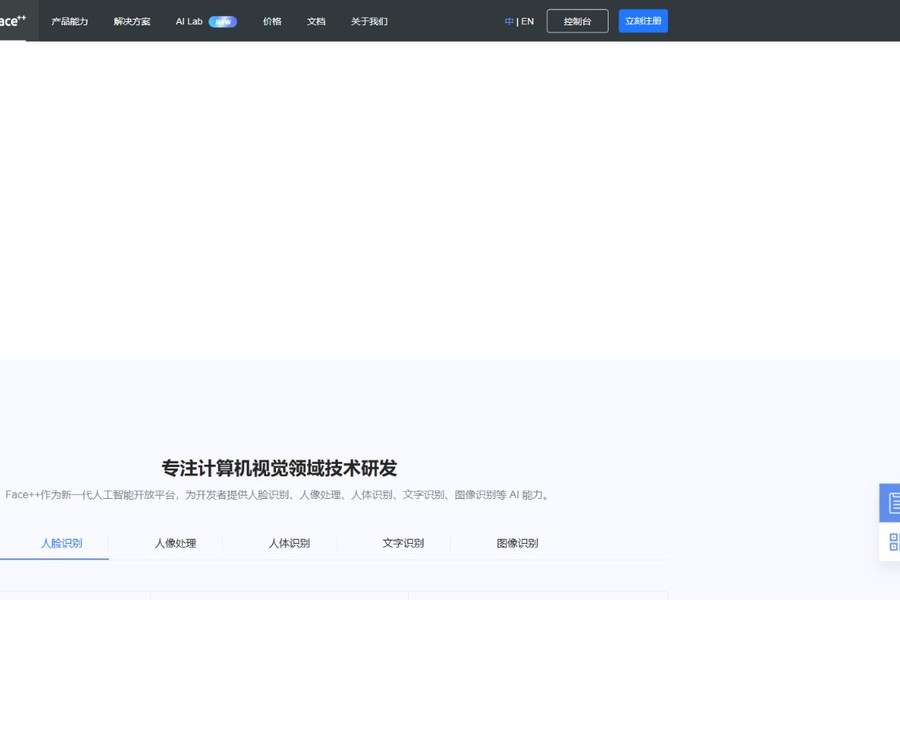
Megvii AI platform FACE++
Next-generation artificial intelligence open platform
Tags:Common AI image toolsWhat is Megvii Face++?
Face++ is an open computer vision platform operated by Beijing SenseTime Technology.
Developers can access visual capabilities through public cloud APIs, online or offline SDKs, server-side SDKs, and private solutions.
Core competencies
| Category | Key capabilities | Typical uses |
|---|---|---|
| Face recognition | Detection, comparison, search, attributes, and key points | Identity verification assistance and image analysis |
| Portrait processing | Integration, beautification, shaping, filters, and makeup testing | Applications in imaging and beauty industry |
| Human recognition | Human body detection, bone points, keying, and gestures | Separation of posture, interaction, and background |
| Text recognition | Documents, cards, business licenses, and general OCR | Information entry and document recognition |
| Image recognition | License plates, dog nose prints, scenes and objects | Vehicle, pet, and content understanding |
Face detection, comparison, and search
| Interface | Function | It cannot represent directly. |
|---|---|---|
| Detect | Detect face frames, key points, and attributes | Verify true identity |
| Compare | Compare the similarity between two faces. | It’s 100% the same person. |
| Search | Search for similar faces in the face database. | Make a final decision automatically. |
| FaceSet | Create and manage face collections | Obtain authorization for lawful processing |
| Analyze | Analyzing attributes based on facial tokens | Medical or personality conclusions |
The threshold should be determined by taking into account business risks, the rate of false positives, and the rate of false negatives; it cannot be simply copied from the example values.
Facial key points and 3D analysis
The platform offers capabilities such as regular keypoints, dense keypoints, facial features, and 3D face reconstruction.
- Keypoints can be used for alignment, special effects, and portrait processing.
- Dense keypoints are used for more precise contour localization.
- 3D reconstruction is used to establish the geometric information of faces.
- Skin analysis is used to assist in the assessment of visual condition.
- These outputs cannot replace medical examinations.
Portrait processing
Face++ offers functions such as face blending, beautification, profile enhancement, filters, stickers, and virtual try-on.
- Obtain explicit permission before using real-person photos.
- Avoid creating content that can be used for identity fraud.
- Beauty effects must not be used in misleading medical advertising.
- For commercial materials, it is necessary to verify the copyright of the portraits and templates.
- The synthesized content is appropriately labeled in accordance with the rules.
Human recognition
Human body capabilities include single or multi-person detection, attributes, 22 skeletal points, body keying, and gesture recognition.
- Complex occlusions and poses may reduce accuracy.
- Bone points cannot be used for medical diagnosis.
- Human attributes are the result of probabilities.
- For keying, it is necessary to check the hair and the edges.
- The categories currently supported for gesture recognition are as specified in the document.
OCR text recognition
| Interface type | Identifiable content | Key risks |
|---|---|---|
| ID card OCR | Text information on second-generation ID cards | Highly sensitive identity data |
| Driver’s license OCR | Information on the original and duplicate copies of the driver’s license | The validity of the documents still needs to be verified. |
| License OCR | Vehicle and owner information | Protection of personal and vehicle information |
| Bank card OCR | Information on the surface of the bank card | Recording of data such as security codes is prohibited. |
| Business license OCR | Enterprise registration information | Check the registration status and expiration date. |
| Universal OCR | Ordinary text in the image | Complex layouts may cause lines to shift. |
| Template OCR | Customized ticket and form areas | Template changes lead to identification errors. |
Image recognition
The image interface is used for special tasks such as license plate recognition, dog nose print identification, as well as scene and object recognition.
- At night, reflectivity and obstruction still need to be taken into account when it comes to license plates.
- Dog nose print recognition cannot replace legal registration.
- Scene and object outputs are predictions made by the model.
- The production system should include settings for confidence levels and manual review.
- Confirm the legal basis for processing before saving the image.
Public cloud API
Public cloud APIs are suitable for use by online applications such as mini-programs, H5 pages, web sites, and apps.
- Create an API Key and Secret in the console.
- The key is stored only on the server side.
- Submit the image or its URL as specified in the document.
- Handle timeouts, rate limiting, and error codes.
- Log the calls but avoid saving the original images in the logs.
SDK and private deployment
The SDK is suitable for video streaming on mobile devices and PCs, while the private deployment option is intended for use in scenarios with more stringent requirements regarding data, network performance, or latency.
| Form | Features | Suitable scenarios |
|---|---|---|
| Network authorization SDK | An internet connection is required for authorization. | Small and medium-scale end-user applications |
| Offline authorization SDK | The operation authorization does not depend on the public network. | Mature, large-scale businesses |
| Server-side SDK | Integrated on the institution’s server side | Background batch processing and system calls |
| Private deployment | Dedicated environment and project delivery | Sensitive data and internal network systems |
Face++ API Integration Tutorial
- Register an account on the Face++ console.
- Read the instructions regarding the required interfaces and data compliance.
- Apply for testing services and API keys.
- Configure keys and access control on the server side.
- Testing is carried out using fake or unauthorized data.
- Submit the images and necessary parameters according to the document.
- Parsing results, confidence level, and error codes.
- Set business thresholds and manual review processes.
- Test scenarios of misrecognition, rejection, occlusion, and attack.
- Complete the impact assessment for personal information protection.
- Switch to official service and monitor costs and QPS.
- Regularly delete data that is no longer needed.
Pay-as-you-go API pricing
The official API price list was last updated on June 6, 2023; the following are some of the representative unit prices listed therein.
| API | Official document unit price | Official QPS |
|---|---|---|
| Face detection | 0.001 yuan per transaction | 10; after corporate certification, it can reach 20. |
| Face comparison | 0.01 yuan per transaction | 10; after corporate certification, it can reach 20. |
| Face search | 0.01 yuan per transaction | 10; after corporate certification, it can reach 20. |
| Face database management | 0.0005 yuan per transaction | In accordance with the rules of the facial recognition service |
| Human body detection | 0.002 yuan per transaction | 1 |
| Human body keying | 0.004 yuan per session | 1 |
| ID card recognition | 0.01 yuan per transaction | 3 |
| Business license identification | 0.05 yuan per transaction | 1 |
| License plate recognition | 0.01 yuan per transaction | 2 |
The price was verified on August 30, 2026; the document was updated some time ago, so it is necessary to refer to the current information in the console before making a purchase.
Package duration and number of packages – package prices
| Plan | Representative official price | Rules |
|---|---|---|
| Face recognition API package | 1 QPS × 1 day = 100 yuan | Unlimited call volume during the paid period |
| Face recognition API package | 1 QPS × 30 days = 1,000 yuan | Cover the specified facial recognition interface group |
| Human face recognition API package | 1 QPS × 30 days = 1,000 yuan | Includes human body detection and bone point detection. |
| Universal text recognition | 1 QPS × 30 days = 500 yuan | The current interface version shall prevail. |
| License plate recognition | 1 QPS × 30 days = 1,000 yuan | Suitable for stable and continuous calls. |
| Number of packages | Pricing based on volume tiers | The validity period of a single usage package is 1 year. |
Failed calls may also incur charges.
With pay-as-you-go services, not only are charges incurred when a request is successfully processed, but small fees can also be generated due to incorrect parameters or delays in image downloading.
- Some calls within category 400 are charged at 0.0005 yuan each.
- A charge of 0.001 yuan is applied for delays in downloading image 412.
- Verify the parameters and image accessibility before going live.
- Do not retry failed requests indefinitely.
- Monitor abnormal and erroneous consumption through bills.
What needs to be confirmed before making a purchase?
- Interface version and accurate unit price.
- Difference in QPS between testing and production services.
- Applicable costs for pay-as-you-go, hourly, or fixed-quantity plans.
- SDK platform, number of devices, and authorization period.
- Fees for failed calls, storage, and value-added services.
- Contracts, invoices, and service levels.
- Data deletion, privatization, and exit mechanisms.
Biometric recognition and compliance with personal information regulations
Face images, ID cards, and personal biometric data are highly sensitive, and they should not be collected merely because the technology makes it possible to do so.
- Clear, reasonable, and necessary purposes for processing.
- Provide thorough information prior to collection.
- Obtain separate consent or other basis in accordance with the law.
- Provide reasonable alternatives that do not rely on facial recognition.
- Complete the impact assessment for personal information protection.
- Strictly limit the retention period and the users who have access.
- Encrypt transmission, templates, and backups.
Model bias and threshold testing
- A test set based on the actual population distribution is used.
- Calculate the rates of false acceptance and false rejection separately.
- Test age, lighting, posture, and occlusion.
- High-risk outcomes should not be determined solely by algorithms.
- Provide channels for appeals and manual correction.
- Verification is performed again after the model is updated.
GitHub and the open-source status
The official FacePlusPlus GitHub organization has made available SDK repositories for Java, Matlab, and other languages; some of these are intended for use with the older V2 API.
- The release of an example SDK does not equate to the open-sourcing of the cloud platform.
- Before connecting, check the warehouse update time and interface version.
- Third-party PHP or framework wrappers are not official SDKs.
- The licensing for MegEngine by Megvii is different from that of the Face++ service.
- The core business algorithms and platform services have not been made fully open source.
Which developers and companies are suitable?
- The team responsible for developing identity verification assistance systems.
- Companies that develop applications for portrait creation and the beauty industry.
- Developers who need human pose detection and keying.
- Handling OCR tasks for documents and invoices.
- Systems that require license plate or scene recognition.
- Organizations with needs for offline or privatized solutions.
Product advantages
- Computer vision capabilities have a wide range of applications.
- It also offers APIs, SDKs, and a private deployment option.
- The official documentation lists the detailed interfaces and prices.
- Supports pay-as-you-go, package-based, and usage-based pricing.
- Provide compliance, security, and access documentation.
Usage restrictions and precautions
- Some of the official price documents were updated quite some time ago.
- The model results exhibit misidentifications and group differences.
- Some failed calls may also incur fees.
- Face and identification data must comply strictly with regulations.
- The trial service cannot be used directly in production.
- The older version of the GitHub SDK may be incompatible with the current interfaces.
- The final decision is that manual review must be retained.
Frequently Asked Questions
What capabilities does Face++ mainly offer?
It offers face, portrait, human body, OCR, and image recognition functions, and supports API, SDK, and private access.
Can Face++ be tested for free?
A free testing service can be requested, but the QPS, stability, and features of this testing service differ from those of the official production service.
What is the difference between face detection, comparison, and search?
Detection is used to locate faces, comparison is used to compare two faces, while search is used to find similar individuals in a face database.
How is the Face++ API priced?
It supports payment based on usage volume, by time package, or by number of operations; the cost for detecting a representative face is 0.001 yuan per operation, while the cost for comparison is 0.01 yuan per operation.
Is there a fee for failed API calls?
Certain parameter errors and delays in image downloading incur fees; the specific error codes and pricing are specified in the current official documentation.
Is Face++ an open-source platform?
No, the official team has made some SDK repositories available publicly, but the cloud platforms, core algorithms, and commercial services have not been made fully open source.
Can facial recognition be the sole basis for making a decision?
It is not recommended; for high-risk operations, manual review, alternative verification methods, appeal channels, and continuous deviation testing should be implemented.
Tools similar to the Megvii AI platform FACE++.




 Guigong Network Security Registration No. 45132202000164