






Depix
Depix – makes AI-based image processing more efficient and simpler.
Tags:Common AI image toolsWhat is Depix?
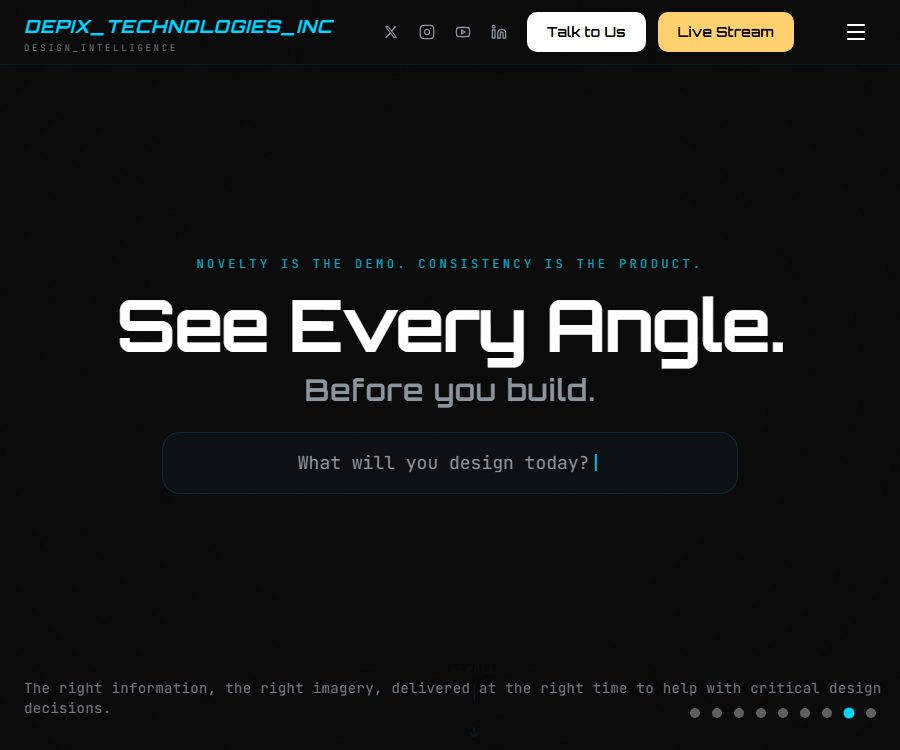
Depix is an AI-driven design platform developed by Depix Technologies, Inc. in Montreal, Canada; it is designed to serve teams working on automotive, transportation, and industrial products. It brings together concept generation, exploration of colors, materials, and surface treatments, image iteration, video presentation, and early-stage 3D modeling within a single design workspace.
The platform focuses on addressing the issues related to idea generation, brainstorming, and decision-making prior to the use of formal CAD tools in engineering projects. It generates outputs that help convey the design direction and facilitate reviews, but it does not include data such as dimensions, tolerances, collision safety considerations, material strength, or manufacturability aspects.
Product composition
| module | Main inputs | Main output | Suitable for tasks | Access Instructions |
|---|---|---|---|---|
| Design Lab | Project brief, images, and generation results | Project space, asset library, comparison and demonstration | Organizational concepts, collaborative review, and project reporting | Core of enterprise workflows |
| Product Vision | Written ideas or oral briefings | Product concept and realistic display images | Early direction exploration without a sketch | Testing and enterprise access depend on the account. |
| CMF Vision | Product images, colors, materials, and trend requirements | Variants in color, material, and surface treatment | CMF research and product line exploration | Features may be made available in stages. |
| Video Lab | Product stills or rendered images | Camera movement, lighting effects, and short videos | Concept proposal and presentation demo | The quota is determined according to the plan. |
| Product Shape | Product intent, image, or shape orientation | 3D shapes that can be explored further | Divergence in proportions, contours, and structure | It belongs to the preliminary design phase and is not equivalent to CAD for production. |
| ImageLab | Prompt, sketch, CAD screenshot, or image | Generate images, enhanced images, product photos, and videos | Product photography, architecture, fashion, and automotive visualization | The web version provides a dedicated interface for creative work. |
Main functions
Text to product concept
Users describe the product category, design language, usage scenarios, materials, and the intended mood in natural language, and Product Vision uses this information to generate realistic concept images. It is suitable for quickly creating a subject of discussion when no complete sketches are available, and it also allows multiple approaches to be developed for designers to consider, all based on the same objective.
Convert sketches and CAD screenshots to renders
ImageLab can take in rough sketches, reference images, or CAD screenshots to create a more detailed visual representation of the product, including aspects such as lighting, materials, and the environment. The clearer the outlines, proportions, and key features in the input, the easier it is to maintain the intended design; however, structural variations may still occur even after generating the image multiple times.
Color, material, and surface treatment
CMF Vision is used to apply colors, materials, textures, and surface treatment options to product images, allowing for quick comparison of various combinations. It reduces the time needed to explore trends and preview outcomes, but screen rendering cannot replace physical samples of materials, durability tests, or verification through the supply chain.
Image editing and enhancement
The platform allows for image creation, partial modifications, scene replacement, exploration of different styles and materials, zooming in for detailed viewing, as well as converting materials that are not yet fully developed into presentable images. Designers can retain the valuable elements of an image and then adjust the background, lighting, and details step by step, using hints and reference images.
Convert static images to video
Video Lab converts the rendered version of the selected product into short videos featuring camera movements, changes in lighting, or animations. It is suitable for design reviews, client presentations, and concept presentations; however, the geometric continuity, logos, and detailed elements in the output still need to be checked frame by frame.
Early-stage exploration of 3D shapes
Product Shape allows for the creation and adjustment of a product’s shape based on specific intentions or images, enabling the team to examine proportions, contours, and overall volume before moving on to traditional modeling. The result is a design direction along with relevant documentation; it should not be considered a ready-to-produce model with engineering constraints.
Project and Asset Management
The Design Lab allows for saving projects, creating diagrams, developing CMF solutions and iterating on design concepts; it also supports functions such as searching, comparing, sharing, and presenting results. The outputs from various design agents are brought together in the same workspace, which helps the team to move from a range of potential options to a selected direction.
Dialogue with design consultants
Raymond is a conversational assistant designed with an industrial design mindset; it can be used to discuss design shapes, brand expression, and decision-making regarding concepts. It provides creative feedback rather than engineering validation, and design decisions still need to take into account user research, brand guidelines, and professional evaluations.
Complete usage process
- Create a project and specify the product type, target audience, brand language, usage environment, as well as any design constraints that must be respected.
- Upload sketches, product images, CAD screenshots, or reference materials; in cases involving confidential projects, first check the account’s data and deployment terms.
- Use Product Vision, ImageLab, or CMF Vision to generate variations of concepts, materials, and scenes, ensuring that only a small number of key variables are changed in each iteration.
- In the Design Lab, compare the results and identify the proportions, contours, details, and materials that can be retained, then proceed with targeted iterations.
- When dynamic display is required, the selected still image is sent to Video Lab; when shape transition is needed, Product Shape is used to explore the 3D dimensions.
- Review it together with the design, engineering, marketing, and management teams to verify brand consistency, originality, manufacturability, and budget.
- The selected visuals are exported as proposals or inputs for the preliminary design, after which further development is carried out through CAD, engineering simulation, prototype creation, and material testing.
Input and output
- Text input: product concept, design brief, material requirements, scenario, camera settings, and revision instructions.
- Image input: sketches, reference images, photos of existing products, CAD screenshots, and materials to be enhanced.
- Generated outputs: conceptual renders, product photography-style images, scene images, CMF variations, and enhanced images.
- Dynamic output: Videos and animated effects based on static images of the product.
- Shape output: The 3D dimensions used for preliminary exploration and design handover; the specific format and engineering compatibility should be determined through pilot projects.
- Project outputs: a searchable asset database, solution comparisons, and presentation materials for clients or management.
Suitable for users
- Automobile and transportation design team: Rapid exploration of exterior design, lighting, interior elements, and CMF aspects.
- Industrial and consumer product designers: Develop product concepts from text or sketches, and increase the number of options available.
- Design lead and design operations team: Responsible for the centralized management of initial assets, the scheduling of reviews, and decision-making across different teams.
- Brand and marketing team: Prepare concept sketches, product scenarios, and demonstration videos before starting formal production.
- Corporate Innovation Department: Conducts pilot tests within defined scopes to evaluate the value of AI in existing design processes as well as the associated security requirements.
Typical scenarios
- When a new vehicle model or product is planned, multiple visual concepts are developed quickly, and only after selection are resources allocated for modeling.
- Convert hand-drawn sketches or incomplete CAD screenshots into realistic images that are easier to communicate.
- For the same product, compare combinations of colors, metals, fabrics, plastics, and surface textures.
- Create consistent concept diagrams, solution comparisons, and short videos for management reviews.
- Preview the display environment, lighting, and visual presentation before product photography or the prototype is completed.
Price and availability
Depix’s current main website does not display a unified currency-based price; enterprise users can take advantage of services through workshops, time-limited trials, or large-scale deployments, while individual creators can request access via private testing. Time-limited prices have been shown on historical pages or for specific events, but these cannot be considered as the standard pricing for the entire platform at present.
| Package or version | Price | Billing cycle | Core benefits or quota | Suitable for users |
|---|---|---|---|---|
| Design Intelligence Mapping | Contact sales | 2 to 3 days workshop | Process review, design data mapping, use case selection, security requirements, and pilot roadmap | Team prepared to evaluate the AI design process |
| 4-Week Pilot Sprint | Contact sales | 4-week pilot | Design Lab settings, image exploration, regular reviews, prototypes, and final presentations | Companies that wish to verify their value through real-world projects |
| Enterprise Studio Deployment | Custom quote | In accordance with the contract | Private data, multi-team spaces, SSO, management and governance, as well as private cloud or on-premises deployment | Automobile manufacturers and large design firms |
| Individual creator testing | Not yet made public | Private testing | Specific features, limits, and operating hours depend on the approved account. | Independent designers and early adopters |
There are no current unified rules in place regarding refunds, cancellations, excess usage, and renewal details. Before making a purchase, it is necessary to clarify the costs, quotas, data processing options, terms for termination, and refund conditions through a pilot order or corporate contract.
Platforms and integration
| Platform or capability | Support status | Explanation |
|---|---|---|
| Web application | Support | Design Lab, ImageLab, and the testing entry points are primarily browser-based. |
| Team workspace | Support | Offers project, asset, sharing, role, and auditing capabilities |
| REST API | The company provides | Public certification, endpoints, SDKs, and individual pricing are not yet available; confirmation from sales is required. |
| Private cloud and on-premises deployment | Available for enterprises | Used for data residency, network isolation, and enterprise security requirements |
| Native iOS and Android apps | No findings yet. | Accessing via a mobile browser is not the same as using the official native app. |
| Browser extensions | No findings yet. | No official extensions released by Depix Technologies have been identified. |
API and open-source status
Depix indicates that enterprise solutions can be integrated into existing design processes via REST APIs, but no public development documentation, SDKs, authentication methods, rate limits, or API pricing information is available at the moment. Teams that wish to carry out such integration should request a list of interfaces, a sandbox environment, error-handling mechanisms, data retention policies, and support commitments as part of a pilot project.
The core platform of Depix is not a product with publicly available source code, nor does it possess a verifiable open-source license. There are several projects on the internet that use the same name for pixel restoration or payment purposes; these projects have nothing to do with this industrial design platform, and therefore they cannot be used as evidence to conclude that Depix is open-source.
Copyright and Commercial Use
Users retain ownership of the assets they create through the service to the greatest extent permitted by applicable law, and this right remains in effect even after their membership is downgraded or canceled. If images from others are enlarged or processed, the original rights to those images still belong to their respective creators; users must ensure that they have the authority to upload and use such materials.
- The scope of copyright protection for the generated assets varies depending on the jurisdiction and the effort invested in human creation.
- Before commercialization, it is necessary to check whether the output resembles existing products, trademarks, patented designs, or protected configurations.
- The platform prohibits infringement of intellectual property rights, fraud, concealment of the AI-generated nature of content, political campaigning, and illegal material.
- The terms prohibit reselling access to the platform, automated scraping, reverse engineering, and using the service to develop competitive products.
- An AI concept diagram cannot prove that a design is original, manufacturable, or compliant with industry regulations; legal and engineering reviews are still required.
Privacy and data processing
Depix handles registration and billing information, usage records, IP addresses, cookies, prompts, uploaded sample images, favorites, as well as the generated results; this is done to provide and improve services, facilitate transactions, offer personalization, conduct analysis, and ensure compliance. The data may be processed by payment, analysis, and customer service providers, and it may also be stored in Canada or other jurisdictions.
- The platform states that it does not sell or rent personal information, but it may disclose such information when required by law or as part of business transactions.
- Personal information is retained for as long as it is necessary to achieve the intended purpose of processing; there is no fixed, unified deadline for its deletion.
- Users can request access to or correction of their information, and can unsubscribe from marketing messages as well as manage browser cookies.
- The privacy policy does not specify whether all uploaded designs are used for training purposes; confidential projects should be covered by separate corporate contracts.
- For projects that contain customer data, unreleased products, and NDA-related materials, approved private deployment and data terms should be used preferentially.
Enterprise security
- SOC 2 Type II: It is used to demonstrate that an organization’s controls have been independently audited, but it does not mean that there are no risks in all scenarios of use.
- Transmission and storage: It is specified that TLS 1.3 is used for transmission encryption, while AES-256 is employed for static encryption.
- Permission management: It offers role-based access control, team spaces, and audit logs.
- Identity access: The enterprise solution supports SAML and OIDC for single sign-on.
- Deployment options: Private cloud or on-premises deployment are available, and data residency controls can be discussed.
Product advantages
- It is focused on the design of products and vehicles, rather than simply creating generic artistic images.
- Link text, sketches, reference images, renderings, CMF data, videos, and form exploration into a continuous process.
- Design Lab allows for the centralized storage, retrieval, comparison, and display of the results from multiple agents.
- The enterprise solution covers identity management, permissions, auditing, and private deployment, making it suitable for inclusion in formal security assessments.
- First, the value is assessed through mapping and pilot tests, which helps to mitigate process risks prior to large-scale procurement.
Restrictions and Precautions
- The public prices, individual quotas, export formats, resolution levels, and API restrictions are incomplete; account verification or confirmation from sales is required.
- The generated image may exhibit geometric drift, incorrect reflections, structures that are not feasible to manufacture, as well as distorted text and labels.
- In the initial stage, 3D and visual concepts are not used for creating CAD models; it is impossible to bypass engineering modeling, simulation, prototyping, and testing.
- Some agents are in the testing phase or available in a phased manner, and different accounts may have access to different functions.
- The service does not guarantee stability, continuous availability, or specific output attributes; therefore, unverified results should not be used as the sole basis for making decisions.
- The public privacy policy does not specify the deadlines for excluding certain design data from training processes or for permanently deleting such data; companies must provide these details in the contracts.
Frequently Asked Questions
Is Depix suitable for basic photo editing?
ImageLab can be used to create, enhance, and modify images, but Depix’s main focus is on product concept development and industrial design workflows. Users who only need basic cropping, color adjustment, or batch image editing may not require a full-scale enterprise platform.
Is it not possible to use any sketches?
Yes. Product Vision allows for the creation of concept diagrams from text or verbal descriptions, while sketches and reference images help in controlling the outlines, proportions, and visual orientation.
Can the generated 3D model be manufactured directly?
It cannot be understood in that way. Product Shape is intended for the initial exploration of the form; the final product still requires determination of dimensions, tolerances, materials, structure, compliance with regulations, and manufacturing verification.
Is there a free version of Depix?
The current main site does not list any unified free plans; individual users can request private testing. For corporate workshops, 4-week trials, and deployments, it is necessary to get in touch to determine the costs and available quotas.
Can the generated images be used for commercial purposes?
Users are entitled to own the assets they create within the limits permitted by applicable laws, but they must have the rights to the materials used and must ensure that trademarks, copyrights, designs, and the overall originality of the output are respected. The specifics depend on the terms of the contract and the laws in force in the relevant jurisdiction.
Is Depix open-source software?
It is not a verified open-source product. The core platform, models, and enterprise APIs do not come with publicly available source code or licenses; the repositories with similar names on the Internet are unrelated to this product.
Are sensitive design data suitable for uploading?
Enterprise solutions offer private clouds, on-premises deployment, as well as capabilities for permission management and auditing; however, it is still necessary to first clarify the terms related to data exclusion during training, data saving and deletion, data retention, and vendor access. Unreviewed public test accounts are not suitable for use in NDA agreements or in documentation related to unreleased products.
Summary
Depix organizes product concepts, conceptual rendering, CMF design, videos, and preliminary 3D explorations into a collaborative workflow for design teams. It is useful for expanding the range of possible solutions and accelerating reviews before moving on to CAD, but its price, feature set, and data policies need to be confirmed through trials or corporate contracts.
Tools similar to Depix




 Guigong Network Security Registration No. 45132202000164