






Artivatic AI
Artivatic AI makes AI-based image processing more efficient and simpler.
Tags:Common AI image toolsWhat is Artivatic AI?
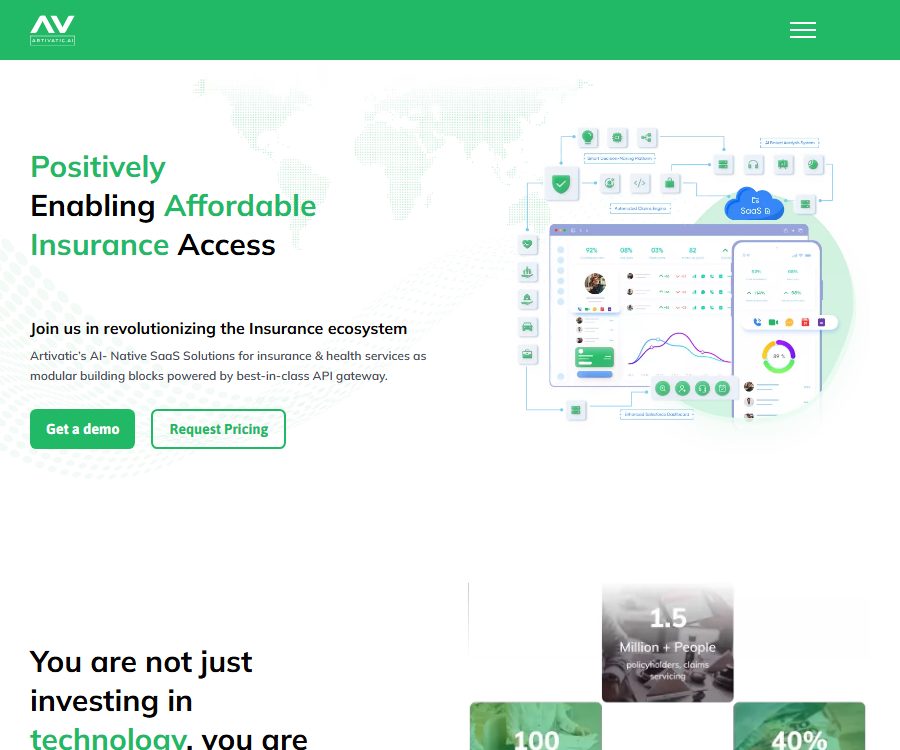
Artivatic AI is an enterprise-grade, AI-based platform designed for the insurance and healthcare industries. Through modular products, API gateways, and data models, it helps insurance companies, brokers, medical institutions, and fintech firms to carry out digital processes such as underwriting, claims processing, distribution, and risk management.
Artivatic is now part of the RenewBuy system; product purchases are primarily carried out through demonstrations and requests for quotes. It is not a general AI application designed for individual users to use for chatting, writing, or creating images.
The main functions of Artivatic AI
Intelligent underwriting
AUSIS provides real-time underwriting for life and health insurance, carrying out risk analysis by combining policy application details, health information, financial data, and data from third parties. The system allows for the configuration of business rules, risk scoring methods, and manual underwriting workflows.
Insurance product design
PRODX Design is used to design insurance products and define their terms and rules, incorporating analysis based on historical claims data, underwriting risks, and geographic information. It helps the product development team shorten the time required to move from concept discussion to the actual implementation of the products.
Distribution and embedded insurance
PRODX Distribution is designed for B2B2C distribution, brokers, and partners, enabling the integration of insurance products into existing business operations. Companies can use API connections to access functions such as quoting, purchasing, renewing policies, receiving services, and filing claims.
Intelligent claim processing
ALFRED and related platforms are used for health claim processing, pre-authorization, document management, and rule-based decision-making. AI can assist in identifying abnormalities, organizing medical documents, and suggesting appropriate action steps, but the final decisions regarding compensation must still be made in accordance with contracts and regulatory requirements.
OCR and intelligent document processing
Artivatic offers OCR/ICR and document analysis services for processing KYC, financial, medical, claims, and insurance forms. The system is capable of extracting fields, matching data, and delivering the results to the underwriting or claims processing workflows.
Risk assessment and anti-fraud measures
The platform identifies risks by leveraging historical data, images, location information, claims patterns, and business rules. It can be used for pre-application assessments, detection of early signs of claim fraud, identification of instances of waste and abuse, as well as screening for abnormal cases.
Insurance API Cloud
The official website states that the platform offers more than 400 APIs for developing components related to insurance and health services. These APIs cover areas such as identity, location, finance, healthcare, policies, payments, claims processing, and integration with partner systems.
Health data and services network
NiO Health is used for managing personal health records, while the modules related to ABDM deal with ABHA accounts and the authorization of health records. The healthcare provider network platform connects patients, hospitals, insurance companies, and payment processes.
Payment, settlement, and renewal
Artivatic also offers functions related to purchasing, renewing contracts, making payments, settling accounts, tracking renewal rates, and collecting overdue amounts. The specific cash flows, licensing responsibilities, and payment partners need to be specified in the project contract.
Main products and uses
- AUSIS: Intelligent underwriting and risk assessment for life and health insurance.
- ALFRED: Health claims, pre-authorization, and automated processing.
- ASPIRE: Employee health, group insurance, and insurance for small and medium-sized enterprises.
- INFRD: Insurance API infrastructure and location intelligence.
- NiO Health: Personal health records and patient services.
- PRODX Design: Design of products, rates, rules, and risks.
- PRODX Distribution: Insurance distribution and embedded insurance.
Which institutions are suitable?
- Life and health insurance companies that need to upgrade their underwriting, claims processing, and policy administration processes.
- Brokerages and distribution platforms that wish to sell multiple products through APIs.
- Fintech companies that integrate insurance into loans, e-commerce, travel, or corporate services.
- Operations centers that require automatic processing of medical and financial documents.
- A health platform that requires collaboration among patients, hospitals, third-party management agencies, and insurance providers.
- Large enterprises that wish to meet data and regulatory requirements by opting for on-premises deployment.
Artivatic AI implementation process
- Identify the specific business processes that need to be improved, such as new policy underwriting, health claims processing, or channel distribution.
- Organize the existing core systems, interfaces, documents, rules, and regulatory requirements.
- Schedule a product demonstration and ask the supplier to show a real-world process that corresponds to the target scenario.
- Select a small number of products or organizations to carry out concept validation, and define accuracy rates as well as criteria for manual review.
- Configure rules, scoring, role permissions, and exception handling; do not simply follow the model’s recommendations.
- It connects core insurance services, hospitals, payment systems, and third-party data interfaces.
- Proceed with production only after completing assessments of security, privacy, model bias, and auditing.
- Continuously monitor the fairness of denials, rate increases, claims processing, and fraud flags, as well as the outcomes of appeals.
What should be confirmed before making a purchase?
- The quote includes the products, the number of API calls, as well as users and environments.
- Model training data, accuracy, target audience, and known biases.
- A storage area for personal, health, financial, and biometric data.
- Can rule modifications, model updates, and decision versions be fully audited?
- Who is responsible in case of misjudgments, service disruptions, and regulatory changes?
- Ways of exporting, deleting data, and migrating the system after the contract ends.
The advantages of Artivatic AI
- It focuses on the insurance and healthcare industries, and is not merely a simple application of general AI capabilities.
- It covers the entire process, including product design, underwriting, distribution, claims processing, and renewal.
- APIs, SDKs, SaaS, and on-premises solutions cater to different enterprise architectures.
- Document recognition, risk models, and business rules can be integrated into existing processes.
- It offers a variety of modules designed for insurance companies, brokers, medical institutions, and businesses.
- It supports low-code or no-code configuration, reducing the development effort required to make changes to certain business rules.
Usage restrictions and risks
- Insurance pricing, denial of claims, and claim processing are decisions with a high impact, and they cannot be handled solely by black-box models.
- Health, financial, identity, and biometric data are highly sensitive.
- The performance of the model may vary across different regions, populations, diseases, and products.
- Automated document extraction can result in field errors; key amounts and diagnoses must be verified manually.
- The efficiency, speed, and accuracy of the official website are based on the manufacturer’s examples and cannot serve as a substitute for verification by our organization.
- The deployment cycle depends on the core systems, third-party data, the number of rules, and regulatory approvals.
Human decision-making and appeals
The system is suitable for assisting with sorting, extraction, scoring, and recommendations; however, necessary manual underwriting and claim review processes should not be eliminated. Customers should also have access to means to understand decisions, correct inaccurate information, and file complaints.
Companies need to keep track of the data, rules, model versions, and records of any manual adjustments used in each decision. Only by having traceability can they deal with regulatory inspections and customer disputes.
Price of Artivatic AI
As of August 26, 2026, the official website offers only options to “get a demo” and “request a price quote”; there is no information available regarding self-service packages, fixed monthly fees, free usage quotas, trial periods, or refund policies.
The pricing offered by companies is usually influenced by factors such as the number of modules, the number of API calls, data sources, the scope of integration, custom models, the method of deployment, the level of support provided, and compliance requirements. Purchasers should request that the costs associated with implementation, subscriptions, API calls, maintenance, and third-party services be listed separately.
Data, Security, and Compliance
The data processed by Artivatic may include insurance policies, health records, financial information, identification documents, images, and claims details. The official website provides links to pages on privacy, security, terms, and cancellation policies; however, specific services require the signing of agreements regarding data processing, confidentiality, and service levels.
When using SaaS or APIs, it is necessary to take into account issues such as data cross-border transfer, sub-processors, and log retention; when opting for local deployment, it is important to determine whether remote support and model updates will result in data being transmitted outside. The capabilities related to ABDM should be implemented in accordance with the current regulations regarding health data in India.
Is Artivatic AI open source?
No official open-source repository for Artivatic’s complete insurance platform or its core models has been identified; therefore, it should be classified as a proprietary enterprise product. The provision of APIs and SDKs merely indicates the existence of integration interfaces, and does not mean that the business platform, model weights, or server-side code are made available publicly.
Frequently Asked Questions
Is Artivatic AI suitable for individual users?
It is not suitable for general individual AI-based Q&A. It is primarily intended for insurance companies, brokers, enterprises, and healthcare institutions, and requires demonstrations, integration, and enterprise-level procurement.
Can Artivatic AI perform intelligent underwriting?
Yes. AUSIS utilizes business rules, insurance data, and AI models to assist in the underwriting of life and health insurance policies, but decisions with a high impact still require human intervention and regulatory oversight.
Does Artivatic AI provide APIs?
Available. The official website states that Insurance Cloud boasts over 400 APIs, and it supports various delivery methods such as APIs, SDKs, SaaS, and on-premises deployment.
Can Artivatic AI handle claims processing?
Yes. The platform handles tasks such as health claim processing, document management, anomaly detection, pre-authorization, and rule-based decisions; ultimately, it is the insurance company that decides on the compensation in accordance with the law.
How much is Artivatic AI?
The official website does not disclose a fixed price; a corporate quote must be requested based on the product modules, volume of usage, deployment requirements, integration needs, and support requirements.
Is Artivatic AI an open-source tool?
No. There is no verification of an open-source license for the entire platform or its core models; the availability of APIs and SDKs does not mean that the product itself is open source.
Tools similar to Artivatic AI




 Guigong Network Security Registration No. 45132202000164