






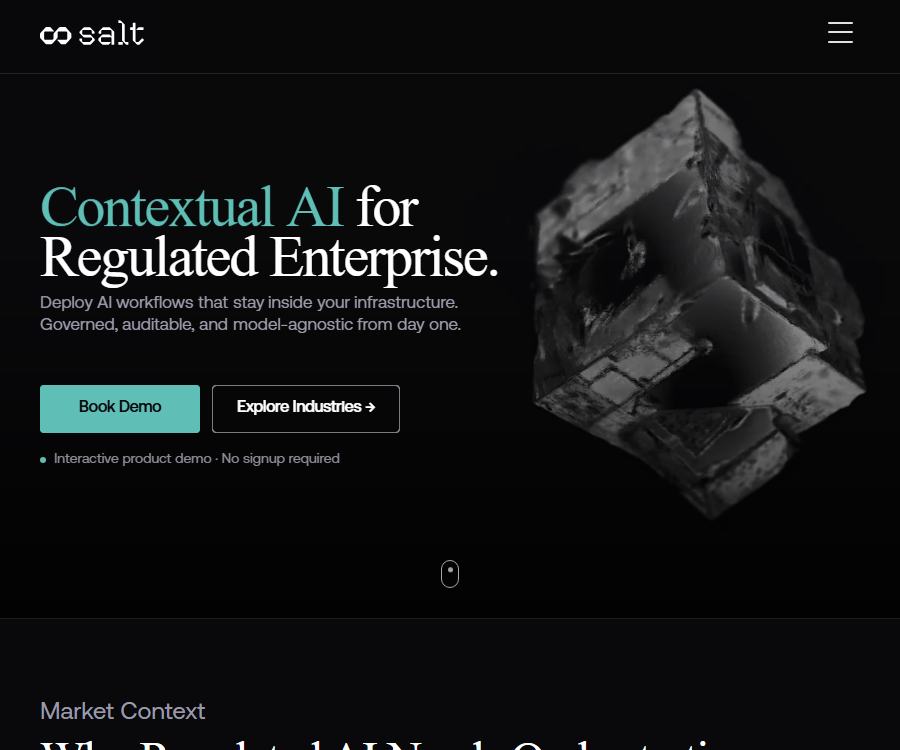
Plailabs
Plailabs: an intelligent tool specialized in AI-powered image processing.
Tags:Common AI image toolsTool Introduction
In the database, Plailabs corresponds to Salt AI and its Salt OS enterprise platform; its focus has shifted from general-purpose AI collaboration in the early stages to the use of AI solutions in regulated industries. It is used to connect models, data, and processes within an organization’s own infrastructure, while also maintaining records of permissions, operations, and audit information.
Main functions
Visualize AI pipelines
Teams can connect models, data sources, tools, and processing steps within the node canvas to create reusable pipelines. The platform is designed for both those who work without writing code and for technical professionals who need to write custom code.
- Nodes have input and output types, and can be executed in the order of the data flow.
- It supports viewing operation history, logs, version snapshots, and collaborative editing by multiple users.
- Different models can be replaced to test performance, thereby reducing reliance on a single model supplier.
Private deployment and data governance
Salt OS emphasizes operation within an environment under the customer’s control, and it supports private clouds, on-premises enterprise environments, as well as isolated network setups. Its features such as access control, audit tracking, and data residency are suitable for organizations that require strict governance; however, the actual scope of authentication shall be determined in accordance with the contract and audit reports.
- It can be deployed in enterprise cloud VPCs, and it supports AWS, Azure, OCI, and GCP.
- It can be deployed in a containerized manner within one’s own data center, while connecting to existing identity systems and retention policies.
- In highly sensitive environments, isolated deployment without access to the public internet can be employed.
Deployment, operation, and monitoring
The completed workflows can be made available as web forms or via APIs; they also enable the execution of batch tasks with tracking of each execution. The platform records inputs, parameters, outputs, and errors, which facilitates troubleshooting and oversight.
- Workflows can be saved, shared, deployed, and their execution status can be viewed.
- API deployment allows for the configuration of public input and output fields, with results returned via callbacks.
- Enterprises can conduct centralized monitoring of failed nodes, model performance, and operational results.
Connectors, knowledge bases, and models
Pipeline can connect to enterprise data sources, knowledge bases, model services, and custom nodes, allowing for the replacement of components without having to rebuild the entire process. Each connection still requires separate configuration of credentials and access rights.
Usage process
- Contact the Salt AI team to provide details on the industry, the location of the data, compliance requirements, and the desired workflow.
- Choose between hosted, private VPC, on-premises data centers, or isolated environments, and complete the configuration for identity, networking, and data connections.
- Add models, data, tools, and output nodes to the canvas, connect edges, and set parameters.
- Run the Pipeline using test data, and check the logs, output quality, permissions, and audit records.
- Publish the stable process as internal forms, APIs, or proxy tools, and then set up monitoring, version control, and change approval processes.
Comparison of deployment methods
| Deployment method | Operation location | Key capabilities | Suitable scenarios |
|---|---|---|---|
| Private VPC | The customer’s AWS, Azure, OCI, or GCP environments | By default, there is no outbound data transmission to the public internet, along with no permission or audit controls. | Cloud-based enterprises that require rapid implementation |
| Local deployment | The company’s own data center | Control hardware, networking, storage, identity, and retention policies | Healthcare, finance, and critical infrastructure |
| Isolated deployment | Independent environment without public network access | Suitable for highly sensitive or confidential networks | Government, defense, and strict data boundaries |
Which users are it suitable for
- Life science teams that need to organize biomedical models, literature, and internal experimental data into an auditable process.
- Financial and energy companies that need to run models on their own infrastructure while meeting requirements regarding data retention.
- Enterprise AI platform teams that need to manage multiple models, knowledge bases, connectors, and permissions in a unified manner.
- A cross-functional organization is desired, one in which business experts and engineers work together to maintain production-grade AI processes.
Prices and Purchases
The official website does not currently disclose the prices of standard packages, seat fees, or the cost per unit of resources; it offers interactive demonstrations and the possibility to schedule corporate consultations. The deployment costs are influenced by factors such as infrastructure, the number of users, connectors, implementation services, and compliance requirements, and the actual prices shall be based on formal quotes and contracts.
| Package or version | Price | Billing cycle | Core benefits or quota | Suitable for users |
|---|---|---|---|---|
| Interactive product demonstration | Free trial | One-time experience | It is possible to understand the product process without registering; this is not equivalent to having a production account. | Preliminary assessment team |
| Enterprise deployment | Contact sales | The authorities have not made this information public yet. | Private deployment, model and data orchestration, governance, auditing, and the scope of implementation are determined as per the contract. | Regulated enterprises and public institutions |
Product advantages
- Centralize models, enterprise data, permissions, operations, and auditing in the same orchestration layer.
- It supports various methods of private deployment, enabling it to meet different data boundaries and network conditions.
- Visual pipelines coexist with custom code, allowing business experts and engineering teams to work together on their maintenance.
- Workflows can be published as APIs, forms, or proxy tools to facilitate integration with existing applications.
Usage restrictions and precautions
- This is an infrastructure product designed for businesses; it is not suitable for ordinary individuals who merely want to use a single chatbot quickly.
- Private deployment does not automatically meet all regulatory requirements; organizations still need to conduct risk assessments, validations, permission design, and ongoing audits.
- Models, cloud resources, and third-party data sources may incur additional costs, and their service terms are separate from those of Salt.
- The current privacy policy states that the service is intended for users in the United States; organizations in other regions should verify the availability of the service and the arrangements for data processing before making a purchase.
- The write permissions for generating APIs and MCPs, as well as those used to manage enterprise resources, should be adjusted as necessary; the principle of least privilege should be applied, and access tokens must be protected.
API, MCP, SDK, and open-source status
Salt allows pipelines to be published as APIs, and it offers remote MCP services with OAuth support for reading or managing workflow, execution, node, knowledge base, and model resources. The official product page mentions API and SDK integration, but the public documentation does not state that the entire platform is licensed under an open-source license; therefore, the availability of these interfaces cannot be considered to mean that the product itself is open source.
Frequently Asked Questions
What is the relationship between Plailabs and Salt AI?
Plailabs was the old name of the company in the database; relevant company documents and early policies referred to Salt AI as Plai Labs Corp. The current official website uses the names Salt AI, Salt OS, as well as the new name for the company, and it is necessary to follow the name specified in the current contracts when making a choice.
Is there a free version of Salt AI?
The official website offers interactive product demonstrations that can be used without registration, but it does not provide any free, long-term usage plans. To carry out a formal deployment, it is necessary to contact sales for a proposal and quote.
Is it possible to integrate the workflow into existing systems?
Integration can be achieved through the Pipeline API, web forms, or MCP, among other methods; however, the specific capabilities available depend on the permissions of the enterprise account and the services that have been activated. Before going live, it is necessary to verify the requirements related to authentication, callbacks, error handling, and auditing.
Tools similar to Plailabs




 Guigong Network Security Registration No. 45132202000164