






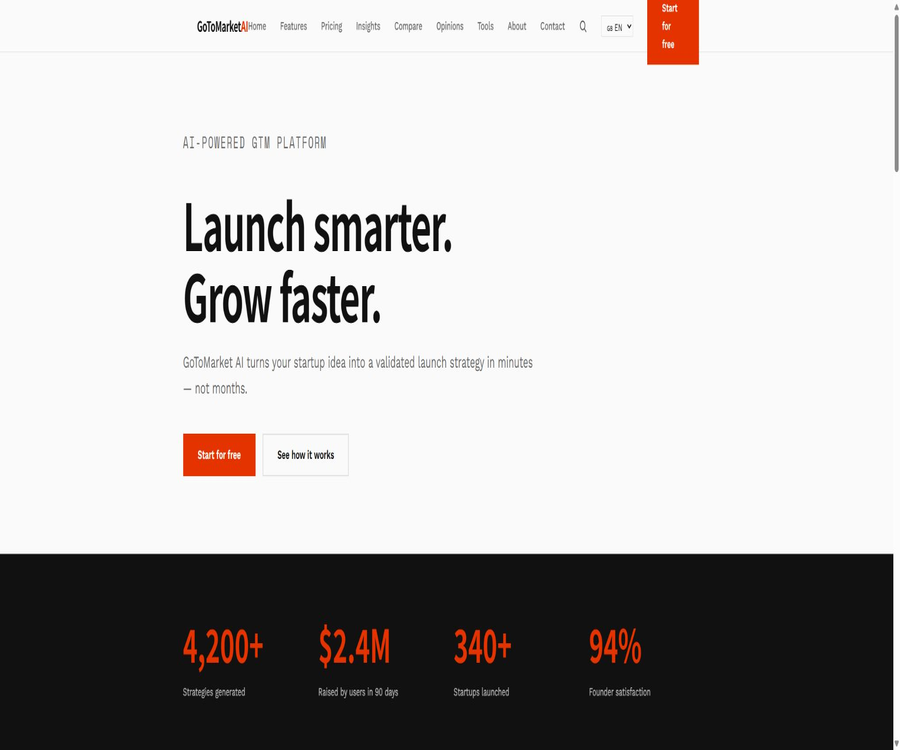
Launch smarter. Grow faster.
Launch smarter. Grow faster. – A smart tool focused on AI-powered imaging.
Tags:Common AI image toolsWhat is GoToMarket AI?
GoToMarket AI is a platform for market entry strategy development, designed for entrepreneurs, product teams, and growth specialists. After users describe their products, the current stage of development, and target markets, the system generates customer profiles, product positioning, launch plans, competitive analysis, marketing strategies, and growth tactics.
The old title in the database, “Launch smarter. Grow faster,” was used as a promotional slogan for the page; the actual name of the product is GoToMarket AI. It is neither an AI-based image tool nor a traditional CRM – rather, it is a web service that transforms market research and GTM planning into actionable documents.
Main functions
- Generate primary and secondary ideal customer segments.
- Organize the target position, company size, pain points, and purchase triggers.
- Establish category definitions, differentiation factors, competitive barriers, and positioning levels.
- Generate a weekly release calendar tailored to the product development phase and team resources.
- Monitor competitors’ pricing, positioning, and market gaps.
- Create titles, value propositions, objection handling strategies, and channel information.
- Generate growth strategy priorities based on market, stage, and budget.
- Export the results as PDF or CSV; the paid version offers additional collaboration features.
ICP generator
The ICP generator is used to identify the groups of individuals or companies that are most likely to purchase a particular product. Users need to specify the product category, target audience, region, stage of the business, and existing awareness regarding the product; the system then analyzes demographic, corporate, behavioral, and purchasing motivation factors.
| Output items | Included content | Actual use |
|---|---|---|
| Customer segmentation | Primary ICP and secondary ICP | Decide which type of market to serve first. |
| Character traits | Position, company size, and decision-making role | Select outreach and content objects |
| Pain points | Business difficulties, unmet demands, and urgency | Improve product value and sales issues |
| Purchase trigger | Events, budgets, tasks, and timing | Designing marketing campaigns and sales messages |
| Channel preference | Common information and communication channels used by potential customers | Allocate content and deploy resources |
| Disagreement mode | Issues of price, risk, migration, and trust | Prepare sales materials and response templates |
Product positioning canvas
Positioning the canvas helps the team determine to which category the product belongs, how it differs from alternative solutions, and what its core values are. The results obtained can then be used to develop the homepage layout, sales presentations, release messages, and product narratives.
- Define the product category and the framework for user understanding.
- Identify unique differentiators and competitive barriers.
- Establish an information hierarchy from core values to supporting evidence.
- Organize the proof points that can be used on pages and sales materials.
- Check whether the positioning corresponds to the pain points of the target customers.
Release Planner
The Launch Planner generates weekly roadmaps based on the pre-launch, official launch, or post-launch phases, taking into account the differences in resources available to individual founders, small teams, or funded teams. The Growth package includes the Launch Planner for up to 12 weeks.
| Phase | Typical content | Information that the team should add |
|---|---|---|
| Pre-release | Verification, candidate list, content preparation, and channel testing | Goals, budget, existing audience, and timeline |
| Release date | Distribution channels, notifications, demonstrations, and real-time responses | Responsible persons, materials, indicators, and emergency plans |
| After publication | Follow-up, retention, feedback, and iteration | Actual conversion rates, user feedback, and reasons for churn |
| 30-day milestone | First-round data and positioning adjustments | Customer acquisition cost, activation, and sales feedback |
| 60 to 90 days | Channel expansion and resource reallocation | Effective channels, repeat purchases, and revenue quality |
Competitor intelligence
The competitive intelligence module is used to gather information on the prices, positioning, and market gaps of competing products. Growth allows tracking of up to 10 competitors, while Scale has no limit on the number of competitors that can be tracked. The page states that competitive information is updated on a weekly basis, but important pricing details, features, and customer assessments still need to be reviewed manually by the team.
- Create a list of direct competitors, indirect substitutes, and proprietary solutions.
- Compare target users, core commitments, and price structures.
- Look for niche markets or work processes that competitors have overlooked.
- Record changes in competition and update the handling of sales objections.
- Avoid treating AI-generated summaries as legal, financial, or investment conclusions.
Marketing information framework
The system can generate titles, value propositions, responses to objections, and content suitable for various channels based on the ICP and positioning information. The output serves as a draft, which should be revised by the brand team using actual evidence, appropriate language style, and compliance requirements.
| Copy type | Main purpose | Key points of manual inspection |
|---|---|---|
| Main Title | A brief explanation of objects and values | Is it specific, credible, and easy to understand? |
| Value proposition | Link pain points, solutions, and outcomes | Are there any data or examples to support this? |
| Functional information | Explain how the product solves problems | Avoid describing planning functions as already available. |
| Handling of objections | Responding to price, risk, and alternatives | It is not allowed to disparage competitors or make false promises. |
| Channel copywriting | Suitable for emails, social media, and web pages | Comply with character, advertising, and privacy rules |
Growth strategy
The Growth Playbook ranks growth strategies based on the product market, stage of development, and budget. It can help teams create a list of experiments to try, but the actual priorities should still be determined by channel costs, the quality of conversions, the team’s capabilities, and customer feedback.
- Rank the growth activities based on expected return and implementation difficulty.
- Break down the strategy into responsible persons, time, and required resources.
- Set success, termination, and review conditions for each experiment.
- Record the actual data and eliminate ineffective channels.
- Regenerate or adjust the plan periodically in line with market changes.
Complete usage process
- Create an account and select the Starter, Growth, or Scale plan.
- Fill in the product name, category, development stage, and target market.
- Enhance product capabilities, business models, budgets, teams, and competitors.
- Generate ICP first and check whether the customer segments correspond to the actual interviews.
- A positioning canvas and marketing messages are generated based on the confirmed ICP.
- Generate a release calendar, assigning personnel, times, and metrics for each task.
- Establish competitor tracking and manually verify key pricing and features.
- Export the strategy to proceed with project management, content handling, or sales process execution.
- Real-world results are imported weekly to adjust targeting, channels, and growth priorities.
How to improve the quality of generation
- Do not just provide a single sentence describing the product; instead, explain how customers can solve their current problems with it.
- Provides a summary of existing interviews, sales, churn, and support feedback.
- Distinguish between users, influencers, purchasers, and decision-makers.
- Define the region, industry, company size, budget, and sales cycle.
- List the direct competitors, alternative solutions, and scenarios in which customers do not take action.
- Compare each generated result with the actual market evidence item by item.
- Keep different versions and record which assumptions have been verified through experiments.
Prices and packages
The price information was verified on August 23, 2026; the actual amounts, taxes, exchange rates, and discounts may vary, and the final figures will be those displayed on the settlement page.
GoToMarket AI offers a permanently free Starter plan, as well as a Growth plan costing $19 per month and a Scale plan costing $79 per month. The paid plans can be canceled at any time without the need for a long-term contract; all paid plans come with a 7-day refund guarantee.
| Package or version | Price | Billing cycle | Core benefits or quota | Suitable for users |
|---|---|---|---|---|
| Starter | Free | Permanently free | 1 product strategy per month, 3 AI executions, basic ICP templates, community templates, and email support | Verify products and occasionally planned individual users |
| Growth | 19 dollars | Monthly | Unlimited AI operations, complete ICP and positioning capabilities, a 12-week release schedule, up to 10 competitors, an information framework, strategies for growth, and export in PDF and CSV formats | Founders who are preparing or carrying out a release |
| Scale | 79 dollars | Monthly | Includes Growth; up to 10 team seats, API, custom templates, branded PDFs, no restrictions on competing products, Slack integration, and introductory calls. | Growth teams that require collaboration and integration |
AI usage quota
Each time a policy, ICP, or Playbook is created or regenerated, it is counted as one instance of AI execution. Starter provides 3 such executions per month, while Growth and Scale offer unlimited executions; teams should still verify the reasonable usage limits and conditions for frequent calls before making a purchase.
| Operation | Whether to count as AI operation | Ways to save on costs |
|---|---|---|
| Generate policy for the first time | Yes | Organize the complete product information before entering it. |
| Regenerate policy | Yes | First, identify the assumptions that need to be changed. |
| Generate or regenerate ICP | Yes | Adjust the inputs using interview and sales data. |
| Generate or regenerate the Playbook | Yes | Define phase, budget, and channel constraints. |
| View existing results | It is usually not regenerated. | First, read and manually edit the existing version. |
| Export file | Not marked as running on AI | Choose PDF or CSV based on the package. |
Team collaboration and export
Growth supports PDF and CSV exports, while Scale offers up to 10 team seats, white-label PDFs, custom Playbook templates, and Slack integration. White-label exports are suitable for use by consulting or agency firms, but it is still necessary to verify the content generated and edit it in accordance with the client’s brand guidelines.
APIs and Integration
The Scale package includes API access and Slack integration, but no public API documentation, SDKs, call quotas, or authentication instructions are available. Teams that need automated integration should verify the endpoints available, rate limits, data retention policies, technical support options, and any additional costs before subscribing.
| Developer capabilities | Current status | Correct understanding |
|---|---|---|
| API access | Scale includes | Specific endpoints, quotas, and documents require login or consultation. |
| Slack integration | Scale includes | Used for collaborative notifications or process connections; the scope of permissions needs to be confirmed. |
| Public SDK | Not verified. | Do not mark it as providing Python or Node SDK. |
| Official GitHub | Not verified. | Do not associate GTM warehouses with similar names. |
| Open-source platform | No | It is a closed-source commercial Web service. |
Supported platforms and languages
| Platform or method | Support status | Precautions |
|---|---|---|
| Web browser | Support | Creating policies, viewing results, tracking, and exporting are all done through the web interface. |
| Native iOS apps | Not verified. | Do not mark it as an official iPhone app. |
| Native Android apps | Not verified. | Do not mark it as an official Android app. |
| PDF export | Growth and Scale support | Increase the white-label output via Scale. |
| CSV export | Growth and Scale support | Suitable for external analysis and migration |
| Multilingual website | Multiple page languages are available. | It does not mean that all generated content and support are fully localized. |
Data and Privacy
The service handles names, email addresses, company information, usage patterns, generation policies, IP addresses, as well as data related to browsers and devices; this information is stored on servers located in the United States. The privacy policy states that personal data will not be sold, and encryption both at rest and in transit, access controls, and regular security audits are employed.
- AI generation uses the input provided by the user to produce the results of a request.
- Payments are processed by third-party services such as Stripe.
- Essential cookies are used to keep the service running, while analytics cookies require corresponding permission.
- Users can request access to, correction of, deletion of, or export of their personal data.
- Users in Europe and California may have additional data rights.
- No network transmission can be considered 100% secure.
Content ownership and commercial use
Users retain ownership of the data they enter, and the outputs generated by AI are licensed for use in the users’ businesses. The platform itself and its original content remain the property of the operators; the team cannot assume that service codes, templates, or brand assets are part of the generated results and therefore copy them freely.
AI strategies serve only as a tool for providing information and assistance in planning; they do not constitute professional business, legal, or financial advice. Before announcing product positioning, competitor pricing, or profit expectations, the team should verify the relevant facts, intellectual property rights, and applicable regulatory requirements.
Cancellation and refund
Paid plans are billed on a monthly or annual basis, and can be canceled with just one click from the account panel; there are no long-term commitments required. The public pricing page offers a 7-day refund guarantee, and the terms state that refunds are generally not provided except as required by law or under this guarantee.
- Before subscribing, confirm whether to pay monthly or annually.
- Submit a qualified refund request within the guaranteed period.
- After cancellation, confirm the end time of access and the status of the next deduction.
- Export in advance the policies, PDFs, and CSV files that still need to be retained.
- For team plans, the relevant documents should be transferred first, along with the management of member permissions.
Which users are it suitable for
- Verifying whether the target customer is an independent founder who matches the desired profile.
- Early-stage startup teams preparing a plan for launching new products.
- Product marketers who need to integrate ICP, information, and growth strategies.
- Teams that aim to quickly develop frameworks for comparing competitors and addressing sales objections.
- Consultants or agencies that develop GTM strategies for multiple clients.
- Growing companies that need team seats, API connections, and Slack integration.
Product advantages
- Integrate ICP, positioning, publishing, competitors, information, and growth plans into one unified framework.
- The input process is centered around the product stage and target market, making it suitable for entrepreneurial contexts.
- The free tier does not require a credit card, allowing you to test the basic functionality first.
- The price of Growth is clear, and it includes all the essential planning modules.
- The paid tier supports PDF and CSV formats, facilitating the transition to subsequent execution steps.
- Scale offers team, API, Slack, and white-label delivery capabilities.
- A 7-day refund guarantee is provided, with cancellation possible at any time.
Restrictions and Precautions
- The market data and competitor analyses generated by AI may be incomplete or outdated.
- Marketing figures such as user base size, financing details, and satisfaction levels are not equivalent to the results of independent audits.
- The Starter allows only 3 AI runs per month, which is not suitable for frequent iterations.
- Although Growth is indicated as being able to run without restrictions, the specific policies regarding its proper use still need to be confirmed.
- The Scale API does not come with any public technical documentation nor a standardized quota for calls.
- No native mobile applications, public SDKs, or official open-source repositories were found.
- The data is stored in the United States, and industries that are sensitive to such data need to assess the cross-border and contractual requirements.
- The value of a strategy depends on the quality of the input, genuine interviews, and feedback from implementation.
Pre-purchase checklist
- First, use the Starter to verify whether ICP and positioning output are actually useful.
- Prepare information from actual customer interviews, as well as data on transactions and customer churn, for comparison.
- Verify whether unlimited operation of Growth meets the expected usage frequency.
- Check the number of competing products being tracked, the update frequency, and the accuracy of the data.
- When the team is in use, it is necessary to verify seats, permissions, export functions, and seat recovery upon departure.
- When an API is needed, information on endpoints, rate limiting, authentication, and technical support must be obtained.
- Evaluate U.S. storage, third-party processing, and data deletion processes.
- Confirm the monthly/annual payment options, cancellation timing, and 7-day refund policy.
- Use a real project release to test the entire workflow before expanding its use.
Frequently Asked Questions
Is GoToMarket AI free?
Starter is available permanently and free of charge, without the need for a credit card; it includes 1 product strategy document and 3 AI executions per month. For full ICP, positioning, launch planning, competitor tracking, and export capabilities, Growth or Scale is required.
How is the cost of running AI calculated once?
Each time a policy, ICP, or Playbook is created or regenerated, it counts as one instance of AI operation. Viewing existing results and performing manual editing should not be confused with regeneration.
What is the difference between Growth and Scale?
Growth is intended for individual founders or small teams, and it includes a comprehensive plan as well as support for up to 10 competitors; Scale adds up to 10 additional users, API access, Slack integration, a white-label PDF version, custom templates, and no limit on the number of competitors.
Can policies be exported?
Growth and Scale support PDF and CSV export; Scale also offers branded PDFs. The free Starter version does not list all the export options available.
Can it be canceled at any time?
Cancellation is possible from the account panel, without any long-term contracts or commitments. The payment plan includes a 7-day refund guarantee; the time frame for submission and the required qualifications are subject to the settlement and account rules.
Is GoToMarket AI open source?
No, it is a closed-source commercial Web service. Scale provides API access, but there are no public SDKs, official technical documentation, or verified GitHub projects available.
Summary
GoToMarket AI is suitable for those who wish to rapidly turn vague entrepreneurial ideas into an ICP, a clear positioning strategy, a release schedule, a map of competitors, and growth experiments. It offers three distinct pricing tiers: the free tier is ideal for testing purposes, the Growth tier covers the basic needs of individual users, while the Scale tier is designed for teams and integrated solutions.
The generation strategy still needs to be cross-verified through customer interviews, real-world market data, and actual performance results. The most effective approach is to have AI create a structured preliminary draft, after which the team determines the assumptions, metrics, responsible parties, and criteria for stopping the process.
Similar to tools like Launch smarter. Grow faster.




 Guigong Network Security Registration No. 45132202000164