






Jot
Jot, an intelligent tool focused on AI-generated images
Tags:Common AI image toolsA one-sentence summary
Jot was once an AI-powered tool for creating advertising copy aimed at marketers; it could generate various short texts based on individual product descriptions and organize them by brand. The current domain is used only for restoring historical pages for demonstration purposes, as the registration and login functions are no longer available.
What is Jot?
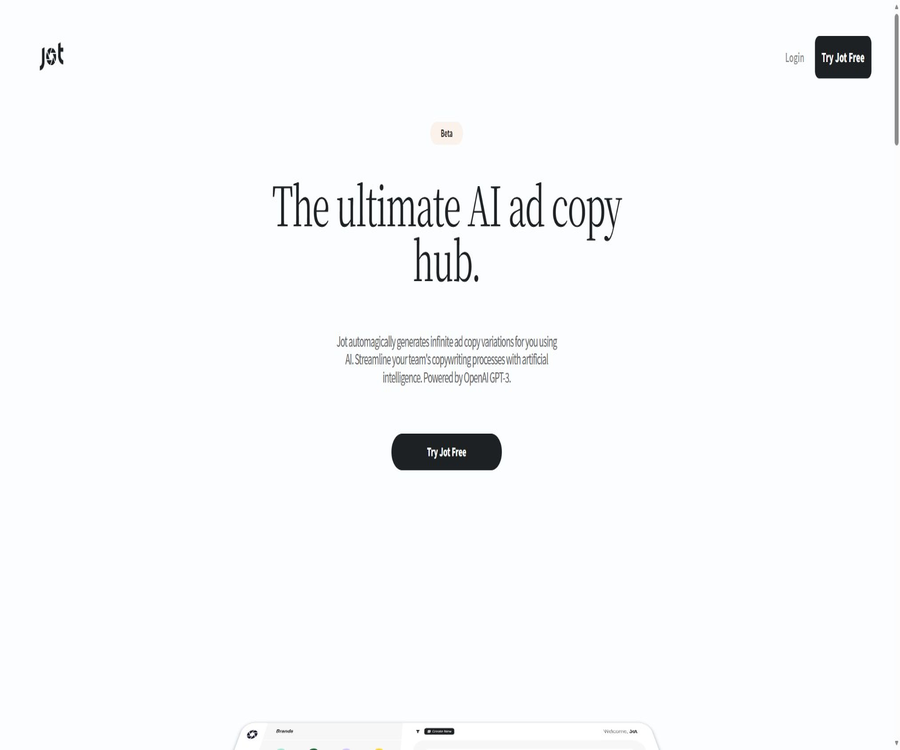
Jot is positioned as an AI Ad Copy Hub, designed to address the issue of the need for numerous variations of headlines and short copy in advertising campaigns. It was released around 2022; its historical pages were marked as Beta, and it uses OpenAI GPT-3 for its operations.
Previously, users could save product descriptions for different brands, and then create, refresh, edit, and save text cards. It is a tool designed for short advertising texts, rather than a platform for long articles, image design, or comprehensive advertising campaigns.
Current operating status
| Inspection items | Current results | Judgment |
|---|---|---|
| Product homepage | It is still possible to display the old version of the promotional and pricing pages. | It can only be viewed as historical product information. |
| Bottom of the page | Marked as a demonstration of restoring historical sites. | It’s not a page for active products that are under normal maintenance. |
| Registration portal | The page returned does not exist. | It is not possible to create a new account. |
| Login page | The page returned does not exist. | It is not possible to verify the original account service. |
| Price button | Points to an invalid registration path | It is not possible to complete the purchase or trial. |
| Update time | The copyright information is current as of 2022. | Lack of evidence of continuous operation |
Therefore, Jot should no longer be labeled as a functional AI tool that can be registered normally, tried out for free, or purchased. The catalog may retain its historical descriptions of the tool, but it must also indicate that the service is not available at present.
Core historical functions
| Functions | Historical use | Current availability |
|---|---|---|
| Advertising copy creation | Generate various short ad copy from product descriptions | Verification is not possible through the invalid account entry. |
| Copy card | Split different candidate contents into separate cards. | Only retain the page description. |
| Brand management | Managing product descriptions and copy for different brands | Only retain the page description. |
| Refresh to generate | Request new copy candidates | Cannot be used in practice |
| Edit update | Modify and generate copy within the card. | Cannot be used in practice |
| Collecting and filtering | Save your favorite items and filter by brand. | Cannot be used in practice |
| Labels and time markers | Organize different activities and generate batches | Cannot be used in practice |
| Character statistics and emoji panel | Adjust ad length and quickly insert emojis | Cannot be used in practice |
| Copy to clipboard | Copy the final version to other advertising tools. | Cannot be used in practice |
Ways to create advertising copy
The historical process of Jot relies on a product description as the main input; GPT-3 then generates various text versions roughly of ad length. It can serve as a starting point for creativity, but it cannot verify the authenticity of a product’s features on its own, nor can it replace the review processes carried out by advertising platforms.
- Enter the product name, target users, and main benefits.
- Explain the events, discounts, and calls to action.
- Generate multiple candidate titles and bodies.
- Filter by brand and save the available versions.
- Manually altering numbers, promises, and legal disclaimers.
- Copy it to the advertising platform and then check the character limit.
Brand management
The History page highlights brand management as its main advantage; users can create multiple brands in a single interface and save corresponding product descriptions. Basic allowed only 10 brands, while Pro claims to have no limit on the number of brands.
This structure is suitable for agents or marketing professionals who manage multiple product lines at the same time. Since access to the backend is not possible at the moment, it is not feasible to verify the brand fields, collaboration permissions, and export options.
Copy card workflow
- Create a brand and enter the description of the reference products.
- Submit product information to generate ad copy cards.
- Refresh inappropriate candidate versions.
- Edit the text that needs to be retained directly.
- Organize the results using favorites, tags, and time information.
- Check the character count and add any necessary disclaimers.
- Duplicate the finalized version and upload it to the actual platform.
The steps mentioned above are based on the design described on the product’s history page; they do not mean that these actions can still be carried out at present. At this stage, both the registration and login pathways are unavailable.
Historical price packages
The older version of the page still offered monthly subscription plans in the Basic and Pro categories, along with a 7-day free trial. Since the purchase and registration links are no longer functional, these prices can only be considered as historical figures and not as current rates.
| Historic packages | Historical prices | Billing cycle | Main limit | Common functions | Current status |
|---|---|---|---|---|---|
| Basic | 9 dollars | Monthly | 10 copywriting cards, 10 brands | Collect, refresh, edit, filter, tags, character statistics, and copy | Cannot be purchased |
| Pro | 29 dollars | Monthly | No restrictions on text cards, no restrictions on brands | Collect, refresh, edit, filter, tags, character statistics, and copy | Cannot be purchased |
| Free trial | The history page does not show separate prices. | 7 days | The page does not indicate the trial quota. | Used to experience older versions of the features | Unable to register |
Why can’t the old price be used directly?
- The page’s copyright information dates back to 2022.
- The website is clearly marked as a demonstration of restoring historical pages.
- Both the registration and login paths return “not found”.
- There is no available settlement process to confirm the amount and renewal period.
- There are no recent announcements indicating that the package is still on sale.
- The same price in third-party directories may just be a copy of old pages.
The tool catalog should indicate the price type as \"Historical payment plan\" or \"Not available for purchase at the moment\", instead of continuing to show it as starting at $9. If new operators and valid payment pages become available in the future, it will be necessary to verify identities again before making any updates.
Model and output boundaries
The history page for Jot clearly states that GPT-3 is used, but it does not specify the exact version of the model, the length of the context, the training data, or the parameters used for generation. GPT-3 belongs to an earlier generation of models; therefore, its capabilities are not on par with those of the current advanced large language models.
| Project | Public historical information | Unconfirmed matters |
|---|---|---|
| Model | OpenAI GPT-3 | Specific version and update time |
| Main inputs | Single-product description | Maximum length and supported languages |
| Main output | Variants of short ad copy | Number of items generated each time and platform template |
| Edit | Supports updating text cards | Version history and collaborative editing |
| Export | Copy to clipboard | Batch downloading and file formats |
| Content quota | Packages are categorized by the number of copy cards. | Is refreshing charged separately? |
Appropriate historical settings
- Prepare multiple ad titles for the same product.
- Test different value propositions and calls to action.
- Short descriptions of different products organized by brand.
- Create a pool of creative options quickly before release.
- Adjust the length for ad slots with limited character count.
- Help small teams reduce the time needed to start working on a blank page.
These scenarios illustrate the problems that Jot used to solve, but current users are unable to carry out their tasks using the original domain name. When such capabilities are needed, it is advisable to choose alternative tools that are still under maintenance and have clear policies regarding privacy, pricing, and data export.
Precautions for using AI-generated ad copy
- First, confirm the product details, price, and promotion period.
- Remove the claims about effects that cannot be proven, as well as the absolute wording.
- Check the advertising guidelines and industry policies of the target platform.
- Avoid using unauthorized trademarks and customer reviews.
- Professional audits are provided for sensitive industries such as healthcare and finance.
- Retain records of manual modifications and the final approver.
- Expand the rollout after testing with a small budget.
Data and privacy information
The current history page does not provide access to a privacy policy, information on the duration for which data is stored, procedures for deletion, or guidelines regarding the use of model data. Due to the unavailability of the backend system, it is also not possible to determine whether old accounts and brand-related data can still be exported or deleted.
Users should no longer submit email addresses, passwords, customer information, or advertising materials to invalid registration addresses. When an old account that is still accessible is found, it is necessary to first export the relevant data, and verify the status of data processing through valid contact methods.
API, GitHub, and open-source status
No public API, SDK, developer documentation, or official GitHub repository that matches the characteristics of this advertised product was found. The use of OpenAI GPT-3 is merely an internal modeling capability of the product; it does not mean that Jot provides external interfaces.
Jot’s core products cannot be labeled as open source, they cannot be deployed privately, nor do they support programmed integration. There are many projects with the same name as Jot; voice notes, diaries, and development tools are not the same products as those mentioned here.
Supported platforms
| Platform | Historical status | Current status |
|---|---|---|
| Web | Provides marketing pages and an account backend. | The marketing page is accessible, but the backend access point is not functional. |
| Windows | Use via a browser | Unable to log in |
| macOS | Use via a browser | Unable to log in |
| Android | The native app has not been confirmed. | There are no verifiable official applications. |
| iPhone and iPad | The native app has not been confirmed. | There are no verifiable official applications. |
| Browser extensions | Not disclosed | Not provided |
| APIs and SDKs | Not disclosed | Not provided |
Historical advantages
- Focus on short advertising copy rather than stacking a large number of content types.
- A single product description can generate multiple candidates.
- The text cards make it easy to compare and filter.
- Brand management is suitable for working with multiple products.
- It provides functions for collecting, editing, tagging, and character counting.
- The old version of the package had a simple structure that was easy to understand.
Current main issues
- Domain names are retained only for the demonstration of restoring historical pages.
- Both the registration and login pages are not functional.
- The old plan and the 7-day trial cannot be purchased.
- The model information remains at GPT-3.
- Information on current operations, updates, and customer support is missing.
- There are no accessible rules regarding privacy, security, and refunds.
- There are no public APIs, SDKs, or GitHub repositories.
- It is easy to get confused with multiple Jot products that share the same name.
What to check when choosing an alternative tool
- Confirm that the registration, login, and settlement processes can be completed successfully.
- Check whether the model, language, and advertising platform templates have been updated.
- Compare the number of brands, generation quota, and team seats.
- Check whether batch generation, export, and approval are supported.
- Read the policies on data training, saving, and deletion.
- Check the rules for subscription renewal, cancellation, and refunds.
- First, test the quality using real but non-sensitive product information.
Frequently Asked Questions
Can Jot still be used?
It cannot be used as a normal online service at the moment. The domain name indicates that it is for demonstrating the restoration of a former website, and both the registration and login pages show an error indicating that such accounts do not exist.
What did Jot do mainly in the past?
It generates various short ad copy versions based on a product description, and helps marketers organize the available options through copy cards, brand filtering, bookmarking, editing, and character counting.
Is Jot free?
The older version of the page offered a 7-day free trial, but the registration link is no longer valid; therefore it can no longer be marked as available for a free trial.
How much is Jot?
The history page shows that Basic costs $9 per month and Pro costs $29 per month. Neither of these plans can be purchased through the original page anymore; those prices are considered to be the old rates.
What model does Jot use?
The older version of the page explicitly stated that OpenAI GPT-3 was being used, but no more specific information regarding the version was provided. Currently, there is also no evidence indicating that the model has been upgraded.
Does Jot have an API?
No official API, SDK, or developer documentation was found. The use of GPT-3 internally within the product does not mean that OpenAI’s interfaces are made available to users.
Is Jot open source?
No. No official open-source repository or license corresponding to the product described in that advertisement was found; the historical versions of this service were closed-source web products.
Is it the same product as the voice note app Jot?
No. There are several voice note or diary apps with the same name available in current app stores and on other domain names; their developers, features, and prices all differ from those of the tool mentioned in this advertisement.
Summary
Jot once offered a focused marketing drafting process based on GPT-3, ad copy templates, and brand management; its previous Basic and Pro plans were also quite simple. Its approach to product design still helps us understand how AI-driven ad creation tools organize content.
However, the current domain name leads only to the old page that has been restored; the processes for registration, logging in, trying out the service, and making payments are all unavailable. The tool catalog should clearly indicate that the services are discontinued or unavailable, and the prices of $9 and $29 should be shown as historical prices, so as to prevent users from thinking that they can still purchase those services.
Tools similar to Jot




 Guigong Network Security Registration No. 45132202000164