






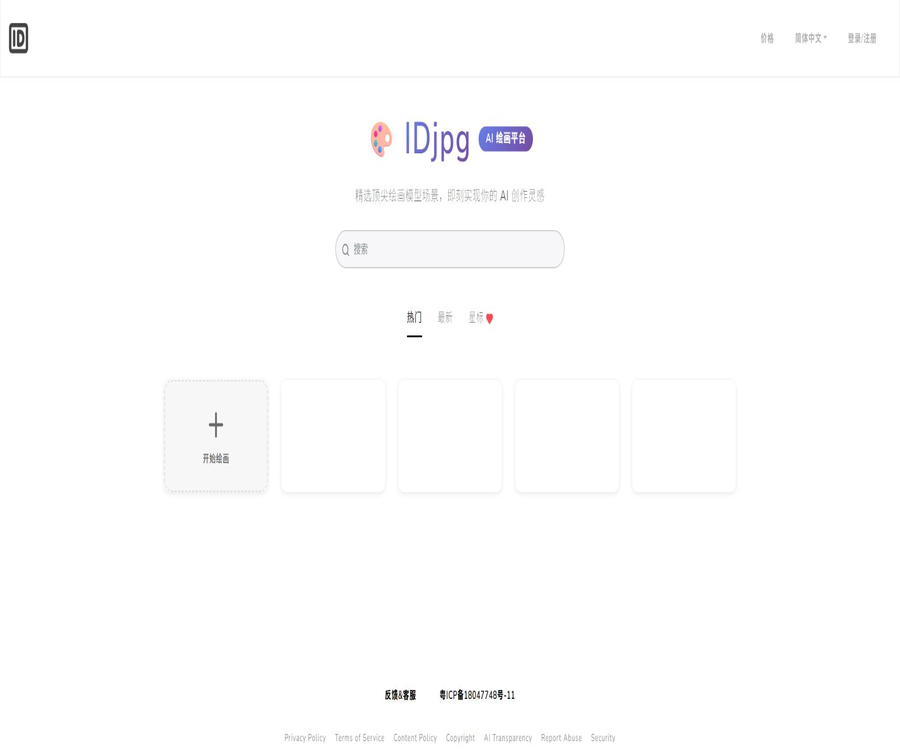
IDjpg
IDjpg, a smart tool focused on AI-powered image processing.
Tags:Common AI image toolsA one-sentence summary
IDjpg is an AI-based image generation and editing platform that relies on scenario templates; users can select models, prompts, resolution, and reference images to quickly create portraits, product photos, identification pictures, apply style changes, and enhance image quality.
Tool Introduction
The name IDjpg might lead one to think that it is used only for creating identity photos, but in reality its capabilities cover a wide range of image creation and photo editing tasks. The platform brings together different models and preset workflows in a single web interface, allowing users to select templates from categories such as popular ones, the latest releases, and those saved in their collection.
Each scenario specifies in advance the number of reference images that need to be uploaded, and the number of tokens is calculated dynamically based on the model and the output resolution. It is necessary to check the actual amount of tokens used next to the button before generation, to avoid estimating the number of images that can be created solely based on the total tokens allocated for the package.
Core working method
| Settings | What can be chosen? | Impact | Precautions |
|---|---|---|---|
| AI models | GPT Image 2, Nano Banana, Nano Banana 2, Nano Banana Pro | Image quality, adherence to instructions, and Token consumption | The models made available by different templates may vary. |
| Prompt | Add elements such as subject, style, lighting, and modification requirements. | Control the direction of generation | The preset template already contains some hidden logic. |
| Resolution | 1K, 2K, 4K | Clarity, generation time, and token consumption | The 4K option does not guarantee that the details will be on par with those achieved in professional photography. |
| Reference image | Upload one or more images using the template. | Maintain the characteristics of the characters, products, or composition. | Assess privacy before uploading sensitive photos. |
| Scene template | ID photos, product images, style conversion, etc. | Reduce the workload related to complex prompts. | The template results still require manual verification. |
Currently available models
- GPT Image 2 is used for certain tasks related to image generation, editing, and style transformation.
- Nano Banana is suitable for general reference image editing.
- Nano Banana 2 appears as an update option in multiple templates.
- The Nano Banana Pro is designed for tasks that require higher quality or more complex instructions.
- Not all models may be available at the same time in the same scenario.
- Model names and availability are updated frequently; the information displayed on the generated page should be taken as the reference.
How to choose a model
Start by testing the composition using models with lower resolution and lower cost, and then move on to higher-specification models once a satisfactory result is achieved. When high standards are required in terms of consistency in the appearance of characters, text formatting, or product details, it is necessary to compare the actual samples of different models, rather than relying only on their names.
Main image scene
| Scene | Main inputs | Target output | Suitable uses |
|---|---|---|---|
| Studio Shot Product | Product images and prompts | Product images taken in a studio setting | Concepts of e-commerce main images, ads, and product detail pages |
| ID Photo | Frontal photo of the person | Standardized ID photo style | Resume profile picture and preview for non-stringent regulatory purposes |
| Line Art | Photos or reference images | Hand-drawn line art effect | Illustration sketches, tutorials, and design references |
| Line to Real | Line art or illustrations | Realistic images | Conceptual design and visual prototypes |
| Art to Real | Paintings or artistic illustrations | Realistic characters or scenes | Experiments on character concepts and styles |
| Hyper Portrait | Portrait reference images | Highly realistic portraits | Profile pictures, posters, and character visuals |
| Photo Booth | Reference image of the character | Instant camera or photo booth-style series | Social content and commemorative images |
| Makeup Swap | References for characters and makeup | Makeup transfer effect | Beauty preview and creative testing |
| Swap Character | References for characters or roles | Replacement of the main identity or role | Character creation and visual narrative |
| 4K Enhance | Low-resolution images or those that need enhancement | Results of zooming in and enhancing details | Restoration of old images and enlargement before publication |
| Brand Design Guide | Brand direction and reference materials | Brand visual proposal | Style exploration and design communication |
Product studio photography
The product scenario is used to transform ordinary product photos into studio-style images with more consistent lighting, background, and composition. It is suitable for quickly testing different advertising approaches, but it cannot guarantee that the text on the packaging, labels, dimensions, and material qualities will be entirely accurate.
- Upload product images with a clear subject, no obstructions, and a simple background.
- Specify the background, tabletop, lighting, camera lens, and frame size in the prompt.
- When requesting the retention of brand identifiers, check the generated result character by character.
- Close inspection of products with transparent, reflective, fuzzy surfaces and complex edges.
- False packaging claims should not be made for medical products, food items, and functional goods.
Production of identification photos
The ID Photo template allows an image of a person to be transformed into a standard photo format suitable for official use. It is appropriate for resumes, internal documents, and visual previews, but official documents such as passports, visas, and identity cards have strict requirements regarding biometric features and cannot be modified.
- Use a portrait that is clear, well-lit, with even lighting and no obstructions.
- Do not ask for changes to facial features, age, or real identity characteristics.
- Check the background color, head proportions, eye position, and image size.
- Export according to the specific requirements regarding pixels, file size, and shooting time set by the institution.
- When official documents are involved, it is preferable to use recognized offline or professional photography services.
Portrait and character editing
Highly realistic portraits
Hyper Portrait can generate more photographically realistic portraits based on reference images, making it suitable for use in creating avatar images and posters. This model is capable of altering facial proportions, skin texture, accessories, and identifying features; it therefore should not be used for identity verification.
Makeup transfer
Makeup Swap is used to transfer a makeup style to a target portrait, and it is suitable for conveying ideas related to makeup and styling. The result is merely a visual simulation; it cannot guarantee the actual colors, skin texture, potential allergic reactions, or suitability after applying the makeup in reality.
Replacement of characters and roles
Swap Character allows for the replacement of the main subject or characters in an image; usually, one or more reference images are required. When using real-person photos, permission must be obtained, and their use is prohibited for purposes such as impersonation, fraud, harassment, or unauthorized commercial endorsements.
Line art to realistic conversion
- The Line template converts photos into hand-drawn line drawings or outlines.
- Line to Real converts illustrations, sketches, or line drawings into realistic images.
- Art to Real is used to transform characters or scenes in an artistic style into a photographic-looking appearance.
- The conversion process adds materials, lighting, and details that were not present in the original image.
- Architecture, industrial design, and product structure cannot treat AI-generated completions as engineering drawings.
- When there are clear role definitions, the original text should be retained and the differences should be compared item by item.
4K enhancement
4K Enhance is used to enlarge images and add details; it is suitable for social media posts, old photographs, and design previews. AI enhancement reconstructs the textures rather than restoring all original information, and text, eyes, fingers, and small patterns are particularly prone to being altered.
Judicial evidence, medical images, historical archives, and identity verification materials should not rely on generative techniques to enhance or restore facts. When an accurate enlargement is necessary, the original documents should be retained, and traditional, traceable processing methods should be used.
Same style and scene library
The platform organizes scenarios by popularity, recency, and favorites, and provides a “Start Same Style” option. Users can quickly access similar templates from the publicly available results, and then replace the reference images and prompts as needed.
- It is widely used to identify currently common use cases.
- The latest version is used to view templates that have been added recently.
- Collections make it easy to keep frequently used workflows.
- The same style reuses the template structure, but it is not guaranteed that an identical result will be produced.
- The publicly available examples may be selected, and they do not represent the average quality of each generation.
From upload to download
- Register or log in to your IDjpg account, and check the balance of your free or purchased Tokens.
- Select the target scenario from Popular, Latest, Favorites, or Search.
- Read the template requirements and prepare a specified number of reference images of the appropriate type.
- Select the AI model supported by this template.
- Enter additional prompt details to specify the subject, background, style, and the elements that must be retained.
- Start by choosing 1K for low-cost testing, and then decide whether to use 2K or 4K.
- Confirm and submit after the actual Token consumption displayed on the generate button is shown.
- Check the results of the task, download the qualified images, and save the original reference images along with the parameters.
Increase the success rate of generation.
- Use reference images that are complete, clear, and not severely compressed.
- Change only one main variable at a time, such as the background, clothing, or lighting.
- Specify in detail the product colors, character features, and composition that must be retained.
- Avoid including conflicting styles and camera requirements at the same time.
- First, compare the model at low resolution, and then enlarge it to get the final orientation.
- A 100% scaling inspection is performed on faces, hands, text, logos, and edges.
- Keep the generation records and authorization materials when it comes to commercial releases.
Token consumption logic
IDjpg is billed on a token basis; the basic cost per generation depends on the selected model and template, while the resolution adds an additional cost. The required number of tokens is displayed in real time next to the generation button, so there is no fixed price that applies to all situations.
| Factors affecting it | How it might be possible to change consumption levels | How should users confirm it? |
|---|---|---|
| Model | Different models use different base tokens. | Check the button number after switching models |
| Resolution | 2K and 4K are usually higher than 1K. | Compare different specifications separately |
| Template | Multiple image inputs or complex scenarios may vary. | View current template requirements |
| Retry | A deduction may be applied again each time it is regenerated. | Check the prompt and reference images before submission. |
| Failed tasks | The public page does not indicate whether the amount is returned automatically. | Retain task records in case of anomalies and contact support. |
Price and validity period
As of August 23, 2026, the platform offers free monthly tokens as well as one-time token packages. Paid packages are not subject to automatic renewal; each package has its own valid period, and it is necessary to choose the appropriate package based on the actual frequency of usage before making a purchase.
| Package | Price | Number of tokens | Validity period | Additional benefits or features suitable for users |
|---|---|---|---|---|
| Free | 0 yuan | 2 per month | Refresh monthly | Occasionally experience and test templates |
| 60 Tokens | 36 yuan | 60 | 1 month | Short-term concentrated generation |
| 200 Tokens | 90 yuan; the marked price on the page is 120 yuan. | 200 | 6 months | Moderately frequent individual creation |
| 500 Tokens | 120 yuan; the marked price on the page is 300 yuan. | 500 pieces | 12 months | Create content over the long term and gain early access to new features |
Value for money of the package
Based on the current displayed price, 60 units cost approximately 0.60 yuan each, 200 units cost about 0.45 yuan each, and 500 units cost roughly 0.24 yuan each. This calculation does not take into account any losses due to expiration; therefore, users who order in smaller quantities may not find it advisable to purchase the largest packages.
Payment methods
The purchase interface indicates that PayPal, WeChat Pay, and Alipay are supported, and redemption codes are also available. The actual payment methods available may vary depending on the region, account details, and the payment page used.
Accounts and purchase history
- Registration or login can be done using an email address and password.
- Provides procedures for forgetting a password and resetting it.
- The purchase record shows the item, quantity, remaining tokens, expiration date, and purchase time.
- You can enter a redemption code to obtain additional benefits.
- The page offers an option to display only tasks from the last 3 days.
- The filtering in the past 3 days is only a display option on the interface; it cannot be used to conclude that the server has deleted items automatically.
Language and platform
IDjpg is a web-based tool that can be accessed via desktop or mobile browsers. No official clients for Windows, macOS, iOS, Android, nor browser extensions have been identified.
The interface offers options in English, Simplified Chinese, Traditional Chinese, Japanese, Russian, Indonesian, Malay, German, Turkish, Arabic, Spanish, French, Portuguese, and Vietnamese. The quality of understanding prompts in different languages still depends on the model.
Privacy and portrait security
Photo ID shots, portraits, makeup applications, and character replacements involve the processing of recognizable facial data; product images may also contain unreleased items. To date, there is no publicly available detailed privacy policy, information regarding the duration for which data is stored, details on how it is used for training purposes, or procedures for deleting such data.
- Do not upload original identification documents, passport pages, or any sensitive materials containing numbers.
- Only process your own photos or images of people for whom you have explicit permission.
- Remove unnecessary metadata such as location, device, and shooting time before uploading.
- Companies should not upload unreleased products, customer data, or materials subject to confidentiality agreements.
- Download the results as soon as they are generated, and check whether it is possible to delete the task from the account.
- The “Tasks from the last 3 days” filter should not be interpreted as meaning that the data will be automatically deleted after three days.
- Highly sensitive or regulated images are not suitable until the saving and training rules have been confirmed.
Copyright and commercial use
The public page does not provide information regarding the complete commercial license for the generated images, user ownership rights, platform usage permissions, or rules for resolving disputes. A paid token merely grants access to a certain amount of generation capacity; it does not automatically confer all rights related to third parties.
- The images uploaded must be owned by the user or for which editing permission has been obtained.
- Do not create unauthorized endorsements by celebrities, brand collaborations, or impersonations.
- Assess platform and regional rules by using the artist’s name or the style of a clearly living creator.
- Product packaging, trademarks, and promotional text need to be checked item by item.
- For commercial projects, it is necessary to verify that the model supplier and the current terms of IDjpg permit the intended use.
- Retain the original image, prompts, output, and records of manual modifications.
API, GitHub, and open-source status
- No public API documentation for developers, key application processes, or pricing information for calls have been identified.
- The internal fields in the purchase records and the page template variables do not represent open interfaces.
- No official GitHub repository for the IDjpg core platform was found.
- There is no public license proving that the website code or templates can be freely copied and deployed.
- IDjpg should be regarded as a closed-source commercial web service.
Which users are it suitable for
- Businesses that need to quickly create conceptual images for e-commerce product photoshoots.
- Designers who wish to use templates to complete line drawings and to convert designs between realistic and artistic styles.
- Content creators who produce social media avatars, photo booth series, and poster portraits.
- Ordinary users who need to test different image models and resolutions at a low cost.
- Job seekers who wish to create a profile picture that is not subject to strict regulations using photo template tools.
- A small team that needs image enlargement, as well as visual experiments related to backgrounds and makeup.
Situations that are not very suitable
- Official identification photos that can prove they have not been altered using generative tools are required.
- Process images for medical, judicial, law enforcement, or identity verification purposes.
- Organizations that need to define SLAs for data retention and deletion, as well as corporate confidentiality agreements.
- Development teams that require public APIs, large-scale automation, or private deployment.
- Users who need the complete open-source code and models that can be audited independently.
- Commercial projects that are unable to obtain licenses for real-person portraits or reference materials.
Main advantages
- Multiple image models can be placed in a unified scene interface for selection.
- The templates cover products, portraits, ID photos, line drawings, realistic styles, and high-definition enhancement.
- It supports 1K, 2K, and 4K resolutions, facilitating phased testing.
- Free users can obtain 2 tokens per month for testing purposes.
- Paid Token packages are available with different expiration periods of 1 month, 6 months, and 12 months.
- PayPal, WeChat Pay, Alipay, and redemption codes are supported.
- The multilingual interface is more user-friendly for international users.
Usage restrictions and precautions
- The cost per token for different models, templates, and resolutions is not fixed.
- Paid tokens expire, and purchasing the largest package is not necessarily the most cost-effective option.
- AI can change faces, text on products, logos, materials, and structures.
- 4K upscaling adds details, but it cannot restore all the original information.
- The full terms regarding privacy, refunds, copyrights, and commercial use have not yet been confirmed.
- There are no public APIs, official clients, or open-source repositories.
- The free quota is very limited and is only suitable for initial testing.
- Official documents and high-risk materials should be handled using professional procedures that meet the organization’s requirements.
Basic information
| Project | Content |
|---|---|
| Tool name | IDjpg |
| Product type | Multi-model AI image generation and photo editing platform |
| Current model | GPT Image 2, Nano Banana, Nano Banana 2, Nano Banana Pro |
| Output specifications | 1K, 2K, 4K |
| Price pattern | Free monthly tokens and one-time token packs |
| Free quota | 2 Tokens per month |
| Minimum payment package | 36 yuan for 60 tokens, valid for 1 month |
| Supported platforms | Web browser |
| API | Public API not confirmed |
| Open-source status | Open source not confirmed |
| Privacy Policy | The complete public policy has not been confirmed. |
Frequently Asked Questions
Does IDjpg only handle ID photos?
No. The ID photo is just one of the templates available; the platform also offers options such as product photography, line drawings, realistic image conversion, highly realistic portraits, photo booths, makeup transfer, character replacement, and 4K enhancement.
Is IDjpg free?
Free accounts receive 2 tokens per month. The actual number of tokens that can be generated depends on the consumption per display by the model, template, and resolution.
Do paid tokens expire?
Yes. 60 tokens are valid for 1 month, 200 tokens are valid for 6 months, and 500 tokens are valid for 12 months; it is necessary to assess the frequency of use before making a purchase.
Which models are supported?
On the current page, GPT Image 2, Nano Banana, Nano Banana 2, and Nano Banana Pro are available. The combination of models offered for each scenario may vary.
How do I know how many Tokens are needed each time?
After selecting the model, template, and resolution, the generation button will display the required Token. It should be checked before each submission, as there is no fixed price per image.
Can the photo generated be used for a passport?
It is not recommended to use them directly. Passports, visas, and identification documents generally prohibit any changes to personal details, and there are strict requirements regarding photography and documentation; one should follow the rules set by the issuing authority.
Does it support WeChat and Alipay?
The purchase interface shows WeChat Pay, Alipay, and PayPal as payment options. The available payment methods may vary depending on the region and the settlement page.
Is the portrait uploaded safe?
At present, no complete privacy policy nor clear retention period has been identified; therefore, it is not advisable to upload original documents, sensitive facial images, or unapproved portraits.
Does IDjpg provide an API?
No public developer API, authentication documentation, or pricing information for calls has been made available. Users who need batch automation should first contact the platform to get confirmation.
Is IDjpg open source?
No official open-source repository or license was identified. It should be considered a commercial web service.
Summary
IDjpg’s feature lies in combining multiple model options with specific image scenario templates, allowing users who are not familiar with complex instructions to try out functions such as product photos, portraits, ID photos, style conversion, and high-definition enhancement. A free quota is available for small-scale testing, while three different token packages cater to various usage needs.
When deciding whether to use a particular solution on a long-term basis, it is important to compare the individual consumption of energy by different models, the consistency of the images produced, and the risk of expiration of the payment tokens. Given that issues related to privacy, copyright, refunds, and commercial usage policies have not yet been fully clarified, extra caution is required when dealing with sensitive images in formal commercial projects.
Tools similar to IDjpg




 Guigong Network Security Registration No. 45132202000164