






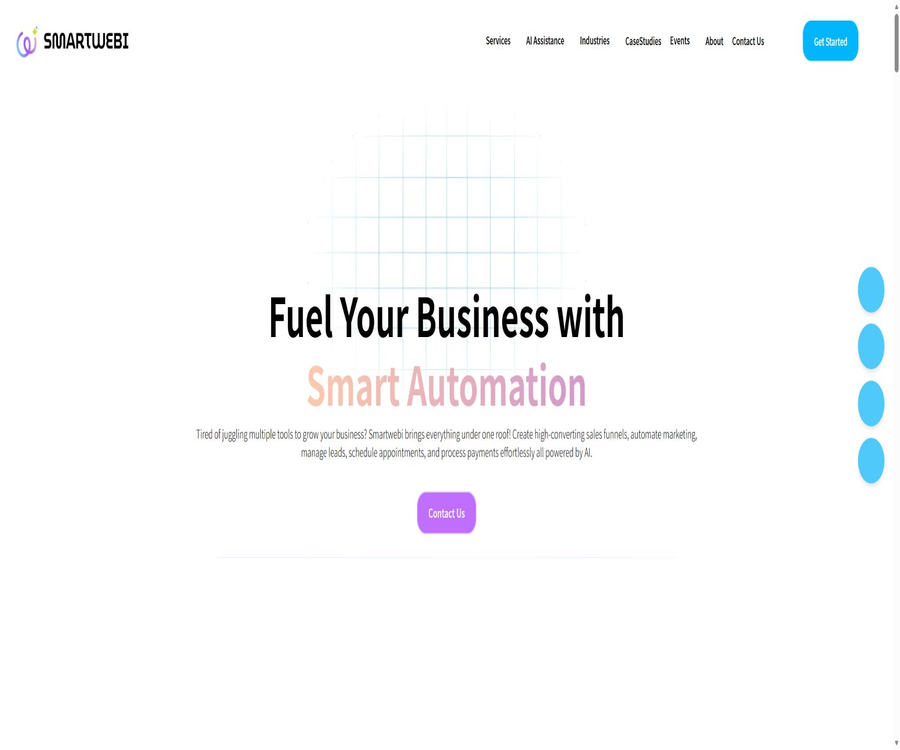
Home SmartWebi
Home SmartWebi: a smart tool focused on AI-powered image processing.
Tags:Common AI image toolsA one-sentence summary
SmartWebi is an enterprise business platform that integrates AI-powered voice functionality, intelligent chat, content generation, evaluation management, CRM, marketing automation, lead management tools, scheduling capabilities, payment systems, and reporting functions within a single backend. It is designed for organizations that wish to unify their processes for acquiring customers, communicating with them, closing deals, and managing customer relationships.
Tool Introduction
SmartWebi follows a delivery model that includes consulting, demonstrations, configuration, and support once the system is deployed; it is not a standalone software that can be purchased directly at a public price. Customers need to submit their business requirements, after which the team develops a solution based on factors such as industry sector, number of users, communication channels, AI modules, and the scope of integration required.
The platform’s website is credited to Agamverse Studio LLP, but the contact form lists SmartWebi as the commercial name of Edsync LLC; the available contact information covers the United States, India, and the UAE. Before making a purchase, companies should determine who the actual contracting party is, who will handle the data processing, who will issue the invoices, and what laws apply.
Product module
| module | Primary uses | Typical results | Suitable for teams |
|---|---|---|---|
| Voice AI | Automatic answering and making of calls | Appointments, eligibility assessment, reminders, and transfers | Front desk, sales, customer service, and follow-up teams |
| Conversation AI | Intelligent chatting on websites and social media platforms | Immediate responses, clue collection, and scheduling | Customer Service and Growth Team |
| Content AI | Generate text and image content | Blogs, ads, emails, social posts, and images | Content and marketers |
| Review AI | Collect, analyze, and respond to customer reviews | Evaluation requests, draft responses, and insights | Stores, service providers, and brand teams |
| Workflow AI | Translation, summarization, and intent recognition in automation | Conditional judgment, data processing, and subsequent actions | Operations and process managers |
| CRM and funnels | Manage leads, transactions, and conversion paths | Customer profiles, pipeline, and testing data | Sales and Marketing Team |
| Websites and marketing | Website creation, social media, email, and SMS campaigns | Websites, events, and automated follow-ups | Small and medium-sized enterprises and agencies |
| Payment and reservation | Payment collection, subscriptions, invoicing, and schedule management | Payment links, order details, and reservation records | Service providers, clinics, and member organizations |
| Reporting | Aggregates ads, calls, appointments, and system operations | Real-time dashboard and audit logs | Management and operational team |
Main AI features
Inbound Voice AI
AI voice assistants can handle calls around the clock, answering common questions, identifying user intentions, scheduling appointments, and forwarding complex requests to the appropriate personnel. During setup, it is necessary to provide information on business knowledge, operating hours, the scope of commitments that can be made, rules for forwarding calls, and a procedure to follow when a question cannot be answered.
Outbound Voice AI
The system can be used for following up on leads, handling renewals, sending payment reminders, collecting feedback, and performing other outbound calling tasks; it enables multiple rounds of communication based on scripts and the context. Before making a call, it is necessary to verify the validity of the phone number, determine the appropriate time to call, check the list of numbers that should be ignored, specify how the AI’s identity will be presented, and adhere to the rules regarding automatic dialing.
Multilingual voice interaction
The Voice AI page lists various languages such as English and Spanish, stating that it can adapt to regional accents and the context of conversations. Before going live, it is necessary to test each language using real names, addresses, amounts, and industry-specific terms; accuracy cannot be assessed solely based on demonstrations.
Call routing and scheduling
Voice assistants can determine the purpose of an incoming call, handle common tasks or transfer the call to team members; they can also be connected to a calendar to facilitate scheduling. It is necessary to define the time zone, as well as the procedures for repeating appointments, rescheduling, canceling them, dealing with emergency situations, and when human assistance is not available.
Call records and analysis
The communication module includes recording functions, historical logs, real-time tracking, as well as reports on call outcomes and analyses; it can be used for quality control and team training. Recording and transcription require mutual consent, take into account sensitive content, specify retention periods and access rights, and requirements vary from one region to another.
Conversation AI
Chat assistants can automatically answer questions, understand intentions, gather information, and facilitate appointments on websites and in social communications. Administrators can set the robot’s personality, tone, response style, and objectives, and they can monitor the performance of these interactions via a dashboard.
Knowledge training and objectives
Conversation AI can utilize real conversations and common questions to generate responses, and it can set goals such as clue creation, customer service, or appointment scheduling. After updates to the knowledge base, regression testing is still necessary to prevent the use of old prices, outdated policies, or incorrect responses.
Content AI text generation
After entering the topic, purpose, and brand tone, users can generate blog posts, social media content, advertisements, emails, headlines, and website text. The resulting content is suitable for drafting and rewriting, but product facts, offers, copyright information, regulatory statements, and industry recommendations must be reviewed manually.
AI image generation
Content AI also offers image generation capabilities for ads, social media posts, and websites. Users should check for issues related to people, trademarks, text, brand assets, and training data; generated images cannot be assumed to possess complete exclusive rights automatically.
Review AI evaluation analysis
Review AI is capable of analyzing each review and identifying issues that may require attention, thereby helping teams to spot trends related to service quality, products, and store experiences. However, it might misinterpret sarcasm, dialects, or the context when assessing emotions and intentions; negative reviews still need to be handled manually.
AI evaluation response
The system can generate automatic customer reviews or suggest personalized responses, while striving to maintain the brand’s tone. Reviews related to refunds, responsibilities, medical issues, finance, or personal information should not be published automatically; instead, they must first go through an approval process.
Evaluation invitation
Teams can send requests for feedback via email, text message, or WhatsApp, and incorporate the collection of such feedback into the customer service process. These requests must be neutral; they should not encourage satisfied customers to give ratings nor try to manipulate platform evaluations through improper incentives.
Workflow AI
The AI actions within a workflow can translate text, summarize content, identify intentions, and participate in conditional judgments; they can also trigger notifications, data updates, or communications with customers. For high-risk decisions, human approval, confidence thresholds, logging, and rollback mechanisms should be implemented.
External AI model connection
The automation module can integrate external AI capabilities to enable more complex reasoning and customized decision-making. The specific models, costs, data transmission locations, and retention policies are not publicly specified; these details must be confirmed individually when making a purchase.
Funnel AI
Funnel AI is used to assist in optimizing the structure of the conversion funnel, page content, and target audience, and it is utilized in conjunction with multiple versions for testing. Optimization alone cannot replace actual experiments; therefore, the team should define the conversion events, sample size, and criteria for stopping the tests in advance.
Websites, CRM, and marketing features
Code-free website creation
The website module offers templates, drag-and-drop editing, responsive layout, media storage, a blog, animations, and built-in SEO settings. It is suitable for quickly creating brand websites or service pages; however, complex interactions and special compliance features may still require custom development.
Sales funnel
Users can create funnels using templates or blank pages, connect them to custom domain names, and link forms, follow-up actions, payment processes, and additional sales features together. The platform also offers multi-version testing and real-time analysis to help compare the performance of different pages and workflows.
CRM and visual pipelines
CRM stores leads and customer information in a centralized manner; it allows for the import or capture of contacts, task assignment, setting of reminders, and tracking of transactions through a visual pipeline. Fields, stages, responsible persons, and rules for merging duplicate entries must be standardized before import.
Multi-channel marketing
The marketing module includes options for email, SMS, and social media campaigns; it allows for the creation of campaigns, automatic sending of messages, and tracking of the results. Teams need to manage consent, frequency, cancellation requests, and error messages separately for each channel, and it is not possible to apply the permissions set for one channel to other channels automatically.
Social content plan
Social Planner is used to schedule posts across various social media channels, as well as to monitor metrics such as reach, interactions, and performance of the content. Before publishing, it is necessary to verify the permissions for each platform account, the requirements regarding the media files, the parameters of the links, and who will be responsible for managing comments.
Reusable content segments
Marketers can save frequently used text snippets to avoid repeated editing and ensure consistency in the brand’s messaging. Whenever there are changes in prices, discounts, legal statements, or contact information, all of these reused snippets need to be updated accordingly.
Reputation and merchant information
The reputation module is used to collect reviews, manage information about online merchants, and track customer feedback. Automatic synchronization can lead to incorrect opening hours or addresses being spread across multiple platforms; therefore, any changes to important fields should be verified one by one.
Appointments and Reminders
The scheduling module allows for setting reservation times, sending confirmations and reminders, and it can be integrated with automation systems and Voice AI. Teams should define buffer times, resource capacities, limits on date changes, procedures for handling no-shows, as well as account for time zones in different locations.
Invoices, quotes, and payment links
The payment module allows for the creation of invoices and estimates, converts those estimates into invoices, and sends payment links via email, SMS, or WhatsApp. Transaction status, customer documents, and contact information can be stored in one place; the specific payment methods and fees are determined according to the implementation plan.
Subscription and periodic billing
Companies can set up periodic subscriptions and keep track of renewal and payment status. Before going live, it is necessary to define the trial period, the date of deduction, options for retrying in case of failure, procedures for cancellation, proportional billing, taxes, and refund processes.
Real-time reports
Reporting aggregates data from Google Ads, Facebook Ads, attribution mechanisms, calls, appointments, and system audits. The results of attribution depend on tracking parameters, cookies, cross-device identification, and the integrity of integrations; therefore, a single dashboard should not be regarded as absolute truth.
Automated workflows
SmartWebi Automation manages contacts, communications, data, and internal processes through triggers, conditions, and actions; it can also be connected to Webhooks, Google Sheets, and custom integrations. Workflow transitions, date formats, branches, and split tests make it possible to create more complex customer journeys.
| Workflow category | Executable actions | Typical scenarios | Key checks |
|---|---|---|---|
| Contact person | Labels, assignments, field updates, and interaction records | New lead allocation and customer segmentation | Duplicate records and field overwriting |
| Communication | Emails, text messages, calls, social interactions, and message replies | Welcome, Reminders, and Follow-up | Agreement, frequency, and manual takeover |
| Data | Webhooks, table synchronization, and custom connections | Transferring clues or orders across systems | Signature verification, retry, and deduplication |
| Internal processes | Conditions, jumps, time handling, and notifications | Approval, task, and team reminders | Loops, time zones, and abnormal paths |
| Workflow AI | Translation, summary, intent, and decision-making | Routing conversations and information extraction | Accuracy, sensitive data, and confidence level |
| External AI | Invoke external models to participate in the process. | Custom classification and task generation | Suppliers, costs, and data retention |
Usage process
- Fill out the request form or apply for a demonstration, specifying the industry, team size, customer channels, and main objectives.
- Define the scope of modules such as website, CRM, voice, chat, marketing, payment, and reporting in conjunction with the implementation team.
- Confirm the contracting party, pricing, implementation costs, communication fees, AI usage, and the boundaries of integration and support.
- Import a small number of test contacts, and configure fields, pipelines, calendars, numbers, and team permissions.
- Prepare accurate business knowledge, prohibited response topics, and rules for manual transfer for voice and chat assistants.
- Create a minimal workflow to test triggering, branching, messaging, failed retry, and unsubscribe handling.
- Connect to payment, advertising, social media, forms, or existing CRM systems, and verify data mapping.
- Use test customers to go through the entire process of consultation, booking, payment, evaluation, and customer service.
- It will be launched officially only after privacy, recording, automated outbound calls, industry compliance, and AI identity disclosure have been reviewed.
- Continuously monitor call, conversion, appointment, complaint, and audit reports to make optimizations based on the actual results.
Process for launching Voice AI
- Select an inbound, outbound, or bidirectional scenario, and define the specific tasks that can be completed automatically.
- Organize information on business hours, services, prices, location, policies, common questions, and contact persons for upgrades.
- Set the AI identity, opening phrase, language, tone, number, and audio prompts that must be included.
- Connect CRM to the calendar, and map contact information, appointments, call results, and follow-up fields.
- Establish rules for manual routing that result in unidentifiable situations, customer anger, sensitive information, and emergency events.
- Confrontation tests are conducted using different accents, noises, interruptions, dates, amounts, and names.
- Real calls are enabled on a limited scale, with manual checks of recordings, summaries, appointments, and compliance.
- Set up a blocklist, designated calling times, maximum call frequency, as well as procedures for data retention and deletion.
- Once the quality threshold is met, traffic can be increased gradually; concurrent capacity should not be equated with business performance.
Prices and cooperation models
SmartWebi does not disclose any fixed packages, monthly fees, free usage limits, or standard trial prices. The current pricing is determined based on the company’s needs, the size of its team, and the modules selected; users must submit their requirements or schedule a demonstration in order to receive a written quote.
| Plan or step | Price | Billing method | Possible contents | Suitable for users |
|---|---|---|---|---|
| Demand consultation | Usually, you should get in touch with the team first. | Not disclosed | Requirement analysis and product demonstration | Companies that are evaluating the platform |
| Platform subscription | Custom quote | Contract confirmation | CRM, website, marketing, funnel, reservations, payments, or reports | Organizations that need a unified business backend |
| AI module | Custom quote | It may be based on modules or usage amount. | Voice AI, Conversation AI, Content AI, Review AI, and Workflow AI | Teams that need AI for customer communication and automation |
| Implementation and integration | Custom quote | One-time or project-based | Configuration, migration, numbers, payment, CRM, and custom connections | Companies that have existing systems |
| Communication and third-party fees | Not disclosed | It may be based on actual usage. | Phones, text messages, numbers, models, and payment methods | Teams with high call volumes or multiple channels |
| Corporate support | Quotation confirmation | Contract period | Dedicated onboarding, online support, and priority assistance | Organizations that require ongoing services |
Items that must be verified in the quote
A written quote should specify the number of users, contact person, website, phone number, minutes used, SMS messages, AI calls, storage requirements, integration needs, implementation processes, migration procedures, level of support provided, minimum contract duration, taxes, and the price per additional unit. If only a total price is indicated, it becomes difficult to make a fair comparison with other CRM or Voice AI platforms.
Refunds and cancellations
The terms of service state that certain functions are available for a fee, and payments are generally non-refundable unless otherwise specified; overdue payments may result in suspension or termination of the service. Before signing the contract, it is necessary to include in it the notice period required for cancellation, any unused credits, implementation fees, data export options, and the timeline for deletion after termination.
Platforms and integration
| Platform or connection | Support status | Uses | Precautions |
|---|---|---|---|
| Web backend | Support | Manage all modules | Main operation entry point |
| Mobile web page | Supports mobile optimization | View customers, tasks, and operations across devices | Independent native app not confirmed |
| Desktop and mobile communications | Listed on the Voice AI page | Coordination between calls and text messages | The specific client needs to be confirmed during the demonstration. |
| VoIP and PBX | Custom connections are supported. | Numbers, calls incoming and outgoing, and routing | The page uses Twilio as an example. |
| CRM | Can be connected to existing systems | Synchronization of contacts, transactions, and activities | The specific brand and the range of two-way synchronization need to be confirmed. |
| Calendar | Support | Appointments, reminders, and available times | Checking time zones and handling conflicts |
| Google Sheets | The automated page lists them clearly. | Real-time data synchronization | It is necessary to control shared and personal data. |
| Webhook | Support | Transmit events to external systems | Signing, retry, and idempotency control are required. |
| Advertising platforms | Provide Google and Facebook reports | Advertising spending, clicks, and conversions | The quality of attribution depends on the tracking settings. |
| Payment gateway | Supports popular channels and custom connections | Payment links, invoices, and subscriptions | The specific gateways and regional eligibility criteria are not listed uniformly. |
API, GitHub, and open-source status
SmartWebi allows for integration with APIs, Webhooks, CRM systems, payment solutions, and other marketing tools. However, no comprehensive development documentation intended for the general public, a unified SDK, any limits on the number of calls that can be made, or developer packages are available. Teams that need programmed integration should request information regarding interfaces, authentication methods, rate limiting, sandbox environments, and versioning strategies during the procurement process.
No verifiable official open-source code repository, model weights, or self-hosted community version of SmartWebi has been found. The platform and its AI modules should be regarded as closed-source hosted services; third-party integrations or external models do not change the open-source nature of the product itself.
Which users are it suitable for
- Small and medium-sized enterprises that wish to manage their website, CRM system, marketing activities, telephone services, appointments, payment processes, and reports in a centralized manner.
- A customer service and front desk team that is required to be available 24/7 to handle appointments, provide reminders, and make outbound calls.
- A marketing team that acquires customers through websites, social media, email, text messages, and WhatsApp.
- Brands with multiple stores that need to automatically collect reviews and establish a process for manual approval of responses.
- Operations departments that wish to connect internal processes using triggers, Webhooks, and AI actions.
- Companies that need to customize their platforms according to industry processes, rather than purchasing pre-defined modules.
- Clinics, educational institutions, retail, and service organizations that are willing to adopt a model of demonstration, implementation, and ongoing support.
It is not very suitable for which users
- Individual users who wish to view the transparent low-cost packages immediately and activate them on their own.
- Only users who need a single-text generator, an image generator, or a general chatbot.
- Companies that require open-source products, self-hosting, or full control over the model infrastructure.
- Teams that cannot accept the compliance scrutiny associated with AI-powered calls, recording, customer data, and third-party integrations.
- Development companies that require public standard APIs, official SDKs, and detailed developer documentation in order to initiate a project.
- Organizations that lack human oversight for automated responses, outbound calls, evaluations, and high-risk decisions.
- Purchasers who demand immediate deployment even when the contracting parties, data processors, and location of the data are unknown.
Typical use cases
- Use AI to answer inquiries after working hours, respond to common questions, and schedule services for the following day.
- Automated text messages and emails are sent for new leads, followed by qualification assessment carried out by Voice AI.
- Deploy a chat assistant on the website; after collecting the requirements, add the contacts to the CRM pipeline.
- Create funnel pages and use A/B testing to compare titles, forms, and payment processes.
- Automatically generate tasks based on customer interactions, remind sales staff, and synchronize tables.
- Send evaluation invitations; AI generates draft responses which are then approved by the store manager.
- Create invoices and payment links, and trigger multi-channel reminders when due dates are missed.
- Aggregate advertising, call, appointment, and transaction data to create management dashboards.
- Use Content AI to draft social media posts, emails, and website copy in bulk.
Product advantages
- AI’s capabilities in voice, chatting, content generation, and evaluation are integrated into the same business process as CRM data.
- It supports inbound and outbound calls, multiple languages, call forwarding, recording, and call analysis.
- The workflow can handle contacts, communications, internal conditions, Webhooks, and AI actions simultaneously.
- Websites, funnels, marketing, booking, and payment cover various stages ranging from acquiring customers to closing deals.
- Conversation AI allows for the setting of personality traits, knowledge levels, and goals, as well as the monitoring of interaction performance.
- Review AI covers evaluation invitations, analysis, recommendations, and automated responses.
- The report provides different perspectives such as advertising, attribution, calls, appointments, and auditing.
- The custom implementation approach is suitable for companies that need to adapt modules to their existing processes.
Usage restrictions and precautions
- There are no publicly available fixed prices, free quotas, standard trial periods, or unit prices based on usage volume.
- Some features, integrations, and industry-specific solutions may require customized implementation and are not available immediately after registration.
- There is limited disclosure regarding the name of the AI model, the supplier of the model, as well as the rules for data retention and use in training.
- The information provided in the website footer and the contact form does not exactly match the details given about the operating or commercial entity.
- The naturalness of Voice AI, its multilingual capabilities, and its ability to handle multiple tasks simultaneously need to be tested using real-world business data.
- Automatic calls, recording, text messages, and WhatsApp communications are subject to the regulations of different regions as well as the rules of the respective platforms.
- The official website states that Voice AI complies with HIPAA, but medical institutions should still request a BAA and current security certifications.
- The official website claims to use end-to-end encryption and role-based access, but it does not release a detailed security white paper.
- Automatically generated content, evaluation responses, and intent detection may contain errors, and manual approval is required.
- After the account is closed, the data may be deleted; the contract must specify the periods for exporting and retaining it.
- No official native mobile app, public SDK, open-source, or self-hosted version has been confirmed.
- Marketing effectiveness, conversion rates, and ROI depend on data, processes, customer needs, and human effort.
Privacy, Security, and Compliance
SmartWebi handles names, email addresses, phone numbers, company information, web addresses, browser details, page visits, Cookies, and data related to business operations; this data may be shared with services such as CRM systems, analysis tools, and email services. The platform claims that it does not sell personal data, but the scope of processing by third parties still needs to be specified in contracts and processing agreements.
| Risk areas | Main problems | It is recommended to exercise control. |
|---|---|---|
| AI calls | Identity disclosure, automatic dialing, recording, and rejection of calls | Configure scripts by region, as well as approval and blocklists. |
| Medical information | Patient data, transcripts, and third-party models | Sign the BAA and verify the actual system scope |
| Contact marketing | Communicate via email, SMS, phone calls, and WhatsApp | Record channel approval and cancellation separately. |
| AI content | Misleading promises, copyright, and brand risks | Fact verification, approval, and sensitive word rules |
| Evaluation response | Publicly disclosing personal information or admitting responsibility | High-risk evaluations require manual processing. |
| Payment | Bills, subscriptions, refunds, and chargebacks | Use the minimum required permissions and compliant payment methods. |
| Third-party integration | Data transfer across systems and credential leakage | Review permissions, regions, reservations, and cancellations |
| Account termination | The data may be deleted and the customer will lose access to it. | Export in advance and arrange for a deletion certificate. |
| Minors | The privacy policy is intended for individuals over 13 years of age, with the requirement that account holders be at least 18 years old. | Obtain guardianship consent and restrict data in educational contexts |
HIPAA statement: How to verify it
The Voice AI page claims to be in compliance with HIPAA, but a single marketing statement is not sufficient to prove that its use by customers meets all the relevant requirements. Medical purchasers should verify whether a BAA has been signed, which modules and sub-processors are involved, where the data is stored, what audit logs are available, and what procedures exist for handling data breaches and data deletion.
AI identity and recording prompts
The platform states that the voice output can be very similar to that of a human being, to the point where customers may not even realize they are talking to an AI. Companies should not use this level of realism as an excuse to hide the truth; instead, they must provide clear indications regarding their identity and the fact that it is a recorded message, in accordance with laws, industry ethics, and customer expectations.
Right to privacy
The privacy policy mentions rights such as access, updating, deletion, data portability, restriction of processing, and opting out of marketing, but it does not provide details on the verification process or the time frames for carrying out these actions. The purchaser should request a data processing agreement as well as a clear procedure for submitting requests.
Basic information
| Project | Content |
|---|---|
| Tool name | SmartWebi |
| Product type | AI business automation, Voice AI, CRM, and marketing platforms |
| Web page signature | Agamverse Studio LLP |
| Contact form wording | SmartWebi is the trade name of Edsync LLC. |
| Main morphology | Web platform with custom implementation |
| Core AI | Voice AI, Conversation AI, Content AI, Review AI, Workflow AI, and Funnel AI |
| Business modules | Websites, CRM, marketing, funnels, reservations, payments, communication, and reports |
| Price | Custom quote |
| Free version | Not disclosed |
| Mobile support | Optimization for mobile web pages; native apps not confirmed yet |
| API and Webhook | Integration is supported; no complete public documentation available. |
| Official SDK | No findings were detected. |
| Is it open source? | No |
| Applicable age range | The account user must be at least 18 years old. |
Frequently Asked Questions
What is SmartWebi?
It is an AI-based platform for automating business processes, which integrates voice communication, chat, content management, reviews, CRM functions, marketing tools, lead tracking, scheduling, payment processing, and reporting into a single system.
What is the price of SmartWebi?
There is no fixed public price. The platform provides customized quotes based on business requirements, team size, and the modules selected; the costs related to communication, AI, integration, and implementation need to be determined separately.
Is it possible to try it for free?
At present, no publicly available permanent free plan or standard trial period has been found. To get started, you need to fill out a request, contact the team, or ask for a demonstration.
What types of calls can Voice AI handle?
It can handle inquiries, answer common questions, schedule appointments, and route calls; it can also be used for outbound tasks such as following up on leads, handling renewals, sending payment reminders, and collecting feedback.
Is multi-language support available?
Supported; the page explicitly mentions English, Spanish, as well as other languages and accents. The actual languages, regional codes, and recognition quality should be tested during demonstrations and pilots.
Will the customer know it’s AI?
The platform claims that the voice can sound similar to that of a real person, but companies should still disclose the fact that it is AI-based in accordance with relevant rules and customer expectations, and provide warnings during recording.
Is SmartWebi compliant with HIPAA?
The Voice AI page contains a statement that complies with HIPAA requirements. Healthcare organizations still need to obtain a BAA, security documentation, and a list of sub-processors in order to ensure that their modules, processes, and data are indeed covered by these regulations.
Can it generate marketing content?
Yes. Content AI supports blogs, social media posts, advertisements, emails, website copy, and images; it can also be used for brainstorming, refining, and rewriting through chat.
Is an API provided?
The platform supports API, Webhook, and custom connections, but no comprehensive public development documentation or unified SDK is available. Specific interfaces, rate limits, and costs need to be confirmed with the team.
Is SmartWebi open source?
It is not open source; no official open-source core repository, model weights, or self-hosted version could be found.
Can it be used from a mobile phone?
The website is optimized for mobile use, and the communication pages mention integration between desktop and mobile versions; however, there is no confirmation regarding the availability of standalone native apps that can be downloaded from official app stores.
What will happen to the data after it is canceled?
The terms state that access will be revoked upon termination, and the data may be deleted. Companies should specify in the contract the format for exporting data, the period during which it can be retained, the proof of deletion, and how the data will be handled in third-party systems.
Summary
SmartWebi is suitable for companies that need to integrate AI-powered voice services, customer conversations, content, reviews, CRM systems, marketing tools, scheduling functions, and payment processes into a cohesive workflow. Its value lies in the coordinated operation of multiple modules and in the ability to implement customized solutions, rather than in the use of individual AI functions in isolation.
Before making a purchase, it is essential to verify the quality of the actual voice output, the boundaries between different modules, the total cost associated with usage, the entities involved in the contract, the data processing protocols, the HIPAA compliance requirements, as well as the procedures for disclosing AI-related information and carrying out migrations. The most reliable approach is to start with a limited number of numbers, a small number of contacts, and a single business process as a pilot project; thereafter, expansion can be decided based on factors such as accuracy, conversion rates, complaints, and operational costs.
Tools similar to Home SmartWebi




 Guigong Network Security Registration No. 45132202000164