






Flexberry AI Assistant
Flexberry AI Assistant, a smart tool focused on AI-powered image processing.
Tags:Common AI image toolsA one-sentence summary
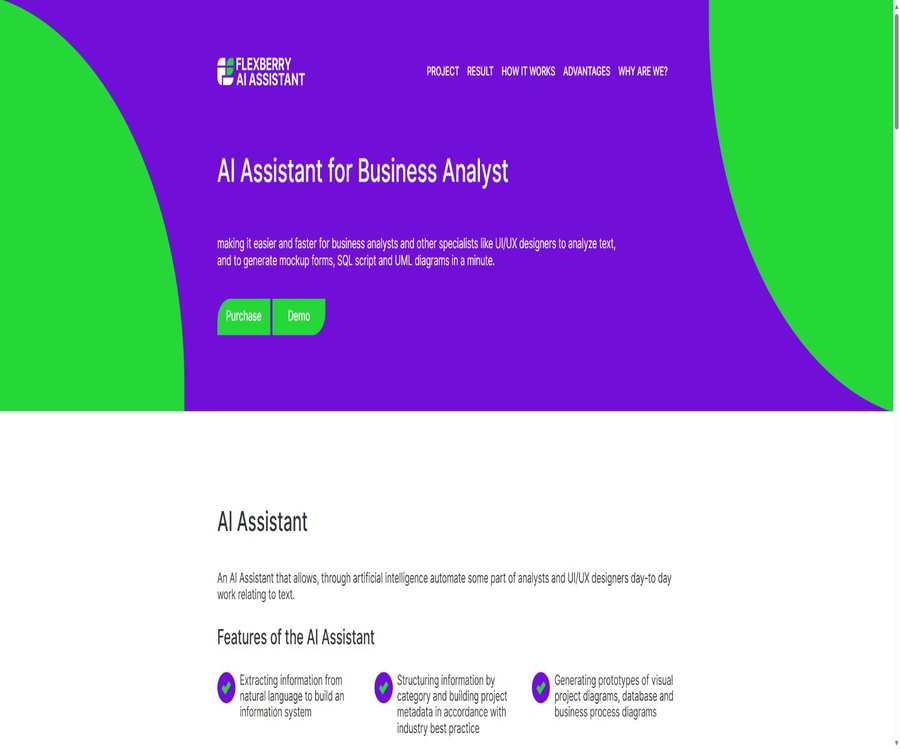
Flexberry AI Assistant is an AI-driven requirement modeling tool designed for business analysts and UI/UX designers; it enables the conversion of natural language requirements into project details, and it generates class diagrams, databases, SQL scripts, as well as prototypes for lists or edit forms.
Tool Introduction
Flexberry AI Assistant is part of the Flexberry PLATFORM ecosystem and is operated by the teams at Institute of Information Systems LLC. This product aims to automate the repetitive tasks involved in text analysis of requirements, as well as in the modeling and prototyping of information systems.
It is designed to assist analysts, rather than replacing human judgment. Its current capabilities focus on analyzing various texts, identifying business concepts and relationships, generating draft interfaces and database-related results; it does not mean that a complete production system is delivered automatically.
Main output
| Output type | Included content | Primary uses | Manual inspection is required. |
|---|---|---|---|
| Project metadata | Entities, attributes, and relationships organized by category | Lay the foundation for creating a demand model | Terms, boundaries, and omissions |
| Class diagram | The identified classes and their structural relationships | Domain modeling and technical communication | Base numbers, inheritance, and business constraints |
| Database or SQL script | Initial implementation of tables, fields, and relationships | Database prototype | Types, indexes, constraints, and migration |
| List form prototype | Browse and manage interface for object collections | Backend list and information architecture | Operations, permissions, and pagination |
| Edit form prototype | Interface for adding and modifying individual objects | Field layout and interactive discussions | Verification, status, and availability |
| Business process diagram | The process or structural framework for text extraction | Process discussion and documentation | Exceptions, roles, and approval paths |
| Standard document text | Draft description for repetitive items | Accelerate document preparation | Facts, contracts, and organizational norms |
Main functions
Natural language information extraction
The user pastes the business requirements, task descriptions, or details of the system to be developed; the AI then identifies the objects, attributes, actions, and relationships within them. The more specific the input, the closer the output will be to the actual business scenario.
Demand classification and structuring
According to the practices of information system design, the tool organizes the extracted content into project metadata. Analysts can use it to create an initial version of the glossary and domain model, which can then be reviewed with business professionals.
Requirement completeness analysis
The product can assist in determining whether statements and requirements are complete, helping to identify any missing roles, fields, statuses, or processes. AI is unable to understand all implicit policies; ultimately, it is the business owner who is responsible for ensuring completeness.
Generation of UML class diagrams
After identifying the business objects, a class diagram prototype can be created, allowing the team to discuss the structure and relationships more intuitively. The resulting diagram should be regarded as a draft model, rather than an approved system architecture.
Databases and SQL scripts
The tool can generate database designs and SQL scripts from structured requirements, enabling quick verification of entities and relationships. Before actual use, it is necessary to check the database dialect, data types, primary and foreign keys, indexes, and security rules.
List and edit form prototypes
Each identified class can generate a list form and an edit form draft, which helps UI/UX designers and analysts discuss fields and pages. The prototype does not take into account responsiveness, accessibility, permissions, and error states automatically.
Business process diagram
The official website lists the database and business process diagrams as visual outputs that can be generated. The public demonstration did not show all process markers and export formats; it is necessary to verify them using actual examples before use.
Project documentation assistance
AI can automatically generate parts of the standard text, thereby reducing the need for manual formatting in requirements specifications and design documents. However, matters related to acceptance, law, finance, or security still require verification by professionals on a case-by-case basis.
Enterprise task adaptation
Product promotion can be tailored to specific analysis, design, and presentation scenarios of enterprises. The scope of customization, the samples required, the model types, as well as the costs associated with deployment and services are not specified on the public website.
Early-stage design of MVP
The generated metadata, charts, SQL queries, and forms can serve as a starting point for designing the MVP, facilitating quick discussions among the team members. They are not complete MVP applications that have been tested, deployed, and come with proper maintenance support.
Standard usage process
- Organize the business text to be analyzed, remove duplicate paragraphs, and standardize the names of the same entities.
- Add user roles, business objects, fields, statuses, rules, exceptions, and expected reports.
- Paste text on the demonstration page and enter the email address to receive the delayed results.
- Submit it to the AI for processing; wait for the page to return immediately or receive the results via email.
- Check each item such as classes, attributes, relationships, forms, SQL statements, and charts, then record any omissions and errors.
- Modify the original requirements and analyze them again until the model aligns closely with the views of the business staff.
Prepare high-quality requirement texts
- First, clarify the system objectives, boundaries, and matters that will not be addressed in this period.
- List each user role, the operations permitted, and the data that is not visible.
- Provides a unique name, key fields, status, and lifecycle for business objects.
- Describe the normal process, and also outline cancellation, failure, repetition, timeout, and manual handling.
- Requirements for supplementary data retention, auditing, notification, search, reporting, and external systems.
- Use a few real examples to verify the terms, but do not submit sensitive customer or production credentials.
Review and generate class diagrams and databases.
- Compare the generated entities with the business glossary item by item, merge synonyms, and split mixed concepts.
- Confirm one-to-one, one-to-many, and many-to-many relationships, as well as whether these relationships can be empty.
- Check the primary key, uniqueness, data type, amount precision, time zone, and enums.
- Additional indexing, soft deletion, versioning, audit fields, and tenant isolation.
- Run SQL queries in an isolated database to verify the table creation order, dialect, constraints, and rollback functionality.
- Proceed with development only after it has been approved by business personnel, architects, and database engineers.
Review form prototype
- Confirm the fields that need to be displayed, filtered, sorted, and exported on the list page.
- Check the required fields, formatting, default values, read-only status, and rules for conditional display on the edit page.
- Additional statuses such as creation, saving, cancellation, deletion, conflicts, and insufficient permissions are included.
- Control field visibility, operation permissions, and the minimization of personal data based on different roles.
- Invite real users to complete task tests, and record comprehension errors and operational obstacles.
- Write the approved interaction rules back into the requirements, rather than keeping only the image prototype.
Which users are it suitable for
- Business analyst: Quickly create a preliminary draft of the domain model based on interview notes and requirement specifications.
- System analyst: Convert business objects into class diagrams, as well as draft designs for databases and SQL queries.
- UI/UX designers: Generate lists and edit form prototypes based on the identified categories.
- Product manager: Structure ideas in the early stages of the MVP to identify missing roles and processes.
- Development team: Uses a unified model to discuss data, interfaces, and acceptance criteria with business personnel.
- Educators and trainers: Demonstrate the process of converting natural language requirements into UML and databases.
Typical use cases
- Interview transcript modeling: Identifying customers, orders, contracts, and statuses from the descriptions provided by business staff.
- Preparation for requirement review: Generate class diagrams and a list of issues before the meeting to discuss any omissions together.
- Backend prototype: Create lists for the identified entities and draft edit forms.
- Preliminary database design: Quickly generate table structures and SQL codes, which are then adjusted by engineers.
- Old system restructuring: Convert the existing procedural descriptions into clearer object and relationship models.
- Course exercise: Compare the results obtained from students’ manual modeling with those generated by AI, and analyze the differences in modeling.
Product advantages
- It focuses on business analysis, UML, databases, and forms, rather than being a general-purpose chat interface.
- By entering a simple text description of the requirements, various interconnected design outcomes can be obtained.
- Class diagrams, SQL, and interface prototypes help business, design, and development teams develop a common language.
- The public demonstration page does not require the use of complex modeling software, making it suitable for quick testing.
- Emphasizing human-AI collaboration, the authorities have made it clear that AI is intended to serve as a helper only, and not to replace analysts entirely.
- The Flexberry ecosystem includes a large number of platforms, ORMs, designers, and repositories of data components, which enable technical teams to become familiar with this ecosystem.
Usage restrictions and precautions
- The official website does not disclose the name of the model, the context length, the languages supported, the file formats, or the accuracy rate.
- The public demonstration focused mainly on entering text and email addresses; it did not show account details, project versions, or team collaboration features.
- The results are shown sometimes immediately, and at other times they are sent to the email address later; there are no guarantees regarding the processing time or service level.
- The generated result is a design draft; it may omit implicit rules, abnormal processes, as well as security and non-functional requirements.
- There may be errors related to relationships, dialects, types, constraints, or execution order between class diagrams and SQL.
- Form prototypes do not automatically ensure usability, accessibility, mobile compatibility, and correct role permissions.
- The purchase page does not reveal the available packages or their prices; it is necessary to submit personal and company information in order to await further contact.
- The retention period specified in the consent form for personal data on the official website is indefinite, until a written request to withdraw it is received.
- The submitted text may contain customer, employee, or business confidential information, and the public page does not provide complete details regarding data retention and model training.
- The AI Assistant repository on the official GitHub contains mainly static website files; it does not expose any AI algorithms or backend systems.
- The LICENSE file is not visible in the AI Assistant warehouse; being publicly accessible does not equate to having an authorization for open-source use.
Price and purchase methods
As of August 22, 2026, the official website offers a purchase application form and a demo version, but it does not disclose any information regarding free usage limits, subscription plans, per-use fees, or prices for enterprise deployments. The Freemium options indicated by third parties should not be considered as official pricing.
| Usage method | Public price | Currently visible content | Confirmation is needed. |
|---|---|---|---|
| Online Demo | Not disclosed | Text and email input are used to generate results or to receive responses via email. | Number of uses, data storage, and language support |
| Purchase of standard products | Contact the team | Submit a purchase request | Seats, number of items, quota, and support |
| Enterprise task adaptation | Custom quote | The promotion on the official website can be adjusted according to the company’s objectives. | Scope of implementation, samples, delivery, and maintenance |
| Privatization or on-premises deployment | Not disclosed | There is no clear self-service solution. | Deployment methods, models, data storage, and upgrades |
| Flexberry open-source ecosystem | Most warehouses can be viewed for free. | Independent projects such as ORM, frontend, and designer. | License and maintenance status per warehouse |
Before making a purchase, it is necessary to request a written quote, a list of functions, the rules regarding models and data, the format of the results, the level of service provided, and the terms for terminating the agreement. The final price shall be determined in accordance with the contract or order between the two parties.
Support for platforms and input/output.
| Project | Support status | Explanation |
|---|---|---|
| Web version | Support | Product introduction, online demonstration, and purchase request |
| Text input | Support | Paste the natural language request |
| Reception via email | Support | Some of the results will be sent later. |
| Class diagram | Support | UML class structure prototype |
| Databases and SQL | Support | Database design and script drafts |
| Lists and edit forms | Support | Generate prototypes based on the classification type. |
| File upload | No findings were detected. | The public demonstration does not provide a clear entry point to the documents. |
| Desktop and mobile clients | No findings were detected. | No official stores or installation packages were found. |
| API | No findings were detected. | There are no publicly available API documentation. |
GitHub, APIs, and open source status
The official Flexberry GitHub organization hosts a large number of open-source repositories, including those related to ORM, Ember components, UML and form designers, documentation, as well as MCP-related projects. Different repositories use different licensing agreements; it is not possible to assume that all products are open source just because the entire organization is open source.
The repository associated with AI Assistant makes available the website’s HTML, CSS, JavaScript files, images, and demo pages; it does not expose the backend AI algorithms, model services, or APIs. Nor is any license information displayed on the repository page, so such a product should be labeled as non-open source rather than open source.
| object | Public status | License | Make the right judgment. |
|---|---|---|---|
| Flexberry AI Assistant web repository | Public | Not displayed | The fact that the code of a static website is visible does not mean that AI services are open source. |
| AI algorithms and the backend | No source code was found. | Not applicable | Closed-source or not publicly available |
| Public API | No document found. | Not applicable | Programmatic access cannot be guaranteed. |
| Flexberry ORM | Public | MIT | Independent open-source components |
| ember-flexberry-designer | Public | MIT | Independent UML and form editor |
| Other Flexberry warehouses | A large number of open-source projects | It varies from warehouse to warehouse. | Use after confirming each item individually |
Privacy and data processing
The personal data included in the purchase request covers name, first name, phone number, email address, job title, and resume; it also permits collection, recording, organization, accumulation, storage, updating, use, transmission, anonymization, blocking, deletion, and destruction of such data.
The agreement states that its validity is indefinite, lasting until the Institute of Information Systems LLC receives a written notice of withdrawal; such withdrawal does not have any retroactive effect on any actions that have been taken previously. Users also agree to allow relevant employees to use their data to send files, letters, job-related information, and to create databases.
- The demonstration text must not contain the actual names of customers, identification details, accounts, keys, or unpublished contracts.
- When entering an email address, use the work-related address and ensure that the organization permits sending requests to external services.
- Before making a purchase, enterprises are required to specify the requirements, the output results, as well as the retention period for logs and emails.
- Confirm whether the input is intended for model training, manual inspection, quality improvement, or corporate customization.
- When dealing with cross-border or regulated data, it is required to specify the location of the data, the sub-processors involved, and the mechanisms for transmitting it.
- When they are no longer needed, withdraw written consent for unnecessary personal data and submit requests to access or delete it.
- Save a local copy of the sent content and the returned results, but avoid using the email account as the sole place for storage.
- Before using SQL in production, code reviews and isolated database tests are carried out to prevent data corruption.
Basic information
| Project | Content |
|---|---|
| Tool name | Flexberry AI Assistant |
| Ecological niche | Flexberry PLATFORM |
| Relevant operating entities | Institute of Information Systems LLC |
| Tool type | AI requirement analysis, UML, and interface prototype creation |
| Primary users | Business analysts, system analysts, and UI/UX designers |
| Core input | Natural language requirement text |
| Core output | Project metadata, class diagrams, databases, SQL, and form prototypes |
| Price pattern | Not available; purchase requests and custom quotes required. |
| Is registration required? | The demo does not show the account requirements; some results require an email address. |
| Chinese support | No clear Chinese language support was found. |
| Web version | Support |
| API | No public documents were found. |
| Official SDK | No findings were detected. |
| Is the product open source? | The AI services are not open source; the static website repository is available publicly, but there is no explicit license. |
| Price verification date | August 22, 2026 |
Recommendation score
Recommendation score: 3.3 / 5. Flexberry AI Assistant has a clear workflow for handling requirement texts, UML diagrams, databases, and form prototypes; it is suitable for quickly creating draft designs that can be discussed in the early stages of business analysis.
The main shortcomings are the lack of transparency regarding price, models, languages, data storage, interfaces, and export specifications; moreover, the available demo versions are quite basic. It is better suited as a tool for auxiliary modeling experiments, rather than a tool for system design or production code development that does not require further review.
Frequently Asked Questions
What does the Flexberry AI Assistant do?
It extracts business objects and relationships from natural language requirements, organizes project metadata, and generates class diagrams, databases, SQL statements, as well as prototypes for lists and edit forms.
Is Flexberry AI Assistant free?
The official website offers an online demo, but it does not specify whether it is available permanently and free of charge, whether there are any limits on the number of times it can be used, or what the price of the full version of the product is. To make a purchase, it is necessary to submit an application and wait for a quote.
Can a complete application be generated directly?
Public capabilities are primarily related to requirement analysis and design outputs. They can assist in preparing an MVP, but there is no evidence to suggest that online demonstrations can directly yield a fully functional application that has been tested and ready for deployment.
What kinds of interfaces can be generated?
The official website clearly lists the form templates for each recognition category as well as the forms for editing them. Complex dashboards, mobile-based workflows, and a complete design system have not been made available publicly.
Can SQL be generated?
SQL scripts and database drafts can be generated, but it is necessary to check the dialect, data types, primary and foreign keys, indexes, permissions, and migration security before running them in an isolated environment.
Is UML supported?
Class diagrams are supported, and it is possible to generate diagrams of databases and business processes. The specific UML formats, methods for exporting graphics, and modeling standards need to be confirmed through actual results.
How long does it take to generate the results?
The instructions on the official website are sometimes displayed immediately, while at other times they are sent to the email address provided later. There is no fixed time frame for processing or defined service level specified.
Is Chinese support available?
The public page does not explicitly state that Chinese support is available; the interface is mainly in English with some elements in Russian. Chinese text should first be tested using non-sensitive examples to verify term recognition and output functionality.
Is it necessary to upload a file?
The public demo shows only text input and email fields; file uploading is not explicitly included. Requirements regarding longer documents, as well as format and character limits, need to be confirmed with the team.
Are APIs provided?
As of the verification date, no public API, authentication mechanisms, SDKs, or pricing information for AI Assistant were available. If it is necessary to integrate this tool into an analysis process, written confirmation must be obtained prior to making a purchase.
Is Flexberry AI Assistant open source?
It cannot be labeled as open source. The GitHub repository with the same name contains mainly static files for the website; the AI backend and algorithms are not made available, nor is there any explicit license specified.
Does the open-source nature of the Flexberry PLATFORM mean that the AI assistant is also open source?
It’s not the case in all situations. The Flexberry organization does indeed have open-source components licensed under MIT and other licenses, but each repository has its own set of permissions; the AI assistant service requires separate evaluation.
Is the request text secure?
The official website includes a consent form for personal data, but it does not provide a detailed explanation of the rules regarding the storage, training, and manual access to such data. When dealing with customer or business confidential information, it is necessary to anonymize that information and obtain written approval from the company first.
Is it suitable as a replacement for a business analyst?
It is not suitable. The authorities also consider it to be a helper; rules, conflicts of interest, non-functional requirements, and acceptance criteria still require manual investigation and decision-making.
Summary
Flexberry AI Assistant can quickly convert ordinary requirement descriptions into class diagrams, databases, SQL statements, and form prototypes, providing a preliminary version of the material that can be used for discussions among business, design, and development teams.
When adopting it, the output should be regarded as a draft, and it needs to be refined through business reviews, database tests, and usability verification. Before making a formal purchase, it is also necessary to confirm the price, model, language, data storage method, intended use for training, export format, and interface capabilities.
Tools similar to Flexberry AI Assistant




 Guigong Network Security Registration No. 45132202000164