






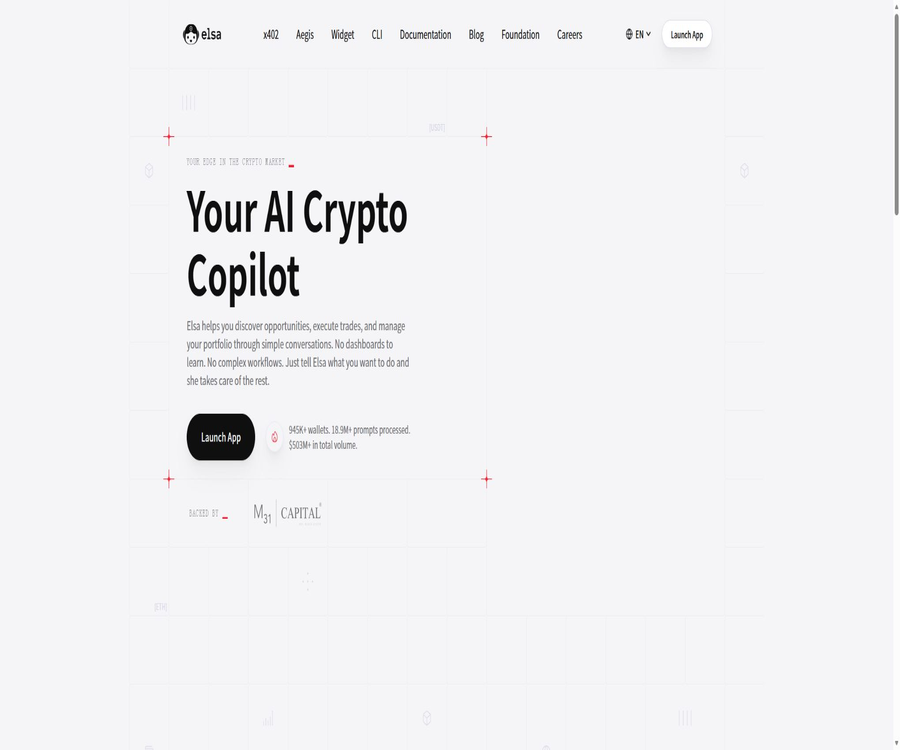
Elsa: AI Crypto Copilot
Elsa: AI Crypto Copilot, an intelligent tool focused on AI-generated images
Tags:Common AI image toolsA one-sentence summary
Elsa AI, also known as HeyElsa, is an unmanaged, conversational cryptocurrency assistant that enables the conversion of natural language requests into actions such as asset queries, token exchanges, cross-chain transactions, transfers, staking, yield optimization strategies, and certain automated trading tasks. It displays the execution pathway and related risk information to the user before they sign off on the transaction.
Tool Introduction
Elsa AI is operated by Elsa AI Ltd., a company registered in the British Virgin Islands; it functions as an encrypted intelligent proxy layer that connects data from both on-chain and off-chain environments. It offers Copilot for individuals, and is also developing Widgets and SDKs for wallets and decentralized applications, as well as AgentOS for specialized proxies.
The platform is not an exchange, a custodial wallet, a broker, or a licensed investment advisor. Users are responsible for authorizing each transaction carried out in third-party wallets on their own, and they bear the risks related to private keys, the network, protocols, assets, regulations, and taxes.
Product composition
| Product or level | Primary users | Core function | Current boundary |
|---|---|---|---|
| Elsa Copilot | Individual encrypted users | Query, plan, and execute on-chain operations using text or voice. | Official Web Application |
| Elsa Smart Wallet | Registered users | Provides EVM compatibility and access to Solana smart wallets | Unmanaged properties and recovery procedures need to be confirmed within the account. |
| External EOA wallet connection | Existing wallet users | Use the existing wallet to view assets and sign transactions. | Elsa should not be given a private key or mnemonic phrase. |
| Widgets and SDKs | Wallets, dApps, and content platforms | Integrated AI Q&A, sending, and exchange capabilities | Access credentials are required; public access remains limited. |
| AgentOS | Agent developers and partners | Build and host dedicated proxies as well as coordinate between them. | The expansion directions outlined in the white paper will be introduced gradually, as new capabilities are added. |
| ELSA utility token | Eco-users and partners | Fees, discounts, usage tiers, and phased governance | It is not equity, debt, deposits, or capital-protected assets. |
Main functions
Natural language asset query
Users can inquire about the current balance, the tokens held, the total value, and an overview of cross-chain assets. Public chain data changes over time as new blocks are added, as price sources change, and depending on the index status; therefore, the values displayed should not be used as basis for accounting or tax purposes.
Token exchange
Users can describe the assets to be sold or purchased, the amount involved, and the target network; Elsa will then find an executable path. Before the exchange takes place, it is necessary to check the token contract, the pricing mechanisms, the minimum quantity that can be received, the impact on prices, slippage, authorization requirements, and the total costs involved.
Cross-chain bridging
Elsa allows for the planning of cross-chain asset transfers in just one sentence, and it is possible to combine multiple chains and protocols. Cross-chain bridges introduce elements such as the source chain, the target chain, message verification, liquidity issues, latency, and risks associated with bridge contracts; moreover, a refund may not be available immediately in case of failure.
On-chain transfer
Users can send assets to regular addresses, name service addresses, or other compatible blockchain addresses. Blockchain transactions are usually irreversible; it is necessary to verify the network, address, token, decimal places, and amount before signing.
Pledge and yield strategies
The platform can identify opportunities for collateralization, lending, liquidity, and earnings, and it can assist in the allocation of assets. The annualized returns shown vary depending on the token price, utilization rate, incentives, impermanent loss, and the status of the protocol; they are not guaranteed returns.
Portfolio recommendations
Elsa can suggest portfolios that consist of large-cap, mid-cap, or diversified funds, based on the user’s goals and risk tolerance; it may also recommend actions such as rebalancing or directions for generating returns. Such outputs are still information generated by algorithms, and they do not constitute regulated investment advice tailored to an individual’s specific situation.
Price limits and automation
The official website lists limit orders and automated strategies that can be activated when certain price conditions are met. Users need to verify the source of the trigger price, its validity period, the available balance, slippage, options for retrying in case of failure, permission levels, and the method for cancellation.
Perpetual contracts and leverage
The official guide shows how to create leveraged long/short positions related to crypto assets, foreign currencies, or commodities using Hyperliquid and Avantis. Leverage amplifies losses and can lead to rapid liquidation; it is not suitable for users who are not familiar with the margin mechanism.
Real-time market and on-chain information
The platform uses on-chain transactions, market trends, social content, and other off-chain channels to answer questions and attempt to identify changes in the market. Data may be delayed, incomplete, or manipulated; therefore, important decisions should be verified by referring to block explorers, protocol interfaces, and multiple independent price sources.
Risk assessment
The official website states that transactions are subject to risk checks and verifications prior to execution, with warnings issued for any potential issues. No automated check can detect all malicious tokens, phishing signatures, proxy upgrades, oracle manipulations, or unknown contract vulnerabilities.
Multilingual and voice capabilities
Users can express their intent to perform an action using natural language or voice, which reduces the difficulty of understanding the interface on the chain. Voice recognition may mishear amounts, tokens, and networks; any transaction should be based on the final structured preview.
Supported chains and capabilities
| Internet | Public guide status | Representative capabilities | It is necessary to pay attention. |
|---|---|---|---|
| Base | Support | Exchanges, transfers, earnings, and ELSA tokens | Verify Base network assets and Gas |
| Arbitrum | Support | Exchange, cross-chain, and DeFi operations | Check the bridge route and the balance of the target chain. |
| BNB Smart Chain | Support | Exchange and cross-chain | There are many tokens with the same name; it is necessary to verify the contract. |
| Optimism | Support | Swapping, cross-chain, and DeFi | Confirm the target chain and withdrawal delay |
| Polygon | Support | Directions for exchange, transfer, and pledging | Pay attention to the native Gas token and older versions of assets. |
| Hyperliquid | Support | Sustainable trading and position management | High leverage and liquidation risks |
| Ink | Support | Interaction between on-chain assets and protocols | Ecological and mobility coverage needs to be verified in real time. |
| Soneium | Support | Widget and on-chain interactions | Token and protocol support may be limited. |
| Solana | Support | Swapping, transfers, cross-chain, and wallets | The address format and transaction model are different from those of EVM. |
Support for a network does not mean that all tokens, protocols, and actions available on each chain are also usable. Users should verify the target assets, routes, liquidity, and protocols in an actual preview of the application before signing.
From dialogue to execution on the chain
- Users log in to Elsa and choose either Elsa Smart Wallet or connect their own external wallet.
- Users describe the assets, amounts, channel chains, target chains, and desired actions in natural language.
- AI analyzes the intent and formulates a plan by taking into account the wallet balance, on-chain data, market data, and relevant protocols.
- The system generates a structured transaction preview, showing the assets, network, protocols, estimated results, and costs.
- The risk layer checks the balance, authorizations, routes, and known risks, and provides the user with alerts.
- After checking each item individually, the user authorizes or signs the transaction in their wallet.
- The transaction is broadcasted onto the chain, where it is processed and confirmed by the network, bridges, or target protocols.
- Users verify the actual results by using transaction hashes and a block explorer, rather than relying only on chat replies.
- Automation strategies also require continuous monitoring of trigger, failure, authorization, funding, and cancellation statuses.
Getting started guide
Create or connect a wallet securely
- Make sure you are at least 18 years old and that your area allows access to relevant digital asset services.
- Enter the app through the official entry point, and check the domain name, certificates, and wallet pop-up options.
- After registration, learn how to control and restore the automatically created EVM-compatible wallet and Solana wallet.
- When connecting to an external wallet, create a new test wallet with a low balance; do not use the main wallet that holds the assets.
- Reject any requests for passwords, private keys, screen sharing, or remote control.
- Check connection permissions; messages, authorizations, or batch operations that require signing cannot be understood without it.
- First, use a small amount of assets to test the target network, payment addresses, and transaction process.
Execute the first token exchange
- Specify the source network, tokens to be sold, tokens to be purchased, and the maximum amount that can be tolerated.
- Confirming the identity of a token using its contract address relies not only on its name and icon.
- Enter specific instructions and ask the system to provide a route instead of carrying out the action immediately.
- Check the quotes, price impacts, slippage, minimum amounts that can be received, Gas fees, and platform or protocol fees.
- Confirm the authorization limit; prefer a specific amount rather than unlimited authorization.
- Sign after verifying the final network, contract, and amount in the wallet.
- Wait for confirmation on the chain, and use a separate blockchain browser to check that the assets have been received.
- After completion, revoke any excessive permissions that are no longer needed.
Perform cross-chain transfers
- Confirm that the target chain possesses native assets from which subsequent Gas can be paid for.
- Check whether the source asset and the target asset refer to the same economic asset or different packaging versions.
- Compare bridge routes, estimated times, minimum amounts required, and all costs.
- Query the contract, audit, suspension status, and historical security events of the bridge in use.
- Send small amounts for testing first, and then handle larger amounts.
- Save the source chain transaction hash, bridge message ID, and target chain transaction hash.
- When there is a delay, use the official status query of the bridge to avoid submitting the same transition repeatedly.
Automation Strategy Tutorial
Set a limit order
- Determine the trade pair, direction, trigger price, quantity, validity period, and acceptable slippage.
- It is important to know the source of the price used and the conditions that trigger it – whether it is the transaction price, the index price, or the oracle price.
- Check the token authorization, Gas balance, and service fees required for automatic execution.
- Start with a smaller amount to prevent erroneous conditions from affecting the entire portfolio.
- Confirm the rules for handling orders during periods of severe volatility, insufficient liquidity, and network congestion.
- Save the order identifier, and test suspension, cancellation, and authorization revocation.
- After the transaction is completed, verify the quantity on the chain, the average price, and the remaining authorization.
Evaluating profit optimization
- List the base yield, token incentives, lending rates, and price risk separately.
- Confirm the protocols, networks, pools, collateral, and smart contracts involved in the strategy.
- Calculate the total fees for depositing, cross-chain transfers, swapping, withdrawing, reinvesting, and exiting.
- Check the lock-up period, withdrawal queue, liquidity, and early exit restrictions.
- Simulate a decline in incentive tokens, decoupling of stablecoins, impermanent loss, and interest rate reversals.
- Invest only an amount that can cover all possible losses, and set a limit on concentration.
- Regularly review the status of the agreement, permissions, revenue streams, and actual net returns.
Portfolio and market information
Elsa can aggregate cross-chain balances, valuations, and asset compositions, and suggest strategies for portfolio construction or rebalancing based on the user’s goals. The prices, liquidity levels, and social signals it relies on can change rapidly, and the portfolio recommendations are also influenced by the risk preferences and time frame specified by the user.
| Information type | Questions that can be answered | Main limitations | Verification method |
|---|---|---|---|
| Wallet balance | Which tokens are held and in what quantities? | Index latency, hidden assets, and junk tokens | Block explorer and the original balance in the wallet |
| Composite valuation | Total asset value and distribution | Errors related to price sources and tokens with low liquidity | Multiple independent market data sources |
| Market trends | Price, transactions, and trends for popular items | Delays, noise, and manipulation | Trading venues and on-chain transactions |
| Social information | Community discussions and narratives | Robots, advertisements, and fake news | Official project announcements and on-chain evidence |
| Profit opportunities | Pawning, lending, and liquidity yields | Volatility in incentives and risks are not taken into account. | Agreement terms, utilization rate, and actual net earnings |
| Risk warnings | Known issues in contracts, routes, or transactions | Unknown vulnerabilities cannot be covered. | Auditing, permissions, simulation, and small-scale testing |
Which users are it suitable for
- Crypto beginners: Learn concepts in natural language, but are willing to gradually understand the risks associated with wallets and transactions.
- Multi-chain users: wish to be able to view EVM and Solana assets in one place and to simplify cross-chain transactions.
- DeFi users: It is necessary to compare exchange, staking, lending, and yield generation options.
- Active traders: They use limit orders and perpetual options, but they have knowledge of risks and liquidation processes.
- Researchers: Quickly create a list of market issues using on-chain and off-chain information.
- Wallet and dApp team: Assess the feasibility of integrating the HeyElsa Chat Widget.
- AI agent developers: Focus on AgentOS, A2A collaboration, and machine payment solutions.
Typical use cases
- Query the balance and distribution of portfolios for multiple assets on the supported network.
- Exchange USDC on Base for ETH and compare the fees before signing.
- Bridge assets from Arbitrum to Base, and monitor the confirmations on both chains.
- Send a small amount of tokens to the verified address.
- Compare the returns, locking risks, and exit risks of various DeFi protocols.
- Set limit orders with a limited amount and expiration date.
- Check the perpetual position and liquidation risks, rather than focusing only on potential profits.
- Embed Q&A, as well as sending and exchanging interactions, within dApps.
Product advantages
- Use natural language to uniformly query, plan, and execute various on-chain operations.
- It covers the EVM network and Solana, reducing the need to switch between different applications.
- Transactions are still authorized by the user’s wallet, and the platform’s terms specify a non-hosted model.
- Place the on-chain data, market data, risk checks, and execution preview in the same dialog.
- It supports both text and voice, which helps to reduce the learning barrier associated with the complex interfaces of DeFi.
- It evolves from a personal Copilot to Widgets, SDKs, and AgentOS, making it suitable for ecosystem integration.
- The official GitHub offers open-source projects such as the Agent tool, x402 examples, and development frameworks.
Usage restrictions and risks
- Elsa is not a licensed investment advisor, broker, fund manager, or custodian.
- Any AI responses, combination suggestions, or profit strategies may be incorrect, outdated, or unsuitable for individual circumstances.
- The prices of crypto assets are highly volatile, and it is possible to lose some or all of the initial investment.
- Wallet signatures and transactions on the chain are usually irreversible; errors in the address cannot be corrected by Elsa.
- The private key, mnemonic phrase, and wallet device are the responsibility of the user; losing or exposing them can result in the permanent loss of assets.
- Smart contracts may have vulnerabilities, administrator privileges, upgrade risks, and oracle attacks.
- Cross-chain bridges introduce additional factors such as verification, messaging, liquidity, latency, and risks associated with the target chain.
- Yields may be driven by high inflation, so it is not sufficient to rely solely on the annualized figures shown.
- Perpetual contracts and leverage can amplify losses, leading to liquidation in a short period of time.
- Network congestion, node failures, and fluctuations in Gas prices can cause transactions to be delayed or result in significantly higher costs.
- Services may be subject to age, country, sanctions, anti-money laundering, and local regulatory restrictions.
- The limits on the platform’s liability, as well as the laws governing disputes and the locations for arbitration, are not favorable for some users.
Check before signing the transaction
- Verify that you are accessing the official app, and not a search ad or a fake domain name.
- Check the wallet address, network, token contract, and decimal places.
- Read all calls, asset flows, and contract permissions in the trading simulation.
- Confirm quotes, minimum received amounts, price impacts, slippage, and routing.
- Include Gas, protocol fees, bridge fees, platform fees, and potential taxes in the calculation.
- Avoid unlimited authorization, and check whether batch signing or proxy permissions are included.
- For large transactions, conduct small-scale tests first, and avoid signing on public devices or via screen sharing.
- Save the transaction hash and verify the final status in a separate blockchain browser.
Fees and pricing
As of August 22, 2026, Elsa’s official website does not provide a fixed list of monthly subscription fees. The actual costs for users may include network gas fees, expenses related to exchange or bridge protocols, price adjustments, as well as protocol-level or service fees that are disclosed before execution.
| Cost type | Recipient | Billing method | Is it fixed? | Check location |
|---|---|---|---|---|
| Online Gas | Target blockchain | Based on changes in network resources and congestion | Not fixed | Estimated value before signing the wallet |
| Exchange protocol fee | Decentralized protocols or liquidity pools | Proportion of transaction amount or agreement rules | Changes with the agreement | Route and transaction preview |
| Cross-chain bridge fees | Bridges and related networks | Fixed, proportional, or Gas combination | Not fixed | Quotations for source chain and target chain |
| Price impact and slippage | Market liquidity | Differences in transaction results | Not fixed | Minimum received amount and its impact on price |
| Elsa service fee | Elsa app | It may be fixed, proportional, based on a spread, or involve a strategy fee. | By functional change | Pre-execution interface |
| Automation costs | Elsa or integrated protocol | Usage, execution, or policy-related | No unified standard has been made public. | Before creating policies and triggers |
| Widget integration with enterprises | Elsa AI Ltd. | Subscriptions, usage, or custom contracts | Contact the team | Business quotation |
| ELSA discount | Elsa ecosystem | Holding or pledging may entitle one to fees and credit limits. | According to the current rules | Instructions for using official tokens |
The terms of service state that certain features or transactions may incur fees, and these fees are generally non-refundable. The final cost of each transaction must be confirmed before signing; it cannot be estimated based on previous screenshots or messages from the token community.
ELSA utility token
ELSA is the utility token of the Elsa ecosystem; the white paper describes its uses as payment or for obtaining discounts, increasing usage limits, accessing advanced automation features, and participating in governance processes under legal and established conditions. It does not represent any equity in a company, any debt obligations, profit shares, rights of redemption, or capital protection.
The MiCA white paper makes it clear that this document has not been approved by any of the competent authorities in the EU member states, and the issuer is responsible for its content. The roadmap, governance structure, and future uses outlined in the white paper may change over time; purchasing tokens cannot be considered as an acquisition of a fixed set of functions.
| Project | Public explanation | Users need to understand. |
|---|---|---|
| Token type | ERC-20 compatible utility tokens on Base | Prices can fluctuate sharply. |
| Primary uses | Fees, discounts, usage tiers, and phased governance | Not all uses are yet fully available. |
| Nature of equity | It does not include equity, debt, dividends, or principal repayment. | There is no guarantee of capital preservation or a fixed return. |
| Pledge | Used for permissions, quotas, or stability; no returns are guaranteed. | There may be risks related to locking, rules, and smart contracts. |
| Internet | It is mainly based on Base, and may be expanded if necessary. | A wallet that is compatible with non-hosted wallets is required. |
| Transaction price | Determined by market supply and demand | It may differ significantly from the reference price stated in the white paper. |
| Regulatory documents | Compiled in accordance with MiCA Title II | It does not mean that the regulatory authorities have given their approval or that the investment has been authorized. |
Evaluate the ELSA token
- Verify that the contract address, network, and token decimal places come from multiple official sources.
- Distinguish between white paper reference information, actual issuance, trading platforms, and the current on-chain status.
- Reading on supply, distribution, unlocking, team holdings, and liquidity arrangements.
- Check contract auditing, administrator permissions, upgrade capabilities, and suspension mechanisms.
- Assess the actual usage needs of the product, rather than relying solely on governance considerations or future feature plans.
- Calculate liquidity, spread, market depth, and concentration risk.
- Invest only funds that can cover all potential losses, and handle taxes independently.
Wallets, privacy, and data security
The Elsa terms define the platform as a non-hosted interface that does not store users’ private keys or seed phrases, and it is also unable to recover lost credentials or reverse transactions on the blockchain. The official guidelines state that upon registration, an EVM-compatible wallet as well as a Solana Smart Wallet are created; users should verify their signatures, recovery options, third-party wallet providers, and account abstraction mechanisms within these wallets.
The privacy policy states that the platform may collect names, email addresses, passwords, wallet and transaction information, on-chain transactions, IP addresses, browser details, operating system information, usage patterns, social media content, and market data; it also uses large language models to enable personalization. On-chain transactions, once recorded, cannot be removed from the blockchain by simply deleting an account.
- Never provide memorization phrases or private keys to Elsa, customer service, community moderators, or any website.
- Use hardware wallets or dedicated wallets with low balances to isolate the main assets.
- Regularly check and revoke token authorizations and contract permissions that are no longer needed.
- Treat wallet addresses as data that can be linked to an identity, in order to prevent accidental association of personal information through public channels.
- The request to delete the account states that it will be processed within 30 working days, but the records on the blockchain cannot be removed by the platform.
- Data may be processed outside the user’s country; it is necessary to assess cross-border and local rights before using it.
- Market, social, and on-chain data are used by the data engine; users should avoid entering unnecessary personal information.
- Upon detecting unusual signatures, authorizations, or transfers, immediately terminate the connection and check the wallet and device.
Developer Widgets and SDKs
The HeyElsa Chat Widget is a React component that can be embedded in dApps; it provides functions for answering DeFi-related questions and handling wallet interactions. This component requests connections, signatures, or transactions from the host dApp via MessagePort, while the host dApp is responsible for implementing the wallet adapter and carrying out the actual operations.
The official documentation states that an access token is required to use npm packages, and public access to the Widget dashboard remains limited. The example implementations cover knowledge base queries, sending, and exchanging data, with Ethereum, Base, Soneium, and Polygon listed as example blockchain platforms supported.
| Develop components | Current status | Key capabilities | Restrictions |
|---|---|---|---|
| Chat Widget | Provide documents | React interface, Q&A, and wallet requests | An npm access token and Key ID are required. |
| Widget Dashboard | Limited access | Creating Widget instances and Key IDs | It is not yet fully open to the public. |
| MessagePort adapter | Implemented by the host | Connection, signature, and wallet status synchronization | The host dApp is responsible for wallet security. |
| Example dApp | Public GitHub | Examples of sending, exchanging, and querying knowledge | Examples do not equal a guarantee of operational safety. |
| AgentOS | Introduce gradually | Dedicated agent coordinates with A2A | Public production capacity and pricing are limited. |
| x402 tool and examples | Partial open source | Machine payments and on-demand Agent tools | Unlike the full Copilot platform |
Steps to integrate a widget
- Apply to HeyElsa for access to the Widget Dashboard, npm packages, and a testing environment.
- Create a separate Widget instance for testing the dApp and obtain the Key ID.
- Install React components and implement an isolated MessagePort wallet adapter.
- Specify the permitted chains, tokens, actions, maximum amounts, and contract whitelist.
- Before signing, the network, contract, methods, parameters, amount, and fees are displayed.
- Verify each request from the Widget; do not treat interface messages as reliable commands.
- Use test wallets to cover cases of rejection, timeout, chain switching, insufficient balance, and malicious tokens.
- It is made available to real users only after passing security reviews and external audits.
GitHub and open source
HeyElsa has an official GitHub organization; its public projects include terminal-chart, elsa-openclaw, elsa-x402-examples, elsa-x402-skills, aether-forge, brand assets, and Widget examples. Several of these projects are licensed under the MIT license, while there is also a branch for external x402 projects licensed under Apache-2.0.
These repositories are used for terminal dashboards, Agent tools, machine payment examples, as well as skills and development frameworks; they do not provide evidence related to Elsa Copilot, Smart Wallet, transaction routing, AI orchestration, or open-source backend solutions. The project with the same name, elsa-workflows, is an independent .NET workflow project that has no connection to HeyElsa’s encryption products.
| Project | Public status | License or instructions | Relationship with the main product |
|---|---|---|---|
| HeyElsa GitHub organization | Public | Contains multiple development repositories | Official organizations |
| terminal-chart | Open source | MIT | Terminal chart SDK |
| elsa-openclaw | Open source | MIT | DeFi portfolio, token search, and exchange Agent tools |
| elsa-x402-examples | Open source | MIT | x402 Machine Payment Example |
| aether-forge | Open source | MIT | A framework for building agents with a focus on standards |
| Widget example dApp | Public | Used for integrated demonstrations | It’s not a complete Widget backend. |
| Elsa Copilot | Not open source | Commercial Web Services | Core personal products |
| AgentOS complete platform | Not verified as open source | The ecological layer in the white paper | It cannot be inferred from the example repository. |
Basic information
| field | Content |
|---|---|
| Tool name | Elsa: AI Crypto Copilot |
| Brand name | Elsa AI, HeyElsa |
| Operating entity | Elsa AI Ltd. |
| Registration region | British Virgin Islands |
| Tool type | Unmanaged encryption AI assistant, DeFi execution, and Agent infrastructure |
| Key capabilities | Query, exchange, cross-chain, transfer, collateralization, earnings, limit order, and perpetual |
| Network support | Base, Arbitrum, BSC, Optimism, Polygon, Hyperliquid, Ink, Soneium and Solana |
| Wallet | Elsa Smart Wallet and external EOA wallets |
| Price pattern | Network fees, agreement fees, possible service fees, and quotes for enterprise integration |
| Fixed subscription price | Not disclosed |
| Utility tokens | ELSA is mainly located in Base. |
| Age requirement | At least 18 years old |
| Investment advice | Not available |
| Managed assets | No |
| Widgets and SDKs | There are documents available, but access is limited. |
| Official GitHub | Yes |
| Is the main product open source? | No; some tools and examples are open source. |
Recommendation score
The recommendation score is 4.0 out of 5. Elsa connects multi-chain assets, market information, natural language processing, risk alerts, and wallet signatures, which helps to reduce the complexity of the interface needed to carry out complex DeFi operations; it also provides dApps with Widget and Agent tools.
The main shortcomings are the combination of risks related to blockchain and AI, as well as the lack of transparency regarding fixed prices; automatic revenue generation and leverage features can in particular lead to significant losses. It is suitable as a tool for research and for organizing trades, but it should not be used as a means to ensure capital preservation, as an investment advisory service, or as a shortcut that eliminates the need to learn about wallet security.
Frequently Asked Questions
What is Elsa AI?
Elsa is an unmanaged encryption AI assistant that allows users to query assets and find routes using natural language, and it can assist with carrying out tasks such as exchanges, cross-chain operations, transfers, pledging, and automated strategies.
Will Elsa take care of my assets?
No. The terms of service define it as a non-hosted interface; transactions are authorized by the user through a third-party wallet, and Elsa should not have access to private keys or seed phrases.
Why is there an Elsa Smart Wallet after registration?
The official guidelines state that registration results in the creation of EVM-compatible and Solana smart wallets. Users should still verify within their accounts the wallet provider, signature control methods, recovery options, and the account’s structural layout; they cannot rely solely on the fact that the wallet is “non-hosted”.
Which chains does Elsa support?
The current official guidelines list Base, Arbitrum, BSC, Optimism, Polygon, Hyperliquid, Ink, Soneium, and Solana. The specific tokens and actions available depend on the real-time status of the applications.
Is Elsa free?
The official website does not list any fixed individual subscription plans. Even though accessing the interface is free, blockchain transactions still incur costs related to Gas, protocols, bridges, slippage, and possibly Elsa service fees.
Can Elsa guarantee the highest return?
No. Returns vary depending on the market, agreements, and incentives; they also involve risks such as contracts, settlement issues, de-anchoring, impermanent losses, and liquidity risks. Any presentation provided does not constitute a guarantee.
Can I use Elsa for leveraged trading?
The official guide provides examples of perpetual trading with Hyperliquid and Avantis. Leverage can lead to rapid liquidation and losses that exceed expectations, and it is only suitable for users who fully understand the rules regarding margins.
Does Elsa provide investment advice?
Not provided. The terms explicitly deny any investment advice, recommendations, or fiduciary relationship; users should seek financial, legal, and tax advice on their own.
Is the ELSA token a stock?
No. It is described as a utility token that does not offer equity, debt rights, dividends, profit sharing, principal repayment, or capital protection.
Does the MiCA white paper represent regulatory approval?
It does not mean that. The white paper clearly states that no approval has been obtained from any competent authority in an EU member state, and the publisher is responsible for the content.
Are widgets and SDKs available?
There is a React Chat Widget, npm packages, integration documentation, and example dApps; however, access to these packages requires a token, and the Dashboard currently has limited accessibility. For production use, it is necessary to contact the official team and go through a security review.
Is Elsa open source?
The main product is not open-source. There are several tools and examples available on the official GitHub under the MIT license, but these projects do not include the full Copilot functionality, transaction routing, wallet features, or the AgentOS backend.
Can deleting an account remove the historical data on the chain?
No. Privacy requests can delete account data from the platform’s system, but transaction records that have been recorded on the public blockchain cannot be removed by Elsa.
Can a refund be obtained if the transaction fails?
Not necessarily. Service fees are usually not refundable, and the gas and agreement-related costs may have already been used; cross-chain or contract failures need to be handled in accordance with the specific protocols and the status on the blockchain.
Summary
Elsa AI transforms complex blockchain operations into natural-language interactions, allowing users to provide final authorization from within their wallets. Its value lies in shortening the process of research, planning, and execution, rather than eliminating the technical, market, and contractual risks associated with cryptocurrency transactions.
When using it, it is necessary to adhere to the principles of testing wallets with low balances, previewing each transaction individually, granting precise authorizations, performing independent verification on the blockchain, and determining acceptable loss levels. The ELSA tokens, open tools, Widgets, as well as the future AgentOS, must also be evaluated separately from the current Copilot functions.
Tools similar to Elsa: AI Crypto Copilot




 Guigong Network Security Registration No. 45132202000164