






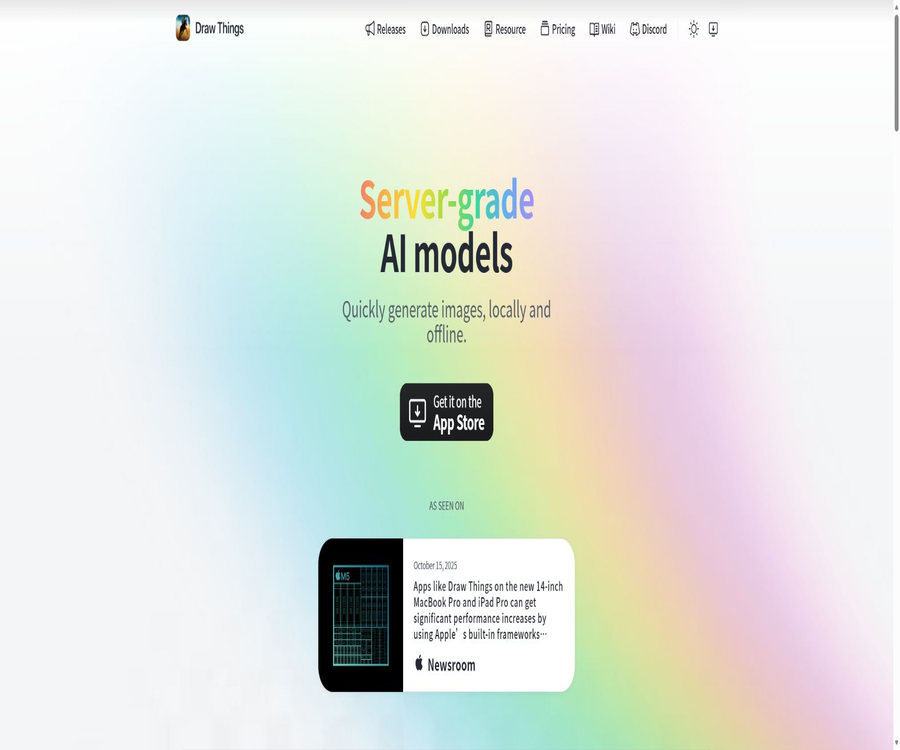
Draw Things
Draw Things: a smart tool focused on AI-powered image processing.
Tags:Common AI image toolsA one-sentence summary
Draw Things is an AI-powered image and video creation application that primarily runs locally on Apple devices. It allows for text-to-image and image-to-image generation, editing, LoRA training, and advanced control using diffusion models offline; it also enables switching between official servers and self-hosted servers as needed.
Tool Introduction
Draw Things was developed by Draw Things, Inc., and it is compatible with iPhone, iPad, and Macs equipped with Apple chips. It combines model downloads, prompt inputs, sampling parameters, an infinite canvas, mask editing, ControlNet, LoRA, and scripting all within a single native application.
Local generation does not require a subscription; prompts, images, and projects can be kept on the device. When the device’s performance is insufficient, the model is too large, or faster speeds are needed, users can opt for Community cloud computing, Draw Things+, or a self-hosted Server-Offload solution.
Core generation method
| Method | Operation location | Is an account required? | Suitable scenarios |
|---|---|---|---|
| Local computing | iPhone, iPad, or Mac | It’s not necessary. | Privacy first, free access with no limit on the number of uses, full control over parameters |
| Community Cloud Computing | Draw Things hosting server | It is necessary. | Limited cloud generation is carried out when the device is slow. |
| Draw Things+Cloud Computing | Draw Things hosting server | A paid account is required. | Higher limits, custom LoRA, Privacy Pass, and Boost |
| Server-Offload | Own Mac, Linux NVIDIA servers, or remote bare-metal machines | According to the deployment configuration | The team develops its own inference mechanisms and high-performance generation tools. |
| Enterprise | Organize computers, servers, or local infrastructure | Corporate contracts | Centralized deployment, integration, and support |
Main functions
Text-to-image and image-to-image
Users can enter positive and negative prompts to generate images from text, or they can import photos as a starting point for image generation. Resolution, number of steps, guidance strength, random seed, sampler, and model all affect the resulting image.
Local AI video generation
The current version supports video models such as LTX and Wan; it enables the creation of short videos from text or images, and offers various video encoding options. Video inference requires significantly more memory, storage space, and processing time compared to image processing.
Multi-model and quantized versions
The application supports SDXL, FLUX, Qwen Image, Z Image, Ideogram, Krea, and other models that are continuously being added, and it also offers some 8-bit or quantized versions. Whether a particular model can be downloaded, imported, or trained depends on the current version of the application and the hardware used.
Model import and management
Users can import checkpoints, LoRA, and Textual Inversion from local files or compatible model communities; they can also delete, export, or specify external model folders. Model files typically range in size from a few hundred MB to nearly 10 GB, so sufficient storage space should be reserved.
Local redrawing and image expansion
The mask tool can be used to select the areas that need to be modified and to apply inpainting; it is also possible to expand the image beyond its original boundaries. The outcome of the editing depends on the type of model, the range of the mask, the intensity of redrawing, and the prompts provided.
ControlNet and pose control
ControlNet enables the control of the image layout using parameters such as pose, depth, sketch, and other structural signals, and it is possible to combine multiple control conditions. Different control models have compatibility requirements with the base model.
Infinite canvas
The infinite canvas allows for sketching, placing reference images, scaling, using masks, and generating content sequentially; it is ideal for comparing different options or expanding a composition within the same space. The project history and generated files continue to occupy local storage.
LoRA import and local training
Draw Things allows multiple LoRA models to be loaded and their weights adjusted; it is also possible to train LoRA models for characters or specific styles on a device. Training requires images of consistent quality, appropriate trigger words, and sufficient memory – otherwise, mobile devices may crash or the process may take a very long time.
Script automation
The application allows JavaScript scripts to be executed, which enable operations on the canvas as well as the creation of processes and files using objects such as canvas, pipeline, and filesystem. Scripts can specify an API version, thereby reducing the risk of compatibility issues after the application is upgraded.
Color calibration and zoom repair
The latest update adds features such as color calibration, one-step zooming, and model restoration, which are useful for improving old images or reducing color discrepancies resulting from repeated editing processes. Restoration cannot bring back real details that were not present in the original image.
Supported inputs and outputs
| Category | Supported content | Precautions |
|---|---|---|
| Text input | Prompt words, negative prompt words, weights, and script parameters | Different models have varying prompt syntaxes and language understanding capabilities. |
| Visual input | Photos, sketches, masks, poses, depth, and reference images | It is necessary to ensure the privacy of individuals and obtain proper authorization for the use of materials. |
| Model input | Checkpoint, LoRA, Textual Inversion, and certain control models | The format, architecture, and model version must be compatible. |
| Image output | Generate images, edit images, zoom in on images, and view project history | Metadata and export format are determined by the application options. |
| Video output | Generate videos locally or in the cloud | High time consumption, memory usage, and encoding size. |
| Training output | Custom LoRA | Model licensing and rights to training materials need to be confirmed separately. |
Usage tutorial
Generate the first image locally.
- Install Draw Things by downloading it directly from the official app store or the website’s download page.
- After the first startup, select a base model that is suitable for the device’s memory, and wait for the model file to be downloaded completely.
- Enter prompts for the main subject, environment, style, and composition of the image, and also specify what you do not want to appear in it.
- First, test the composition using a lower resolution and moderate step size, to avoid spending too much time from the start.
- Fix a satisfactory random seed, and gradually adjust the model, guidance strength, LoRA, and control parameters.
- After completion, zoom in, make local adjustments, and export the result; at the same time, remove any items and models that are no longer needed.
Modify a specific area using a mask.
- Import or select a previous image, then switch to edit mode.
- Use the eraser or mask tool to accurately cover the areas that need to be replaced.
- Select a compatible inpainting model to describe the new content and its relationship with the surrounding environment.
- Start generation with a lower rendering intensity, and check for consistency in edges, lighting, perspective, and characters.
- Expand or shrink the mask and repeat the testing, then fix the seams and details.
Train your own LoRA
- Prepare a set of training images that are clear, have well-defined permissions, and are consistent in theme.
- Select a base model that is compatible with future generation models, and create unique trigger words.
- Import the images and add additional descriptions; first, conduct tests using a low number of training steps and the default network dimensions.
- Observed overfitting, noise, and distortion of the characters, then adjusted the learning rate, number of steps, and data.
- Export the LoRA and verify its generalization performance across various prompts, seeds, and scenarios.
Switch to cloud computing
- Create a Community or Draw Things+ account, and select Cloud Compute in the device settings.
- Verify the maximum number of Compute Units for the task, the queue priority, and the remaining quota for the current month.
- If you wish to upload your own LoRA, make sure that you are subscribed to a plan that supports this feature.
- For sensitive generation, Privacy Pass should be enabled and the status of the shield checked.
- Check the results after the cloud task is completed, to avoid mistaking content generated in the cloud for something completely offline.
Which users are it suitable for
- Users of Apple devices: Those who wish to create images and videos locally on their iPhone, iPad, or Mac.
- Creators who are sensitive to privacy: It is recommended that prompts, reference images, and output be kept on the device as much as possible.
- Advanced AI painting users: They need model import, LoRA, ControlNet, masks, and detailed parameters.
- Illustrators and designers: Use an infinite canvas to explore concepts, expand images, and make local adjustments.
- Developers and researchers: Use scripts, cloud APIs, or Server-Offload to set up the generation process.
- Enterprise teams: They require their own infrastructure for deployment as well as organization-level integration support.
Typical use cases
- Create concept sketches, character drafts, and visual inspiration pieces without an internet connection.
- Generate promotional or narrative visuals that are closer to the predetermined composition through posture and depth control.
- Use masks to replace specific parts of an object, refine details in a portrait, or expand the image frame.
- Train a brand style or character LoRA to maintain a consistent visual direction across multiple works.
- Allow weaker mobile devices to submit complex tasks to the cloud, or offload the processing to their own GPU servers.
- Use scripts to change seeds, parameters, canvas content, and file processing steps in bulk.
Price and version
As of August 2026, the local version of Draw Things is available permanently for free; the cloud-based features are divided into Community, Draw Things+ and Enterprise tiers. The app store lists it as a free download with in-app purchases, and the final costs and prices vary by region as indicated on the purchase page.
| Version | Price | Billing cycle | Primary interests | Suitable for users |
|---|---|---|---|---|
| Free Edition | Free | Long term | Local computing, model downloading, infinite canvas, and local LoRA training | Individuals who possess appropriate Apple devices |
| Community | Free account | By account | Limited Cloud Compute, Lab Hours, and all features of the local version | Users who occasionally need cloud acceleration |
| Draw Things+ | 8.99 dollars | Monthly | Higher cloud computing quotas, the ability to upload one’s own LoRA models, Boost, and Privacy Pass | Creators who make frequent use of managed computing power |
| Enterprise | Custom quote | contract | Organizational deployment, local inference, on-premises servers, and application integration | Team and controlled infrastructure |
Cloud API quota
The cloud computing API console shows that free accounts are allowed up to 20 test requests per month, while Draw Things+ allows up to 200 requests per month. Pay-as-you-go options are available only for Draw Things+, and when the balance falls below $1, it is possible to opt for an automatic top-up of $1.
Compute Units and Boost
Compute Units are used to measure the complexity of a generation task; higher resolution, more steps, reference images, and large models require more of these units. Plus users can employ one-time Boosts to increase the limit for a single task – each Boost provides 60,000 Compute Units, and these units are deducted only after the task is completed successfully.
Boost cannot be used simultaneously with Privacy Pass. When it is necessary to exceed the limits, users must choose between a larger scale of tasks and better anonymity protection.
Comparison between local and cloud solutions
| Project | Local computing | Cloud Compute |
|---|---|---|
| Costs | The application can be used indefinitely for free; the user is responsible for the costs related to their own hardware. | Restricted by free or membership quotas as well as the amount available on a pay-as-you-go basis |
| Privacy | The prompts and results can remain only on the device. | The task is sent to the hosted server; Privacy Pass is available for Plus. |
| Speed | It depends on the device’s chip, memory, and cooling system. | It depends on the queue, task complexity, and server. |
| Model storage | It occupies a large amount of local space. | Some models do not require long-term use of device space. |
| Own LoRA | Can be used locally | Plus supports uploading content for cloud generation. |
| Use offline | After the model is downloaded, it can be used. | No. |
Supported platforms
| Platform | Support status | Explanation |
|---|---|---|
| iPhone | Native support | Performance and memory vary significantly depending on the model. |
| iPad | Native support | Models with more memory are better suited for training and large models. |
| macOS | Native support | Apple chips are particularly suitable for local inference. |
| Linux NVIDIA servers | Supports Server-Offload | As a remote or self-hosted inference endpoint, it is not equivalent to a regular desktop client. |
| Windows | Not listed as an official native client | Remote service solutions can be studied, but they cannot be implemented in a formal Windows version. |
| Cloud API | Support | Used for managing keys, testing quotas, and application integration. |
APIs, scripts, and server capabilities
| Ability | Status | Uses |
|---|---|---|
| JavaScript script API | Support | Automatically operate the canvas, generate pipelines, and files. |
| Cloud Compute API | Support | Called from an application or proprietary system to generate hosting. |
| gRPC Server | Support | Offload inference to your own Mac, Linux GPU, or remote host |
| ComfyUI extensions | Official public repository | Connect to Draw Things inference via the gRPC protocol |
| Enterprise integration | Customization is supported. | Deploy in organizational devices, servers, or applications |
GitHub and open source
The official GitHub organization makes available to the community code for inference, model directories, scripts, documentation, media generation libraries, ComfyUI extensions, and server components. Different repositories are licensed under GPL-3.0, LGPL-3.0, Apache-2.0, or CC0, among other licenses.
| Project | Public status | License or boundaries |
|---|---|---|
| draw-things-community | Public | GPL-3.0, including code related to the core for public reasoning, the trainer, and the server. |
| community-scripts | Public | GPL-3.0 |
| community-models | Public | CC0-1.0: Management community model and LoRA directory |
| media-generation-kit | Public | LGPL-3.0 |
| homebrew-draw-things | Public | Apache-2.0 |
| Complete client application | Not fully made public | Applications are managed by private monolithic repositories, while public repositories synchronize only some of the core components upon submission. |
Why can’t it be simply written as completely open source?
Making the reasoning engines and servers publicly available does not mean that all the source code of the App Store client is made available. Such components should be labeled as \"partially open-source,\" and their redistribution or use for commercial purposes must be determined in accordance with the license of each specific repository.
Privacy and data security
When not logged in and only local functions are used, the main creative data is stored on the device, with control remaining in the user’s hands. The company claims that no third-party analysis or advertising tools are used for tracking.
When cloud services are used, account identifiers, subscription transaction IDs, generated requests, and the LoRA files uploaded by users are processed. The LoRA files are stored in the cloud until the user decides to delete them or closes their account; encryption is used for both transmission and storage.
Privacy Pass
Draw Things+ allows the use of Privacy Pass to separate identity verification from the specific tasks that are created; each Plus user can issue up to 500 Passes per day. Once this limit is reached, standard authentication is reinstated, and users can disable this feature in the device settings.
Short-term processing of cloud tasks
According to the official statements, Server-Offload and Cloud Compute process requests temporarily in memory, without storing the generated input and output over an extended period. Nevertheless, when dealing with confidential data, it is preferable to use local servers or servers owned by the company itself, and it is necessary to review the relevant contracts.
Model licensing and commercial use
The fact that the Draw Things app is free does not mean that each basic model, LoRA, font, training image, and generated result that can be downloaded can be used for commercial purposes indefinitely. These models are published by different authors, and there may be restrictions on their commercial use, hosting, use in relation to specific characters, or redistribution.
- Before use, check the licenses for the base model, LoRA, and control model respectively.
- Do not use photos of unauthorized individuals to train identity LoRA or to generate misleading content.
- Brands, characters, works, and materials may still be subject to trademark, copyright, or portrait rights restrictions.
- When delivering to the client, save the model version, prompt words, channel authorization details, and records of any manual modifications.
- The license for open-source components and the license for generative models must be evaluated separately.
Product advantages
- It offers a rare local, offline, and free diffusion model workflow on Apple mobile devices.
- It covers images, videos, editing, ControlNet, LoRA training, and scripts simultaneously, offering high levels of control.
- It allows the import of community models and the management of external storage, making it suitable for continuously trying out new models.
- There are three options for computing power: local systems, official cloud services, and self-hosted servers; one can choose between them based on privacy considerations and performance needs.
- By making the core of public reasoning and server code available, companies can explore local deployment as well as verifiable cloud computing.
Usage restrictions and precautions
- Large image and video models require more memory, storage, battery power, and cooling; older devices may operate slowly.
- Some document pages are outdated; the interface, model compatibility, and hardware limitations should be based on the current version.
- Generation is free locally, but downloading models and project history can quickly fill up device storage.
- The training parameters for LoRA are complex; too many training steps or a high learning rate can lead to overfitting and noise.
- Both the Cloud Community and Plus versions have limits on usage quotas and Compute Units; they do not offer unlimited computing power.
- When a script comes from the community, it may have access to the canvas and files; therefore, the code and permissions should be checked first.
- AI can generate issues related to structure, text, hand movements, consistency in characters, and factual errors, which require manual correction.
Basic information
| Project | Content |
|---|---|
| Tool name | Draw Things |
| Development company | Draw Things, Inc. |
| Tool type | Local AI image and video generation and diffusion model studio |
| Price pattern | Free local option, free cloud account, monthly fee of 8.99 dollars, and enterprise pricing options |
| Is registration required? | Local features are not required; cloud features are necessary. |
| Is Chinese supported? | Chinese prompts can be entered; the effectiveness depends on the model selected. |
| Whether API is provided | Yes, script APIs, Cloud Compute APIs, and gRPC servers. |
| Is it open source? | Some of the core components and servers are open source, but the complete client is not fully available to the public. |
| Main platforms | Uninstallation on iPhone, iPad, Mac, and servers |
Recommendation score
Recommendation score: 4.7 / 5. Draw Things offers local privacy, free creation, mobility, and professional spread control within the Apple ecosystem, making it suitable for creators at all levels, from beginners to those with more advanced skills.
The main barriers are the high demands of large models on hardware and storage, the significant learning effort required to master their advanced interfaces, as well as the need for users to manually verify model licenses and certain older documents.
Frequently Asked Questions
Is Draw Things free?
Local generation is permanently free, without ads and without any limits on the number of local tokens. There is a free community tier available in the cloud; for more computing power, one needs to opt for Draw Things+ at a cost of $8.99 per month or the enterprise version.
Can it be generated without an internet connection?
Yes. After downloading the applications and models, local image processing as well as certain video-related tasks can be carried out offline.
Is it compatible with Windows?
There is no public native Windows client available; the main clients are iPhone, iPad, and Mac. A custom inference server can run on Linux NVIDIA servers that meet the required specifications.
Can I train my own LoRA?
Training can be carried out locally, and one’s own LoRA models can be used in the Plus cloud computing service. The quality and stability of the training results depend heavily on the device’s memory, the base model, the data, and the parameters used.
Does Draw Things offer an API?
It offers stable versions of JavaScript script APIs, cloud computing APIs, and gRPC server solutions. The free tier differs from the monthly request limits for the Plus cloud API.
Is Draw Things completely open source?
It is not entirely open source. The official team makes several inference cores, servers, and community repositories available, but the complete client is still managed by a private monolithic repository.
Will locally generated content be uploaded?
In pure local mode, the creative content and data remain on the device; cloud processing occurs only when cloud computing, accounts, or LoRA files are used.
Can the generated images be used for commercial purposes?
It depends on the base model, LoRA, the input materials, as well as the licenses and rights related to the target content. The fact that an application is free or its components are open source does not automatically grant commercial rights to all the content generated.
Summary
Draw Things brings the desktop-based diffusion workflow to iPhone, iPad, and Mac, allowing users to choose between local processing, hosted cloud services, or self-hosted servers. Free local computing is its main advantage; the Plus version is better suited for those who need cloud-speed processing, their own LoRA models, and enhanced privacy.
New users should start with small models and low resolution, gradually learning about masks, ControlNet, and LoRA, while also cleaning up their storage regularly. For commercial or sensitive uses, it is necessary to verify the licensing of the models, the rights to the materials used, as well as the cloud storage pathways.
Tools similar to Draw Things


 Guigong Network Security Registration No. 45132202000164