






Ctrify
Ctrify, a smart tool focused on AI-powered image processing.
Tags:Common AI image toolsA one-sentence summary
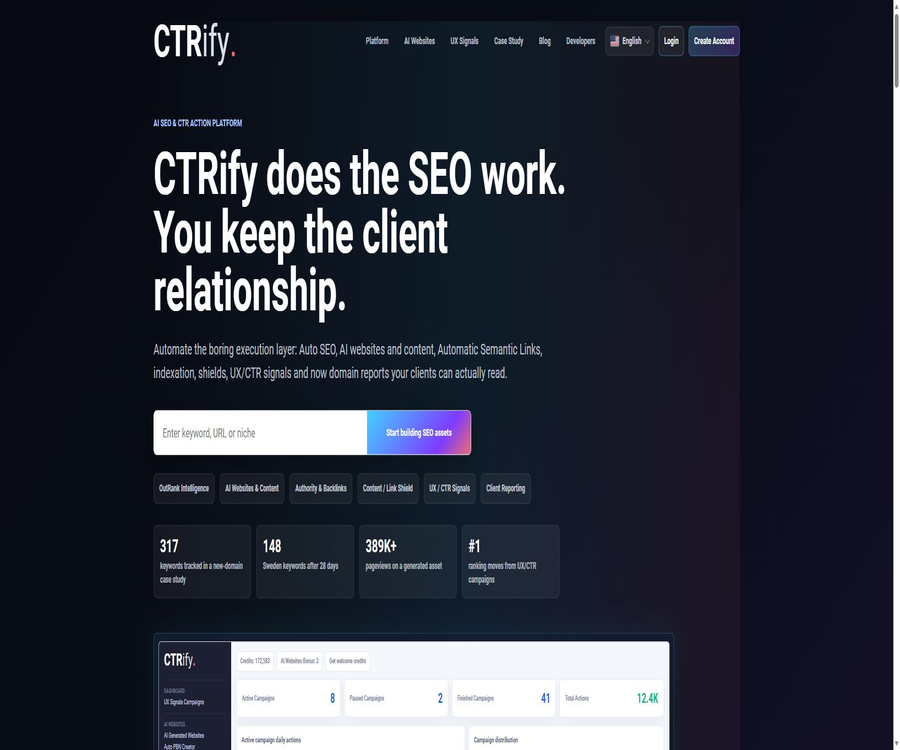
CTRify is an SEO execution platform that integrates keyword research, AI-generated content and website creation, semantic linking, indexing, ranking tracking, as well as UX and CTR metrics, and it is designed to serve website owners, affiliate marketers, and agencies.
Tool Introduction
CTRify is not merely an AI article generator. Users can start from keywords, URLs, or specific market segments, analyze search results, generate content assets, create supporting websites, integrate with WordPress, and arrange for SEO tasks to be carried out.
Some of the platform’s capabilities include automated website creation, link exchange, and the provision of search traffic data; before using these features, it is necessary to assess both the quality of the content, any brand-related risks, and the search engine’s policies. No ranking, traffic volume, DR score, or indexing status can be considered a guarantee of results.
Main functions
OutRank Intelligence
OutRank Intelligence is used to analyze target pages, keywords, and competitive results, helping to determine what content, links, indexing actions, or other measures should be taken next. The diagnostic findings should be combined with data from Search Console, internal analysis tools, and manual checks of SERPs.
AI websites and content generation
After the user enters the seed keyword, the platform can plan the structure of the site and create a hosted website, articles, metadata, internal links, and images. A typical website includes around 40 pieces of initial content along with one year of hosting; however, the actual number of elements and the amount of credit consumed depend on the number of pages created.
SEO Machine and content workflow
SEO Machine can create, improve, and publish SEO content, as well as manage authors and content tasks. When generating content in bulk, it is necessary to incorporate real-world experience, verify facts, and remove duplicate pages in order to avoid the creation of large amounts of low-quality content.
WordPress plugins
The plugin connects customer-hosted WordPress sites to CTRify, enabling the automatic or scheduled publication of generated content and images. Before going live, it is necessary to verify permissions, backups, categories, permanent links, and any conflicts with other plugins on a testing site.
Automatic semantic linking
External websites that meet the quality requirements can be included in the automatic exchange system; the system creates inbound and outbound links when there is a semantically relevant match. Each package specifies a maximum number of websites that can be connected as well as a maximum number of links per month, but these limits do not guarantee that links will actually be assigned.
Authority and Backlinks
The platform also provides features such as context links, workflows related to supported sites and paid links. Creating, purchasing, or exchanging links in order to manipulate rankings may violate the search engine’s policies; customers should first assess the attributes of those links, as well as their transparency and the genuine value they offer to users.
Indexation Lab
Indexation Lab is used to submit, check, and manage tasks related to website discovery and indexing. Submitting requests only helps search engines discover pages; it does not guarantee that those pages will be captured, included in the index, or given a high ranking.
UX and CTR signal activities
CTRify offers services such as AI CTR UX, Manual CTR, and Viral Booster, which are used to send click or traffic signals to specific websites and keywords. Automatically generating ranking signals or artificially creating them may violate the rules of search engines; short-term fluctuations should not be considered as sustainable natural growth.
Content Shield and Link Shield
The Shield class is designed to protect content and link rights, as well as to manage search results and public display pages separately. When configuring it, it is important to avoid providing crawlers and users with a misleading experience that differs from the actual reality.
Local rankings and customer reports
The local ranking map allows for the checking of the same keyword in 25 different locations, showing the actual differences in rankings across various regions. Scanning is available both in the free and paid versions; the paid version includes reports tailored for white-label clients.
Comparison of core modules
| module | Main tasks | Output | Key risks |
|---|---|---|---|
| OutRank Intelligence | Diagnostic competition and opportunities | Action recommendations and reports | Data definition and time differences |
| AI Websites | Create a themed website | Managed sites and initial articles | Thin content, maintenance, and renewal |
| SEO Machine | Create and publish content | Articles, metadata, and internal links | Facts, repetition, and widespread abuse |
| Semantic Links | Automatically match relevant sites | Entering the chain and leaving the chain | Link policies and quality are not guaranteed. |
| Indexation Lab | Submit and check URL | Index task records | Submission does not equate to inclusion. |
| UX and CTR Signals | Run click and behavior campaigns | Traffic and signal data | Search policy and abnormal traffic risks |
| Shields | Protect the rights related to content or links. | Controlled display and protection | Avoid presenting misleading differences. |
| Reporting | Show the customer the progress. | Ranking maps and white-label reports | Correlation does not equal causation. |
Standard usage process
- First, connect to the website and services such as Search Console to obtain authorized data, and record the current baseline for traffic, indexing, and rankings.
- Enter the target website address, keywords, or niche market to have OutRank analyze the main gaps.
- Determine whether the current bottleneck lies in content, technology, indexing, authority, or click performance.
- View the credit cost, side effects, and estimated duration of the selected action.
- Give priority to carrying out those tasks and implementing those technologies that are reversible, in line with policy guidelines, and capable of improving the user experience.
- After publication, track crawling, display, clicks, conversions, and any abnormal fluctuations, rather than focusing only on the ranking.
- Stop activities that are ineffective or carry too high a risk, and record the conclusions in the client report.
Tutorial for creating an AI website
- Choose a topic that has a clear target audience and practical value; do not create a website merely to share links.
- Confirm the domain name, region, language, brand, and business objectives.
- Use Super Site Planner to generate topic maps and Silo structures, then manually remove duplicate and unnecessary pages.
- Check the website to see the estimated credit, number of articles, hosting period, and renewal cost.
- After creation, each piece is checked for accuracy of facts, author information, image licensing, external links, and internal links.
- Add contact information, privacy policy, editorial standards, and accurate business details.
- After going live, the index and user behavior are monitored; no guarantees are provided regarding fixed DR, traffic levels, or ranking positions.
Tutorial on connecting to WordPress
- Back up the WordPress files and database, and install the plugin in a testing environment first.
- Enter a valid license; only the minimum permissions required for publishing are granted.
- Set the author, category, publication status, frequency, and any steps that require manual approval.
- First, release a small number of drafts to check the HTML, images, internal links, structured data, and caching.
- The editor reviews the original value, facts, brand tone, and copyright.
- After confirming that there are no plugin conflicts, gradually expand the scope of the tasks while continuously monitoring credit consumption.
Which users are it suitable for
- SEO agency: Manages content, assets, indexes, links, and client reports in a workspace.
- Site owners and affiliate marketers: Create content websites for verified topics and maintain them on a regular basis.
- Local marketing team: Views the ranking map for multiple locations and prepares progress reports for clients.
- WordPress administrators: Integrate AI-generated content into the approval and publishing processes of their own websites.
- Developers and AI agents: They can read account information, audit data, and perform permitted operations via MCP or REST APIs.
- Experienced SEO professionals: Manage various implementation actions while taking into account search policies and the risks associated with experimentation.
Typical use cases
- Analyze why existing pages are visible but have low click-through rates, and prioritize improving the titles, summaries, and user experience.
- Create manually edited clusters of thematic content for products or services.
- Synchronize the draft generated by CTRify to WordPress’s review queue, rather than making it publicly available automatically.
- Track the local rankings of the same keyword in different locations within a city and generate customer reports.
- Through the API, internal tools can retrieve information on websites, usage levels, and available capabilities, after which human approval is required to proceed with the payment.
- Split the credit budget by customer, website, and target, and compare each execution with business outcomes.
Automatic semantic linking quota
| Plan | Maximum number of websites to connect to | Maximum number of entries per station per month | Maximum outbound traffic per station per month | Explanation |
|---|---|---|---|---|
| Free | 10 | 1 piece | 1 piece | Created only when relevant and quality-checked matches exist. |
| Personal | 30 | 5 items | 5 items | The upper limit is not a guaranteed quantity. |
| Agency | 100 pieces | 10 items | 10 items | Suitable for multi-site management; link policy review is still required. |
How to calculate the integral
CTRify treats Credits as a budget for executing tasks; browsing the interface, reading reports, and viewing assets generally do not consume any credits. Credits are used only when creating, publishing, or retrieving external data, running campaigns, or renewing services. Some ongoing tasks require credits to be reserved in advance.
| Action | Publicly available reference consumption | Explanation | Budget recommendations |
|---|---|---|---|
| 40 articles on AI websites | Approximately 485 Credits or 1 Website Generation Bonus | Includes typical configurations for generation and first-year hosting. | Check the page estimate before creation. |
| Website renewal | Approximately 60 Credits/year | Maintenance and hosting for the first year | Reserve separately for each site. |
| Google local search | 1 Credit per transaction | Used for local data lookup | Recorded separately from the publication cost. |
| Publish local Citation | 1 Credit/site | Publish the merchant’s information on the target website. | First, verify NAP consistency. |
| Content, links, and signal activities | Display dynamically based on configuration. | Affected by objectives, duration, and suppliers. | Confirm the preview before proceeding. |
Price and purchase methods
As of August 2026, the official website offers free options, monthly plans, pay-per-use subscriptions, WordPress licenses, as well as time-limited lifetime deals. The prices of some monthly packages are displayed in images on the page or on the settlement screen after logging in; it is not possible to determine these prices based solely on old promotional pages.
| Product or solution | The price can be verified on the official website. | Included content | Precautions |
|---|---|---|---|
| Free | $ | Up to 3 local ranking campaigns and 10 entry points such as auto-exchange websites | The specific credits and features depend on the account. |
| Pay as you go AI Website | Starting at $97 | 1 website, hosting for the first year, around 40 articles and initial links | Fees for custody in the following year are calculated separately. |
| WordPress Pro plugin | 97 dollars | Up to 10 domain name licenses and 50,000 content Credits | The page states that the content costs 1 Credit per word. |
| Lifetime Deal promotion | $ | Corresponds to benefits of a $197 monthly plan, 4 website bonuses, and 10 domain plugin licenses. | Circular Credits are not included; promotions may end. |
| Personal and Agency | Refer to the real-time settlement page. | Higher limits for activities, websites, links, and white-labeling. | Do not use historical prices. |
The lifetime discount page clearly states that recurring Credits are not included; the concept of \"lifetime\" is also subject to the ongoing operation of the service and specific terms and conditions. Before purchasing any long-term plan, it is necessary to save a snapshot of one’s rights and benefits, and to check the rules regarding refunds, renewals, the validity period of credits, and service termination.
MCP and REST API
CTRify offers stream-based MCP and OAuth REST APIs, which enable compatible proxies or custom software to access account information, website data, usage metrics, SEO audits, and capability catalogs, as well as to carry out approved actions.
| Development entry point | Authentication method | Key capabilities | Safety control |
|---|---|---|---|
| MCP | OAuth automatic discovery | Allow compatible AI clients to call the CTRify tool. | Execute in accordance with the authorization scope and capability catalog. |
| REST API | OAuth authorization code and PKCE S256 | Accounts, usage, websites, auditing, and operations | Bearer Token is linked to the customer account. |
| OpenAPI | Public read | Machine-readable interface contract | No tokens are consumed, nor are any points used. |
| Mutation operation | OAuth plus Idempotency Key | Create or modify the allowed assets. | Duplicate keys and changes in parameters will be rejected. |
For the first approved external connection, 100 CTRify Credits are deducted at once, and both MCP and API are activated. Each customer is entitled to 100 external access points per day; beyond that, 1 Credit can be used to purchase 1,000 reusable access points. Native payment transactions are not charged repeatedly as a result of external orchestration.
API integration process
- Create a CTRify account and ensure that you have sufficient Credits to cover the activation of the first external connection.
- Choose MCP or REST API from the available contracts; do not treat ordinary web addresses as server endpoints.
- The REST client uses OAuth authorization codes and PKCE to obtain user authorization.
- First, read the account, usage, and capability catalogs, then query the complete parameters and side effects of the target operation.
- Before performing a write operation, the costs, objectives, and impacts are displayed to the user, and an idempotent key is generated.
- Save the audit results, but do not record the original access tokens, refresh tokens, or sensitive customer data.
- After completion, check the returned usage metadata and asset status, and revoke authorization if necessary.
Security design and data considerations
- The API derives the customer identity from the OAuth token; the caller cannot override the customer_id on their own.
- External clients can only invoke operations that have been approved and added to the directory; they cannot access SQL, the file system, or internal methods arbitrarily.
- Write operations require idempotent protection, and the checks regarding native ownership, status, price, and supplier are continued.
- Access and refresh tokens are stored on the server in hashed form, but the client must still protect the original values.
- When connecting Search Console, WordPress, and customer sites, it is necessary to adhere to the principle of minimum permissions and to revoke any unnecessary access rights on a regular basis.
- Conversations, keywords, customer website addresses, and business strategies may be considered sensitive information; the team should first read the current privacy and data policies.
Search engine policy risks
- Google explicitly classifies links that are created or exchanged primarily to manipulate rankings as a risk of link spam; they cannot be considered safe just because the platform matches them automatically.
- Automatically sending queries to search engines or generating machine traffic may violate the spam policies and terms of service.
- Using generative AI to create a large number of pages that add no new value to users can constitute large-scale misuse of content.
- Showing different content to crawlers and users can be considered a form of hiding or deception.
- Meeting technical requirements does not necessarily guarantee that content will be crawled, included in search results, or ranked; moreover, the times and metrics mentioned in the examples cannot be reproduced.
- The most reliable strategy remains focusing on reliable and high-quality content for users, genuine product value, transparent links, and verifiable technical improvements.
Product advantages
- Bring diagnostics, content, sites, links, indexes, signals, and reports together in the same workspace.
- Press the button to allocate Credits; before execution, you can view the costs and set a budget for the task.
- It supports hosting AI websites, and it is also possible to manage one’s own WordPress site through plugins.
- Local ranking maps and white-label reports facilitate agencies in explaining regional changes.
- It provides MCP, OAuth REST API, OpenAPI, as well as clear metrics for external access.
Usage restrictions and precautions
- SEO results are influenced by the quality of the website, competition, algorithms, and the market; therefore, no ranking or traffic figures can be considered guaranteed.
- Multiple plans, bonuses, and credits exist; it is necessary to calculate the total cost of creation, activation, and renewal before making a purchase.
- Automatic linking, CTR signals, and bulk websites can pose risks related to search policies and brand integrity.
- AI-generated articles may contain errors, repetitions, or irrelevant content, and they require professional editing and fact-checking.
- Third-party hosting sites require ongoing payment for renewal, as well as proper handling of exports and migration backups.
- Before automatically publishing on WordPress, use draft approval to prevent incorrect pages from being made public.
- APIs and MCPs can initiate paid or destructive actions; therefore, their permissions should be restricted and explicit confirmation required.
- Different website pages may retain historical promotions and older pricing details; the final terms apply as stated on the settlement page.
Supported platforms
| Platform | Support status | Primary uses | Explanation |
|---|---|---|---|
| Web platform | Support | Management of SEO assets, campaigns, credits, and reports | Main entrance |
| CTRify-hosted websites | Support | Websites that publish AI-generated content | Renewal is required after the first year. |
| WordPress | Official plugins | Publish content and images to self-hosted sites | Licenses are assigned by domain name. |
| MCP clients such as Cursor | Support | The AI agent invokes the approved actions. | OAuth activation is required. |
| ChatGPT-compatible proxy | Supports MCP | Audit, query, and execution workflows | Based on the MCP capabilities of the client. |
| Proprietary software | REST API | Accounts, websites, usage, auditing, and operations | OAuth and PKCE |
| Official mobile app | No findings were detected. | A mobile browser can be used. | It should not be written as a native app. |
APIs, GitHub, and open source status
The official sources provide REST API, MCP, OpenAPI, and machine-readable documentation; however, no official open-source repository or open-source license for the CTRify core platform has been found. The availability of APIs does not mean that the source code of the product is available openly.
Whether a WordPress plugin allows modification and redistribution depends on the license included in its package; it is only possible to download, install, or activate it for multiple domain names, and this does not automatically mean that the plugin is open source.
Basic information
| Project | Content |
|---|---|
| Tool name | CTRify |
| Tool type | AI SEO implementation, content creation, website building, link building, and signal platforms |
| Target users | Site owners, SEO agencies, local marketing and affiliate teams |
| Price pattern | Free, subscription, pay-per-use, Credits, and promotional lifetime plans |
| Core metering | Credits, Bonus, and external access points |
| AI websites | Supports creation, hosting, and export. |
| WordPress | Provide official plugins |
| API | OAuth REST API |
| MCP | Yes |
| Official GitHub | No core official repository was found. |
| Is it open source? | The core platform is not open source. |
Recommendation score
The recommendation score is 3.6 out of 5. CTRify’s advantage lies in bringing together numerous separate SEO tasks and development interfaces on a single platform, making it suitable for experienced professionals who are able to assess strategies and risks on their own.
The points deducted stem mainly from policy-related risks associated with complex billing methods, promotional practices, automatic linking, and traffic signals; furthermore, the processing of large volumes of AI-generated content requires significant manual quality control. Beginners should not view this as a way to guarantee higher rankings effortlessly.
Frequently Asked Questions
Is CTRify free?
There is a free entry point, and it supports up to 3 local ranking campaigns as well as a limited number of automatic semantic exchange websites. Most tasks related to creation, publishing, and running campaigns still require Credits.
How much does it cost to create an AI website?
The pay-per-use plan starts at 97 dollars; for a typical website with 40 pages, around 485 Credits are required, or alternatively a Website Generation Bonus can be used, and hosting is included for the first year. The costs for configuration and renewal depend on the number of pages to be created.
Can CTRify guarantee a good Google ranking?
No. The examples on the official website, as well as metrics related to DR and traffic growth, represent the results of specific projects; search engines do not guarantee that content will be crawled, indexed, or ranked.
Is it possible to export and create a website?
It is possible to export content and images in JSON format, and articles as well as images can be migrated using WordPress plugins. Before performing the migration, it is necessary to check the compatibility of media files, links, and templates.
Is an API provided?
It offers OAuth REST APIs and MCP. A fee of 100 Credits is charged for the first external connection, and there are also rules regarding daily external accesses and any excess usage.
Is CTRify open source?
The core platform is not an open-source project. The availability of public API contracts, MCP interfaces, or downloadable plugins does not mean that the server-side source code is made available.
How much do WordPress plugins cost?
The public page indicates that the Pro plugin costs $97, and it includes a license for up to 10 domain names as well as 50,000 content Credits. The discounts and additional benefits may vary.
Are automatic semantic links always created?
No. The official website clearly states that links are created only when there are semantically relevant matches that pass the quality checks; the package numbers merely represent the monthly limit.
Can AI-generated content violate Google’s policies?
Using AI itself is not necessarily illegal, but the mass creation of pages that do not add any new value can constitute widespread misuse of content. All content should be aimed at real users and edited accordingly.
Is it suitable for SEO beginners?
It is not very suitable for complete beginners with no experience. The platform involves many actions, and some of the strategies carry high risks; users need to understand search policies, link quality, data attribution, and budget management.
Summary
CTRify covers the entire SEO implementation process, from opportunity analysis to content creation, website setup, indexing, linking, tracking signals, and generating reports; it also enables controlled operations through APIs and MCP.
In practice, usage should be guided by user value and search policies; diagnosis should be carried out first, followed by small-scale testing, with the credit costs and business outcomes being recorded item by item. The greater the degree of automation, the more essential manual review and access control become.
Tools similar to Ctrify




 Guigong Network Security Registration No. 45132202000164