






AI-Writer
AI-Writer, an intelligent tool focused on AI-generated images
Tags:Common AI image toolsWhat is AI-Writer?
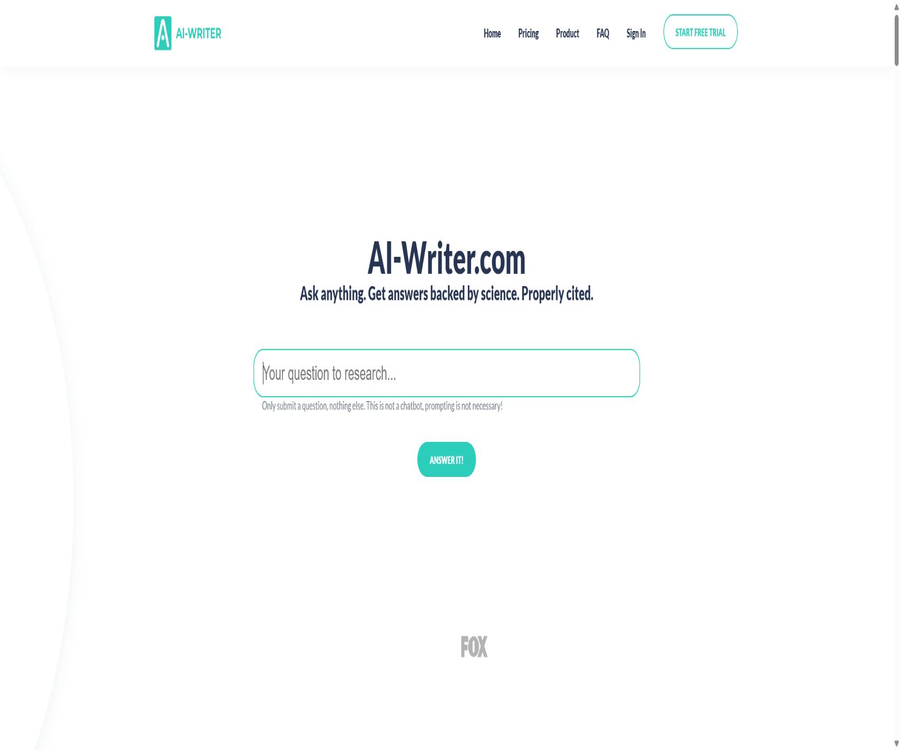
AI-Writer.com is an AI-assisted tool designed for academic research and professional writing; its official website emphasizes the use of over 100 million open-access scientific papers to answer questions. The content generated includes information on the source of the papers, the locations where they are cited, as well as complete bibliographic details, which facilitates users’ verification of each piece of information.
Current product positioning
In its early stages, AI-Writer focused on generating SEO articles, rewriting text, and providing sources for facts; currently, its home page offers content related to academic research, scientific questions, and review papers. Before making a choice, it is advisable to take into account the available tools and current packages, rather than relying solely on evaluations from the older version.
A one-sentence summary
AI-Writer can search for open-access scientific papers related to a research question, generate answers with traceable citations, and organize multiple questions into a structured literature review.
Core functions
- Answer research questions based on open science papers.
- Provide a brief summary and a detailed explanation.
- Add verifiable citations to support the argument.
- Displays the original paragraph from the paper that was used.
- Provides a complete bibliography and various citation styles.
- Identify key research questions through Topic Explorer.
- Combine multiple responses to create a review paper.
- Export or share structured research results.
Open Science Paper Repository
The official website states that the research capabilities are based on a corpus consisting of over 100 million open-access scientific papers. Open access facilitates access to the full texts of these papers, but the size of this database does not mean that it covers all paid journals, conference papers, and the latest preprints.
- Search for multidisciplinary open science literature.
- Search for relevant papers based on the research question.
- Extract supporting paragraphs from the paper content.
- Provide source links and bibliographic information.
- It is suitable for first establishing an overview of the research.
- For important searches, professional databases should still be used as a supplement.
AI Research Science Q&A
- Enter a clear research question.
- Receive concise answers based on scientific literature.
- Continue to view a more detailed breakdown of the topics.
- It mainly discusses the matching sources.
- View information related to the cited papers.
- Sub-problems that require further research were identified.
- The generated answer should not be regarded as a conclusion from peer review.
Topic Explorer
Topic Explorer is used to identify the key questions necessary to understand a particular topic, thereby assisting users in establishing a research framework before starting to write. All packages currently allow unlimited use of Topic Explorer.
- Generate core research questions from broad themes.
- Add theoretical and practical dimensions that are easily overlooked.
- Establish the initial chapter structure for the review.
- Help new researchers understand the boundaries of the field.
- Users are allowed to add additional questions on their own.
- The output still needs to be selected in line with the course or research objectives.
Verifiable reference
AI-Writer not only lists the source titles but also indicates the specific paragraphs in the papers from which the content was generated. This design helps reduce the costs associated with verification, yet it does not guarantee that the model’s interpretation of the original text is accurate.
- View the papers corresponding to each main discussion.
- Locate the actual source paragraph that is being used.
- Jump from the platform to read the original materials.
- Distinguish between direct evidence and AI summaries.
- Check whether the source truly supports the conclusion.
- Cross-verify the key arguments.
References and BibTeX
- Provides the paper’s author, title, and publication details.
- APA citation format is supported.
- The Chicago citation style is supported.
- Supports the Harvard citation style.
- Supports MLA citation format.
- Provide a BibTeX entry for each source.
- It should be reviewed in accordance with the guidelines of the school or journal before submission.
Generation of review papers
Users can generate questions using Topic Explorer, conduct AI research on each of those questions, and then organize the answers into a comprehensive review. This process is suitable for creating drafts and research maps, but it should not replace systematic review methods.
- Generate a set of research questions around the theme.
- Search for and generate sourced answers for each question.
- Add your own research questions.
- Use chapters and sections to organize the content.
- Adjust the order of elements by dragging and dropping.
- Generate a complete draft suitable for further editing.
Structural editing
- Create and rename chapters.
- Add, delete, or modify research questions.
- Place the answers in the corresponding sections.
- Drag and drop to change the order of contents.
- Reorganize the structure based on the logic of the argument.
- Add author analysis and transitions before exporting.
Share and Export
- Download the research as a separate HTML file.
- Present the research findings by sharing links.
- The shared content can be updated in real time as it is edited.
- It is easy for mentors, colleagues, or clients to view.
- Check access permissions and unpublished content before publishing.
- Important projects should also have local backups.
Methods for verifying facts
The fact that a source is provided by a platform does not mean that its authenticity has been verified; users still need to read the context of the paper, as well as information regarding the research design, the sample used, and any limitations related to the conclusions. The number of citations cannot replace the quality of the evidence.
- Open the source and read the surrounding text before and after the relevant paragraphs.
- Verify that the research subject and issues of the paper are consistent.
- Check the publication date, journal, and version.
- Distinguish between correlation and causation.
- Search for retracts, corrections, and follow-up studies.
- Support key conclusions with multiple independent sources.
- Document the manual modification and verification process.
Which users are it suitable for
- Students who need to quickly obtain an overview of a subject area.
- Researchers preparing a framework for a literature review.
- Seek technical writers with scientific backgrounds.
- Editors who need to verify professional content.
- Teachers who prepare materials for courses.
- Consultants who can provide evidence-based reports need to be delivered to clients.
- Product and innovation teams that address interdisciplinary issues.
Typical use cases
- Generate key research questions for the paper topic.
- Create a preliminary literature map for a specific topic.
- Quickly find papers that support or refute a particular viewpoint.
- Generate a draft of the technical article including the source.
- Organize the reading materials and discussion questions for the course.
- Add background and related work to the research plan.
- Combine multiple scientific Q&A pairs to form a draft review.
- Prepare BibTeX for the reference manager.
It’s not very suitable for which situations
- A systematic review that covers all paid databases in their entirety is required.
- Students are required to submit the paper in its unmodified form.
- Research that requires experiments, statistics, or professional judgment as alternatives.
- Teams that only want to produce marketing copy in bulk without any underlying source material.
- Large organizations that require real-time collaboration among multiple people and complex permission structures.
- Developers who wish to achieve batch integration through public APIs.
- Organizations that require a fully installed platform on-site.
Price packages
As of August 2026, AI-Writer offers three subscription plans priced in dollars: Basic, Standard, and Power. Payments can be made on a monthly or annual basis; an annual payment option comes with a discount of around 16%. All plans include all the features as well as unlimited access to the Topic Explorer, though the number of questions that can be answered is limited depending on the chosen plan.
| Package | Monthly payment | Annual equivalent | Number of users |
|---|---|---|---|
| Basic | $ | About $24 per month, or $290 for an annual payment. | 1 person |
| Standard | $ | About $41 per month, or $490 for an annual payment. | 3 people |
| Power | $ | Approximately $312 per month, or $3,750 per year if paid annually. | 10 people |
Comparison of package features
| Project | Basic | Standard | Power |
|---|---|---|---|
| Applicable recipients | University students and light research | PhD and high-frequency research | High-intensity research demands |
| Number of users | 1 person | 3 people | 10 people |
| Topic Explorer | No restrictions | No restrictions | No restrictions |
| AI Research | Includes | Includes | Includes |
| Citations and Bibliography | Includes | Includes | Includes |
| Question answering quota | Plan restrictions | Higher limit | Highest publicly available tier |
| All features | Includes | Includes | Includes |
Question answering quota
On the current public pricing page, the number of specific issues associated with each of the three packages is not displayed correctly in the extracted text; only the maximum number of Questions Answered allowed for each plan is indicated. It is necessary to check the number of issues, the reset period, and the rules regarding excess usage on the real-time pricing page after registration before making a purchase.
How to choose a package
- Occasionally, when completing course research, it is possible to start with the Basic version first.
- Research teams of three or fewer members can use Standard for comparison.
- Consider Power again for high-frequency agencies and teams of ten people.
- Estimate the monthly quota based on the actual number of research issues.
- Do not choose a package based solely on the number of words generated.
- Confirm the shared account details and user permission rules.
- Complete the 7-day trial first before purchasing an annual subscription.
Free trial
The official website offers a 7-day free trial, and it is clear that this trial will end automatically; there is no need for the user to cancel it manually, nor will it result in an automatic subscription. Before starting the trial, it is still advisable to check the registration page to see if payment information is required and what the trial limit is.
Subscribe and Cancel
- Monthly and annual payment plans are available.
- The annual pricing page indicates a discount of around 16%.
- Subscriptions can be canceled from the account dashboard.
- Cancellation can also be requested via an informal email.
- Cancellation must be completed before the next renewal.
- Before purchasing, check the refund policy and the rules regarding the remaining period.
- Important research should be exported before the subscription expires.
Refund policy
The official website’s FAQ states that cancellations can be made at any time, but during this verification process no clear guidelines regarding refunds, deadlines for refunds, or rules for proportional refunds were found. It is necessary to consult the official sources before purchasing an annual subscription or Power plan to find out the refund terms applicable to that order.
Academic Research Tutorial
- Transform broad topics into specific research questions.
- Submit questions on AI Research.
- Read the summary and the detailed answers.
- Open each reference and the corresponding original paragraph one by one.
- Exclude irrelevant, expired, or of lower quality sources.
- Add professional databases and counter-evidence.
- Rewrite using your own analysis and cite according to the guidelines.
Review article tutorial
- Enter the research topic in Topic Explorer.
- Identify the key issues that truly serve the research objectives.
- Add missing issues such as theories, methods, and controversies.
- Generate research responses with citations one by one.
- Create chapters and drag and drop to adjust the order of the arguments.
- Additional search methods, critical analysis, and research gaps.
- Verify all citations and then export HTML or share it.
Reference verification tutorial
- Click to view the source corresponding to the paragraph.
- Read the original paragraphs of the paper that was used.
- Check whether the model’s presentation goes beyond the conclusions of the original text.
- Verify the author, year, title, and publication details.
- Check whether the paper has been withdrawn or if there are any corrections available.
- Select the citation style required by the course or journal.
- After exporting BibTeX, review it in the reference manager.
How to write research questions
- Identify the research subject and key variables.
- Limit the time period, geographical area, or scope of application.
- Avoid cramming multiple complex issues into one sentence.
- Distinguish between descriptive, comparative, and causal questions.
- Raise both positive and negative questions regarding the controversial topic.
- Explore broadly first, then narrow down gradually.
- Keep the version of the problem for reproducing the experiment.
Points to consider for systematic reviews
A review generated by AI-Writer is not equivalent to a systematic review that meets standards such as PRISMA. A rigorous study requires a pre-registered protocol, defined databases, reproducible search strings, inclusion and exclusion criteria, quality assessment, and manual screening.
- Record the retrieval date and database range.
- Save the complete search query and filtering steps.
- At least two researchers are responsible for the key screening process.
- Assess bias and evidence level.
- This does not take into account the impact of paid or non-English literature.
- Do not treat AI-generated abstracts as a complete version of the paper.
Academic integrity
- Comply with the AI policies of schools, journals, and funders.
- Disclose the usage methods of AI tools as required.
- Assignments written entirely by AI cannot be submitted.
- It is not allowed to fabricate claims regarding contributions in the areas of reading, experimentation, and research.
- The author is responsible for the arguments, citations, and errors.
- Retain prompt notes, outputs, and manual modification records.
- AI detection results cannot prove academic integrity.
Citations and copyright risks
- Correct citation format does not mean that the use of ideas is appropriate.
- The abstract may be too close in wording to the original text.
- Extended rewrites can still constitute improper borrowing.
- Charts and data may have separate licenses.
- Open access does not mean giving up all copyright rights.
- Check similarity and citation boundaries before publication.
Content ownership
The website’s FAQ states that the platform does not claim any copyright or ownership over text generated by AI; users are free to use the text they create. However, they must ensure that the input data, output results, sources, and the final works comply with third-party rights and academic regulations.
Privacy and research data
- Do not enter any confidential information regarding the identities of the participants.
- Do not upload the full text of papers that are subject to contractual restrictions.
- Sensitive research data should be de-identified first.
- Check what personal information the account and the website collect.
- Confirm content retention, deletion, and service provider scope.
- Institutional research should conduct a data protection assessment.
- Critical projects maintain independent local copies.
Product advantages
- The current focus is on answering questions related to scientific literature.
- It is built on large-scale open science corpora.
- The main discussion can be traced back to the source paragraph.
- Multiple citation styles and BibTeX are provided.
- Topic Explorer helps in constructing a research framework.
- Structured reviews can be generated by combining them.
- Supports HTML download and real-time sharing.
- The 7-day trial ends automatically, without automatic renewal.
Product restrictions
- It is not guaranteed to cover all academic databases.
- Open science repositories may miss important paid publications.
- AI may still misinterpret the source.
- Generating a review does not meet all the requirements of a systematic review.
- The specific amount for each issue is not clear in the publicly available content.
- The Power package has a higher price.
- The ability for multi-person collaboration and institutional governance is not strong.
- No public APIs, SDKs, or Webhooks were found.
- The platform is not an open-source project.
APIs and developer capabilities
During this verification, no public API keys, interface references, SDKs, Webhooks, or developer billing options related to AI-Writer were found. Sharing links and exporting in BibTeX format are user-specific functions and cannot be considered as third-party integration APIs.
GitHub and the open-source status
No GitHub organization or complete product source code repository that has been verified using the official domain name of AI-Writer.com was found. AI-Writer should be classified as a closed-source online service.
Basic information
| Project | Content |
|---|---|
| Tool name | AI-Writer.com |
| Tool type | AI academic research, scientific Q&A, and review writing |
| Literature foundation | Over 100 million open-access scientific papers |
| Citation format | APA, Chicago, Harvard, MLA, and BibTeX |
| Trial | 7 days, automatically ends |
| Minimum price | $ |
| Public API | No findings were detected. |
| Open-source status | Not open source |
Recommendation score
Recommendation score: 4.4 / 5. AI-Writer is suitable for students, researchers, and professional writers who need to derive questions from scientific papers, verify sources, and create preliminary drafts of reviews.
Useful value stems primarily from traceability of sources, rather than automatic writing; significant research still requires professional databases, reading of the original texts, and rigorous methods.
Frequently Asked Questions
Is AI-Writer free?
There is no long-term free plan; a 7-day free trial is offered, which will end automatically.
How much is the lowest package?
Basic costs $29 per month or $290 per year, which is equivalent to about $24 per month when calculated on an annual basis.
Can a literature review be generated?
Yes, it is possible to draft a review by combining Topic Explorer, scientific Q&A, and chapter editing.
Is the citation reliable?
The platform provides papers and original text passages, but users still need to check whether generation of essays is actually supported.
Which citation styles are supported?
It supports APA, Chicago, Harvard, MLA, and BibTeX.
Can it be used for systematic reviews?
It can assist with exploration and drafting, but it cannot replace a comprehensive systematic review approach.
To whom does the generated text belong?
The official website’s FAQ states that the platform does not claim ownership over the generated text, and users may use what they produce.
Are APIs provided?
No public API, SDK, or Webhook documentation was found.
Is AI-Writer open source?
It is not open source, and no verifiable official source code repository for the product has been found.
Tools similar to AI-Writer




 Guigong Network Security Registration No. 45132202000164