






AI Picasso
AI Picasso: an intelligent tool specialized in AI-generated images
Tags:Common AI image toolsCurrent status of AI Picasso
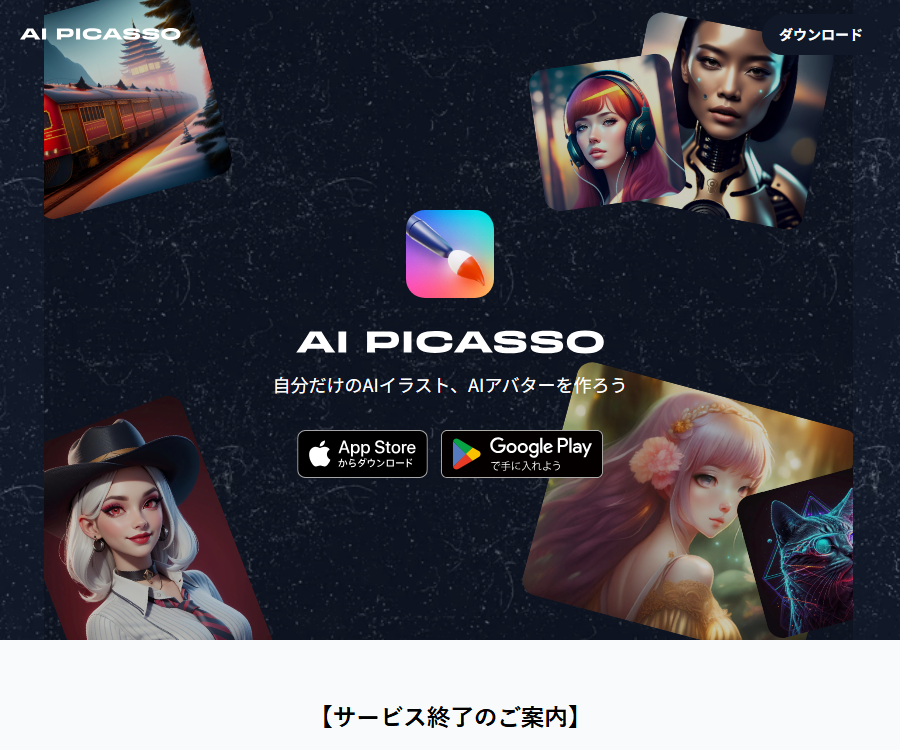
On August 4, 2025, AI Picasso officially ceased its mobile application services. The official website still provides a notice of service suspension, information on past products, technical articles, and contact details for the company; however, the original services for AI-generated art, avatar creation, and dance videos can no longer be considered active products that can be registered for and used with payment.
App stores or third-party websites may still display old pages, old prices, and installation links; such information does not indicate that the backend services are still functional. The tool catalog should indicate a \"service discontinued\" status to prevent users from making unnecessary payments or attempting to use functions that are no longer available.
A one-sentence summary
AI Picasso was a Japanese AI-based image and video application that ceased to operate on August 4, 2025; it offered services such as text-to-ilustration generation, AI avatars, AI-generated photos, LINE stickers, and the creation of dance videos from photographs.
What was the original product?
AI Picasso was developed by the Japanese company AI Picasso Co., Ltd. It initially focused on generating images from text and on AI-driven painting, but later its capabilities were expanded to include personal avatars, pet avatars, photos, outfit changes, LINE stickers, and AI-generated dance videos.
The official website has also released image generation technologies and models intended for use by businesses, and provides downloadable model experiments based on Emi, Manga Diffusion, and Picasso Diffusion. The discontinuation of a particular application does not mean that all of the company’s models and business projects will disappear as well.
Core historical functions
- Text to image: Enter a prompt and select a style to create an illustration.
- Japanese prompt: Optimize operations and content for Japanese users.
- Multiple styles: covering anime, realistic, beautiful women, fantasy, and cyberpunk themes.
- AI avatar: A custom avatar can be created using 10 to 20 personal photos.
- AI-generated photos: Create profile pictures that resemble those taken in a studio.
- Pet avatars: Convert photos of pets such as dogs into different styles.
- LINE stickers: Turn AI avatars into chat stickers.
- AI Beauty Maker: Creates enhanced versions of facial features based on photos.
- AI outfit transformation and Cosplay: Converting characters into specific clothing or character designs.
- AI dancing: Creates dance videos from a single image of a person or character.
- Image generation API: It used to provide enterprises with some proprietary image generation technologies.
- Downloadable models: Publish weights for models such as Emi and Manga Diffusion.
The original process for generating images from text
- Open the app and select text to image conversion.
- Describe the subject and scene in Japanese or other supported languages.
- Choose between anime, realistic, or other visual styles.
- Click to generate and wait for the image to be returned from the cloud.
- Check the character’s hands, text, background, and composition.
- Save the satisfactory result or modify the prompt to generate again.
- Check for copyright, portrait rights, and platform content rules before publishing.
Original process for AI avatars and photos
- In the application, select the option for AI avatars or AI-generated photos.
- Prepare 10 to 20 clear photos of the same person.
- Use single-person photos with different angles, expressions, and backgrounds.
- Avoid masks, sunglasses, excessive shading, and overly small faces.
- Upload the photo and select the person type as required by the app.
- Wait for the training of the dedicated model and the generation of batch avatars.
- Download the qualified images from the result database.
- Delete or deactivate photos and items that are no longer needed.
Original AI dance process
- Activate the AI Video or AI Dance feature.
- Select a preset dance move or video style.
- Upload a picture of a person or character.
- Give priority to photos of the entire body with clear posture.
- After submission, wait for it to be generated in the cloud; it takes about 30 minutes for the result to become available.
- Check for flickering on the face, hands and feet, clothing, and background.
- Save the results and crop them to meet the specifications of the social media platform.
- Only content for which permission for use of portraits and materials has been obtained is published.
Features of AI dance technology
- Enter an image of a person or character.
- Use motion and pose data to drive continuous video.
- Try to reduce flickering in ordinary image-to-video conversions.
- A full-body photo usually yields better results than a photo of just the face.
- When a character turns quickly, imaginary body details may appear.
- Its generation time is much longer than that of ordinary static images.
- Officials once described it as one of the early similar functions on mobile devices.
- This feature is no longer available as the original application has stopped serving.
How to choose an AI avatar photo
- All photos feature the same person.
- Select different angles such as front, side, and with a slight head turn.
- Keep the face clear and occupy enough of the frame.
- Use different backgrounds and lighting to enhance generalization.
- Avoid group photos and distant views that are hard to identify.
- Avoid having masks, sunglasses, or hair that cover the facial features too much.
- Do not upload photos of others without their consent.
- Photos of minors require explicit authorization from their guardians.
Which users it was suitable for in the past
- Regular users: Create social profile pictures and fun illustrations.
- Anime enthusiasts: Use prompts to explore characters and scenes.
- Content creators: Generate short videos and social media content.
- Pet owner: Create pet-themed avatars.
- LINE users: Create personalized avatar stickers.
- Small brands: Explore advertising and cover concepts.
- Developers and researchers: Download models such as Emi for experimentation.
- Corporate clients: Inquiry about cooperation in image generation technology.
Historical use cases
- Generate SNS avatars and profile photos.
- Convert selfies into anime, realistic, and vintage styles.
- Create LINE chat stickers.
- Make the people or characters in the photo dance.
- Create anime characters, beautiful women, and fantasy scenes.
- Create interesting graphic video clips for short videos.
- Convert pet photos into styled avatars.
- Explore illustration concepts for advertising and publishing.
There is nothing more that should be done now.
- Do not purchase subscriptions that are no longer available based on old tutorials.
- Do not consider the residual pages in the app store as proof that the service is available.
- Do not enter an Apple or Google account with unofficial installation packages.
- Do not upload photos of faces to mirror services of unknown origin for testing.
- Do not trust so-called cracked memberships, unlimited generation options, or internal interfaces.
- Do not list the old annual fees or weekly fees as the current purchase prices.
- Do not mistake the public version of the model for an indication that the original app is still in operation.
Timeline of discontinuation
| Time | Event | Current meaning |
|---|---|---|
| 2022 | The development of AI-based painting and image generation applications | It belongs to the historical product phase. |
| 2023 | Introduce AI avatar, portrait, texture, and model projects | Functional information can still be used to understand the product. |
| January 2024 | The AI dance feature has been officially released. | The capability to generate videos from original images is no longer available in apps that have stopped operating. |
| March 2025 | There are still update records for the Android page. | It doesn’t mean that long-term operation will follow. |
| August 4, 2025 | The authorities have stopped the service of the AI Picasso application. | The directory should be marked as having its service stopped. |
| After stopping the medication | The official website retains announcements, news, and model articles. | Can be used as an entry point for historical and model data |
Official announcement regarding service suspension
- The date of discontinuation is August 4, 2025.
- The authorities apologized for the suspension of services and the sudden announcement.
- Users who were still on the paid plan at that time could apply for a refund through the platform.
- Refunds for iOS must comply with Apple’s guidelines.
- To get a refund for Android, you need to submit a request based on your purchase history from Google Play.
- The discontinuation announcement does not promise that the application will resume operations in the future.
Refund processing
| Purchase channels | Official announcement guidelines | Users should be prepared. |
|---|---|---|
| iOS | Apply through the App Store in accordance with Apple’s regulations. | Order, subscription, and deduction records |
| Android | Request based on the purchase history from Google Play | Order number, subscription status, and payment receipt |
| Other channels | The announcement did not provide a unified solution. | Contact the original payment platform and official support. |
As a considerable amount of time has passed since the service was discontinued, the refund policies and eligibility requirements may have changed. Users who are still in dispute should check the current rules of the payment platform directly, and must not provide their account passwords or verification codes to any third parties.
Historical prices
Before it ceased operations, AI Picasso offered a service for generating free images along with a PRO subscription; according to available records, the cost was 600 yen per week or around 4900 yen per year, and during certain promotions this annual fee dropped to 3600 yen. The figures listed below are provided only for historical context and do not represent current pricing.
| Historical plans | Historical price reference | Original equity | Current status |
|---|---|---|---|
| Free | 0 yen | Generation of text images with ads | The application is no longer in service. |
| PRO Weekly | About 600 yen per week | AI avatars, no ads, all styles, and fast generation | It cannot be recommended as a purchase option at the moment. |
| PRO Yearly | Approximately 4,900 yen per year | Long-term use of advanced features | It cannot be recommended as a purchase option at the moment. |
| Annual promotion | It used to cost around 3,600 yen per year. | Event discounts | Expired |
| Enterprise API | Contact the authorities to inquire about prices. | Some image generation techniques | It is necessary to confirm separately whether to proceed at this time. |
Why can’t the old prices be shown anymore?
- The service has been discontinued, and old subscriptions no longer correspond to any deliverable functions.
- The app store cache may still retain information about in-app purchases.
- The promotional prices, weekly fees, and annual fees come from different periods in history.
- The discontinuation notice takes precedence over older reviews and tutorials.
- Any resumption of listing requires re-verification of the operating entity and version.
- The tool catalog should clearly mark old prices as historical data.
Platform and availability
| Platform or resource | Historical support | Current situation |
|---|---|---|
| iOS App | Support | The original service has been discontinued; it is not recommended to make purchases through the old page. |
| Android App | Support | The original service has been discontinued, and the information remaining in the store may be outdated. |
| Official Web Site | Product introductions and news | You can still view the service suspension announcements and past articles. |
| LINE features | Profile picture textures and AI beauty maker | The current availability needs to be verified item by item. |
| Hugging Face models | Models such as Emi are available for download. | Make a separate judgment from the discontinuation of the app. |
| Corporate technical cooperation | Consulting and interface services were provided previously. | It is necessary to confirm the current services directly with the company. |
Privacy and facial data
For AI avatars, 10 to 20 photos of the face are required, and AI dance features also need images of the person. Past disclosures from the Android Store indicate that such apps may collect personal information, messages, photos, and videos, and may share these photos, videos, as well as data related to the app’s performance with third parties.
- Face photos are highly sensitive personal data.
- Do not upload photos to old clients of unknown origin after stopping use.
- Historical Store revealed that it was not possible to request deletion directly within the app.
- The discontinuation notice does not specify the date on which the historical facial data will be deleted.
- Users can contact the original operator to inquire about the status of their accounts and training data.
- Do not upload photos of minors or of others without their consent.
- Companies and schools should not use old clients to process data managed by administrators.
The issue of authenticity of AI avatars
- Generating a profile picture involves beautifying, redrawing, and estimating facial details.
- When the number of photos is insufficient, the similarity may drop significantly.
- Obstructions, side views, and low light can affect the model’s learning.
- The generated result is not the same as a photo of the actual identity.
- It cannot be used for documents, certifications, or identity verification.
- The output may change the age, skin color, hairstyle, and facial features.
- Before public release, one should confirm that they accept the generated image.
Risks of AI-driven dancing and deepfake technology
- A single photo can be used to create a video of seemingly real movements.
- Using someone else’s photos without authorization may violate their rights to their portrait and personal dignity.
- The generated result should be clearly marked as being created by AI.
- It must not be used for impersonation, fraud, harassment, or false endorsement.
- The risks are higher when public figures and minors are involved.
- After the platform stops operating, one must be especially vigilant against unofficial mirrors and fake applications.
Commercial use and copyright
Different functions in an application may require the use of different models; therefore, the commercial licensing for the Emi series cannot be applied to all app outputs. For commercial use, it is necessary to check the input materials, the specific models used, the rules of the output platform, as well as any third-party trademarks or images.
- Only use your own or authorized photos and reference images.
- Do not create unauthorized characters, trademarks, or celebrity endorsements.
- Retain records of the generated models, versions, and manual modifications.
- The Emi series should be used in accordance with the specific model cards and licenses.
- The proof-of-concept version of Manga Diffusion is not equivalent to a fully developed commercial product.
- After the application is discontinued, it is no longer possible to rely on the original platform for ongoing provision of rights information.
- High-value business projects should undergo independent copyright reviews.
Emi series models
AI Picasso has made available on Hugging Face image models such as Emi, Emi 2, Emi 2.5, and Emi 3. The official article states that the Emi series is designed for anime and manga styles, and it emphasizes that no images obtained through unauthorized copying were used in the further training process.
- Emi is based on Stable Diffusion XL 1.0 as its foundation.
- Emi 2 further enhances the stability of full-body characters.
- Emi 2.5 is designed for AI art with higher resolution.
- Emi 3 is based on the updated Stable Diffusion 3.5 Large version.
- Model weights can be used independently of the original mobile application.
- Local execution requires a compatible environment, a GPU, and experience in using models.
- The model card and license must be read separately for each version.
Manga Diffusion and Clean AI
- Manga Diffusion is a proof-of-concept model designed for the comic book industry.
- Officials state that the sources of training data include the public domain, CC0, and licensed data.
- The project emphasizes communication with creators and data authorization.
- The proof-of-concept version has limited expressiveness and stability.
- The publicly available weights do not guarantee suitability for all commercial or production purposes.
- Before use, it is necessary to verify the base model and the licenses for additional data.
The difference between public models and open-source applications
- Making the model weights public does not equate to making the source code of a mobile application open source.
- The AI Picasso client, backend, avatar training, and video system are not made public.
- Hugging Face models come with their own licenses; the lack of uniformity does not equate to OSI open-source standards.
- The Emi 3 model card is currently labeled under the Other license category.
- Projects with the same name on unofficial GitHub platforms should not be considered as AI Picasso code.
- The catalog should indicate that the app is not open-source, with some models available for public download.
Corporate APIs and technical partnerships
AI Picasso once announced that it would provide enterprise interfaces for Picasso Diffusion and the technology used for generating Japanese-style characters; the specifications and prices are available upon contacting the company. Since the consumer-oriented applications have been discontinued, it is necessary to verify with the service providers whether these enterprise interfaces still accept new customers.
- There is no currently available standardized price list for interfaces.
- Historical announcements cannot prove that the service levels and availability zones remain valid.
- Before connecting, obtain the latest documents, contracts, and data processing terms.
- It is necessary to confirm the model version, content filtering, and commercial responsibilities.
- Old app keys or unofficial interfaces must not be used.
- During the prototype phase, public models can be evaluated first.
Historical advantages of the product
- It offers a user-friendly image generation experience for Japanese users.
- Text, images, avatars, photos, and video features are all available in one place.
- Supports Japanese prompts and local social scenarios.
- An AI avatar requires only 10 to 20 photos.
- AI dance can turn a single image of a person into an animated video.
- Integration with commonly used Japanese channels such as LINE stickers.
- Downloadable models such as Emi have been made available.
- Explored mechanisms for partnering with creators regarding licensed data.
Current restrictions and precautions
- The original mobile application was discontinued on August 4, 2025.
- Old installation packages and store pages do not guarantee that the generated service will be available.
- The old weekly fees and annual fees should not be listed as the current prices.
- The historical deletion status of face and video data is not clear enough.
- The original service cannot be restored using unofficial mirrors.
- The application’s source code, avatar training features, and video backend are not open source.
- Making the Emi model public is not the same as having the original app’s functions.
- Different model licenses and commercial terms need to be checked one by one.
- The current status of the enterprise interface requires further consultation.
- The tool catalog should give priority to alternative products that are still under maintenance.
GitHub and open source
No GitHub repository containing the source code for the official AI Picasso mobile application was found. The repositories with similar names such as Picasso and PicAIsso that appeared in the search results belong to other organizations, and therefore cannot be considered as the official code for this Japanese product.
AI Picasso has made some of the model weights available on Hugging Face rather than on GitHub. The description should state that \"the application is not open source; some models are available for download under their respective licenses\", and it is not appropriate to label the entire product as open source.
Basic information
| field | Content |
|---|---|
| Product name | AI Picasso / AIピカソ |
| Development company | AI Picasso Co., Ltd. |
| Product type | AI image, avatar, and video generation applications |
| Service status | Service has been discontinued. |
| Date of discontinuation | August 4, 2025 |
| Historical platforms | iOS and Android |
| Historical price patterns | Free plus PRO subscription |
| Public model | Emi, Manga Diffusion, etc. |
| Enterprise API | It was available in the past; the current status requires consultation. |
| Is it open source? | The application is not open-source; some models are available for public download. |
Recommendation score
2.0 / 5. AI Picasso was well-known in Japan for its AI-generated avatars and dance videos, but its consumer-oriented applications have been discontinued; therefore it is not suitable as a recommendation for use in creative tasks today. Its Emi series of models, however, still hold value as references for research and local deployment.
Frequently Asked Questions
Can AI Picasso still be used?
The original mobile app ceased to operate on August 4, 2025; therefore, there is no need to continue paying or uploading photos using the old instructions.
Why can I still see pages on the app store?
Store indexes and third-party caches may retain old data; the presence of a page does not mean that the backend is still running.
What could AI Picasso do before?
It used to support text-to-image generation, AI avatars, photos, LINE stickers, and the creation of dance videos from a single image.
Can I get a refund for an old subscription?
The announcement regarding the suspension of service requires iOS users to apply through Apple, while Android users must apply through Google Play; the eligibility criteria are determined by the rules of the respective payment platforms.
What were the historical prices?
There were once PRO plans costing around 600 yen per week and around 4,900 yen per year; the promotional annual fee was about 3,600 yen, but these are not the current prices.
Can the Emi model still be downloaded?
The official Hugging Face page still lists several versions of Emi, but it is necessary to verify the model cards, licenses, and operating environment separately.
Is AI Picasso open source?
The mobile application is not open-source; only some weights of the image models are available for public download.
Are enterprise APIs still available?
The official website retains historical API announcements, but the current specifications, prices, and availability need to be confirmed directly with the company.
Can I download the old installation package to continue using it?
It is not recommended; after stopping use, the old client may be unable to connect to the backend, and there are also risks related to accounts, privacy, and malicious installation packages.
Tools similar to AI Picasso




 Guigong Network Security Registration No. 45132202000164