






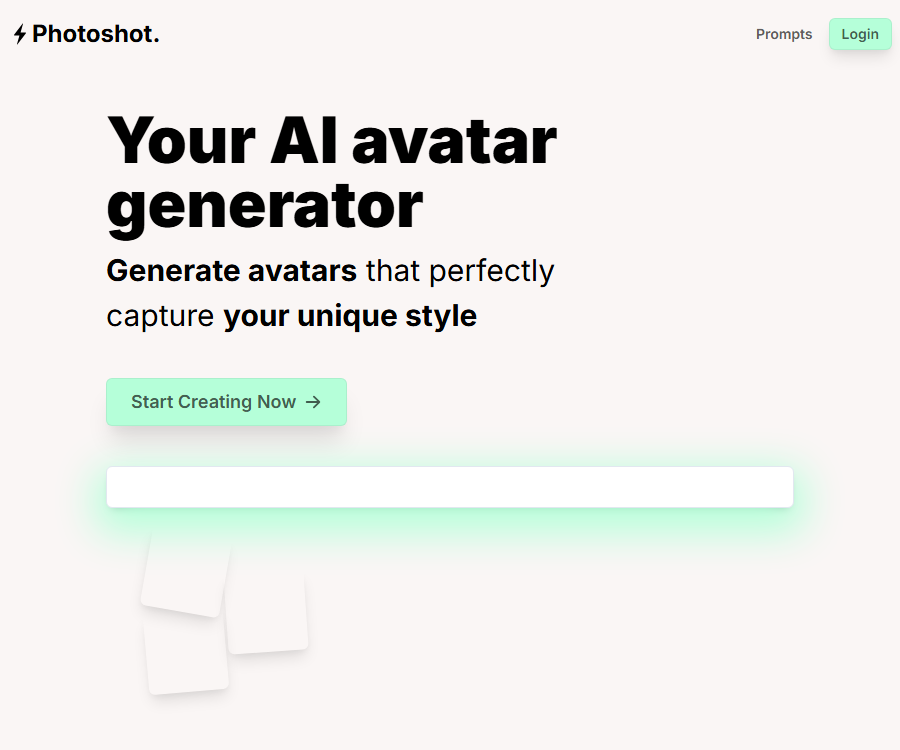
Photoshot
Photoshot, an intelligent tool focused on AI-powered image processing.
Tags:Common AI image toolsWhat is Photoshop?
Photoshot is an open-source AI tool for creating avatar images and personal photos. Users upload selfies taken from different angles, and the platform uses these to train a customized Studio model; thereafter, it generates avatars with various outfits, backgrounds, and styles based on textual instructions.
It charges through a one-time purchase of the Studio version, with no requirement for a recurring subscription. The current package available on the official website includes a customized training model and 100 credits for generating 4K avatars.
Project background and open-source status
The source code for Photoshot is hosted on GitHub, with the repository having been redirected from the shinework organization to the premieroctet account. The project is licensed under the MIT license, allowing developers to view, modify, and deploy the code as long as they comply with the terms of this license.
The code for the Photoshop website is open source, but this does not mean that Replicate, Flux, DreamBooth, OpenAI, AWS, Stripe, and other dependent services are all free or subject to the same licensing terms. For self-hosting, it is still necessary to have external accounts, pay for models, and provide the necessary infrastructure.
Main functions
- Upload selfies from multiple angles to create a personal training dataset.
- Train a custom AI Studio model using personal photos.
- Generate personalized avatars in various styles through text prompts.
- Use AI to optimize prompts and reduce the barriers to writing for new users.
- Users are allowed to create their own clothing, scenes, and photography styles.
- Generate profile pictures in a resolution of up to 4K.
- One Studio includes 100 credits for generating avatars.
- Users can delete the datasets saved in Studio and Photoshop.
- It provides open-source code for developers to learn from and host on their own.
- The self-hosted version supports integration with Replicate, S3, Stripe, and email login.
Photoshop workflow
| Phase | User operations | System processing |
|---|---|---|
| Prepare photos | Collect selfies that are clear, taken from various angles, and show different expressions. | Create a character training dataset |
| Create Studio | Upload a photo and make the payment. | Save projects and training configurations |
| Model training | Click on Train and wait. | Train custom models using external services such as Replicate. |
| Write prompt instructions | Describe the clothing, setting, camera angle, and style. | Generate images using custom character identifiers. |
| Filter avatars | Compare similarity, structure, and visual effects | Deduct the amount allocated for that Studio. |
| Delete Studio | Delete items within the account | Delete photos and datasets from Photoshop. |
Which photos work better when uploaded
Officials recommend uploading diverse, clear photos of the intended person only. A combination of close-up shots, side views, and full-body photos can help the model understand the facial and physical features.
- Prepare photos from the front, left side, right side, and at a slight pitch angle.
- It includes natural expressions, smiles, and other common facial expressions.
- Use different locations, backgrounds, and shooting distances.
- Choose photos with even lighting, a clear face, and no excessive filters.
- Include a few full-body photos to help understand the body shape and posture.
- Make sure that each photo features only the same subject.
- Do not include pets, group photos, or other faces.
- Avoid sunglasses, masks, covering the face with hair, and excessive beauty filters.
Photos that are not recommended for uploading
- Images that are overly compressed, severely blurred, or have too low a resolution.
- A large number of photos taken in quick succession, with repeated angles and the same background.
- Group photos with multiple people in which it is not possible to determine the training subject.
- Images that are explicit, pornographic, or violate the platform’s rules.
- Photos of others without their consent.
- ID cards, medical records, work permits, and other sensitive information.
- Contains information on client secrets, unreleased products, or precise locations.
Create an AI Studio tutorial
- Register and access the Photoshop account console.
- Create a new Studio and check the current price and quota.
- Upload clear and diverse selfie photos of the target person.
- Check again to ensure there are no other people, sensitive information, or prohibited content.
- After completing the payment, go to the Studio training page.
- Confirm that the photo meets the requirements, then click Train to start the training process.
- Wait for services such as Replicate to complete the model training.
- After the training is complete, use simple prompts to verify the similarity between the individuals.
Clicking on \"Train\" means that the use of digital services has begun, and this affects the eligibility for a refund. If there are significant issues with the quality of the photos, they should be replaced before starting the training process, rather than requesting a refund after the training is complete.
Avatar creation tutorial
- Open the Studio that has completed its training.
- Choose to write your own prompts or use AI-generated prompts for optimization.
- Describe the characters’ clothing, the setting, the camera angles, the lighting, and the visual style.
- Avoid changing the core identity characteristics of the character in the prompts.
- Generate a small number of results first and compare the face shapes and overall consistency.
- Modify a single variable gradually; do not change all conditions at once.
- Download the available avatars and note down the corresponding prompt words.
- Export all the finished products that need to be retained before the quota is exhausted.
Profile picture prompt structure
- Characters: Use the dedicated character identifiers specific to Studio.
- Clothing: business suits, casual wear, sportswear, or outfits with a specific theme.
- Environment: studio, office, street, natural or solid-color background.
- Lenses: passport-style front view, half-body, full-body, or movie close-up.
- Lighting: soft light, rim light, sunset light, window light, or studio lighting.
- Style: Realistic photography, illustrations, movies, vintage or futuristic.
- Quality: clear face, natural skin, realistic hands, and high detail.
- Exclusions: extra characters, distorted facial features, blurriness, and text watermarks.
What determines the similarity between characters?
According to the official statement, the similarity of avatars depends primarily on the number, quality, and diversity of the photos uploaded. While the training model can learn the characteristics of individuals, it cannot guarantee that each generated image will be exactly identical to the real person.
- A clear front view helps the model identify the eyes, nose, and face shape.
- Side-profile photos help to understand the contours, ears, and jaw.
- The different expression reduction models have the problem of only generating one type of expression.
- Different backgrounds can reduce the incorrect association of characters with a particular scene.
- Too many filters can cause the model to learn about unrealistic skin and facial features.
- Generating prompts that excessively change the age and style will reduce similarity.
The relationship between DreamBooth, Flux, and Replicate
The website’s page explaining how it works still uses DreamBooth and Stable Diffusion to illustrate the concept of personalized training. The current GitHub README also lists Flux as an image generation model, and it is possible to run cloud-based machine learning tasks using Replicate.
| Components | Its role in Photoshop | Precautions |
|---|---|---|
| DreamBooth | Use a small number of subject photos to fine-tune the personalized image model. | The training cost is higher than that of ordinary text-to-image generation. |
| Flux | The image generation models listed in the current README | The specific version and licensing requirements need to be determined based on the deployment configuration. |
| Replicate | Managing training and inference tasks | Charging is based on the amount of computation used, with data being processed separately. |
| OpenAI | Self-hosted Prompt Wizard | An independent API key is required, along with payment for each invocation. |
| S3 object storage | Save uploaded images and generate assets | It is necessary to configure the region, access permissions, and lifecycle. |
Website documentation and code may be updated at different rates; therefore, deployers should rely on the current repository, environment variables, and the actual models in use. It is not appropriate to determine the model used in the production environment based solely on old documentation pages.
Studio price
When the official website was checked in August 2026, the price of a Studio was $8; this package included a custom-trained model as well as 100 4K avatars. The website stated that training a custom model required computational power, which is why there were no completely free Studios available.
| Project | Current price or quota | Explanation |
|---|---|---|
| 1 Studio | 8 dollars | One-time purchase, not a monthly subscription |
| Custom training models | 1 | Trained based on photos uploaded by users |
| Avatar quota | 100 pieces | The official website states 4K generation. |
| Prompt optimization | Includes | AI can be used to assist in rewriting and generating prompts. |
| Custom prompt | Includes | Users can describe the style of their avatar on their own. |
| Additional fees | A separate charge applies for self-hosting. | Replicate, OpenAI, S3, databases, and email services, etc. |
Whether the generated credit is refunded due to failed tasks, as well as the actual 4K pixel specifications and the new prices for Studios, may change depending on operational adjustments. It is necessary to refer to the settlement page and the real-time information available in the account before making a payment.
Refund rules
The official FAQ allows for a refund request within 14 days after purchase, provided that the AI has not yet been trained. Once the user clicks on \"Train\" and starts using the service, or if 14 days have passed, the condition for a refund is no longer met.
- Prepare a sufficient number and quality of photos before making the purchase.
- Do not click Train if the photo is not qualified.
- Refund requests must be submitted within 14 days after purchase.
- Provide the account email, order history, date, and reason for the request.
- Disatisfaction with the similarity level after training completion is generally not a reason for a refund.
- Mandatory consumer rights are still governed by the laws of the applicable jurisdiction.
Rules for deleting photos and models
Users can delete the photos and datasets stored on the Photoshop server by removing Studio. Once the quota allocated to Studio is exhausted, the custom models will be automatically deleted within 24 hours.
- Download all the profile pictures that need to be kept before deleting Studio.
- Deleting an account will result in the loss of access to related content and data.
- Account deletion and the removal of associated data can be requested via email.
- Photoshop does not overwrite the data that has already been sent to Replicate.
- Requests for data on the Replicate side must be made separately, in accordance with its rules.
- Running and backup copies may still exist before the training model is automatically deleted.
Privacy and risks related to facial data
Photoshot processes email messages, device logs, cookies, selfie photos, training data, and the content that is generated. Face images are considered highly sensitive data; before uploading them, it is necessary to understand the data flow between Photoshot and Replicate.
- Only upload your own photos, or obtain explicit permission from the person being photographed.
- Do not use the platform to create account avatars that impersonate others.
- Remove location, device, and other EXIF information from photos.
- Do not upload photos of children, patients, customers, or employees for testing.
- Use a separate email address and set a strong password to protect your account.
- After the training is complete, delete Studio and the datasets as needed.
- Further contact Replicate to process the already transmitted data.
- Different privacy protection laws may apply to international data transfers.
Requirements for content and photos
The privacy policy requires the uploader to ensure that the photo shows them themselves, that they have the rights to use it, and that it does not contain any explicit or pornographic content. If a photo from a third party is submitted, the uploader must be able to prove that they have obtained consent from the person whose photo it is.
- It is not allowed to use photos obtained without consent to identify other people.
- Content that is explicit, pornographic, or intended for harassment must not be created.
- Avatars must not be used for fraud, impersonation, or identity theft.
- For commercial use, it is also necessary to verify the rights to portraits, trademarks, and clothing designs.
- Images generated should indicate that they are AI-generated, in order to prevent misleading the audience.
Self-hosted technical architecture
| Components | The project adopts this solution. | Function |
|---|---|---|
| Frontend and backend | Next.js | Pages, interfaces, and application logic |
| Interface components | Chakra UI | Build a web interactive interface |
| Database | PostgreSQL and Prisma | Account, Studio, order, and task data |
| Model execution | Replicate | Personalized training and image reasoning |
| File storage | Object storage compatible with S3 | Photos, datasets, and generation results |
| Payment | Stripe | Studio purchases and order processing |
| Login and Email | NextAuth and SMTP | Account authentication and notifications |
| Prompt Assistant | OpenAI API | Rewrite and expand avatar prompt words |
| Local development | Docker Compose | Start PostgreSQL and other dependent services such as Maildev. |
Self-hosted deployment tutorial
- Read the MIT license, README, and instructions for the current submission.
- Prepare the Node.js, package manager, Docker, and Git environments.
- Install the project dependencies and start the local PostgreSQL and email testing services.
- Copy the environment variable example and create a separate development configuration.
- Configure the database, NextAuth keys, and email server.
- Configure the S3 bucket, region, access key, and lifecycle.
- Configure the Replicate account, API Token, training parameters, and model version.
- Configure Stripe product prices, Webhooks, and image quotas for Studio.
- Configure the OpenAI prompt wizard as needed.
- Execute the database migration and start the development server.
- Complete the entire training and deletion process using test subjects with no sensitive information.
- Before going live, add encrypted connections, backups, monitoring, rate limiting, and content filtering.
Self-hosting costs
The MIT code itself does not require any licensing fees, but its actual use generates costs related to model training, image generation, object storage, databases, servers, email services, payment processing, and prompt API usage. The larger the number of users, the more important become the costs associated with managing facial data and providing customer support.
| Cost items | Basis for billing | Control method |
|---|---|---|
| Replicate training | GPU training time and model tasks | Limit on photos, number of training steps, and retries on failures |
| Replicate reasoning | The runtime for each avatar model | Set Studio quotas and concurrency limits |
| S3 storage | Capacity, requests, and traffic | Automatically delete the original images and outdated results. |
| Servers and databases | Instance specifications, traffic, and backups | Split by environment and monitor slow queries. |
| OpenAI Prompt Assistant | Number of token requests | Limit length, cache templates, and set budgets |
| Stripe | Transaction fees | Include payment and refund costs in the price. |
| Number of messages sent and service provider plans | Only send necessary login and task notifications. |
Self-hosted security recommendations
- All API keys are stored only in the server’s key management system.
- S3 buckets are private by default and use short-lived signature links.
- Set automatic deletion schedules for the training compression package and photos.
- Stripe Webhooks must verify signatures and prevent duplicate orders.
- Rate limits are set for the registration, uploading, training, and generation interfaces.
- Limit file types, size, and image decoding resources.
- Log administrator access and data deletion operations.
- Regularly update dependencies and check for open-source security vulnerabilities.
- Establish a Photoshop-Replicate integration process for deletion requests.
What use cases are suitable?
- Create social media, forum, and game avatars personally.
- Working professionals try out different professional looks with various outfits and backgrounds.
- Creators build personal brands and create cover materials for their content.
- Developers learn personalized image training and Web product architecture.
- The startup team has developed a customized avatar service based on open-source code.
- Researchers evaluate the personalized processes of DreamBooth or Flux.
- After completing the compliance assessment, companies develop internal avatar tools.
Tasks that are not suitable for completion directly
- Training someone else’s facial features without their consent.
- Creating avatars intended to impersonate real people for fraudulent or harassing purposes.
- Uploading sensitive photos of minors, patients, or customers.
- It is required that each profile picture be an identification document that matches the actual person exactly.
- Deployments that require local offline training and for which data cannot be sent to Replicate.
- Use AI avatars as a basis for identity verification and liveness detection.
- Public services without data deletion, permission, or complaint procedures.
- Users who only want to create one or two ordinary AI images for free.
Product advantages
- Provides a complete Studio workflow for personalized character training.
- One purchase includes a custom model and 100 avatars.
- It supports 4K output and custom prompts.
- AI prompt optimization is suitable for users who are not familiar with generation grammar.
- The authorities have clearly specified the requirements for preparing the photos and the conditions for refunds.
- Users can delete data from Studio and Photoshop.
- The project is fully open-source and uses the permissive MIT license.
- The technology stack covers accounts, databases, storage, payment, and model services.
- It can serve as a foundation for learning and further development of personalized AI avatar products.
Usage restrictions and precautions
- Training is a paid service; it cannot be tried out for free immediately like regular image generation tools.
- After clicking “Train”, the condition for a 14-day refund is usually no longer met.
- The similarity of profile pictures depends on photo quality, angle, and diversity.
- AI can change facial features, age, skin color, hairstyle, and physical characteristics.
- Once the Studio quota is used up, the custom models will be deleted within 24 hours.
- Deletion in Photoshot does not automatically remove the data on the Replicate side.
- The privacy policy was last updated in 2022; some technical details may be outdated.
- The official website still states DreamBooth as the working mechanism, while the README lists Flux.
- Self-hosting requires multiple third-party services and ongoing maintenance.
- The MIT license does not include permissions for external models, data, and brands.
- The website does not have a separate public API available for external developers.
GitHub repositories and licenses
The official GitHub repository is currently named premieroctet/photoshot; the old address shinework/photoshot will be automatically redirected. The repository is licensed under the MIT license and remains under open maintenance.
Developers can modify and deploy code, but they must retain the copyright and license statements required by the MIT license. In a production environment, it is also necessary to comply with the terms set by Replicate, Flux, OpenAI, AWS, Stripe, and other services that are used.
Basic information
| field | Content |
|---|---|
| Tool name | Photoshot |
| Tool type | AI avatars, personalized photos, and open-source web applications |
| Main process | Upload selfies, training Studio, generate avatar from prompts |
| Official website price | 8 dollars per studio |
| Includes quota | 1 custom model and 100 4K avatars |
| Core model services | The README mentions Flux and its operation via Replicate; the official website still provides instructions for DreamBooth. |
| Technology stack | Next.js, Chakra UI, Prisma, PostgreSQL, S3, Replicate, and Stripe |
| Refund | Within 14 days after purchase and before clicking on Train |
| Model deletion | The account is automatically deleted within 24 hours after the Studio quota is used up. |
| Whether a public API is provided | No, the source code can be extended as needed. |
| Is it open source? | Yes, MIT license. |
Recommendation score
4.4 / 5. Photoshot offers a straightforward pricing structure and a clear process for personalized training; its MIT-source code is suitable for learning and further development. However, issues such as facial privacy, the deletion of Replicate data, differences in document updates, and the costs associated with self-hosting need to be carefully managed.
Frequently Asked Questions
Is Photoshop free?
It’s not completely free. The official website explains that training personalized models requires significant computing power, and the current price of one Studio unit is 8 dollars.
What does a Studio contain?
It includes a custom model trained on selfies, 100 4K avatar slots, AI prompt optimization, and custom prompts.
Can I get a refund?
A refund can be requested within 14 days of purchase, as long as the user has not started training yet. Generally, the requirement is no longer met once training begins or after 14 days have passed.
What kind of photos should be uploaded?
Upload clear photos of yourself from various angles, showing different expressions and in different backgrounds, making sure that each photo features only the person in question. Avoid group photos, pets, blurry images, and excessive filters.
Will deleting Studio remove all data?
The photos and datasets on the Photoshop server will be deleted, but the data that has already been transferred to Replicate will not be overwritten automatically. Replicate must handle this matter according to its own policies.
Will the model be retained permanently?
No. According to the official FAQ, once the Studio points are used up, the custom models will be automatically deleted within 24 hours.
Does Photoshop provide an API?
The website does not provide public APIs for independent developers. The project is open source, allowing the technical team to expand the interfaces in their own deployments.
Is Photoshop open source?
Yes. The official GitHub repository is licensed under the MIT license, but external models and cloud services come with their own fees and terms.
Tools similar to Photoshop


 Guigong Network Security Registration No. 45132202000164