






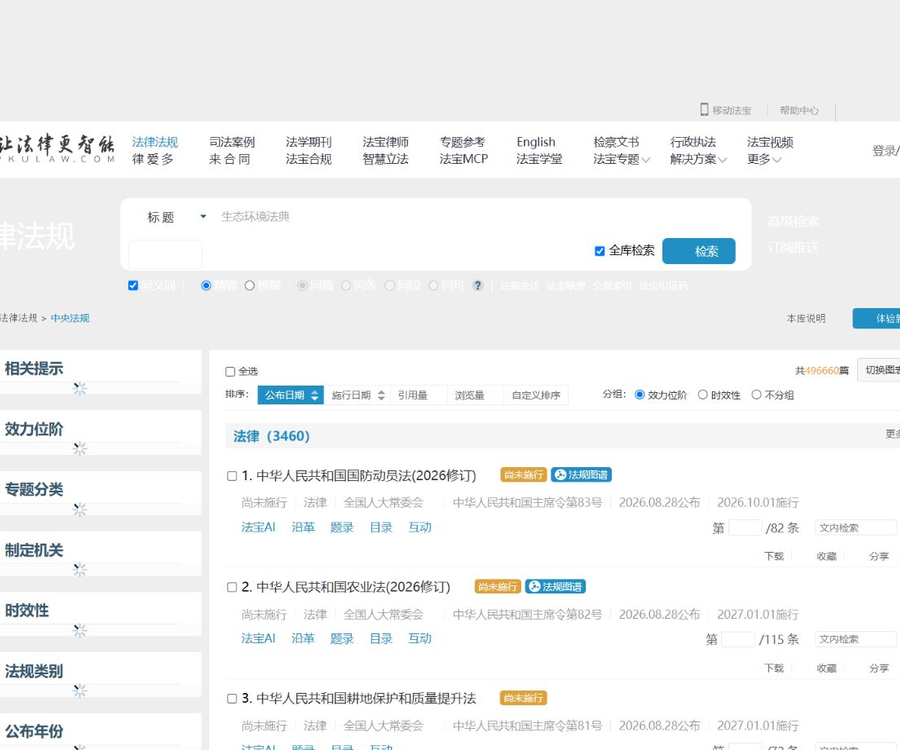
Beida Fabao Legal Database
AIGC Tool Navigation Site (www.aigc.cn), abbreviated as AIGC Navigation, is the most comprehensive directory of generative AI tools available online; its categories include AI writing, AI art generation, AI video creation, AI-powered office tools, AI digital avatars, AI design, AI voice synthesis, and AI music creation.
Tags:AI image illustration generationWhat is Beida Fabao?
Beida Fa Bao is a professional legal information and intelligent search platform operated by Beijing Peking University Yinghua Technology Co., Ltd.
It organizes laws and regulations, judicial cases, journals, and practical materials into a database that can be searched, linked, and continuously updated.
Beida Fa Bao is not just a legal search tool.
The platform also offers traditional legal databases, Fa Bao AI, contract services, MCP, and command-line access.
Users in the legal field can access the original texts, while AI applications can make use of structured legal data and search functions.
What data is included in Beida Fa Bao?
As of August 30, 2026, the Fabao MCP official website shows the following sizes for its databases.
- There are over 5.8 million legal and regulatory documents in the database.
- There are over 170 million judicial cases in the database.
- There are over 47 million records in the administrative law enforcement database.
- There are over 8.2 million prosecutorial documents in the database.
- The legal journal database contains over 450,000 articles.
- There are over 30 specialized reference databases.
The amount of data keeps changing, and the actual accessible range depends on the permissions for the sub-databases purchased with the account.
Functions of traditional legal databases
Search for laws and regulations
Users can filter by keyword, title, validity status, issuing authority, publication date, and regulation category.
The details of the regulations also show a table of provisions, their history, citation relationships, and related information.
Judicial case search
The case database can be searched by case reason, court, court level, judgment date, issues in dispute, and the full text.
When studying similar cases, it is necessary to take into account differences in the judicial level, region, time, and facts.
Legal journals and practical resources
Journals, practical insights from law firms, and specialized materials can be used to complement theoretical knowledge, practical perspectives, and research directions.
The views expressed in the article are not legal norms, nor do they necessarily represent the position of courts or regulatory authorities.
Associations with magical treasures
Magic Tool Association connects current regulations, case studies, journals, and practical articles to form a network of related knowledge.
It is suitable for expanding the scope of searches, but it cannot replace the user’s judgment as to whether the material is truly relevant.
Download, bookmark, and subscribe
Logged-in users can download content, save it as favorites, view past searches, and set up content subscriptions based on their permissions.
The download format, quantity, and scope of full-text access may vary depending on the factor library and account type.
What can Fa Bao AI do?
On its database page, Beida Fabao offers Fabao AI, as well as a Fabao AI+ product ecosystem.
The relevant capabilities include legal Q&A, search assistance, contract processing, and professional intelligent applications.
- Describe the case or legal issue in natural language.
- Look for relevant evidence in regulations and case studies.
- Conduct a preliminary analysis of the document or contract.
- Generate responses with supporting evidence and draft research.
- Assists in identifying regulations, legal provisions, and legal terms.
- Check the correspondence between the references and the original text.
The conclusions generated by AI are probabilistic; it is necessary to revert to the original regulations, case studies, and contract texts for verification.
What is PKU LawMaster MCP?
The Magic Tool MCP enables AI clients that support the MCP protocol to access Peking University Legal Data and tools.
A single token can be used for both MCP and the official CLI, with authentication handled by a unified gateway.
- Regulatory semantic retrieval and keyword retrieval.
- Case semantic retrieval and keyword retrieval.
- Search by statutory keyword.
- Identification of regulation names and clauses.
- Case number identification and structured processing.
- Verification of legal citation.
- Intelligent indexing of documents and regulations.
- Legal retrieval and verification for agents.
The platform currently promotes more than 10 MCP services, but the actual tools available depend on the Application Center and account permissions.
What is the difference between MCP and CLI?
MCP protocol
MCP is suitable for natural language conversations; it enables the model to understand the question and select relevant regulations, examples, or verification tools.
It will load the tool structure and reasoning context, which therefore also consumes the tokens of the large model being used.
CLI command line
The official CLI invokes the legal data interface using fixed commands and returns structured results.
The official website states that CLI does not rely on large models, so there is no consumption of model tokens; it is thus more suitable for batch and script-based tasks.
How to choose
- Dialogic legal research gives priority to the use of MCP.
- For fixed-batch queries, the CLI should be used preferentially.
- Use explicit parameters when reproducibility of the results is required.
- For complex research, data can first be retrieved via CLI, and then organized by AI.
- In any case, the original document and the search criteria must be retained.
Which users are it suitable for
- Lawyers, legal officers, and compliance professionals.
- Researchers in the fields of courts, prosecution, and administrative law enforcement.
- Faculty members, students, and research teams at the law school.
- Financial institutions that require regulatory and case data.
- Companies that conduct contract reviews and risk assessments.
- Technical teams for developing legal AI agents and knowledge bases.
- Public institutions and libraries that need Chinese legal materials.
Guide to Using Beida Fabao
- First, determine whether you need to consult regulations, case studies, journals, or practical perspectives.
- Separate the legal relationships, points of dispute, parties involved, actions taken, and timing.
- Perform the first keyword search using core legal terminology.
- Narrow down the scope of regulations based on their validity status, the authority that issued them, and the date.
- Filter cases by cause of action, court, jurisdiction level, and date of judgment.
- Open the original text and check the clauses, document numbers, version, and date of implementation.
- Use magical artifacts as a reference to supplement information on history, cases, and journal articles.
- Use Fa Bao AI to generate a list of questions or a draft for research.
- Check each AI citation to ensure it corresponds to the original text.
- Record the search query, filtering criteria, and search date.
- Verify the key conclusions using a second database or official source.
- It must be reviewed by qualified legal professionals before being put into official use.
Ordering methods and prices
Beida Fabao is sold through sub-databases such as laws and regulations, judicial cases, legal journals, practical insights from law firms, and thematic references.
As of August 30, 2026, the public purchase guide does not specify a unified standard price for the packages.
- Individual users can log in to view the sub-libraries that support online purchases.
- Institutional clients can submit their organization details and contact information to obtain procurement proposals.
- Different sub-libraries, the number of accounts, concurrency levels, and usage periods can affect the quote.
- Colleges, law firms, bar associations, and enterprises may employ institutional authorization.
- For the local version, APIs, and customized solutions, separate consultation is required.
The specific prices, permissions, invoices, account scope, and renewal rules shall be governed by the order or purchase contract.
Why is there no price list?
The official website does not make the amounts of various packages available for verification to anonymous visitors, which makes it impossible to create a reliable comparison of prices.
Institutional purchase prices, prices for events, and historical quotes may vary; they should not be used as the current prices for individual purchases.
MCP score and model cost
The MCP tool uses account points and tokens for authentication, but anonymous pages do not reveal the specific amounts associated with various recharge options for verification.
MCP scores, access rights to the PKU Law Database, and third-party large-model tokens represent different types of costs.
- Calling MCP tools may consume points on the Magic Item platform.
- The dialogue client also consumes the tokens of the selected large model.
- The CLI does not rely on large models, but legal data services are still subject to account quota limitations.
- The scoring rules for different tools may vary.
- Before making a top-up, check the service details and the billing information for that transaction.
- The team should enable usage billing and Token rotation management.
MCP access process
- Register for a MCP account on Beida Fa Bao and access the console.
- Obtain access tokens for individuals or teams.
- Select services such as regulation verification, case studies, or citation checks.
- Enter the service address in the clients that support MCP.
- Include the Token in the authorization request header; do not include it in public documents.
- First, use low-risk public questions to verify the connection and permissions.
- The inspection results should return the original identifier along with evidence for verification.
- Set limits, logs, key rotation, and anomaly alerts.
Once a token is leaked, it must be revoked immediately and regenerated; it must not be made public in screenshots, code repositories, or shared documents.
What needs to be verified in legal research?
- Title of the regulation, reference number, authority responsible for its enactment, and legal hierarchy.
- Dates of publication, implementation, amendment, repeal, and expiration.
- Differences between the current provisions and previous versions.
- The nature of judicial interpretations, guiding cases, and meeting minutes.
- Court handling the case, jurisdictional level, region, and time of judgment.
- Are the facts, evidence, requests, and points of dispute comparable?
- Are journal articles and practical pieces merely the authors’ opinions?
- Check whether any new laws or new judicial guidelines were introduced on the day of the search.
The risks associated with AI-generated legal responses
Legal AI may cite incorrect versions, misinterpret facts, overlook exceptions, or present relevant cases as general rules.
Professional users should view AI as a tool for searching and organizing information, rather than as the entity that bears ultimate responsibility.
- One cannot determine the legal validity based solely on an abstract.
- Similarity in similar cases cannot be equated with identical judgment outcomes.
- AI cannot replace the review of evidence and the formulation of litigation strategies.
- Unpublished customer information cannot be sent directly to external models.
- The final review by lawyers, legal officers, or compliance specialists cannot be omitted.
- When presenting external opinions, it is necessary to include the citation of the original source and the date of retrieval.
Advice on privacy and confidentiality
- Delete the ID number, contact information, and account details before uploading.
- Implement hierarchical authorization for contracts, case files, and investigation materials.
- Determine how the MCP client and the large model handle data respectively.
- Do not include access tokens in prompts or shared configurations.
- The team uses separate accounts and maintains audit logs.
- The documents related to entrusted cases must comply with the lawyer’s confidentiality obligations and the agreements with the clients.
- Organizations review data processing and security clauses before making purchases.
Product advantages
- The legal data types are complete and continuously updated.
- Regulations, case studies, journals, and practical materials can be searched in conjunction with each other.
- Supports traditional search as well as natural language AI interfaces.
- MCP makes it easy to add legal capabilities to existing AI clients.
- CLI is suitable for batch, scripting, and structured data tasks.
- Provides tools for citation identification, verification, and document indexing.
- It supports various usage methods by individuals, organizations, and developers.
Usage restrictions and precautions
- Some of the full text and features require the purchase of the corresponding sub-database.
- The official website does not disclose the prices of the standard packages.
- The MCP score and model tokens need to be calculated separately.
- Databases and tool permissions may vary depending on the account.
- AI responses cannot replace formal legal advice.
- The outcomes of cases cannot be applied directly by drawing on general facts alone.
- The legal text must be checked against the current version and the date of retrieval.
- The Beida Fabao database is not an open-source project.
Platform, API, and open-source status
Beida Fa Bao offers web and mobile access points, as well as mini-programs; it also provides MCP and CLI tools for AI and development use cases.
MCP and CLI are official ways of accessing the platform, but since the complete source code of the platform is not available, they cannot be classified as open-source databases.
Frequently Asked Questions
What is 北大法宝 mainly used for?
It is used to search for regulations, case studies, enforcement documents, journals, and practical resources; it also provides access for legal AI systems and developers.
Can Beida Fabao be used for free?
Some public content and functions are accessible; however, the full database, download options, institutional access rights, and intelligent services usually require purchase.
How much is Beida Fa Bao?
The official website does not specify a fixed standard amount; quotes should be requested based on sub-library, account, duration, organizational scope, and interface requirements.
Are the AI responses provided by Beida Fabao reliable?
It can provide legal data and citation clues, but it is necessary to verify the original text, its current validity status, the details of the case, and the date of the search.
What is the use of Beida Fa Bao MCP?
It enables AI clients that support MCP to utilize functions such as regulation and case identification, citation verification, and intelligent indexing.
What is the difference between MCP and CLI?
MCP is understood by large models, which then invoke tools, while CLI executes predefined commands directly; it is suitable for structured and batch tasks.
Is Beida Fa Bao an open-source database?
No, the fact that MCP and CLI are made available officially does not mean that the database contents or the entire platform code are made open source.
Tools similar to the Beida Fabaoguo legal database



 Guigong Network Security Registration No. 45132202000164