






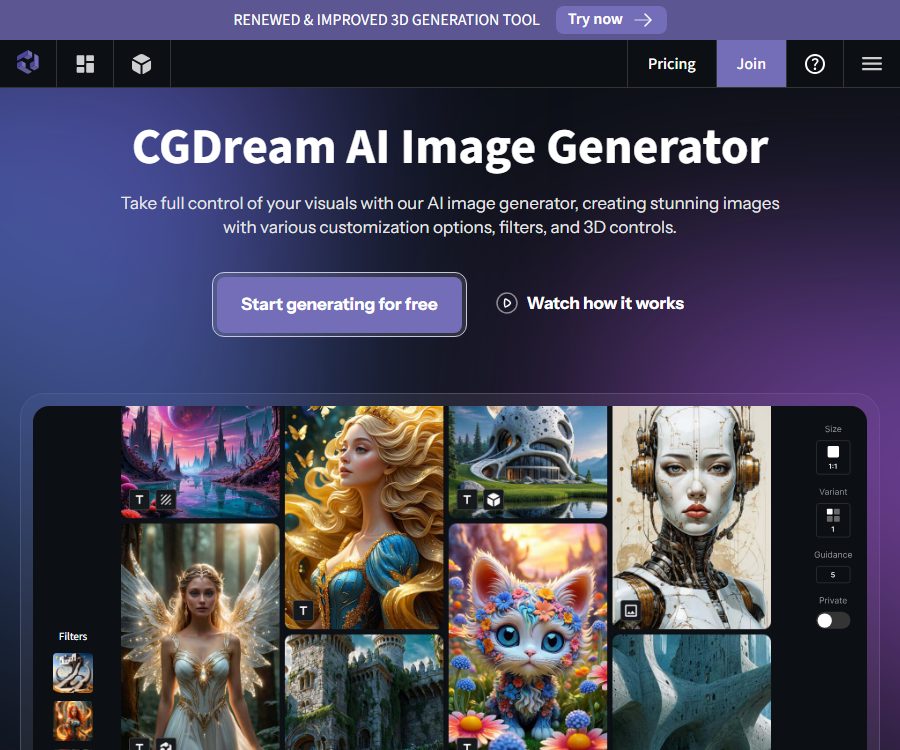
Free AI image generator to visualize your ideas
A free AI image generator to bring your ideas to life, making the creation of AI images and illustrations more efficient and simpler.
Tags:AI image illustration generationWhat is CGDream?
CGDream is an online AI-based visual creation platform operated by UAB CGTrader. Users can use text, images, 3D models, or combinations of these elements to create 2D images and 3D assets.
It places generation, reference control, local editing, zooming, and community display in the browser workspace. It is possible to experiment without installing specialized modeling software, but high-quality results still require iterative refinement of the prompts and manual inspection.
Main functions
Text-to-image and DreamUp
The user enters a description of the image and selects the base model, scale, and generation mode; the system then returns several candidate images. DreamUp allows for the modification or adjustment of the prompt words, and it can also help in exploring possible options when no clear idea is available.
Image-to-image generation
Upload photos as a reference for composition or content, and then use text to indicate the parts that need to be kept or altered. The resulting image will retain the characteristics of the original photo, but its similarity and details will be influenced by the instructions given, their intensity, and the model used.
LoRA filter
The filter library offers LoRA controls for style, environment, subject, material, and effects, and allows the adjustment of their intensity. Using multiple filters increases the amount of energy required, and they may also conflict with each other.
Visual reference control
Users can utilize style transfer, structural references, character consistency, image-to-image generation, or 3D input constraints to create designs. It is suitable for developing product concepts, architectural views, and character designs, but it is not a precise engineering renderer.
Local redrawing and image expansion
Local redrawing involves applying masks and entering modification commands to add, replace, or remove elements in a selected area. Expanding the image means extending its content beyond the canvas, which is useful for adjusting the composition and proportions.
Twofold magnification
The zoom tool allows the generated or uploaded image to be enlarged by a factor of two, thereby helping to enhance the details in it. The new textures are created through algorithmic inference; they do not represent the original camera data.
Generation of 3D from text or images
3D tools can create models from descriptions or clear photos of objects, and they offer guidance, random seed options, grid settings, number of faces, material choices, quality controls, as well as options for exporting the models. Complex objects, transparent materials, and occlusions may require further refinement in external modeling software.
Community gallery and asset management
The works can be added to a public gallery where others can view them, like them, and remix them; paid accounts offer a private mode, search functionality, as well as a more complete history of changes. It is necessary to understand the community reuse license before making the works public.
Input, output, and control methods
| Workflow | Enter | Output | Suitable for tasks | Main limitations |
|---|---|---|---|---|
| Text-to-image generation | Prompt words and filters | 2D image | Concept maps, marketing visuals | The text and details may be incorrect. |
| Image-to-image generation | Reference diagrams and modification descriptions | Variant images | Style transformation and design iteration | It is not possible to guarantee that the main structure will be completely preserved. |
| 3D guide image | 3D models, viewpoints, and prompts | 2D rendering image | Composition and perspective control | It’s not an exact CAD output. |
| Text-to-3D | Text and grid settings | 3D model | Props and prototypes | Topology often needs to be cleaned up. |
| Tusheng 3D | Photos of objects and their parameters | 3D model | Fast reconstruction of a single object | Depends on background, lighting, and occlusion. |
Complete usage process
- Register an account to check your free quota or choose a paid plan.
- Select the text-to-image, image-to-image, 3D guidance, or 3D generation option.
- Prepare the prompt words, images, or 3D models that have permission to be used.
- Specify the subject, environment, lighting, lens, material, and purpose.
- Select a base model, and add LoRA as well as references for structure, style, or characters as needed.
- Set the ratio, quality, number of variants, and other available parameters.
- Generate candidates and compare composition, hands, text, brand elements, and defects.
- Secondary processing is carried out using local redrawing, image expansion, or zooming.
- For 3D results, it is necessary to check the grid, number of faces, materials, and export compatibility.
- Before publishing, verify visibility, commercial permissions, and third-party material licenses.
Price packages
| Package or version | Price | Billing cycle | Core benefits or quota | Suitable for users |
|---|---|---|---|---|
| Free | Free | Refreshed daily | 100 points per day; basic generation; no commercial use and private mode | Learning and personal experimentation |
| Basic | 10 dollars | Monthly | 10,000 monthly points; 3 concurrent connections; private mode, commercial use, history and search functions | Individual creators |
| Pro | 30 dollars | Monthly | 40,000 monthly points; 4 concurrent tasks; higher priority and slower generation | High-frequency design work |
| Premium | 60 dollars | Monthly | 90,000 monthly points; 5 concurrent sessions; additional bonus points from community approvals and more challenge opportunities | Studios and a large number of users |
| Top Up | Click on the purchase page | One-time use | Extra points; the specific tiers and prices are shown in the account. | Temporary additional credit limit |
The price does not include any applicable value-added tax, sales tax, or other fees. The platform also offers annual payment options, but it was not possible to obtain the exact amount for an annual payment; therefore, it is not possible to calculate the cost on a monthly basis.
The points cost for a single task depends on the generation type, the number of variants, whether fast or quality mode is used, and the number of filters. The subscription points are reset upon renewal, and any unused balance is not carried over.
Differences between the free version and the paid version
- Free accounts currently earn 100 points per day; once these points are used up, the user must wait for a refresh or upgrade.
- Free output is available only for personal use; commercial projects require a paid plan.
- Free versions lack a paid private mode; input and output should be processed in a way that may result in them being made public.
- Paid accounts enjoy higher priority, more concurrent operations, as well as full historical data and asset search capabilities.
- Once the paid credits are exhausted, generation can proceed on a lower priority; the specific waiting time is not fixed.
- The dedicated page used to display various free monthly quotas; currently, the pricing page and the account balance should be taken as the reference.
Suitable for users and scenarios
- Graphic designer: Exploring posters, packaging, covers, and visual content for social media.
- Game and film production teams: Rapid creation of character, prop, and environment concepts.
- E-commerce and marketing professionals: Create product atmosphere images and ad drafts.
- Architectural and product designers: Use structures or 3D inputs to control the perspective and shape.
- 3D creators: Obtain model prototypes that can be further refined, starting from text or a single image.
- Photography and content team: Making minor adjustments, enlarging images, and scaling up existing materials.
Advantages
- Text, images, and 3D inputs can be combined within the same creation workflow.
- LoRA, structure, style, and character references offer more control than just prompt texts.
- After it is generated, it can be redrawn locally, its size can be increased, and it can be zoomed in.
- The paid plan includes private generation and commercial use as part of its benefits.
- The slow and relaxed queues allow for further attempts after the standard points are exhausted.
Restrictions and risks
- The model may generate incorrect text, abnormal limbs, repeated objects, and inconsistent details.
- 3D generation cannot replace checks for manufacturability, structural strength, or game performance.
- Using brands, celebrity portraits, and third-party models still requires obtaining the necessary permissions.
- The cost per integration is not fixed; complex configurations will deplete the quota more quickly.
- The content of public image galleries can be reused by other users for a long time.
- No public APIs, SDKs, or batch automation interfaces for developers have been confirmed.
- No official native mobile or desktop applications have been confirmed; it is primarily used through a browser.
Copyright and commercial use
The terms state that users have the right to input data and generate outputs within the limits permitted by current laws. The outputs of the free service are intended for personal use only, while the paid service allows for both personal and commercial use.
Users grant CGTrader a permanent, worldwide, royalty-free, and sublicensable license to use the content they input and generate, which includes the use of such content for training neural networks. When a work is set to public, it also grants other users the right to access it, modify it, and publish it on a long-term basis.
The paid private mode helps to prevent access to public galleries, but it does not revoke the permission granted under the platform’s terms. Confidential designs, products that have not been released by customers, or materials subject to confidentiality agreements should not be uploaded until legal approval has been obtained.
Privacy and security
CGTrader processes names, email addresses, payment information, IP addresses, devices, browsers, operating systems, usage data, as well as certain details from third-party accounts. This information may be provided to affiliated companies, partners, and service providers, and it can also be transferred across borders.
- The privacy policy only states that data is retained for as long as is necessary for the provision of services and for legitimate purposes; it does not specify a precise timeline for deleting images.
- Free content can be made public, but sensitive photos should not be uploaded.
- Remove location data, identification documents, facial images, and internal customer information before uploading.
- Use the account settings and data protection contact channels to exercise the rights of access, correction, or deletion.
- The platform implements reasonable security measures, but it does not provide absolute guarantees of safety.
Refunds and cancellations
Subscriptions can be canceled at any time and remain valid until the end of the current period. Refunds are generally not provided based on the remaining time; however, an exception to this rule may be applied within 14 days after purchase, provided that less than 100 points have been used.
Top Up top-ups are non-refundable, and taxes may be charged separately at the time of settlement. Consumers in the European Economic Area may also enjoy the rights of withdrawal and digital service protection as provided by applicable laws.
API and open-source status
| Project | Current status | Explanation |
|---|---|---|
| Web application | Already provided | The browser handles creation, editing, 3D handling, and asset management. |
| Public API | Not yet made public | The developer’s call documentation or key scheme has not been confirmed. |
| Official SDK | Not yet made public | Unconfirmed versioned development package |
| Product source code | Open source not confirmed | The use of open-source components in the services does not mean that the CGDream products are open source. |
| Native app | Not confirmed yet | The currently verifiable format is a web platform. |
Frequently Asked Questions
Can CGDream generate images for free?
Yes, free accounts currently earn 100 points per day. Advanced settings affect the cost of each task, and once the balance is exhausted, a wait is required before it can be refilled.
Can free images be used for commercial purposes?
It cannot be considered a commercial license under the current terms. Free distribution is allowed only for personal use; for commercial projects, paid packages must be used and the rights to the materials must be verified.
Can new points be generated after they have been used up?
Generation stops once the free account is used up; paid accounts can switch to a lower priority mode to continue processing. The actual queueing speed depends on the load.
Is image-to-image generation and local editing supported?
Supported. Users can upload reference images to create variants, and adjust specific areas using masks and prompts.
Can 3D models be created from images?
Yes, a clear subject, a simple background, and good lighting are beneficial. The output topology, materials, and dimensions still need to be checked.
Are the works private by default?
Free works cannot be set to private mode; private mode is a feature available with a paid subscription, and the publishing status must be verified each time the content is created or shared.
Will the input be used for model training?
The terms grant the platform rights to use a wide range of inputs and outputs, including those related to neural network training. Sensitive or confidential materials should be uploaded with caution.
Does CGDream have an API?
No public developer APIs or official SDKs were identified this time. The internal requests on the website cannot be considered as available public interfaces.
What are the conditions for a refund?
The request generally needs to be made within 14 days of purchase, and it should result in a consumption of less than 100 points; top-ups are non-refundable. The rules also depend on local consumer protection laws.
Summary
CGDream’s advantage lies in its ability to combine 2D generation, reference control, image editing, and 3D generation within the same browser platform. It is suitable for visual exploration and rapid prototyping, rather than being used as a final production system that requires no further review.
Before making a payment, it is important to compare the monthly points, concurrent usage, private mode, and commercial licensing options. Before uploading content, one should also understand the training permissions, rules regarding the reuse of public works, and the restrictions on refunds.
Tools similar to the free AI image generator for visualizing your ideas


 Guigong Network Security Registration No. 45132202000164