






Deep Dream Generator
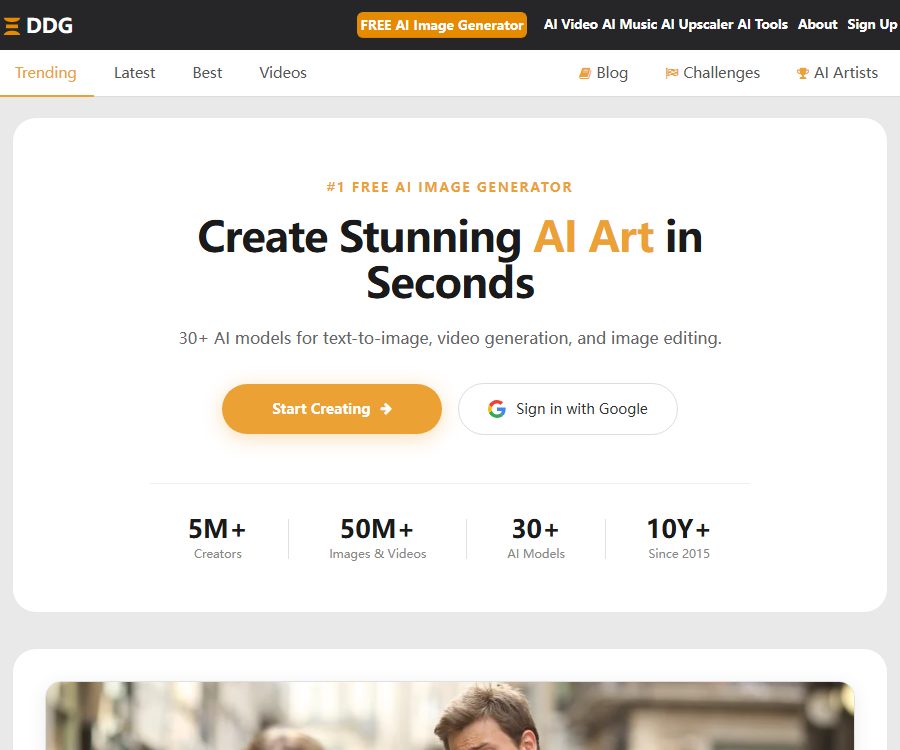
Deep Dream Generator – makes the creation of AI-generated images and illustrations more efficient and simpler.
Tags:AI image illustration generationWhat is the Deep Dream Generator?
Deep Dream Generator is a web-based AI art creation platform operated by the Bulgarian company Aifnet Ltd. It originated from the classic Deep Dream image effect in 2015, and today it has expanded to include various models for creating images, videos, music, as well as editing tools.
It combines generation, post-processing, storage of the resulting works, and community display under the same account, using Energy as the unit of measurement for most tools. Google’s DeepDream research code is not the same project as this online service.
Main functions
- Text-to-image generation: Enter details such as the scene, subject, style, composition, and lighting, select from over 30 models to create an image; each model has its own strengths in terms of text rendering, realism, speed, and image editing.
- Reference images and photo editing: Upload images for which you have usage rights, and specify in text the changes to be made to the subject, style, or specific parts of the image; tools such as restoration, background removal, and text conversion from images are also available.
- Deep Style and Deep Dream: Deep Style takes in an image of the content along with an image representing the desired style in order to apply style transfer, without relying on any textual instructions; Deep Dream enhances the patterns identified by the neural network, allowing for further enhancement of the created artwork.
- AI video: Create short videos using textual descriptions or a single image; models such as Veo, Seedance, Sora, Kling, MiniMax, Grok, or ProVideo can be used. The resolution, duration, audio quality, and energy cost vary depending on the model and setting chosen.
- AI for music and video editing: It allows creating audio by describing rhythm, mood, key, and instruments in text, and it can be integrated into the video creation process.
- Zooming in on images and videos: The Precise mode focuses on accurate zooming, the Creative mode adds details, while the Realismo mode aims for a natural-looking result; when zooming in on videos, the resolution is improved and the original audio track is preserved.
- Work Community: Users can choose to publish their works and participate in trending topics, challenges, and interactive activities; images uploaded are not made visible to other users by default, and it is up to the user to decide whether to make them public.
Input, output, and suitability for tasks
| Functions | Enter | Output | Suitable for tasks |
|---|---|---|---|
| Image generation | Text prompts, optional reference images, models and frame sizes | AI images | Illustrations, poster sketches, concept designs, and social media content |
| Deep Style | Content images and style images | Style transfer images | Artistic experiments, serial visual art, and photo recreation |
| Video generation | Text or images, descriptions of actions and shots | Short videos; some models can include audio. | Dynamic concepts, short-video shots, and social videos |
| Music generation | Descriptions of mood, type, rhythm, key, and instruments | AI audio | Music draft and sound experiments |
| Zoom in on image | JPG, PNG, or WebP images and format parameters | Enhanced high-resolution images | Preparation for printing, restoration of old images, and improvement of AI-generated image details |
Current image and video models
| Category | The representative models listed | Key selection points |
|---|---|---|
| Image model | Nano Banana 2, Ideogram v4, ImagineArt, ChatGPT 2, FluX 2, Krea 2 Turbo, SeeDream, QWEN, DaVinci2, and others | Compare separately adherence to guidelines, text in the image, realism, editing, speed, and energy costs. |
| Video model | Veo 3.1, Seedance 1.5, Sora 2, Kling 2.6, MiniMax 2.3, Grok Imagine, ProVideo | Verify separately the text or image input, duration, resolution, audio, and generation mode. |
The list of models, their names, and costs may change as integrations are updated; some features might also be in the preview stage. Before starting long-video or high-quality tasks, it is necessary to rely on the actual parameters displayed on the creation interface as well as the energy consumption figures.
Basic usage process
- Register an account and verify your email address; then check your current level, the amount of Energy that can be added, as well as your monthly and one-time Energy balances.
- Select an image, video, music file, or editing tool, and then choose a model and quality setting based on the task at hand; the number of times free models can be used differs from that of PRO models.
- Enter specific instructions, including the subject, environment, style, composition, lighting, actions, and elements to be avoided; for image generation or editing tasks, the original materials also need to be uploaded.
- After confirming the estimated energy cost near the generate button, submit the request; wait for processing in the cloud, and then check the text, characters, details, continuity of the footage, and sound.
- When necessary, prompt the user again for edits or zooming in, and then download the result; if it is to be posted on a community, check the privacy policies, content rules, and third-party rights as well.
How to calculate Energy
Energy is the unit used to measure consumption on the platform; different models, resolutions, quality settings, and additional tools require varying amounts of Energy. A standard image requires as little as 4 Energy per image, while higher-quality images typically need 15 Energy or more. Videos usually demand 60 Energy or more, though these figures can vary.
- Additional Energy can be obtained: Free users receive a certain amount of capacity based on their account level, and this capacity is restored at a rate of 1 to 4 points per hour.
- Monthly Energy subscription: After each successful payment, the amount available is reset to the full quota of the package; it is not carried over as a balance for the next period.
- One-time Energy: Comes from energy packs purchased on a per-use basis; it can be used in combination with a subscription, and the information displayed on the page does not get reset as a result of the subscription.
- Order of deduction: First, use the rechargeable Energy; then, the monthly subscription Energy; and finally, the one-time Energy.
Monthly subscription price
| Package or version | Price | Billing cycle | Core benefits or quota | Suitable for users |
|---|---|---|---|---|
| Free | 0 dollars | Long-term free quota | The benefits are determined based on the user’s level: basic storage, a limited number of PRO model uses per day, and additional Energy. | Experience features and low-frequency creation |
| Basic | 9 dollars | Monthly | 750 monthly Energy units: approximately 150 standard images or 10 low-cost videos, plus 10GB of storage space. | Personal lightweight creation |
| Advanced | 19 dollars | Monthly | Monthly Energy in 2000: around 500 standard images or 30 low-cost videos, plus 20GB of storage space. | Creators who provide consistent updates to their content |
| Professional | 39 dollars | Monthly | 5000 units of monthly energy allowance, equivalent to around 1250 standard images or 80 low-cost videos, plus 50GB of storage space. | High-frequency creators and small teams |
| Ultra | 99 dollars | Monthly | 15,000 units of monthly energy usage, equivalent to around 3,750 standard images or 250 low-cost videos, plus 200GB of storage space. | High production volume and large capacity requirements |
The numbers of images and videos shown in the table are estimates based on standard image sizes and video settings that require the least amount of energy; not all models can achieve these values. The paid plans offer a PRO version with no limit on the number of uses per day, video generation capabilities, full zoom functionality, more opportunities to post content that is part of the trending items, as well as commercial usage rights.
One-time Energy pack
| Energy pack | Price | Billing cycle | Core benefits or quota | Suitable for users |
|---|---|---|---|---|
| 120 Energy | 3.99 dollars | One-time use | About 30 standard images or 2 low-cost videos | Small-scale trial |
| 300 Energy | 9 dollars | One-time use | About 75 standard images or 5 low-cost videos | Create occasionally |
| 1000 Energy | 19 dollars | One-time use | Approximately 250 standard images or 17 low-cost videos | Phased projects |
| 2200 Energy | 39 dollars | One-time use | Approximately 550 standard images or 37 low-cost videos | Medium-sized projects |
| 5,000 to 50,000 Energy | 79 to 599 dollars | One-time use | The larger the quantity, the lower the unit cost; no monthly commitment required. | Users with high usage who do not want to subscribe |
One-time packages are suitable for occasional needs or to top up subscription credits, but the cost is still calculated based on the real-time energy usage. Different official pages may show variations in costs due to differences in update frequencies; it is therefore necessary to check the account creation page and the actual billing page before making a payment.
Cancellation, upgrade, and refund
- Subscriptions can be canceled on the Stripe management page, which is accessible from the account settlement area; once canceled, the benefits and any remaining Energy remain valid until the end of the current billing cycle.
- Upgrades are billed proportionally, and the difference in monthly Energy costs between the old and new plans is settled immediately; downgrades take effect in the next billing cycle.
- Except as required by applicable consumer protection laws, paid subscription fees, one-time Energy packs, and upgrade fees are non-refundable. Special cases may be submitted for individual consideration, but this does not guarantee a refund.
Image zooming interface
The platform provides examples of interfaces for enlarging images; authentication is carried out using the Bearer Token generated by the account, and parameters such as the image, zoom level, creative settings, similarity score, HDR settings, intensity, mode, engine, and callback information are sent in JSON format.
- Log in to your account and create an API token, making sure not to expose that token on public front-ends or in shared files.
- Prepare accessible images or upload content, and set the zoom level as well as the parameters related to Precise, Creative, or Realismo.
- A request is sent from the server; the results of the task are received, or asynchronous completion notifications are handled through callback functions.
- Record failures, retries, and energy consumption; after downloading the results, check whether the new textures, faces, and text deviate from the original image.
At present, there is no unified public development platform that covers all image, video, and music-related tools, nor have any official SDKs or complete lists of pricing for the interfaces been found. The capabilities of these interfaces and their associated costs are determined by the token information displayed after logging in, as well as the actual charge records.
Platform and open-source status
| Channels | Current status | Precautions |
|---|---|---|
| Web page | Full product entry point | Functions such as creation, editing, storage, community interaction, and settlement are all available within the browser. |
| Mobile version | The official native app has not been confirmed. | The developer of the app with the same name is not Aifnet Ltd.; do not use mixed accounts or subscriptions. |
| Browser extensions | No official expansion confirmed. | The extensions with the same name available in stores are released by third parties. |
| GitHub | The official product warehouse has not been confirmed. | Google DeepDream and other codes with the same name do not indicate that this platform is open source. |
The online service, hosted models, and frontend of Deep Dream Generator have not been released as a complete open-source product, and no open-source license applicable to the platform itself is currently available.
Privacy, security, and content visibility
- The platform handles email and account settings, prompts, as well as images, videos, and music that are uploaded or generated, in addition to web addresses, devices, browsers, Cookies, and activity logs.
- Bill processing includes the subscription status, invoices, transaction identifiers, tax information or the country related to the bill, as well as the card brand and its last four digits; the full card number is handled by the payment processor.
- Information may be provided to payment, infrastructure, hosting, storage, analysis, content moderation, email, and support service providers, and it may also be disclosed due to legal or security requirements.
- By default, uploaded images are not shown to other users; once a user decides to publish them in the community, they become public content. Public works can attract comments, shares, and external dissemination.
- Users can request the deletion of their accounts and data, but the current privacy policy does not specify a uniform retention period applicable to all types of data.
Copyright, Commercial Use, and Content Restrictions
- Within the limits permitted by applicable laws and third-party rights, the platform does not claim ownership over the content that is created or edited; users may use, modify, distribute, and sell content for which they hold rights.
- The pricing rules link the commercial rights to create images and videos to a paid monthly subscription or a one-time Energy package; when using the free versions for commercial projects, it is necessary to check the current authorization settings on the account page first.
- The platform receives a non-exclusive, global, royalty-free limited license to store, process, display, improve, promote, and maintain the services, but this license does not transfer ownership of the content.
- Users must ensure that the input materials and the output do not violate any copyrights, trademarks, rights related to portraits, privacy, or other rights. Moreover, the AI-generated output is not guaranteed to be accurate, complete, copyrightable, or suitable for a particular purpose.
- Users must be at least 16 years old. The platform strictly prohibits pornographic and explicit content, as well as content that is violent, bloody, hateful, infringes on rights, is illegal, or involves certain political propaganda.
Suitable for users and their capacity limits
- Digital artists and designers: Compare various image models, and integrate generation, style transfer, local editing, and scaling into a single workflow.
- Video and social media content creators: Use images or text to quickly verify the footage, then select from various video models based on duration, audio quality, and cost.
- Low-frequency users: They can rely on free Energy restoration or a one-time energy pack, without the need for a long-term subscription.
- Developer: Image zooming is available, but the existing public information is not sufficient if a full multimodal interface, an official SDK, service level commitments, or enterprise-level permissions are required.
- Teams that need to maintain a fixed monthly production volume: The energy costs vary depending on the model and quality; the estimated number of images or videos cannot be considered reliable, so it is necessary to use a small sample size for estimation first.
Frequently Asked Questions
Can the Deep Dream Generator be used for free?
Yes, free accounts come with a certain amount of recoverable Energy and a limited number of PRO model uses, depending on the user level. Higher-tier models, videos, more storage space, and full zooming capabilities are available only as part of paid plans.
Is the subscription to Energy carried over?
The monthly Energy subscription is reset to the amount specified in the plan each time it is renewed successfully; it is not carried over to the next period. Energy that can be replenished and Energy purchased once are managed separately from the monthly quota.
How much Energy is consumed to generate one image?
It’s not fixed – the model, quality, size, and any additional processing steps all affect the cost. Standard images can have an energy consumption as low as 4 Energy, but advanced models and high-quality options result in significantly higher energy usage.
Can the generated content be used for commercial purposes?
The content generated through a paid monthly subscription or a one-time Energy package can be used for commercial purposes, as long as the terms and the rights of third parties are respected. The current conditions for using free content must be checked on the account page before its use.
Is there an official mobile app for the Deep Dream Generator?
At present, there is no official native application released by Aifnet Ltd.; the app available in the store with the same name was developed by other developers. The web version represents the verified and complete way to use the service.
Is the Deep Dream Generator open source?
It is not a fully established open-source product; no official product repository or open-source license suitable for online platforms has been found. The public example code for Google DeepDream is a separate project.
Summary
The main advantage of the Deep Dream Generator is that it brings together multiple models for handling images, videos, music, as well as functions for editing, scaling, and community interaction within a single web-based workflow. It also allows for flexible combination of free options, subscription services, and pay-per-use models through Energy. When using it, it is important to pay attention to the costs associated with the models, the reset of monthly quotas, the terms for commercial use, the visibility within the community, and the rights related to third parties.
Tools similar to the Deep Dream Generator



 Guigong Network Security Registration No. 45132202000164