






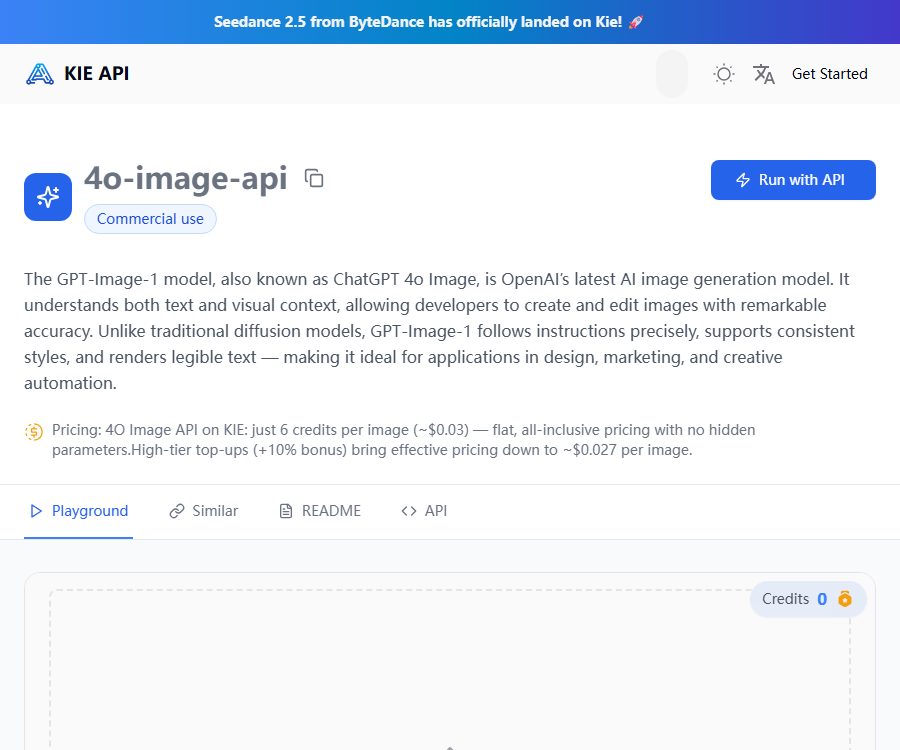
Affordable GPT-Image-1 API
The affordable GPT-Image-1 API makes the creation of AI-generated images and illustrations more efficient and simpler.
Tags:AI image illustration generationWhat is the Kie.ai GPT-Image-1 API?
This is the GPT-Image-1 image generation and editing interface provided by Kie.ai; its product page refers to it as the 4o Image API. Developers can integrate image-related functions into design, marketing, e-commerce, and content creation tools through HTTP requests.
This interface uses an asynchronous task approach: after a request is submitted, a task ID is returned first, and the results are obtained through status queries or callbacks. It is a dedicated interface page within Kie.ai’s multi-model API platform, and it is not a standalone desktop application.
Main functions
1. Text-to-image generation
Developers can enter natural language prompts to generate images, specifying the subject, composition, lighting, colors, and visual style. The official documentation supports three aspect ratios: 1:1, 3:2, and 2:3.
2. Image-to-image generation
The interface can accept reference images, and then modify the content or generate variations based on the given prompts. This document lists up to five input images; the actual file format and size constraints should be checked again before making the call.
3. Mask editing
By using the original image and a mask, it is possible to specify the areas that need to be modified; this approach is suitable for replacing backgrounds, redrawing specific parts, or correcting objects. The size of the mask must match that of the original image, and the meaning of the black and white areas should be determined according to the settings of the current document.
4. Multiple version outputs
One request can specify 1, 2, or 4 versions, which facilitates comparing different compositions and details. The number of versions affects the cost of the service and the time required to process the results.
5. Prompt enhancement
Optional parameters enable the platform to enhance the prompts, helping to add visual descriptions. For brand materials and precise layouts, developers should still retain the original prompts and testing records.
6. Asynchronous status query
Upon successful generation of the request, the task number is returned; the status field indicates whether the processing is in progress, successful, or failed. The application should display the progress and handle timeout situations, failure messages, and empty results.
7. Webhook callback
Developers can provide a callback address to receive notifications once a task is completed. Compared to frequent polling, callbacks are more suitable for batch tasks and production environments; however, it is necessary to verify the origin of the requests and prevent duplicate processing.
8. Backup model mechanism
The document provides optional fallback parameters that allow the use of alternative models when the main service is unavailable. Alternative models may differ in terms of style, capabilities, and pricing, so they should be tested separately before being put into use.
Which users are it suitable for
- Developers who need to add AI image generation capabilities to websites or applications.
- A content platform for creating bulk product images, posters, and images for social media.
- A design tool that enables local editing through the use of references and masks is desired.
- Teams that need asynchronous tasks, callbacks, and automated batch generation processes.
- Small teams that want to test image product prototypes on a pay-per-use basis with low barriers to entry.
Comparison of prices and output versions
As of August 24, 2026, the official GPT-Image-1 product page indicates that pricing is based on the number of API calls, with no subscription plans available. The page also states that platform credits can be purchased starting from $5, and that the pricing tiers and discounts may change.
| Number of outputs per session | Reference price on the product page | Suitable scenarios |
|---|---|---|
| 1 piece | $ | Single-image generation, quick preview |
| 2 pieces | $ | Compare the two candidate versions |
| 4 pieces | $ | Batch creativity and multiple option screening |
The current dynamic price catalog of Kie.ai does not contain any entry for GPT-Image-1, yet the dedicated product page still shows the aforementioned prices and the API documentation is available online. Before making actual calls, it is necessary to check in the account console the availability of the model, the actual points deducted, the rules regarding refunds in case of failures, and the exchange rates for top-ups.
Key points of cost accounting
- Charging is based on successful tasks or tasks submitted.
- Are credits automatically refunded in the case of failure, content review rejection, or timeout?
- Will a different price be applied once the backup model is activated?
- Whether additional fees are charged for using more reference images, prompt enhancements, and mask editing.
- Validity period of the top-up amount, refund conditions, and discounts for large purchases.
- Are there additional charges for image storage, downloading, and external traffic?
API Integration Tutorial
- Register for a Kie.ai account, create an API key in the console, and purchase a small amount of testing credits.
- Store the key in server-side environment variables; do not include it in browser code or in public repositories.
- Send a request for generation according to the document, providing prompts, ratios, and the desired number of outputs.
- When editing is required, provide an input image that is publicly accessible; make local modifications and then supply a mask with the appropriate dimensions.
- Save the returned task number, and choose either status polling or Webhook callback.
- Handle the three states of in-processing, successful, and failed separately; unknown states are not considered successful.
- After the task is completed, download the results and save the images that need to be retained for a long time in your own storage.
- Log tasks, models, parameters, costs, and errors, and establish throttling and retry strategies.
- Test quality and cost using real business samples, then gradually increase concurrency.
Webhook security configuration
- The callback address must use an encrypted connection and only accept the necessary request methods.
- Verify the signature or origin using the verification mechanism provided by the authorities.
- Use task numbers for deduplication to prevent multiple business processes from being triggered as a result of repeated callbacks.
- First, send a quick success response, and then place the downloading and post-processing tasks in the task queue.
- Do not record API keys or sensitive image URLs in the callback logs.
- Compensatory polling is established in case of callback failure, to prevent permanent loss of results.
Rules for image storage and download
According to the documentation for this document, the images generated are retained by the platform for 14 days, and the temporary download links are valid for 20 minutes. The product cannot use the addresses provided by the platform as a permanent source of assets.
- Download the images that need to be kept as soon as the task is completed successfully.
- Save the official materials in your own object storage and set access permissions.
- Records the source tasks and parameters to facilitate auditing and re-generation.
- Regularly clean up unnecessary input images, temporary files, and publicly accessible links.
- Do not rely on expired result addresses as long-term image addresses for web pages.
Product advantages
- Text-to-image generation, reference image editing, and mask editing use the same task workflow.
- It supports the creation of multiple versions at once, and the publicly available per-use pricing makes it easy to estimate costs initially.
- It provides status queries and Webhooks to facilitate integration with asynchronous applications.
- It supports three common ratios and up to five reference images.
- The document contains examples in JavaScript, Python, and the command line.
- An optional rollback mechanism helps reduce the impact of failures in a single model.
Usage restrictions and precautions
- This page corresponds to the older GPT-Image-1 interface; new projects should make use of the image models that are currently available on the platform.
- There is a difference between the dynamic total price catalog and the information displayed on the dedicated product page; the actual charge applied through the console shall prevail.
- The asynchronous generation time is not fixed, and applications need to handle queuing, timeouts, and failures.
- The input image must be accessible to the platform; public URLs can pose risks related to privacy and unauthorized use of the link.
- Errors may still occur regarding the consistency of text and characters, as well as the complexity of the layout in the image.
- After reverting to another model, the image quality and style may change.
- The content generated must comply with the model service guidelines, platform policies, and local laws.
Copyright and commercial use
The product page states that the content can be used in commercial scenarios, but this does not mean that all generated content is free from rights-related risks. Users still need to verify the licensing of the input materials, as well as any issues related to portraits, trademarks, character designs, and training data.
- Do not upload customer images, copyrighted works, or confidential design drafts for which you do not have permission to use.
- Obtain the necessary consent when dealing with real-person portraits, and avoid misleading content.
- Brand projects should retain prompt words, input materials, and records of manual review.
- Creating text, logos, and product details requires manual proofreading.
- Different countries and platforms may have varying requirements for labeling AI-generated content.
API and open-source status
This product is itself a developer API that uses Bearer tokens for authentication, and it offers functions for generating tasks, querying them, downloading results, and handling callbacks. The official documentation provides examples of direct HTTP calls, and there is no requirement to install the official SDK.
As of the verification date, no official open-source repositories or licenses for the Kie.ai platform or the GPT-Image-1 interface were found. Third-party community versions, MCP servers, or example projects do not indicate that the Kie.ai services are open source.
Frequently Asked Questions
Does it support image editing?
It supports image generation from images and mask editing, as well as creating multiple variants based on the input image.
Several images can be generated at once.
The current interface documentation supports 1, 2, or 4 versions, and the product page displays different per-use prices for each version.
How to obtain the generated results
After submission, save the task number; you can poll using the status interface or set up a Webhook to receive completion notifications.
Will the images be saved permanently?
No. The documentation states that the results are retained for 14 days, and temporary download links are valid for 20 minutes; therefore, they should be saved promptly.
Is this an open-source API?
No. The fact that an interface can be accessed publicly does not mean that the source code of the platform is available; it has not yet been confirmed whether the main service uses an open-source license.
Summary
The Kie.ai GPT-Image-1 API is suitable for developers who need to quickly incorporate image generation capabilities, perform image editing, and obtain multiple versions of output. As it is an older specialized interface and the pricing details can vary, it is advisable to use a small amount of credits in a real project first in order to test its usability, quality, the process of refunds in case of failures, and the actual charging mechanism.
Tools similar to the Affordable GPT-Image-1 API


 Guigong Network Security Registration No. 45132202000164