






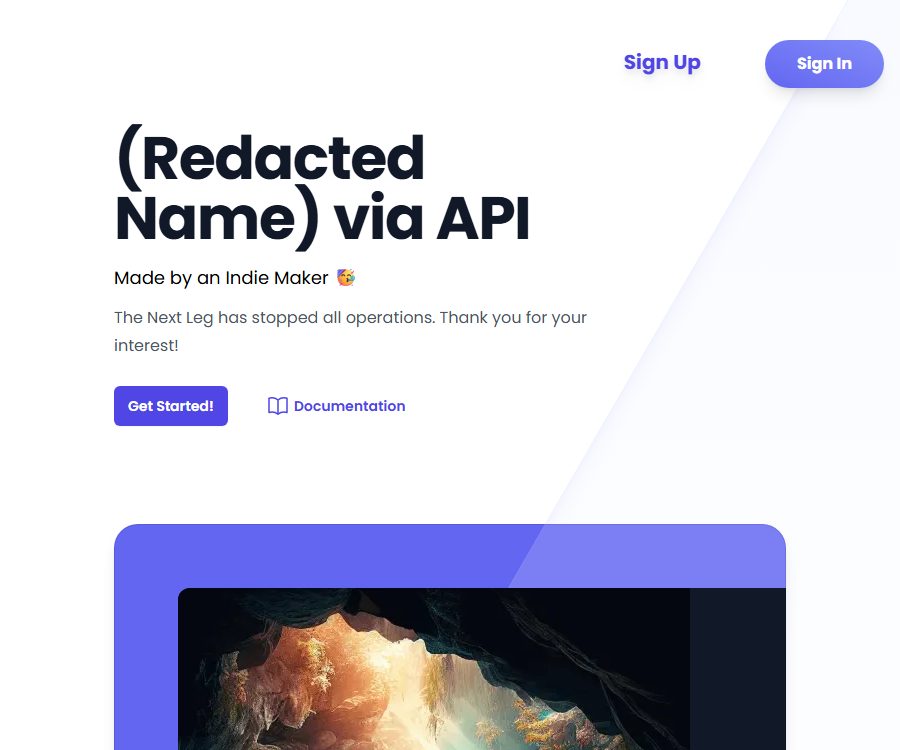
(Redacted Name) API by The Next Leg
(The redacted name) API from The Next Leg – makes the creation of AI-generated images and illustrations more efficient and simpler.
Tags:AI image illustration generationCurrent status of The Next Leg API
The Next Leg’s official website has announced that all operations will be ceased; it is no longer an online API service available for new projects. The website still contains product pages and older version of the development documentation, but these pages are intended only as historical references.
Developers should stop making additional payments or subscriptions, and should not use legacy endpoints in production environments; nor should they assume that a document being accessible means the service is still functional. Existing projects need to have their keys removed as soon as possible, their interfaces replaced, and any failed requests cleared from the queue.
A one-sentence summary
The Next Leg was once an unofficial interface service for Midjourney, allowing users to submit image creation requests, check progress, and receive Webhooks; it is no longer in operation.
What was The Next Leg once?
The Next Leg is operated by independent developers; it wraps Midjourney’s image generation and account features into program interfaces through third-party methods. It is not an interface released or maintained by Midjourney itself.
The official website later displayed the name of the target product as “Redacted Name”, but the old SDKs and project documentation clearly indicated that it was intended for use with Midjourney. The descriptions in the catalog should remain unofficial, so as to prevent users from assuming that there is some kind of licensing relationship between the two companies.
Core historical functions
Imagine: Text-to-image generation
Developers can submit text prompts to create images; the interface returns a task ID. Once the task is completed asynchronously, the results can be retrieved via status checks or Webhooks.
Image-to-image generation
The old SDK allowed submitting both prompts and URLs of reference images to create image-based generation tasks. The caller is responsible for ensuring the copyright, privacy, and accessibility of the input images.
Describe image description
The Describe function can analyze an image and generate a possible textual description to help determine the direction for further suggestions. This description is not necessarily accurate, nor can it confirm the ownership of the image or its true meaning.
Zoom, variants, and button operations
The service includes functions such as zooming, changing variants, and other button actions; developers can proceed with their operations using the button identifier returned from the previous task. The older documentation also supported features like Zoom, Pan, and Niji.
Account and mode control
The management solution can connect to the underlying account and retrieve information such as the remaining time for fast mode use, the task mode, and the queue status. Certain commands allow switching between modes such as Fast, Relax, Private, or Stealth; the actual privileges available depend on the underlying subscription.
Webhook and polling
For each task, it is possible to specify a callback address; alternatively, progress can be monitored by using message numbers. The callback system is responsible for verifying the identity of the requests, handling duplicate notifications, and setting timeout values as well as retry parameters.
Multiple accounts and queues
The platform used to offer multi-account management, allowing the use of 3 or 12 image task queues depending on the underlying subscription. The size of these queues does not mean that tasks are immune to constraints imposed by upstream processes or account-related risks.
Image proxies and image libraries
The service used to offer image proxies and a gallery viewer, which made it easy to transfer the generated results to application servers. After it stopped operating, it is no longer possible to rely on the old proxy addresses to store images over the long term.
Historical Function Status Table
| Functions | Historical use | Current status | Migration suggestions |
|---|---|---|---|
| Imagine | Text to image generation | It cannot be used as an online service. | Replace the image interface with official documentation. |
| Image-to-image generation | Generate with reference to the diagram | No longer in operation | Rebuilding uploads and copyright checking |
| Describe | Convert image to description | No longer in operation | Choose an interface that supports visual understanding. |
| Button operations | Zoom, variants, and expansions | No longer in operation | Redesign the structure of tasks that are not related to suppliers |
| Webhook | Asynchronous receipt of results | Old callbacks cannot be relied on. | Revoke the old public network callback and replace the signature. |
| Image proxy | Forward to generate an image | Access cannot be guaranteed. | Restore to the own object storage |
| Account management | Connect to the underlying account | Authorization should not be continued. | Revoke the relevant tokens and sessions |
Historical API workflow
- Users create a The Next Leg account and obtain an API token.
- Choose to manage your own account or purchase points on a per-use basis.
- Submit prompts, reference numbers, and optional callbacks through endpoints such as Imagine.
- The service returns a message ID, and the task is placed in an asynchronous queue.
- Use polling to check message progress, or wait for a Webhook notification.
- After receiving the image address, perform scaling, variation, or seed lookup.
- Transfer the finished product to one’s own persistent storage.
This set of procedures can only assist in understanding legacy code; it cannot serve as a tutorial for integrating it into the current system. Old tokens, host addresses, and message numbers should not be entered into the new system.
Historical prices
The following are the historical prices that were made public prior to the service’s discontinuation; they do not represent the pricing options available in 2026. When the page was checked on August 24, 2026, it still displayed the old amounts, while it was also clearly stated that the service would be discontinued.
| Historical plans | Historical prices | Included content | Current availability |
|---|---|---|---|
| Account management subscription | $ | Account management, comprehensive interfaces, and unlimited interface requests | Sales and operations have been discontinued. |
| Subscription to the underlying image service | Paid separately | Decide to generate entitlements and queues. | It is not included in the cost of The Next Leg. |
| Per-use integration | $ | Fast earns 4 points per time, while Relax earns 2 points per time. | Old document prices – not worth purchasing. |
The “unlimited requests” option in historical subscriptions does not mean unlimited image generation, as the actual tasks are still subject to the constraints imposed by the underlying account, queues, and upstream rules. If any third party claims to be able to sell these old packages after they are no longer available, it is necessary to verify their identity and determine who is responsible for providing refunds.
Old SDK and code repository
The Next Leg has released a Node.js module that can handle operations such as Imagine, image generation from text, Describe, buttons, seeds, slash commands, as well as settings and account information. This module is licensed under the BSD-3-Clause license, and its source code is still available for viewing.
The open-source nature of the warehouse only means that the SDK code can be used in accordance with the relevant license; it does not imply that the backend services, account access mechanisms, or image processing capabilities remain available. The SDK relies on servers that are no longer in operation, and installing it directly usually does not allow the services to be restored.
Why shouldn’t we continue to connect?
- The official website clearly announced the cessation of all operations, with no commitments regarding production or services.
- Legacy documents, old endpoints, and login pages may be completely taken offline at any time.
- It is originally a third-party, unofficial integration, and there is a risk of changes in the underlying rules.
- Callback functions, image proxies, and task queues do not offer reliable operation guarantees.
- Old tokens and account authorizations can pose security risks.
- There are no confirmed new purchases, refunds, or technical support channels available.
Tutorials for migrating existing projects
- Stop submitting tasks to the old interface, and disable automatic retries as well as the scheduled queue.
- Statistics on old tokens in code, environment variables, databases, and automation platforms.
- Revoke associated accounts, login sessions, Webhooks, and any permissions that are no longer needed.
- Download previously accessible historical images, tips, task numbers, and business records.
- Choose new interfaces that have the current service status, official documentation, and clear terms.
- A supplier adaptation layer is established within the application to prevent the re-binding of specific private fields.
- Use a small number of tasks to verify quality, latency, costs, copyright, and retry on failure.
- Delete the old keys and callback codes, and monitor to see if there are still any abnormal requests.
Interface design during migration
- Use internal task numbers, and do not use the supplier message number as the primary key.
- Define uniformly the states of queued, processing, successful, failed, and canceled.
- Save the hints, models, parameters, and output metadata separately.
- Sign verification, idempotent processing, and timeout retries are applied to Webhooks.
- The generated image is copied to one’s own storage immediately, along with the authorization details being recorded.
- Set daily budgets, concurrency limits, and supplier failover strategies.
How to choose alternative services
It is preferable to choose image interfaces that are officially provided by the model or platform provider, and that come with regularly updated documentation and status pages. It is also necessary to clarify the rights regarding input and output, usage for training purposes, content moderation, retention period, regional handling, and commercial use.
| Check items | Items that need to be confirmed |
|---|---|
| Operation status | It is currently possible to register, top up, and there is information available regarding its service status. |
| Official nature | The model is provided directly by the manufacturer or through a clear authorization arrangement. |
| Price | Based on the diagram, computing power, or the total cost of the subscription |
| Asynchronous tasks | Polling, Webhook, signing, and retry mechanisms |
| Save image | Duration of temporary addresses and self-owned storage methods |
| Content rights | Input authorization, output for commercial use, and training rules |
| Stability | Throttling, concurrency, timeouts, refunds, and service guarantees |
Privacy and security cleanup
Legacy systems may still contain interface tokens, underlying account information, callback addresses, notification messages, and generated images. Even when the service is no longer in use, it is necessary to regularly change relevant passwords and tokens, and to remove keys from code repositories and logs.
If a public webhook is no longer in use, the corresponding route should be disabled or the key should be changed, in order to prevent fake callbacks from triggering subsequent operations. If historical images need to be retained, they should be stored in a controlled environment with appropriate access controls in place.
Copyright and brand risks
The Next Leg is not an official interface of the target image platform; using it does not automatically grant any additional permissions regarding brands, models, or the output content. For commercial use of existing projects, it is necessary to review the applicable terms of service for those services again.
After the migration, it is also necessary to verify whether the new supplier permits the use of portraits, trademarks, protected characters, and reference images. Generative tools cannot eliminate the copyright risks associated with the similarity between the training data and the outputs produced.
Interface and open-source status
The backend services of The Next Leg have stopped operating, and there are no commercial APIs available at the moment. The public Node.js SDK and example projects are still available on code hosting platforms, but they are primarily used for reading and migrating legacy code.
The SDK is licensed under the BSD-3-Clause license, but this does not mean that the entire The Next Leg platform is open source. The authentication methods, endpoints, and fields mentioned in the older documentation also do not come with any guarantees regarding compatibility or usability.
Basic information
| Project | Content |
|---|---|
| Product name | The Next Leg API |
| Historical positioning | Unofficial Midjourney image generation interface |
| Current status | All operations have been halted. |
| Historical prices | $ |
| Is it possible to register for purchase? | It should not be purchased any further. |
| Whether to provide the current API | No |
| Is it open source? | The SDK is open-source, but the backend platform is not necessarily open-source. |
| SDK license | BSD-3-Clause |
Recommendation score
The current recommendation score is 1.0; it is only suitable for maintaining or migrating existing projects. New projects should not make use of services that are no longer in operation – instead, image interfaces that are officially operational and come with clear authorization should be used.
Frequently Asked Questions
Can The Next Leg still be used?
It cannot be used as a reliable online service; the official website has explicitly announced the cessation of all operations. The availability of old documents does not mean that the interfaces are functional.
How much does a historical subscription cost?
Account management used to cost 40 dollars per month, with an additional fee for the underlying image service subscription. The pay-per-use option allowed one to purchase 1,500 points for 20 dollars.
Is it Midjourney’s official API?
No, it was explicitly designed to provide programmed capabilities as a tool for community and third-party extensions. Do not consider the old SDK as an official authorization proof.
Can the code repository still be used?
The SDK code can be read or reused under the BSD-3-Clause license, but the backend service provided by The Next Leg, on which it relies, is no longer in operation; therefore, it is necessary to find an alternative service to replace it.
What to do with old pictures?
Download the still accessible historical results as soon as possible and save them in your own storage, while also retaining the necessary notes, tasks, and authorization records.
How to migrate?
First, stop the tasks, revoke tokens and callbacks, and then select the interfaces that are currently in use and for which clear authorization exists. An adapter layer for suppliers should be added within the application to avoid further strong dependencies.
Summary
The Next Leg once reduced the barriers to accessing unofficial image generation interfaces, but it is no longer in operation. The reason for keeping this entry in the catalog is to remind users to stop making purchases, as well as to provide guidance on how to carry out a safe migration and cleanup of older projects.
Tools similar to the (Redacted Name) API by The Next Leg


 Guigong Network Security Registration No. 45132202000164