






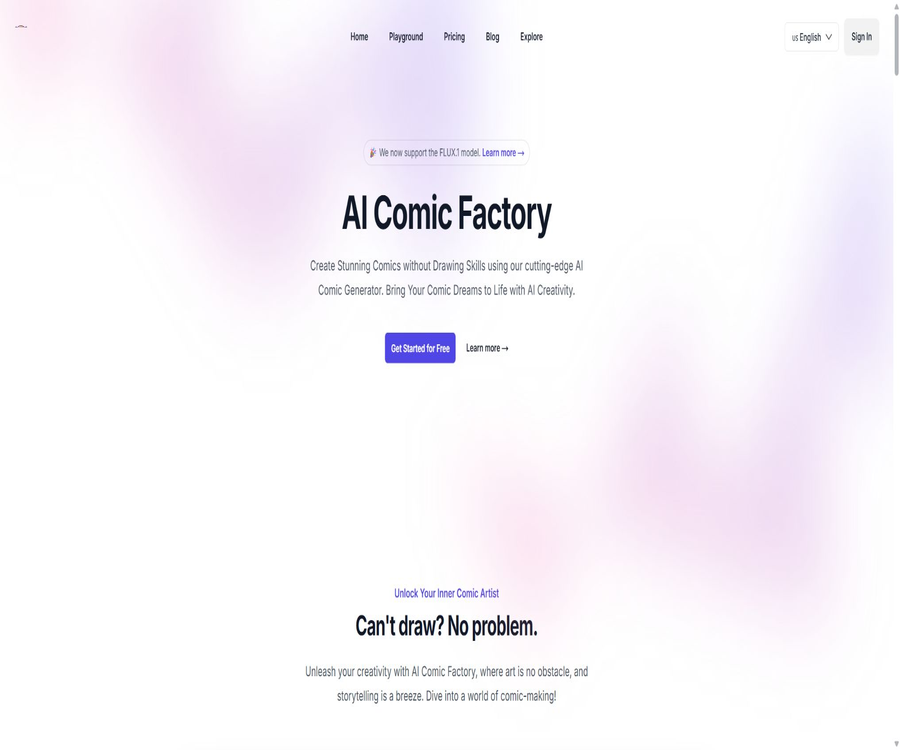
AI Comic Factory
AI Comic Factory: a smart tool focused on AI-generated images
Tags:AI image illustration generationWhat is AI Comic Factory?
AI Comic Factory is an online tool that converts text-based stories into comic pages. Users do not need any drawing skills; they only need to describe the characters, scenes, and plot, and the system will generate comic images with a storyboard layout.
It is suitable for creating creative sketches, visualizing stories, and developing storyboard prototypes; it is not equivalent to a full-fledged software for professional comic creation. For longer works, manual effort is still required to manage the pacing of the script, character design, dialogue in speech bubbles, and the sequence of images.
Relationship between operating companies and versions
The privacy policy and terms of service of this commercial website indicate that its operator is CLOUDBRIDGE INNOVATIONS LTD based in the UK. The website offers features such as Google login, point-based subscription plans, the FLUX.1 model, and paid role consistency options.
On GitHub, there is also an open-source project with the same name, originally created by Julien Bilcke; it is licensed under Apache 2.0 and its repository has been archived. Commercial websites cannot be considered to be identical to the original open-source version in terms of domain names, functions, operation, and paid services.
Main functions
- Automatically generate comic pages with storyboard panels based on the text instructions.
- Choose visual styles such as American, Japanese, Japanese painting, and European comics.
- Switch between various storyboard layouts and single-page, two-page modes.
- Generate or edit subtitles and narration text for each frame of the video.
- Regenerate by modifying the prompt for a single cell.
- Redraw the images that are not satisfactory.
- Upload reference images of characters to control their appearance.
- Try to maintain consistency in the characters across consecutive frames.
- Customize the subtitle language and continue editing the text.
- Paid plans offer faster generation and more stable narrative output.
- Premium and Advanced support the FLUX.1 image model.
Supported comic styles
The styles available on the official website include modern American comics, 1950s American comics, Japanese comics, traditional Japanese paintings, Fabi comics, 3D rendering, and more. The actual options may change as new models and versions are released.
| Style type | Visual preferences | Suitable scenarios |
|---|---|---|
| American Modern | Modern American comics and highly contrasted visuals | Actions, science fiction, and superhero archetypes |
| American 1950 | Retro printing with a classic comic book aesthetic | Nostalgia, satire, and retro stories |
| Japanese | Japanese manga characters and storyboard language | Campus, adventure, emotions, and visualizations in light novels |
| Nihonga | Materials in Japanese painting and traditional artistic tendencies | History, myths, and poetic scenes |
| Franco-Belgian | European comic-style lines and colors | Adventures, travels, and humorous stories |
| 3D Render | The feel of 3D animation and rendering | Children’s stories, conceptual design, and game prototypes |
Tutorial on creating comics from text
- Log in to the website and go to the comic creation workspace.
- First, describe the protagonist, the goal, the conflict, and the outcome in one sentence.
- Break the story into consecutive events that fit on one or two pages.
- Select the comic style, page layout, and storyboard arrangement.
- Enter the requirements regarding the character’s appearance, actions, setting, and camera angles.
- After generation, check each element – the characters, the plot, and the reading order – one by one.
- Edit the prompt for the problem grid and redraw it separately.
- Modify the subtitles to ensure the text is accurate and that the bubbles do not cover the main content.
- Standardize the character design, colors, and page size before downloading.
Story prompt structure
- Characters: name, age, clothing, hairstyle, and distinguishing features.
- Location: Indoor and outdoor environments, era, weather, and time.
- Goal: What the character wants to accomplish on this page.
- Conflict: obstacles, accidents, misunderstandings, or opponents.
- Action: The specific behavior that is visualized in each frame.
- Lenses: close-up, medium shot, wide shot, top-down view or low angle.
- Emotions: facial expressions, body language, and the atmosphere of the scene.
- Write the dialogue, narration, and onomatopoeia separately.
Storyboard layout and page mode
AI Comic Factory breaks the story down into multiple panels and offers various layouts. A single page is suitable for short jokes, poster-style comics, and narratives that cover a single scene, while two pages are better suited for longer sequences with more complex actions and plot developments.
- First, determine whether the reader reads from left to right or from right to left.
- Important turning points are presented with larger frames and a clearer visual focus.
- In continuous actions, the direction of the character should not change suddenly from one frame to the next.
- When there is a lot of dialogue, reduce the number of visual elements and leave space for the bubbles.
- In a two-page layout, it is necessary to avoid important text and facial features located in the central seam area.
- After exporting, check the readability of the text in the mobile thumbnails.
Character consistency
The character consistency feature is used to prevent changes in a character’s hairstyle, clothing, age, and face shape from frame to frame. Users can also upload their own reference images of the character, so that the system can better reflect the desired appearance.
Methods to maintain consistency in characters
- Create a fixed, brief profile for each main character.
- Prepare legitimate reference images of the front view, side view, and various expressions.
- Repeat the character’s core visual features in each key frame.
- Do not switch between models and visual styles frequently on the same page.
- When a deviation is detected, only the relevant grid of the diagram is redrawn, to prevent random changes across the entire page.
- The final version is refined using image editing software to standardize colors and details.
Upload role reference image
Uploading reference images allows users to incorporate their own characters or scenarios into the story. When using real photos, customer characters, or third-party IPs, the uploader must possess the necessary rights and permissions to do so.
- Use character images that are clear, unobstructed, and have even lighting.
- Remove location, device, and personal metadata from images.
- For photos of minors, the consent of both the guardian and the person being photographed is required.
- Do not upload unpublished projects, documents, or private photos.
- Rights for third-party anime characters, celebrities, and brand images need to be checked.
Editing of subtitles, dialogue, and prompts
The platform allows users to customize subtitle languages, edit text, and modify the prompts for individual cells. AI image models tend to produce garbled text; therefore, it is advisable to use editable text for official dialogue rather than relying on directly drawing text on the screen.
- Keep the dialogue brief; one bubble expresses a core idea.
- Narration is used to provide additional information about time, place, and details that are difficult to depict visually.
- Onomatopoeias should be in line with the direction of the action and the focus of the scene.
- Check for consistency in character titles, names, punctuation, and language.
- When translating comics, recheck the length of the speech bubbles and the reading order.
Redrawing and local iteration
The redraw function allows users to generate new versions of the frames that they are not satisfied with, while the prompt editing tool is used to narrow down the range of possibilities. Redrawing still changes the composition and details; it is not possible to ensure that only one object is modified.
- Save the available version first, then redraw.
- Only one or two variables are modified at a time, which makes it easier to determine the impact.
- It is necessary to ensure that elements such as characters, clothing, camera angles, and background remain unchanged.
- Zoom in to examine the hands, props, and text.
- When facing consecutive failures, switch to simpler actions or break the sequence into smaller steps.
FLUX.1 model is supported
The official website now announces support for FLUX.1, and this model is explicitly listed among the Premium and Advanced packages. FLUX.1 is typically used to improve prompt understanding and image quality, but its performance in terms of different styles, characters, and complex compositions still requires practical testing.
| Package | FLUX.1 | Generation speed | Character and narrative skills |
|---|---|---|---|
| Free | Not listed | Normal speed | There is some mixing of text in the display of page benefits; the account information should take precedence. |
| Starter | Not listed | Faster | Character consistency, reference diagrams, and consistent narrative |
| Premium | Support | Faster | Character consistency, reference diagrams, and consistent narrative |
| Advanced | Support | Faster | No limit on points, and it includes the main advanced capabilities. |
How to calculate the integral
The price page indicates that creating one image or one grid consumes 1 point. Redrawing, attempting different versions repeatedly, and using multiple grids continues to consume points; therefore, the actual cost depends on the number of iterations beyond the initial creation.
- To create a page with four panels for the first time, at least four generating units are required.
- Redrawing a single cell incurs new integration costs.
- Role testing, style testing, and drafts should also be included in the budget.
- For longer works, the process is first tested with a few pages before expansion.
- Before making a purchase, check whether unused points have been carried over and are still valid.
Package price
The following are the packages displayed on the official website’s monthly pricing page as of August 2026. An option for annual payment is available, but the discount and the total cost for annual payment need to be confirmed again when changing the billing cycle and processing the payment.
| Package | Monthly price | Monthly points | Primary interests |
|---|---|---|---|
| Free | $ | The page shows 0 points. | Normal speed; the actual free generation quota is as indicated on the account page. |
| Starter | $ | 600 points | Faster generation, stable narrative, no ads, consistent characters, and reference images |
| Premium | $ | 1200 points | Improve Starter capabilities and add FLUX.1 support |
| Advanced | $ | No limit on points | FLUX.1, character consistency, reference diagrams, and key advanced capabilities |
On the pricing page, the list of benefits associated with the free plan is generated more quickly, and there are no ads – features that might suggest a paid version; yet the credit count shown is 0, which can lead to confusion. Free users should refer to the actual amount of credits available in their workspace to determine their rights.
Suggestions for package selection
| User type | Suggested solution | Reason for selection |
|---|---|---|
| First experience | Free | First, verify the consistency of style, wording, and characters. |
| Short stories and occasional works | Starter | 600 points are suitable for small projects where cost control is important. |
| Continuous creation and FLUX.1 requirements | Premium | Earn more points and unlock FLUX.1 |
| High-frequency generation | Advanced | No limit on points, but reasonable use and speed limits must still be respected. |
| Team business projects | Try it first before asking for advice. | The official website does not disclose information regarding team permissions, APIs, and service levels. |
Subscription, cancellation, and refunds
The price page states that users can change or cancel their plan at any time. The terms of service allow users to request a full refund within 7 days of purchase, but it does not specify in detail the criteria for eligibility, usage limits, or the processing time.
- Before making a purchase, save the details of the package, the currency used, the taxes and fees, as well as the renewal period.
- It should be canceled before the next renewal date once it is no longer in use.
- To request a refund, you must contact the official authorities as soon as possible, within 7 days of making the purchase.
- When applying, provide the account email, order number, date, and amount.
- Whether unused points will be carried over depends on the response from the account management team and customer service.
- Unlimited may still be subject to limitations related to fair use, concurrency, and service stability.
Commercial use and ownership of works
The terms of service state that upon purchasing a package, users obtain the comic images created through the service and have the right to resell them. This license does not grant users automatic rights to any third-party characters, trademarks, portraits, or training materials.
- Original characters and custom scripts make it easier to manage rights-related risks.
- Do not directly copy the unique signature style of living artists for commercial purposes.
- Obtain written permission before using the images of celebrities, customers, or real people.
- Superheroes and fictional characters are usually protected by copyright and trademarks.
- Save prompts, drafts, manual edits, and authorization records before commercial publication.
- Different countries may have different approaches to determining the copyright status of purely AI-generated works.
What use cases are suitable?
- The novel writer quickly converts the plot into visual storyboards.
- Comic enthusiasts create short stories, four-panel strips, and concept pages.
- The screenwriter and director rehearse the shots, actions, and pacing of the scenes.
- The game team creates story sketches and prototype character interactions.
- Teachers and students are assigned tasks to create knowledge comics and stories.
- The marketing team creates a draft of the social media infographic.
- Independent creators test different comic styles and character designs.
Tasks that are not suitable for completion directly
- It requires a long manuscript of hundreds of pages in which the appearance and clothing of the characters remain completely consistent.
- A publishing process that requires precise bubble layout, dot management, and print color control.
- Creating portraits of well-known characters, celebrities, or customers without authorization.
- Treat AI-generated images as exclusive assets with absolutely clear copyright protection.
- Cloud processing involving minors, medical, or private photos.
- The final storyboard that relies on the continuity of complex actions and the precise structure of the props.
- Projects that do not allow any third-party models or cloud services to process the materials.
Product advantages
- It is easy to create strip comics directly from story descriptions, with a low entry barrier.
- It offers a variety of styles including American comics, Japanese comics, European comics, and 3D comics.
- It supports single-page, double-page, and various storyboard layouts.
- It is possible to edit the prompts one by one and regenerate them.
- Supports subtitle languages and text editing.
- Character consistency and reference diagrams help with coherent storytelling.
- Premium and Advanced offer the FLUX.1 model.
- Charging by grid makes it easy to estimate the basic cost of short projects.
- The terms of service allow paid users to own and resell the generated images.
Usage restrictions and precautions
- Character consistency is merely a goal for improvement; it does not guarantee that every cell will be exactly the same.
- Complex hands, weapons, vehicles, and groups of figures are prone to structural errors.
- The text generated by AI in the images may be corrupted; official dialogue needs to be edited manually.
- Repeated redrawing increases the amount of energy consumed and alters other details.
- The free plan shows 0 points and the list of benefits is disorganized; the actual rules are not clear enough.
- The website does not provide complete information on point transfer and proper usage.
- Advanced, with no limit on credits, does not mean unlimited concurrent usage or guaranteed speed.
- The platform does not make its API, team permissions, and batch production documentation available to the public.
- The open-source project with the same name has been archived, and it does not represent all the code of the commercial website.
- AI-generated results still require manual handling regarding narrative, copyright, and quality of publication.
Privacy and data processing
The privacy policy states that the platform uses Google login information to access user IDs, in order to identify accounts and grant them corresponding privileges. It also says that the prompts provided by users for creating comics are not retained, nor are the images generated by the platform stored.
- The terms of service presentation collects name, email address, and payment information.
- The website uses cookies to collect non-personal data and improve its functionality.
- Privacy and sensitive information should still be removed before uploading the reference image.
- The fact that no declaration is saved does not mean that there are no risks associated with network transmission and immediate processing.
- Important works should be downloaded locally in a timely manner and backed up.
- The permissions associated with a Google account should be checked regularly, and any authorizations that are no longer in use should be revoked.
- The policy does not specify in detail the model suppliers, the procedures for storing logs, and the processes for deleting data.
GitHub and the open-source status
The ai-comic-factory repository maintained by jbilcke-hf makes available the TypeScript frontend and related configurations; it is licensed under the Apache 2.0 license. The repository notes that the project relies on external language models, SDXL, or other rendering services, and it is not a stand-alone application that can run entirely offline after being downloaded.
This repository has been archived; the last release was AI Comic Factory 1.2. There is no official confirmation from GitHub as to whether the new point system, FLUX.1, account management, and payment features added to commercial websites utilize the same code base.
What is required for the self-hosted open-source version?
- Read the Apache 2.0 license and the archive repository instructions.
- Prepare the access methods for language models and image rendering services.
- Configure keys for Hugging Face, OpenAI, Groq, Anthropic, or Replicate, etc.
- Deploy the front-end, back-end, language model, and image generation components separately.
- Evaluate the costs of GPUs, external APIs, storage, and bandwidth.
- Add authentication, content moderation, rate limiting, and logging for public services.
- Before going live, check the commercial licenses for each model and its supplier.
Differences between commercial versions and open-source versions
| Project | Commercial websites | GitHub open-source projects |
|---|---|---|
| Operation | CLOUDBRIDGE INNOVATIONS LTD | Maintained by contributors including Julien Bilcke |
| Price | Free and monthly points packages | The code can be used under the Apache 2.0 license, but the models and computing resources are subject to separate terms. |
| Model | The website lists capabilities such as FLUX.1. | Multiple LLMs and rendering services can be configured. |
| Deployment | Use in the browser online | It is necessary to combine and configure multiple components on one’s own. |
| Maintenance status | Commercial sites remain operational. | The GitHub repository has been archived. |
| Open-source scope | It has not been proven that the entire commercial backend is open source. | The warehouse code is released under Apache 2.0. |
Basic information
| field | Content |
|---|---|
| Tool name | AI Comic Factory |
| Tool type | Tools for generating comics from text, AI storyboarding, and character consistency management |
| Companies that manage commercial websites | CLOUDBRIDGE INNOVATIONS LTD |
| Main inputs | Story prompts, character descriptions, and reference images |
| Main output | Single-page or two-page multi-panel comic images |
| Supported models | The website currently lists FLUX.1 and others. |
| Price pattern | Free version, point-based subscription, and unlimited-point plan |
| Refund | The terms of service state that a full refund is available within 7 days of purchase. |
| Is commercial use allowed? | Paid users can own and resell images, but must handle third-party rights. |
| Whether API is provided | Commercial websites do not expose their APIs. |
| Is it open source? | The original project with the same name is open-source and has been archived; not all commercial versions are open-source. |
Recommendation score
4.3 / 5. AI Comic Factory combines stories, styles, storyboards, subtitles, and character reference images into an easy-to-use process that is suitable for creating quick comic prototypes; however, aspects such as the free usage quota, point carryover, consistency across long-form works, and the open-source policies related to commercial use need to be carefully verified.
Frequently Asked Questions
Can AI Comic Factory be used for free?
The website offers a Free plan, but the price page shows 0 points and the information regarding the benefits is presented in a disorganized manner. Whether there are points awarded upon registration or any other free credits is indicated in real time once you log in to the workspace.
How many points are required to use one drawing grid?
The official website states that creating a picture or a grid requires 1 point; redrawing and testing also incur additional costs.
How to maintain character consistency?
Fixed character designs, reference images, and a consistent style are used, with the core visual features repeated in each key frame. Nevertheless, the AI may still exhibit variations in face shape, clothing, and age.
Is FLUX.1 supported?
Supported. On the current pricing page, FLUX.1 is included in the Premium and Advanced packages.
Can comics created in this way be used for commercial purposes?
The terms of service permit users who purchase packages to own and resell the generated images. Users are still responsible for dealing with third-party elements, trademarks, portraits, reference images, as well as the AI-related copyright regulations in various regions.
Can I get a refund?
The terms of service state that a full refund can be requested within 7 days after purchase. Users should contact the official party as soon as possible and keep the order details as well as any records of the refund request.
Does the platform save the prompts and images?
The privacy policy states that no prompts for creating comics are retained, nor are the generated images stored. Uploading sensitive reference images still poses a risk of data transmission over the cloud.
Is AI Comic Factory open source?
The original project with the same name was licensed under the Apache 2.0 license, but its repository has been archived. The accounts, points, and model services added to commercial websites cannot be considered entirely open source based on this.
Tools similar to AI Comic Factory


 Guigong Network Security Registration No. 45132202000164