






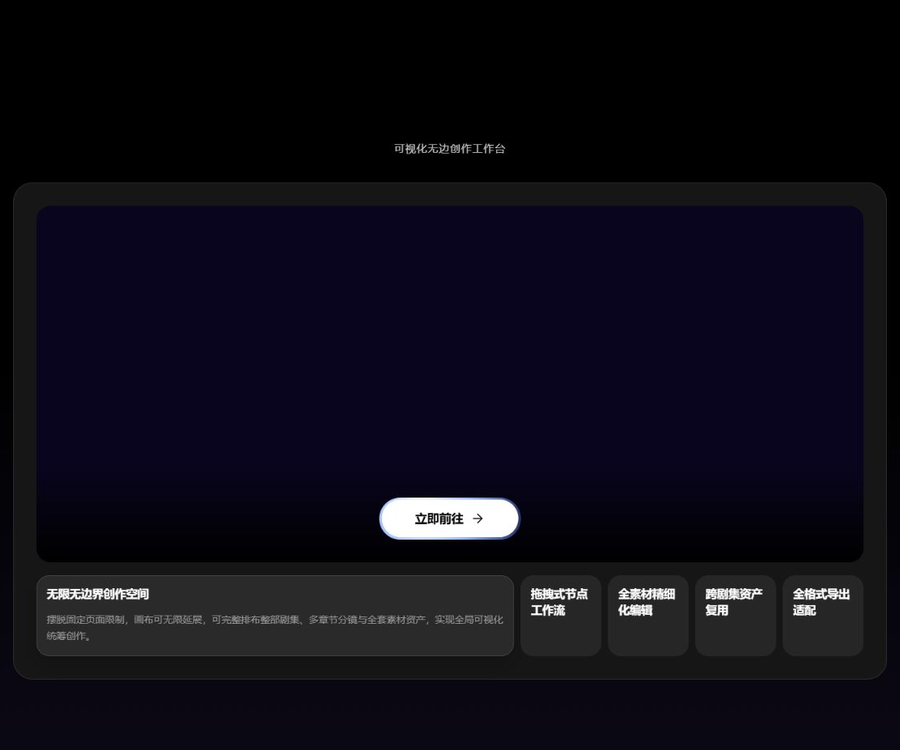
What is DrawDream Workshop AI?
Dream Painting Workshop is a platform that offers end-to-end creation and distribution services for AI-based comics, short series, and long-form episodes.
It can start with script analysis, and then move on to storyboarding, art design, video production, collaboration, and the final delivery of the video.
Core functions
| module | Main function | Creator responsibility |
|---|---|---|
| Script analysis | Identify characters, settings, and plot points. | Check the adaptation and narrative logic. |
| Intelligent storyboarding | Break the script down into shot content. | Adjusting the rhythm and visual language |
| Character consistency | Maintain consistency in the character portrayal across episodes. | Create and review role definitions |
| Set the style tone | Unify the visual style of the entire drama. | Confirming copyrights and audience |
| Batch generation | Create consecutive chapters and multiple episodes of content | Conduct quality checks for each episode. |
| Team collaboration | Share projects, materials, and points | Configure member permissions |
| Dream Painting Canvas | Use nodes to orchestrate image and video workflows | Managing versions and asset materials |
Script analysis and storyboard creation
Users can import script content or the original online text, and the system will then identify the characters, scenes, plot points, and camera requirements.
- Organize chapters, characters, and timelines.
- Break the narrative content down into shotable segments.
- Generate a draft of the scene description and storyboard.
- Adjust the pace of each episode according to the platform’s duration.
- Preserve the creator’s final decision over the plot.
Consistency between characters and scenarios
The platform emphasizes maintaining consistency in character facial features, clothing styles, settings, and art style across long-form series.
- First, create references for the character’s front, side, and facial expressions.
- Fix the clothing, age, and physical characteristics.
- Create visual settings for the main scenes.
- Record the shape changes that occur across different chapters.
- After each episode is created, key characters and props are randomly inspected.
Consistency is the goal to be achieved, but it does not mean that all shots will be exactly identical automatically.
Manhua style
The official website lists visual styles such as Japanese, American, realistic, chibi, cool anime-inspired, and traditional.
| Style | Appropriate content | Key points of production |
|---|---|---|
| Japanese style | Stories of youth, adventure, and romance | Unity of lines and colors |
| American style | Actions and strong narrative themes | Composition and character proportions |
| Real people | Urban and real-life themes | Risks related to faces and portraits |
| Chibi version | Easy and child-friendly content | Audience age and safety |
| 2D coolness | Youth-oriented serialized content | Clothing and character design |
| Ancient style | Historical fantasy and Eastern themes | Costumes, props, and cultural details |
Batch creation at the episode and chapter level
Dream Painting Workshop supports batch creation at the chapter level, which can be used for the continuous updating of serialized manga and long-form series.
- Create unified role and scenario assets.
- Assign individual episode production tasks by chapter.
- Verify the sample before generating in bulk.
- Check the narrative continuity and timeline episode by episode.
- Record the model, prompts, and modified versions.
Team collaboration
The team can set up member accounts and permissions, and manage points, projects, and materials in a centralized manner.
- Assign roles based on writing, art design, review, and management.
- Restrict members from accessing unauthorized items.
- Establish clear naming and versioning rules for the materials.
- When multiple people make modifications, specify the final approver.
- Revoke account permissions promptly after a member exits.
Dream Painting Canvas
The Dream Painting Canvas features an expandable node-based workspace that allows for the organization of text, image, audio, and video tasks.
- Arrange the entire series and its chapters on the canvas.
- Use nodes to connect the input materials with the generation steps.
- Adjust individual frames, character details, and the scene.
- Configure filters, color grading, and lens parameters.
- Repeatedly invoke cloud-based role, scenario, and asset resources.
- Output images, short videos, long-form series, or storyboard drafts.
Drawing Dreams Workshop AI Usage Guide
- Confirm the original script or obtain permission for adaptation.
- Register and create a new series project.
- Import script, web novel, or chapter content.
- Check the characters and scenes parsed by the system.
- Establish the main characters and setting of the scene.
- Choose a consistent visual style for the entire series.
- Create and modify storyboard scripts.
- First, create one episode or a small number of sample shots.
- Check for consistency in characters, art style, and actions.
- After approval, start the batch generation of chapters.
- Add supplementary voiceovers, subtitles, and post-production elements.
- Complete the reviews for copyright, content, and distribution.
Price and point-based billing
The creation side of the Dream Painting Workshop does not disclose a fixed membership fee; the Dream Painting AI model platform charges based on the models used and the points accumulated.
| Service or model | Public billing | unit |
|---|---|---|
| Dream Painting Workshop Creation Platform | Check after logging in. | Benefits of packages or programs |
| Seedance 2.5 | Starting from 0.7 points | Video per second |
| Qwen Image 3.0 Pro | Starting from 0.25 points | Each image |
| Doubao Audio Generation 1.0 | 0.017 points | Audio per second |
| Suno 5.5 | Starting from 0.6 points | Each time audio is generated |
| Video super-resolution | Starting from 0.02 points | Video per second |
| Image super-resolution | Starting from 0.03 points | Each image |
| Enterprise API integration | By model and quantity | Refer to the console. |
The price information was verified on August 30, 2026; promotions, model options, and the values for point exchanges can change.
The final cost shall be determined based on the model details after logging in, the top-up page, the settlement records, and the corporate contract.
How is the price of a model calculated?
- Video models typically charge credits based on the number of seconds generated.
- Image models are usually billed based on the number of images generated.
- Audio may be charged per second or per usage.
- Text models can be billed based on millions of tokens input and output.
- Clarity, duration, and version may affect the unit price.
- To determine whether a failed task warrants a refund, it is necessary to check the real-time rules.
API and developer integration
DreamPaint AI offers enterprise-level API access; the documentation is available only after logging in.
- First, create a key in the console and save it properly.
- Submit an asynchronous generation task based on the model documentation.
- Poll or receive the task completion status.
- Download the results and save them according to the rules.
- Handles throttling, insufficient balance, and generation failures.
- Make the calls on the server side; do not store the keys in the frontend.
What needs to be confirmed before making a purchase?
- Are the creation platforms and API points interchangeable?
- Current model version and actual discount.
- Video duration, clarity, and concurrency limits.
- Charging rules for failed tasks and those blocked during review.
- The retention period for raw materials and the final finished products.
- Management of team members, permissions, and points.
- Terms for commercial licensing, refunds, and invoices.
Open-source status
As of the time of verification, no official release of the Dream Workshop platform’s source code, core model weights, or training data has been found.
- Having an open API does not mean that the platform or the model is open source.
- A node canvas is not the same as an open-source workflow engine.
- Accessing a third-party model does not mean owning its source code.
- Third-party warehouses with the same name cannot be considered official projects.
Rights to adapt scripts and online novels
- Original works should retain records of their creation and versions.
- Obtain a legitimate adaptation license before importing online novels.
- Confirm that the authorization covers AI processing and video distribution.
- The author’s right to be credited, as guaranteed by law, must not be removed.
- Team projects clarify the ownership of scripts and the final products.
- The platform terms cannot replace a separate copyright contract.
Copyright for characters, voices, and materials
- Clear permission is required for real-person images and voices.
- Avoid creating content that could be mistaken for that of public figures.
- Music, fonts, and images require a commercial license.
- The authorization scope of the reference diagram must cover its generation and use.
- Do not remove the rights identifiers from the original material.
- Complete the review of the material list before external distribution.
Compliance with content and distribution regulations
- Label AI-generated content as required by the platform.
- Synthetic content must not be used to disguise real events.
- Safety reviews for content intended for minors need to be strengthened.
- For historical and cultural themes, it is necessary to verify the key details.
- Advertising inserts must meet the requirements for commercial identifiers.
- Save records of review, authorization, and publication.
Which users are it suitable for
- Individual creators who produce manga and short dramas.
- A studio that handles the publication of serialized content.
- A production team that can maintain consistency across multiple episodes is needed.
- Professional creators who use node workflows.
- Companies that need image, video, or audio APIs.
- An organization that manages multi-member projects and assets.
Product advantages
- The continuous process from the script to the final film.
- The focus is on ensuring consistency in characters and scenes across long-form series.
- It supports batch production at the chapter level as well as team collaboration.
- It offers a node-based infinite canvas along with advanced editing capabilities.
- The model platform covers text, images, videos, and audio.
- Provides access to API documentation available after logging in.
Usage restrictions and precautions
- The amounts for the public packages on the creation platform are incomplete.
- The unit price per point and promotional offers may change frequently.
- Character consistency still needs to be checked manually episode by episode.
- Creating long videos incurs higher production costs.
- The availability of third-party models may change.
- The source code of the platform and the model weights are not made public.
- Copyright and content review must be completed prior to issuance.
Frequently Asked Questions
What is the main purpose of PaintDream Workshop AI?
It is used in the creation of manga, short dramas, and long-form series, covering script analysis, storyboard creation, character consistency, and the generation of the final video.
How does Dream Painting Workshop maintain consistency in characters?
The platform maintains a consistent appearance through dedicated models and the reuse of character assets, but manual inspection and correction are still required for each episode.
Does Dream Painting Workshop support multi-user collaboration?
It supports member accounts, permissions, team points, project collaboration, and asset sharing; the exact number of users is determined by the package selected.
How much does DrawDream Workshop AI cost?
The packages for creation purposes can be viewed only after logging in; the model platform charges based on points, and the actual price is as indicated on the current settlement page.
Does DreamPainting Workshop provide an API?
The DreamPainting AI platform supports integration with corporate APIs; specific authentication details, parameters, and restrictions can be found in the documentation after logging in.
Is DreamPaint an open-source tool?
No, the source code of the official platform, the weights of the core models, or the training data have not been made available; having an open API does not equate to open sourcing.
Can web novels be directly imported to create manga?
Technically, it can be imported, but for works that are not original, a legitimate license covering AI processing, adaptation, and distribution must first be obtained.
Tools similar to the DreamWeaver AI



 Guigong Network Security Registration No. 45132202000164