






Flash cut
AI video tools for bulk creation of voiceovers, digital avatars, and short videos
Tags:AI video toolsWhat is a flash cut?
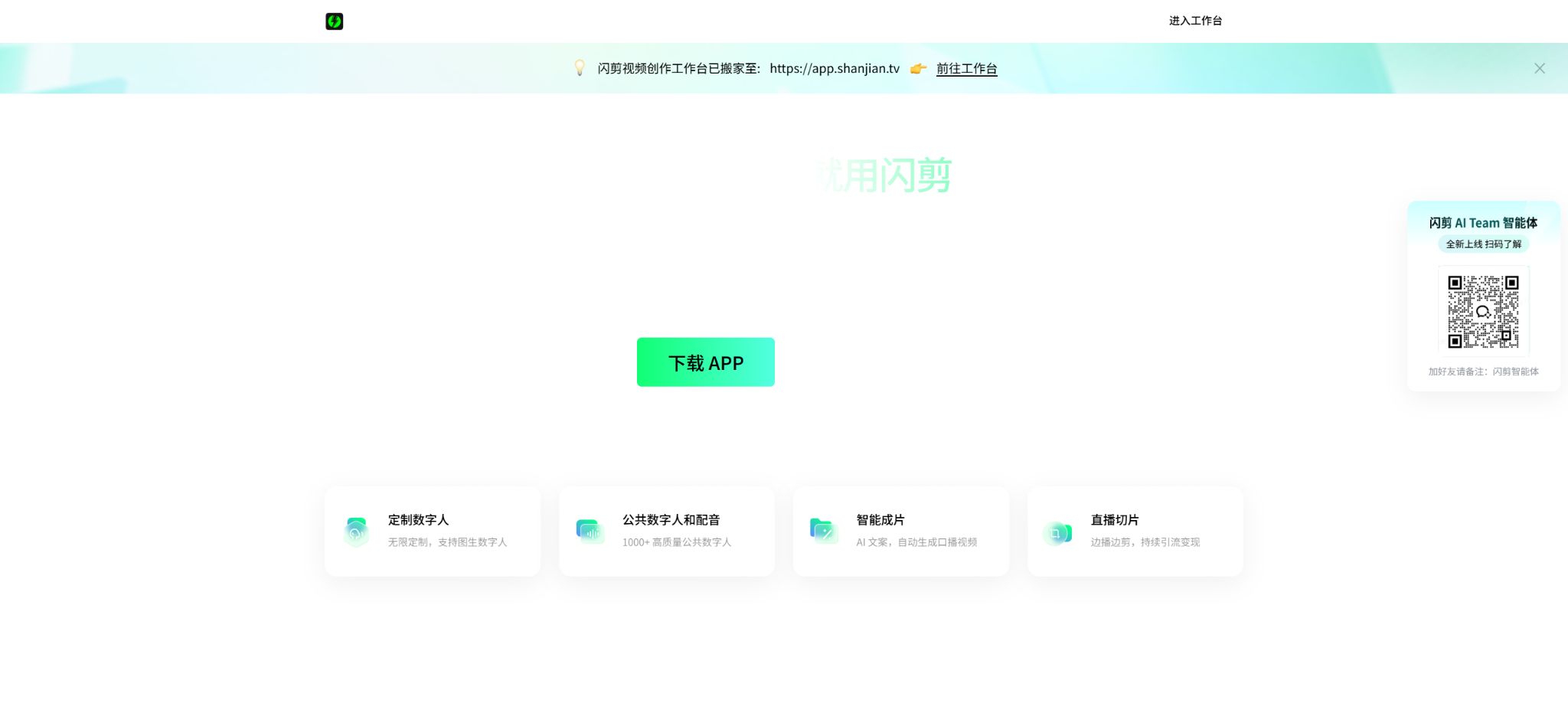
FlashCut is an AI digital human and content creation platform developed by Shenzhen Qutui Technology Co., Ltd. Its main function is to replace the traditional process of having a real person appear repeatedly on screen, record audio, and edit the footage, with a simpler workflow that involves \"preparing the image and voice, entering text or materials, and then generating the final video.\" Users can create a talking digital avatar using just one photo, or they can upload videos of real people to clone digital humans for long-term use; thereafter, text, recordings, or audio can be used to control the movements of the lips and the voice.
With each update to the product, FlashCut is no longer just a tool for digital voiceovers. The content available on mobile devices and the official website now includes AI avatars, intelligent video editing, real-person voiceover services, highlights from live broadcasts, AI image generation, image editing, popular visual effects, advertising videos, AI-driven short dramas, music, articles, graphics, as well as captions for social media posts. It has thus evolved into a one-stop production platform designed for individual influencers as well as businesses and companies looking to create content.
Core functions
1. Digital humans from photos and video-cloned digital humans
The simplified approach requires only the upload of a clear front-facing photo of a person, which is sufficient to create a digital avatar of that person; it is suitable for quick trials, temporary presentations, and audio content that does not involve complex movements. For a full-scale clone, it is necessary to record and upload a video of a real person speaking, so that the system can learn the characteristics of the person’s face, mouth movements, expression, clothing, actions, and the surrounding environment. Once training is complete, this avatar can be used to read new text.
The training materials in the basic version usually last around 30 seconds; the professional version offers longer, higher-quality training videos that include more expressions and gestures. When recording, one person should appear face-on, with stable lighting, a clean background, and no obstructions over the mouth. Rapid head movements, editing, subtitles, background music, and noticeable noise should be avoided.
The quality of the source material has a direct impact on lip-sync accuracy, image stability, and overall similarity.
2. Limits of the digital human’s capabilities
Video cloning does not involve creating a 3D character that can perform in any way desired. The resulting video maintains the camera angle, background, clothing, and movements from the training video; the AI is responsible mainly for changing the mouth movements and generating new audio.
After the training is complete, users cannot ask the digital avatar to perform actions that are not included in the training material, nor can they change its clothes with just one click; if a different hairstyle, posture, or setting is required, a new version of the avatar must be recorded and trained separately.
The basic version typically binds the characters to their original background. When it is necessary to remove the background, a professional solution that supports green screens and background removal should be used, along with a qualified green screen during the recording process.
Once a training task is submitted, it generally cannot be withdrawn or modified midway; therefore, before submitting it officially, it is necessary to check the permissions for the characters, the quality of the video, the audio quality, and the licensing rights related to the version.
3. Voice cloning and multilingual dubbing
Users can record clear voice clips of up to 30 seconds to create their own unique voice tones for training, or they can choose from the public voiceovers provided by the platform. According to the information available on mobile devices, voice cloning supports a variety of foreign languages and domestic dialects, making it suitable for creating localized audio content for marketing purposes in different regions.
After entering text, importing recordings, or extracting audio from existing videos, these can all be used as the sound source for digital avatars.
Voice cloning is affected by factors such as speaking speed, emotion, accent, background noise, and microphone quality. When it is necessary to deliver a serious presentation, an enthusiastic sales pitch, or a polite service, it is best to prepare separate, high-quality audio samples that correspond to the desired emotion.
The commercial usage limits, export restrictions, and member benefits related to public and cloned timbres should be checked prior to release.
4. Text-to-speech generation and intelligent packaging
After selecting the avatar, users can paste their own text, convert recordings into text, choose content from a library of texts, or have the AI generate topics and script for narration. The system can automatically combine the digital avatar, title, dynamic subtitles, highlights, background, images, stickers, and background music, thereby reducing the time required for formatting elements individually in traditional editing software.
In addition to pure digital voiceovers, flash editing can also handle footage shot with real people: it identifies pauses and breath points, adds subtitles and formatting elements to create videos suitable for short-video platforms. Product images, store footage, and other proprietary materials can be combined with the explanatory content to be used for knowledge dissemination, e-commerce promotions, local services, courses, and corporate marketing.
5. Live streaming clips
The mobile version offers the capability to create quick clips from live broadcasts – it allows users to import broadcast content for recording and to identify the most notable moments, after which subtitles, graphics, sound effects and transitions can be added automatically. This feature is useful for breaking down a single live broadcast into multiple short videos intended for marketing or as content replays. It should be distinguished from \"digital human live broadcasts\": official documentation from earlier periods made it clear that the main focus of the application is on short videos featuring digital humans, and it does not mean that a complete live streaming room with digital humans is provided.
The specific live streaming capabilities and entry points shall be as displayed in the current client.
6. AI agents and multimedia content
The FlashCut AI agent can create short videos, articles, graphic notes, content for social media platforms, and podcasts, all based on the user’s profile, industry knowledge, and available material library. The user simply provides a task description to get the creation process started; the system then handles the writing of the text, selecting appropriate materials, adding voiceovers and subtitles, arranging the layout, and editing the content. This approach is ideal for maintaining active presence on platforms such as TikTok, Video Account, REDnote, and official WeChat accounts.
The mobile version also offers features such as AI image generation, photo editing, photo animation, popular effects, promotional videos, AI-driven short dramas, and AI music. These tools are suitable for quickly creating creative drafts and content for social media, but different functions may rely on different models and require separate credits or computing power; moreover, the quality of the output, the time needed for generation, and the terms regarding commercial use vary as well.
7. IP matrix and team collaboration
FlashCut offers individual IPs and corporate networks the capabilities to use public models, generate content in bulk, and manage channels effectively. Its official \"channel\" solution enables headquarters or employees to create personalized content on a large scale once authorization is granted; it allows multiple accounts to share topics and brand materials, while still preserving information related to different presenters or stores.
Mass production does not mean that content can be posted repeatedly without any differences. Platform algorithms are usually able to identify low-quality, repetitive content; nevertheless, the operation team still needs to tailor the titles, beginnings, materials, text, visuals, and timing of publication, and must establish processes for reviewing, authorizing, and analyzing data for each account.
8. Open platforms and APIs
FlashCut offers an independent and open platform that provides developers and corporate clients with the capabilities needed to create digital avatars and other AI-based content. This open platform relies on a system of accounts, paid services, and computing power billing; companies can inquire about API integration, OEM solutions, or custom partnerships in order to utilize these digital avatars in their own applications, marketing systems, and content creation processes.
The interface of the open platform, the consumption units, concurrency levels, the retention period for materials, and the content review rules may differ from those of the app membership options intended for individuals. Before integrating this platform, it is necessary to check the interface documentation, signing methods, callback procedures, error handling mechanisms, and current pricing in the control panel; personal membership accounts cannot be used as a substitute for commercial API authorization.
Prices and memberships
FlashCut offers a combination of free trials, membership subscriptions, computing power packages, and enterprise services for billing purposes. New users are provided with 60 units of computing power for testing purposes; however, this free amount is part of the operational benefits offered, and both its quantity and validity period may change.
As of August 2026, the packages listed on the official website include: the Basic version with a monthly subscription fee of 119 yuan, and the Professional version with a monthly subscription fee of 479 yuan; the Basic version as an annual membership costs 988 yuan, and it includes 14,400 units of computing power, 10GB of cloud storage space, basic customization of digital avatars, voice cloning, 1080P video output, as well as access to public digital avatar and voice-over resources.
The annual subscription to the Professional version costs 3,988 yuan; it includes 57,600 units of computing power, 100GB of storage space, additional training materials, and capabilities for creating professional digital avatars. Computing power and cloud storage can be purchased separately. Once the membership expires, the customized assets may become unusable, but they can be used again after renewing the subscription.
The App Store in China displays another set of in-app purchase options, including an annual membership for 398 yuan, a monthly membership for 258 yuan, a basic monthly membership for 99 yuan, a weekly subscription for 39 yuan, a monthly membership for live streaming clips at 198 yuan, 2100 units of computing power for 99 yuan, 400 units of computing power for 19.90 yuan, a trial version for 6 yuan, as well as other packages offering varying amounts of computing power or gold coins. These options may correspond to older benefits available on mobile devices, different functions, or promotional channels; they cannot be directly equated with the new packages offered on the official website.
At the time of purchase, the details shown on the settlement page within the account – namely the name, computing power, version of the digital avatar, export quality, auto-renewal option, and expiration date – should be taken as the guiding criteria.
Supported platforms
- Web:Access the dashboard through a browser – it is suitable for uploading materials, making configurations, and exporting files on a desktop setup.
- iPhone:The App Store in China offers official apps, and it currently requires iOS 13.0 or a higher version.
- Mac with Apple chip:The app store indicates that it can run on macOS 11.0 and later versions, as well as on M1 or newer chips, but it has not been tested specifically for macOS.
- Android:The official tutorial provides instructions on how to install and use the app in a mobile browser; the specific installation packages and system requirements can be found on the official website.
- API open platform:It provides enterprises and developers with the capabilities to integrate digital avatars and AI-generated content.
Company, Open Source, and Data Information
Both the developer of the official app and the entity responsible for the current privacy policy is Shenzhen Qutui Technology Co., Ltd. FlashCut is a commercial online service, and its official website does not release the full processes related to digital human creation, rendering, intelligent editing, or mobile app development as open-source projects.
Having software copyrights or providing APIs does not mean that the product is open source.
Cloned digital humans deal with sensitive personal information such as faces, portraits, voices, as well as training videos and audio files. The privacy policy states that the platform uses such materials for customization and operation purposes during the provision of virtual digital human services.
Users should read the latest privacy policy to understand how their data is stored, shared, deleted, and revoked, and companies should establish written mechanisms for obtaining consent from employees or models as well as for withdrawing such consent.
Tutorial on using flash cuts
Complete a basic task.
- Identify the audience, platform, format, duration, and the information that needs to be conveyed;
- In flash editing, prepare scripts, shots, or reference materials that have permission to be used;
- Select photo-based digital humans or video-cloned digital humans to create low-cost previews;
- Use the capabilities of digital avatars to adjust the visuals, pace, subtitles, and audio;
- Check each frame for characters, text, logos, lip movements, and factual accuracy;
- Export in the desired format after confirming the licensing for music, portraits, and materials;
Create reusable professional workflows
- Create scripts, shot lists, brand assets, and a list of elements that are prohibited from use;
- Unified parameters are maintained for photo-based digital humans and video-cloned digital humans, as well as for the capabilities of digital humans and for voice cloning and multilingual dubbing.
- First, use representative shots to test the model and the quota;
- Transfer the failed shots to manual editing or regenerate them;
- Uniformize subtitles, volume, colors, and end credits;
- Record the version and reviewer before publishing in batches;
Which users is it suitable for?
- Creators who do not wish to appear in person on a daily basis but still need to maintain their personal brand.
- Businesses that need to create bulk content for product descriptions, attract customers to their stores, and produce clips for live broadcasts;
- A team responsible for creating courses, educational content, recruitment videos, and corporate promotion videos;
- Managing a content matrix that includes multiple employee accounts, store accounts, brand accounts, or regional accounts;
- Operators who wish to expand from short videos to articles, images, podcasts, and social media posts;
- Companies that need to integrate the creation of digital avatars into their own products must do so through APIs.
Product advantages
- The two approaches of rapid digital avatars and video cloning aim to balance user experience with long-term IP value;
- Images, voices, copywriting, subtitles, materials, and the final video are all integrated within one single process.
- It covers both pure digital voiceovers, live broadcasts with real hosts, as well as highlight clips from live streams.
- It has been expanded to include text and images, image generation, short dramas, music, and AI agents.
- Public digital avatars and voiceovers lower the barriers to initial production;
- It offers web, mobile, and enterprise open platforms.
Restrictions and Precautions
- The quality of digital human performances relies heavily on the training materials used;
- Masking of the mouth, side views, strong lighting contrasts, a moving background, noise, and editing all reduce the quality;
- Digital humans retain the movements, clothing, and settings from the training videos, and cannot freely create any performance;
- When it is necessary to change the costume, the actions, or the scene, it is usually required to record again.
- Any cloning of faces or voices requires explicit permission from the individual in question or their rights holder; it is forbidden to impersonate others, create fraudulent content, engage in false advertising, or circumvent the platform’s review processes.
- When publishing deep-fusion content, it is necessary to include AI identifiers in accordance with applicable laws and platform rules, while also retaining information regarding permissions and the sources of the materials used.
- Even with the use of compliance tools, there is no guarantee that the content will not be subject to traffic restrictions or penalties – ultimately, it depends on the quality of the content, the marketing practices employed, and the policies of the platform where it is published.
- AI-generated copy, images, music, and videos may contain factual errors, visual defects, misaligned mouth movements, and potential copyright issues.
- Medical, financial, legal, educational, and advertising content should be reviewed by professionals;
- Before using it for commercial purposes, it is necessary to verify the licensing terms for music, templates, public models, fonts, and the materials that are generated.
Frequently Asked Questions
Can flash cutting be used for free?
It is possible to experience some of these functions; new users may be given access to trial computing power. Continuous video generation, the use of more advanced digital avatars, live streaming slicing, AI agents, or larger cloud storage spaces usually require a membership or the purchase of additional computing power.
Can a digital human be created using just one photo?
Yes. Digital avatars based on photos are suitable for quick voiceovers;
When a long-term IP and more stable expressions and movements are required, it is recommended to record video footage of real people undergoing training in accordance with the relevant guidelines.
Can flash cuts be used to clone sounds?
Yes, it is possible to record short audio clips in order to create a custom voice tone for training, or one can choose from existing public voices. It is necessary to either clone one’s own voice or obtain explicit permission from the owner of the voice rights.
Can digital humans change their clothes and movements at will?
No. Video cloning retains the clothing, actions, and scenes from the original training material; it can usually only adjust the lip movements and voice.
Different styles require separate training materials.
Does FlashCut support live streaming of digital humans?
The product page features promotions related to live streaming clips and virtual host live broadcasts; however, live streaming clips are merely shortened versions of live content, and they do not represent a complete virtual live broadcast system. The actual live streaming capabilities available depend on the current client version and corporate solutions.
How much is a flash cut?
According to the information published on the official website recently, the prices for continuous monthly subscriptions are 119 yuan for the basic version and 479 yuan for the professional version; the annual membership costs 988 yuan for the basic version and 3988 yuan for the professional version. The App Store also offers various in-app purchases for mobile devices.
The benefits vary significantly across different channels; the information on the purchase page should be taken as the reference.
Is FlashClip open-source?
It is not open source. It is a commercial SaaS and mobile application that offers an enterprise open platform;
The availability of APIs does not mean that the underlying training and rendering code is open source.
Tools similar to quick cuts




 Guigong Network Security Registration No. 45132202000164