






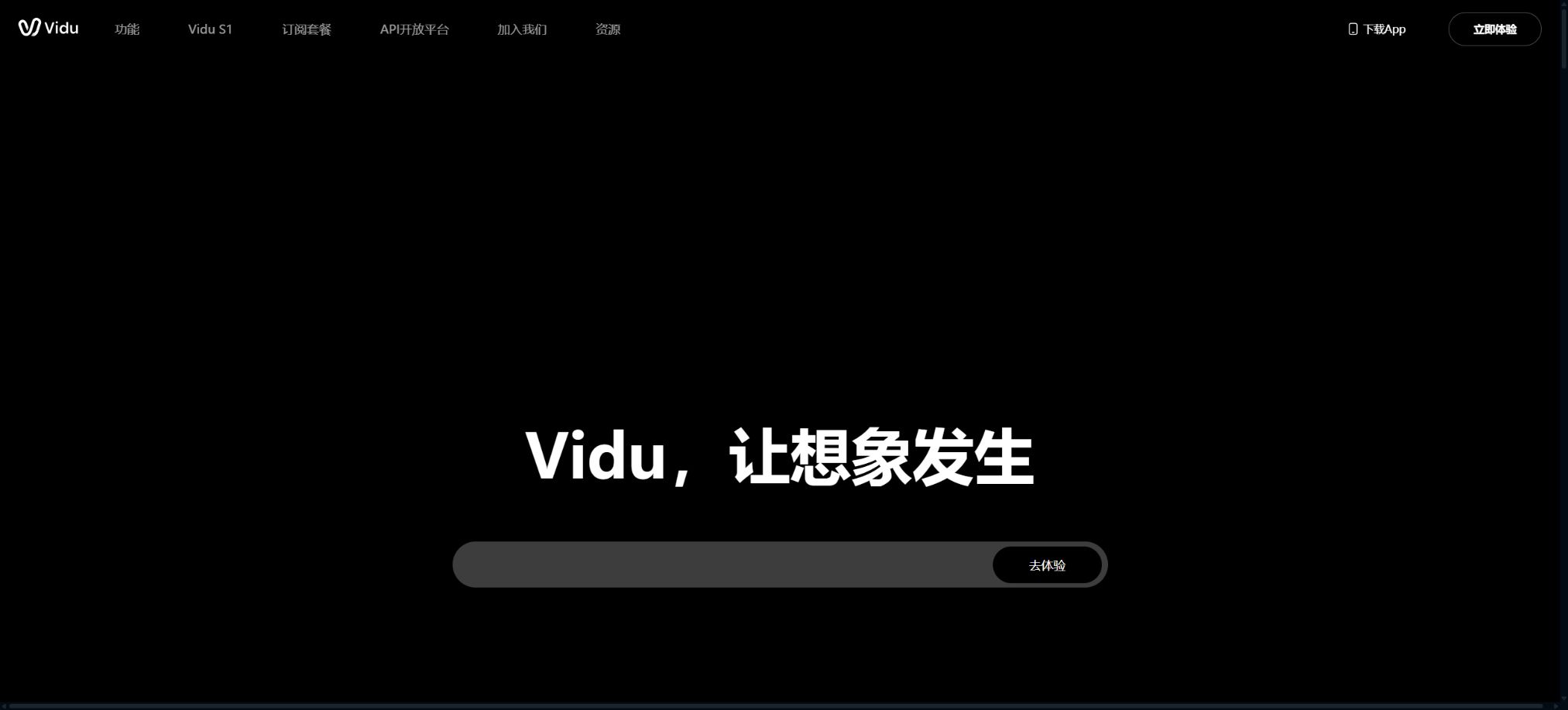
Vidu
The highly consistent AI video generation and creation platform launched by Shengshu Technology
Tags:AI video toolsWhat is Vidu?
Vidu is an AI video generation model and creation platform developed jointly by Beijing Shengshu Technology Co., Ltd. and Tsinghua University. It offers web and mobile applications for individual creators, while providing open APIs for enterprises and developers. Users can use text, a single image, multiple reference images, start and end frames, action videos, or original videos to create and edit videos; they can also proceed with tasks related to audio, lip synchronization, digital avatars, high-definition formatting, and final video production.
As of this verification, Vidu’s latest main storyline has already been launched.Q3 seriesVidu 2.0 or Q1 should no longer be referred to as the latest models. Q3 focuses on stories and finished videos, supporting durations of up to 16 seconds, resolution of up to 1080P, 24 frames per second, simultaneous delivery of audio and video in native format, as well as intelligent scene transitions.
Q2 is still used in various applications such as video editing, reference generation, and image creation, while the older model offers options regarding cost and style.
Vidu Q3 model series
- Vidu Q3 Pro:It is used for video generation from text, from images, as well as for creating opening and closing frames; it supports durations of 1 to 16 seconds, resolution levels from 540P to 1080P, native audio, and intelligent cutaways. It is suitable for content where quality, camera work, and narrative are of importance.
- Vidu Q3 Turbo:It offers faster generation speeds and lower costs; it covers text-to-image, image-to-image, first/last frame generation, as well as reference-based generation, making it suitable for bulk prototype creation, social media content, and tasks where cost is a concern.
- Vidu Q3 Mix:Designed for reference videos, it strikes a balance between consistency, aesthetics, and universal applicability; it can generate content ranging from 3 to 16 seconds long based on references of people, objects, and styles.
- Vidu Q3 Drama:For manga and narrative content, the positioning of characters, dialogue, animations, cuts, and cinematic camera techniques are optimized to better suit continuous story segments.
- Vidu Q3 Ad:It optimizes smart cuts, pacing, product details, and consistency for short video ads, and is suitable for marketing content lasting 5 to 8 seconds.
Core creative functions
- Text-to-video:Enter descriptions of the scene, characters, actions, camera angles, style, and sound to create a video. Q3 enables the creation of visuals, dialogue, sound effects, or ambient sounds within the same clip, thereby reducing the need for additional audio tracks in post-production.
- Tusheng Video:Convert photos of people, illustrations, product images, or scene pictures into animated videos, and use prompts to control the movements and camera angles. The composition, clarity, and completeness of the original images have a direct impact on the quality of the resulting video.
- Reference student video:Upload 1 to 7 reference images, using characters, props, objects, clothing, or styles as the visual context. Multiple-angle references along with a database of subjects can enhance consistency across consecutive shots, making them suitable for IP, anime, and brand content.
- Video generation from first and last frames:Specify the starting and ending visuals so that the model can generate the intermediate movements and transitions; this is suitable for transformations, product displays, scene changes, and connecting existing shots.
- Smart multi-frame:A maximum number of keyframes can be set to generate scene changes and long shots in segments; this approach can be used for storyboarding, sequential narration, and multi-stage actions. Each pair of input images constitutes one segment, and the total cost is calculated by adding up the costs of all these segments.
- Video extension and editing:Extend the segments generated by Vidu, or use original video editing, character/object replacement, and video replication in the Q2 Pro workflow to reduce the need for creating content from scratch.
- Action synchronization:By entering reference video footage of movements and images of characters, the characters can be made to move in accordance with those references; this functionality works for real people, cartoon characters, animals, and other scenarios. However, complex occlusions, rapid rotations, and fine details of the hands may still result in distortions.
- Mouth syncing and digital humans:Text or audio is used to control the lip movements of video characters; the digital avatar feature enables the creation of speaking videos by combining images, dialogue, and voice tones, and it also supports voice replication.
- Images and audio:The Q2 image model supports text-to-image generation, image creation based on references, and image editing, with a resolution of up to 4K available. Its audio capabilities include text-to-sound effect generation, controllable sound effects, speech synthesis, and voice replication.
- Smart Ultra HD:Vidu videos can have their frames supplemented and their resolution increased; the platform offers options of 1080P, 2K, 4K, and 8K. Ultra-high definition cannot restore details that are not present in the original video.
- Template and community replication:It offers templates for special effects such as hugs, kisses, and transformations, as well as a creation community where users can view publicly available works and reuse similar structures. For the template works, it is still necessary to verify the permissions regarding portraits and copyrights.
One-click video creation and industry-specific solutions
The Vidu open platform has expanded the single-camera model into a comprehensive solution for creating complete films. With this general-purpose framework, it is possible to produce animated series, live-action dramas, advertisements, and documentaries.
E-commerce platforms can create promotional videos lasting 15 to 60 seconds from product images, links, or key features; AI-generated MVs can produce a cohesive narrative by combining music, lyrics, and 1 to 7 reference images.
Video replication involves recreating the camera movements, actions, and audio-visual structure based on the original popular video as well as the product or model images.
For short dramas and comic dramas, segments of 2 to 30 seconds can be planned and combined to create content lasting more than a minute. Q3 Drama enhances the continuity of characters, scenes, and shots. The resulting video generation tools can reduce the need for steps such as storyboarding, voiceover recording, and editing; however, matters related to marketing compliance, product authenticity, platform duplication, and music licensing still require manual handling.
Vidu S1 – Real-time interactive digital human
Vidu S1 is a digital human video model designed for real-time interaction; it can continuously generate images of the character based on voice commands and enable two-way communication. The version available for consumer use offers 540P resolution, 25 FPS, and real-time generation with no time limit, while the research version from the official open-source repository can run on consumer-grade GPUs and achieve higher frame rates.
The specifications and licensing for commercial cloud services, the API beta version, and the open-source research version should not be confused with one another.
S1 is suitable for use in live streaming, customer service, virtual companionship, as well as for educational and interactive purposes. The use of real-person avatars or voices requires explicit authorization, and features such as content filtering, latency control, fallback mechanisms in case of issues, and manual intervention are necessary.
Price and version comparison
| Package or version | Prices, quotas, and core benefits |
|---|---|
| Creator package and points rules | Users of Vidu can register for free and earn experience points through being new users, logging in daily, or participating in activities. The service also offers subscription plans such as Standard, Professional, and Flagship. Subscription points are usually valid for 30 days; additional points purchased or awarded through activities are generally valid for 2 years. Point purchases are available only to paid users, and they cannot be exchanged for membership status, given as gifts, or withdrawn. According to the official guidelines, refunds are not provided for payments made. The specific monthly fees and point amounts may vary depending on the region, ongoing promotions, as well as whether the service is accessed via web or app; it is therefore necessary to check the payment page at the time of purchase. The official Vidu AI app is available for free download on the App Store in China; the current version is part of the 3.0 series and supports in-app purchases. The prices of these in-app purchases may change depending on the account status and ongoing promotions. Do not use the old information regarding Vidu 2.0, which indicated a fixed rate of “4 points per second”, when calculating the costs of the current Q3 subscription plans. |
| China Vidu API prices | China’s open platform uses a points-based pricing system, with 1 point equaling 0.03125 yuan. The standard recharge packages are as follows: 500 yuan for 16,000 points, 1,000 yuan for 32,000 points, 2,000 yuan for 64,000 points, 5,000 yuan for 160,000 points, and 20,000 yuan for 640,000 points. These packages are valid for 1 year, and a maximum of 5 concurrent tasks can be carried out at any time. Tasks that fail or are rejected during content review do not result in any point deduction. In the off-peak mode, the points earned are usually half of the normal amount, and tasks may be completed within 48 hours. The prices for the main video formats in Q3 are as follows: Q3 Pro – 9 points per second for 540P, 20 points per second for 720P, and 24 points per second for 1080P; in the off-peak mode, it’s approximately 5, 10, and 12 points per second respectively. Q3 Turbo – 7 points per second for 540P, 12 points per second for 720P, and 13 points per second for 1080P; in the off-peak mode, it’s roughly 4, 6, and 7 points per second respectively. Q3 Pro Fast for video generation – 12 points per second for 720P and 15 points per second for 1080P; in the off-peak mode, it’s 6 and 8 points per second respectively. Q3 Mix reference format – 24 points per second for 720P. |
| Examples of prices for other APIs | For text-to-image generation in Q2, the scores are 6, 8, and 10 points for 1080P, 2K, and 4K resolutions respectively; voice synthesis earns 10 points per 500 characters, while voice cloning costs 300 points per voice tone. Lip synchronization is worth 20 points every 5 seconds. Creating a subject costs 5 points each time, and editing as well as using such subjects is currently free. For action synchronization in V1 at 720P resolution, the cost is 10 points per second; the updated versions cost 19 or 34 points per second. Intelligent ultra-high definition options for 1080P, 2K, 4K, and 8K resolutions incur costs of 10, 20, 40, and 160 points per second respectively. The Vidu S1 cloud API costs 3 points every 2 seconds; the first 10 voice tone clones are provided free of charge, with additional tones costing around 28 yuan each. Basic accounts come with 5 free concurrent uses. |
| International API prices | The value of 1 point on the International Open Platform is 0.005 dollars. For the Q3 Pro, the cost is approximately 0.045 to 0.12 dollars per second, while for the Q3 Turbo it’s around 0.035 to 0.065 dollars per second; the cost is roughly halved when using off-peak times. Taxes, prices depending on region, and bulk purchase rates may vary. Accounts, API Keys, currencies, and points used on the Chinese site cannot be seamlessly integrated with those used on the international site. |
Creator package and points rules
On the Vidu consumer platform, users can register for free and earn experience points by being new users, logging in daily, or participating in activities. The platform also offers subscription plans such as Standard, Professional, and Premium. Subscription points are typically valid for 30 days.
Additional points purchased and those earned through promotions are generally valid for 2 years; the purchase of points is available only to paid users, and they cannot be exchanged for membership status, given as gifts, or withdrawn. According to the official guidelines, refunds are usually not provided for such purchases.
The specific monthly fees and point amounts for consumers vary depending on the region, promotions, as well as whether the purchase is made through the Web or App; it is necessary to check the settlement page at the time of purchase.
The official Vidu AI app is available for free download on the App Store in China; the current version is part of the 3.0 series and in-app purchases are supported. The specific prices for these in-app purchases may vary depending on the account used and any ongoing promotions.
Do not use Vidu 2.0 from the old tutorials to set a rate of \"4 minutes per second\" in place of the current price for the Q3 package.
China Vidu API prices
China’s open platforms use a points-based pricing system.1 point is equivalent to 0.03125 yuan.The standard recharge packages are as follows: 500 yuan for 16,000 points, 1,000 yuan for 32,000 points, 2,000 yuan for 64,000 points, 5,000 yuan for 160,000 points, and 20,000 yuan for 640,000 points. The validity period is 1 year, with a maximum of 5 concurrent tasks allowed by default.
Tasks that fail or are rejected during content review do not result in any point loss; the reduced-point mode typically applies half the usual amount of points, and tasks can be completed within 48 hours.
The prices of the main videos in Q3 are as follows:
- Q3 Pro:540P earns 9 points per second, 720P earns 20 points per second, and 1080P earns 24 points per second; during off-peak times, the earnings are approximately 5, 10, and 12 points per second respectively.
- Q3 Turbo:540P earns 7 points per second, 720P earns 12 points per second, and 1080P earns 13 points per second; during off-peak times, the earnings are approximately 4, 6, and 7 points per second respectively.
- Q3 Pro Fast image-to-video generation:12 points per second for 720P, 15 points per second for 1080P; 6 and 8 points per second during off-peak times.
- Q3 Mix reference student:24 points per second for 720P, and 29 points per second for 1080P; staggered shooting is not supported.
- Q3 Regular Reference Candidates:540P, 720P, and 1080P earn 7, 12, and 15 points per second respectively, while off-peak periods yield around 4, 6, and 7 points per second.
When converted based on the price per point, the Q3 Turbo 540P generates approximately 0.21875 yuan per second under normal conditions, and around 0.125 yuan per second during off-peak times; the Q3 Pro 1080P generates about 0.75 yuan per second under normal conditions, and around 0.375 yuan per second during off-peak times.
The figures above account only for a single successful creation; they do not include repeated attempts, high-resolution versions, audio content, suggestions for prompts, or post-production work.
Examples of prices for other APIs
- For Q2 text-to-image generation, the scores for 1080P, 2K, and 4K are 6, 8, and 10 points respectively;
- Voice synthesis costs 10 points for every 500 characters, while voice replication costs 300 points for each voice tone.
- 20 points for every 5 seconds of lip-reading;
- 5 points are awarded for each entity created; editing and using entities is currently free of charge.
- For action synchronization at 720P resolution, 10 points are earned per second; the updated versions yield 19 or 34 points per second.
- Smart ultra-high definition: 1080P, 2K, 4K, and 8K yield 10, 20, 40, and 160 points per second respectively;
- With the Vidu S1 cloud API, 3 points are earned every 2 seconds; the first 10 sound variants can be used for free, while additional sound variants cost around 28 yuan each. A basic account includes 5 free concurrent uses.
International API prices
The value of 1 point on the International Open Platform is 0.005 dollars. For the Q3 Pro, the cost is approximately 0.045 to 0.12 dollars per second, while for the Q3 Turbo it is around 0.035 to 0.065 dollars per second.
The peak load is reduced by about half.
Fees, taxes, as well as prices for bulk purchases may vary. Accounts, API Keys, currencies, and points for the Chinese site and the international site are not interconnected by default.
Open-source status
Vidu Q3, Q2, the consumer creation platform, and the commercial APIs are not open-source models, and the vendor does not provide complete weight values that can be used for offline deployment. Shengshu Technology has made Vidu Skills, the CLI, and MCP connection tools available on GitHub, allowing it to be used to call the Vidu API from compatible environments such as Claude, Cursor, and Codex.
These tools still require an API Key and are billed on a usage basis.
The authorities have also made public the Vidu S1 research project as well as the related integration skills; some of the code and weights are subject to separate licensing terms. This does not mean that the Q3 model or the entire Vidu platform is open source.
The catalog should be labeled as “Proprietary to commercial generation models; official tools and some S1 research projects are available.”
Vidu usage tutorial
Complete a basic task.
- Identify the audience, platform, format, duration, and the information that needs to be conveyed;
- Prepare scripts, shots, or reference materials that can be used in Vidu;
- Select the Vidu Q3 model series to create a low-cost preview;
- Use the core creation tools to adjust the visuals, rhythm, subtitles, and audio;
- Check each frame for characters, text, logos, lip movements, and factual accuracy;
- Export in the desired format after confirming the licensing for music, portraits, and materials;
Create reusable professional workflows
- Create scripts, shot lists, brand assets, and a list of elements that are prohibited from use;
- Uniform parameters are established for the Vidu Q3 model series, core creative functions, one-click video generation, as well as industry-specific solutions;
- First, use representative shots to test the model and the quota;
- Transfer the failed shots to manual editing or regenerate them;
- Uniformize subtitles, volume, colors, and end credits;
- Record the version and reviewer before publishing in batches;
Supported platforms and target users
- Vidu offers Chinese and international web versions, iPhone apps, APIs, MCP, CLI, and AgentSkills;
- It is suitable for short-video creators, animation and manga teams, e-commerce and advertising companies, film and television pre-production teams, game and virtual IP teams, cultural and educational institutions, as well as developers who need to generate videos in bulk.
Usage restrictions and safety precautions
- AI-generated videos may still suffer from issues such as changes in the identity of the people depicted, errors in the hands, physical inconsistencies, distorted subtitles, misalignment between audio and video, and problems with the continuity of the shots.
- Multi-agent referencing can improve consistency, but it cannot guarantee complete locking.
- For official projects, low-cost testing should be carried out first, followed by the creation of high-resolution versions; then, in editing software, work should be done on adjusting the rhythm, sound, subtitles, and fixing any defects.
- Before uploading real-person photos, voices, video clips, product images, and music, it is necessary to obtain authorization for the use of portraits, voices, trademarks, and copyrights.
- It is forbidden to create content that is deceptive, fraudulent, sexually explicit without consent, or misleading.
- When releasing content to the public, it is necessary to comply with the platform’s rules and the requirements regarding the labeling of AI-generated content. For commercial advertisements, it is also essential to verify the efficacy of the products, their prices, and the relationships between the sponsors and the products.
- API calls should protect keys, verify callback signatures, limit concurrency and budgets, and handle queuing, failures, audits, and timeouts;
- A single usable sequence often requires multiple generations, and when estimating costs it is necessary to take into account the error rate, audio quality, high-definition settings, storage requirements, as well as manual post-processing.
Frequently Asked Questions
What is Vidu’s latest model?
The current main series is the Vidu Q3 series, which includes versions such as Pro, Turbo, Mix, Drama, and Ad; Q2, Q1, and 2.0 are still used for specific functions and cost categories.
How long can a Vidu video be?
In Q3, a single model generation can handle video lengths of 1 to 16 seconds; the typical duration for generated content is 3 to 16 seconds. The one-click video creation feature allows for the planning and combination of longer videos, ranging from 15 to 60 seconds, such as ads, short dramas, or MVs.
How much does Vidu API cost?
On Chinese platforms, 1 point is worth 0.03125 yuan. The Q3 Turbo 540P generates 7 points per second under normal conditions, which is equivalent to about 0.21875 yuan.
4 points per second during off-peak hours, which is approximately 0.125 yuan.
The higher the resolution and the model, the greater the cost.
Is Vidu open source?
Q3 and the full platform are not open-source. The developers have made MCP, CLI, Skills, and some Vidu S1 research projects available, but using the commercial features still requires an API Key and payment.
Tools similar to Vidu




 Guigong Network Security Registration No. 45132202000164