






Conch AI
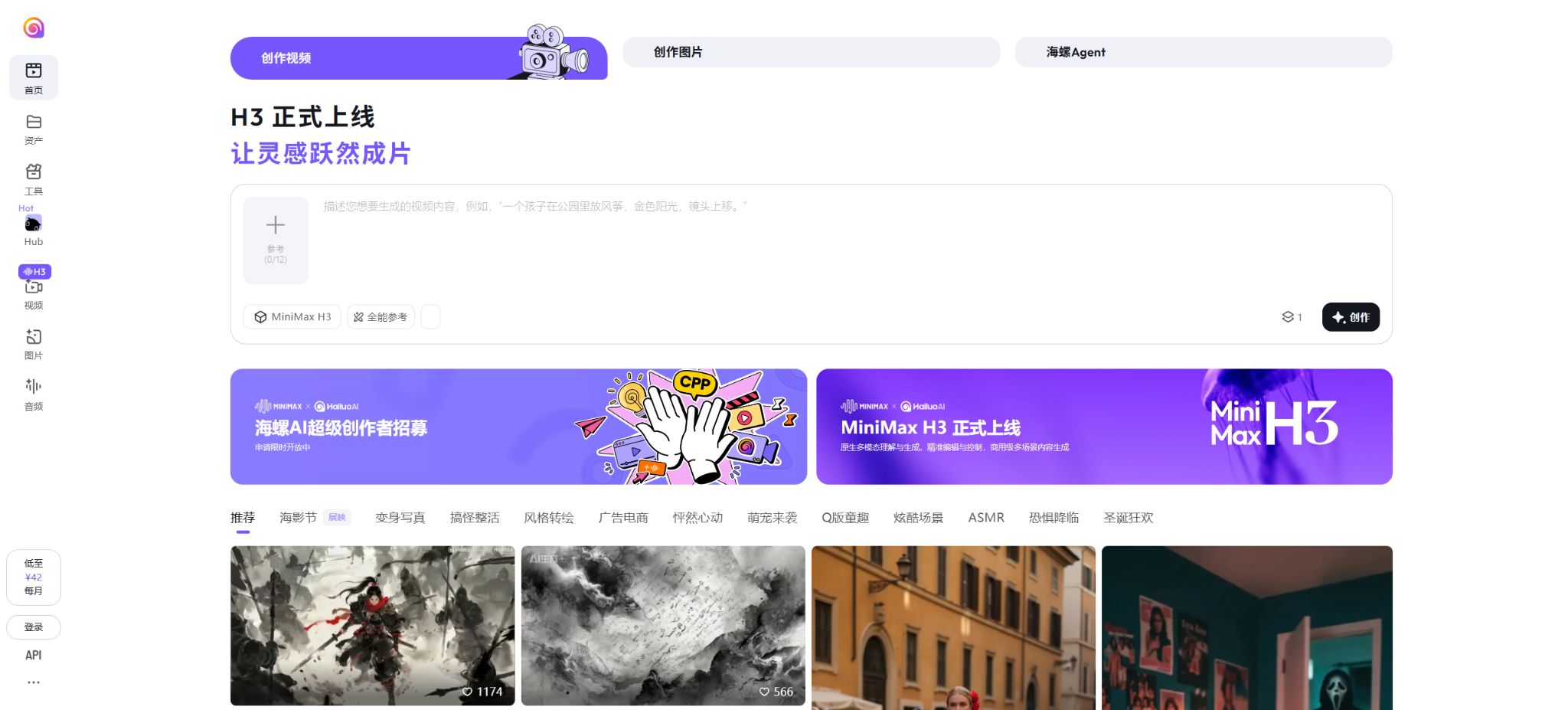
An AI-based visual creation platform under MiniMax that supports video generation from text, video generation from images, and precise control over camera settings.
Tags:AI video toolsWhat is Conch AI?
Hailuo AI is an AI-based video and visual creation platform under MiniMax, designed for use in short videos, advertising, e-commerce, animation, and storyboarding. Users can create videos directly by using textual descriptions, or they can upload images as the initial frame to make characters, products, or scenes come to life.
The current main models of the platform are Hailuo 2.3 and Hailuo 2.3-Fast; models such as Hailuo 02 are still used to handle the first and last frames as well as certain tasks requiring low resolution.
It should be noted that SeaHorn AI and MiniMax Agent are not the same product. The former focuses on videos, images, and creative assets, while the latter focuses on in-depth research, programming, PPTs, and multi-step tasks.
The old version of “Hailuo Wenwen” was also the historical name for the MiniMax chat product.
When searching for the “Haile AI official website”, make sure to use the video creation platform operated officially by MiniMax, and avoid downloading third-party apps with similar names but developed by different entities.
Core functions
- Text-to-video:Enter the subject, scenario, action, camera angle, and visual style to generate a short video directly. Hailuo 2.3 supports resolutions of 768P or 1080P, as well as video lengths of 6 seconds or 10 seconds.
- Tusheng Video:Upload an image as the first frame, and then describe the character’s actions, changes in the environment, and camera movements. The image sets the guidelines for the subject and the overall artistic style; it is suitable for bringing product images, illustrations, and character designs to life.
- Hailuo 2.3:It takes into account both text-to-image and image-to-image generation, with a focus on improving the accuracy of complex human movements, dances, facial micro-expressions, the consistency of anime styles, and the quality of motion in commercial products.
- Hailuo 2.3-Fast:Designed for fast video generation from images and for batch processing, it offers a quicker generation speed and lower integration costs; according to the official documentation, Fast primarily supports video generation from images, and not all of its functions are identical to those of the standard version.
- Camera movement control:Add camera commands such as push, pull, pan, tilt, follow, orbit, and zoom to the prompt in order to control the movement of the image. The model will try to understand cinematic language, but complex combinations do not guarantee precise execution.
- Generation of first and last frames:It also provides start and end screens, allowing the system to generate intermediate transitions. At present, this functionality is mainly supported by Hailuo 02; Hailuo 2.3 does not support start and end frames in all of its configurations.
- Main reference:Upload facial or character reference images to maintain the key features of the subject across different scenarios; it is suitable for continuous characters, advertising figures, and story segments. It helps to ensure consistency, but it cannot guarantee that every frame will be exactly the same.
- Video templates and special effects:Pre-set templates enable quick creation of holiday, social media, product display, and fun effects, thereby reducing the barriers associated with using prompts.
- Image generation and asset management:Create or upload the images needed for your creations, and store videos, images, and favorites in asset libraries and folders to facilitate the reuse of prompts and reference materials.
- Download and Share:Once completed, the work can be previewed, downloaded, or shared; the clarity, watermark, queue priority, and commercial usage rights depend on the package and the rules of the campaign.
Price and version comparison
| Package or version | Prices, quotas, and core benefits |
|---|---|
| Free quota and prices for end-users | Hailuo AI allows free registration and trial use; daily points may be awarded during the launch of new models or as part of special promotions. The points given each day are usually refreshed, and any unused points do not carry over. Creating a video results in point deductions based on the model used, resolution, and duration. Whether tasks that fail or do not pass security checks incur costs depends on the rules stated on the result page. The current reference costs for Hailuo 2.3 are as follows: 25 points for a 768P video lasting 6 seconds; 50 points for a 768P video lasting 10 seconds; 50 points for a 1080P video lasting 6 seconds. Hailuo 2.3-Fast is less expensive, but the specific point deductions may change depending on promotions and updates to the feature pages. The subscription details are displayed dynamically after logging in, and prices can vary depending on region, payment duration (monthly or annual), and any available discounts; therefore, screenshots of old package deals cannot be considered as fixed prices for the long term. Before making a purchase, it is necessary to check the monthly points, whether any bonus points are carried over, the options related to fast processing, the number of concurrent tasks, watermarking options, and the guidelines for commercial use. The subscription points of Hailuo AI and the balance available in the MiniMax open platform API are two separate systems. Web-based memberships cannot be used for program calls, nor can API credits be utilized in that way. |
| MiniMax Video API pricing | The MiniMax open platform offers an asynchronous video generation API, whose workflow includes creating tasks, checking the status of those tasks, and downloading the resulting files. The API supports video generation from text, from images, as well as using the first and last frames or a subject reference for generation; authentication is carried out using a server-side API key. The current pricing in China is as follows: For Hailuo 2.3-Fast video generation, the cost is 1.35 yuan per 6-second video at 768P resolution, 2.25 yuan per 10-second video at the same resolution, and 2.31 yuan per 6-second video at 1080P resolution. For Hailuo 2.3 or Hailuo 02, the costs are 2 yuan per 6-second video at 768P resolution, 4 yuan per 10-second video at that resolution, and 3.50 yuan per 6-second video at 1080P resolution. For Hailuo 02 video generation, the costs are 0.60 yuan per 6-second video at 512P resolution and 1 yuan per 10-second video at that resolution. The platform also offers video resource packages valid for one month: the basic package costs 7,000 yuan and includes 3,680 points, the advanced package costs 15,000 yuan and includes 8,330 points, the premium package costs 30,000 yuan and includes 17,650 points, while the enterprise package costs 40,000 yuan and includes 25,000 points – each package offering different benefits. |
Free quota and prices for end-users
Conch AI allows for free registration and trial use; daily points may be awarded during the launch of new models or as part of special promotions. The points given each day are usually refreshed, and any unused portion does not carry over.
Creating a video results in points being deducted based on the model, resolution, and duration; whether fees are charged for tasks that fail or do not pass security checks is determined according to the rules on the result page.
The reference consumption values for the Hailuo 2.3 consumer version as currently available are as follows: 25 points for a 768P video lasting 6 seconds; 50 points for a 768P video lasting 10 seconds.
50 points for a 1080P video lasting 6 seconds. The Hailuo 2.3-Fast version is less expensive, but the specific points deducted at the consumer level may change depending on updates to promotions and feature pages.
The subscription page is displayed dynamically after logging in; prices may vary depending on the region, as well as whether the payment is made on a monthly or annual basis or under any promotional offers. Therefore, screenshots of previous plan details cannot be used as an indication of fixed prices over time. Before making a purchase, it is necessary to check the points available each month, whether any bonus points are carried over, the features related to fast access, the number of simultaneous tasks that can be handled, any watermarks, and the guidelines for commercial use.
The subscription points for Haile AI and the balance available on the MiniMax open platform API are two separate systems. Web-based memberships cannot be used for program calls by default, and API top-ups do not automatically convert a user into a Haile AI member.
For teams that generate a large volume of content, the estimate should be based on “the number of successful videos × points per video”, rather than merely considering the monthly fee.
MiniMax Video API pricing
The MiniMax open platform offers an asynchronous video generation API; the workflow involves creating tasks, checking the status of those tasks, and downloading the resulting files. The API supports video generation from text or images, as well as the use of starting and ending frames and subject references, and it is authenticated using server-side API keys.
The current pricing for the Chinese market is as follows:
- Hailuo 2.3-Fast video generation: 768P for 6 seconds at 1.35 yuan per video, 768P for 10 seconds at 2.25 yuan per video, 1080P for 6 seconds at 2.31 yuan per video;
- Hailuo 2.3 or Hailuo 02: 768P – 2 yuan per clip for 6 seconds, 4 yuan per clip for 10 seconds; 1080P – 3.50 yuan per clip for 6 seconds.
- Hailuo 02 AI-generated video: 512P, 6 seconds – 0.60 yuan per video; 512P, 10 seconds – 1 yuan per video.
The platform also offers video resource packages valid for one month: the basic package costs 7,000 yuan and includes 3,680 points, the premium package costs 15,000 yuan and includes 8,330 points, the advanced package costs 30,000 yuan and includes 17,650 points, while the corporate package costs 40,000 yuan and includes 25,000 points. These packages correspond to different RPM values. For the Hailuo 2.3 standard version, 1 point is deducted for every 6 seconds of 768P video, and 2 points are deducted for every 6 seconds of 1080P video.
For Fast, 0.7, 1.1, or 1.3 points are deducted accordingly.
The remaining balance of the resource package expires and becomes zero; it is necessary to assess the actual success rate of generation and the level of concurrency before making a purchase.
The Max tier of the MiniMax Token Plan also includes a limited amount of usage rights for Hailuo videos. The standard monthly prices in China are 29 yuan, 49 yuan, and 119 yuan; the 119 yuan tier currently provides 2 videos per day at 768P resolution and lasting 6 seconds each, using either Hailuo 2.3 or Fast. The Token Plan is designed mainly for developers’ keys and multi-modal sharing quotas, and it is not equivalent to the subscription service offered to Hailuo AI creators.
Open-source status
The Hailuo AI platform, the weights of the Hailuo 2.3 video model, the training data, and the full generation services are not open-source products; they cannot be downloaded and installed on ordinary computers for offline use. MiniMax has made Mini-Agent, OpenRoom, VTP, and various research projects available on GitHub, with some of these projects being licensed under the MIT license or licenses that include additional requirements regarding their use.
These repositories do not equate to the open-sourcing of the Hailuo video model.
The catalog should indicate that \"the products and video models are not open source; MiniMax offers open-source Agents and research projects.\"
What developers obtain through the API is the right to make calls, not the model weights.
When using open-source projects, it is still necessary to check the license separately; the MIT terms of one repository cannot be applied to other projects.
Conch AI Usage Guide
Complete a basic task.
- Identify the audience, platform, format, duration, and the information that needs to be conveyed;
- Prepare scripts, shots, or reference materials that can be used in Snail AI;
- Select Video Generation to create a low-cost preview;
- Use image-to-video tools to adjust the visuals, rhythm, subtitles, and audio;
- Check each frame for characters, text, logos, lip movements, and factual accuracy;
- Export in the desired format after confirming the licensing for music, portraits, and materials;
Create reusable professional workflows
- Create scripts, shot lists, brand assets, and a list of elements that are prohibited from use;
- Save unified parameters for text-to-video, image-to-video, and Hailuo 2.3;
- First, use representative shots to test the model and the quota;
- Transfer the failed shots to manual editing or regenerate them;
- Uniformize subtitles, volume, colors, and end credits;
- Record the version and reviewer before publishing in batches;
Which users are it suitable for
- Creators who produce short videos, advertisements, e-commerce content, and materials for social media;
- Designers who need to convert illustrations, portraits, or product images into animated sequences;
- The director and animation team responsible for storyboard previews, action tests, and concept videos;
- Developers who need to generate videos in bulk through APIs and manage concurrency as well as costs;
- Ordinary users who wish to experience AI-generated videos quickly using templates but are not familiar with professional video editing.
Usage tips
Prompt phrases for generating video from text can be structured as “subject + scene + movement or changes + camera angle + lighting and style”. Since the character and artistic style are determined by the first frame in video generation from images, the prompt phrases should focus more on describing actions, expressions, camera angles, and environmental changes.
Attempting to include multiple conflicting actions at once can lead to deformities in the limbs; it’s better to break down longer sequences into separate shots and then combine them using editing software.
The main frames are suitable for preserving the identity of the face, while the initial and final frames are used for creating transitions; they address different tasks. When choosing a model, Fast can be used for quick, batch-based testing, whereas the standard Hailuo 2.3 should be employed for facial expressions, complex movements, and professional-quality videos.
For important projects, it is necessary to prepare budgets for multiple generations; AI-generated videos rarely meet all the requirements from the first attempt.
Copyright, Security, and Restrictions
- AI-generated videos may exhibit issues such as fingers, text, physical movements, inconsistencies in camera movement, and changes in the identity of the characters.
- Resolution is merely an output specification and does not mean that every frame possesses the same level of detail;
- Before commercial release, each frame must be checked, and as necessary, editing, frame addition, voice-over, and color grading should be performed;
- Before uploading real-person photos, customer products, trademarks, film characters, or any materials protected by copyright, it is necessary to verify the rights related to portraits and copyrights as well as the scope of authorization.
- It is forbidden to impersonate others or to create unauthorized deepfakes or misleading news.
- The generated content may contain platform identifiers or metadata; terms regarding commercial use, watermark removal, and ownership are subject to the current terms of service.
Frequently Asked Questions
Can Haile AI be used for free?
You can sign up for a trial period and may earn daily or event points; frequent generation requires a subscription or the purchase of points.
The rules regarding free points, queuing, and watermarks may change.
How long are videos that Hailuo 2.3 can handle?
The commonly used time intervals are 6 seconds or 10 seconds, while the resolution options include 768P and 1080P. Different generation methods support a variety of models.
What is the difference between Hailuo 2.3 and Fast?
The Standard version supports text-to-image and image-to-image generation, with an emphasis on quality and complex visual effects; Fast focuses on fast, low-cost image-to-video generation, making it suitable for batch iterations.
Does SeaHorse AI support the first and last frames?
The platform provides support for this, but it is currently implemented mainly through models such as Hailuo 02. Hailuo 2.3 does not support the first and last frames in all modes; this should be verified on the model selection page.
Is Conch AI open-source?
It is not open source. Although MiniMax has made some of its agents and research projects available publicly, the weights of the Hailuo video model as well as the platform services are not fully disclosed.
Tools similar to Hai Luo AI




 Guigong Network Security Registration No. 45132202000164