






Fuselio
Fuselio – makes AI-driven design work more efficient and simpler
Tags:AI design toolsWhat is Fuselio?
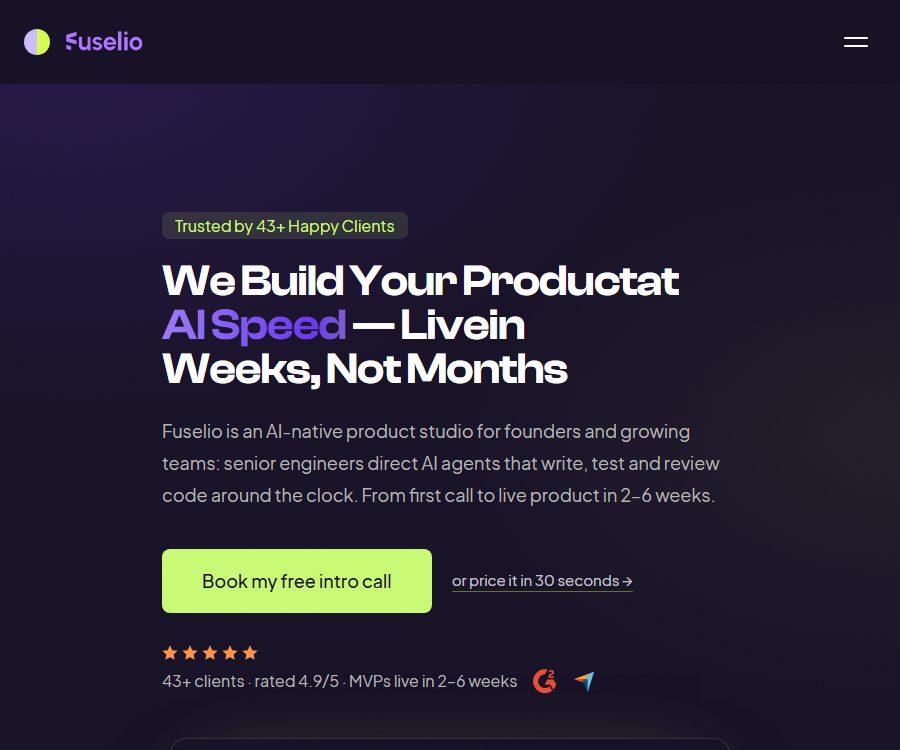
Fuselio is an AI-native product development studio operated by Fuselio Technology Pvt Ltd, which offers customized development services to entrepreneurs and growing teams, covering everything from identifying requirements to bringing the products to market. It is not a subscription-based tool that generates applications simply by entering a command; rather, it is a project service delivered by engineering teams.
The team uses AI agents to handle some of the template coding, testing, and refactoring tasks, while senior engineers remain responsible for architecture, product decision-making, code review, and deployment. This approach helps to shorten the time required to deliver results within a defined scope, but it does not eliminate the complexities associated with changes in requirements, integration, and compliance.
Main services
MVP development
The client provides the product objectives, target users, and key issues, while the team helps to select the initial features and develop a minimum viable product that can be tested by real users. The deliverables include aspects such as design, front-end and back-end development, testing, and deployment, with the specific details depending on the scope of the project.
Websites and SaaS applications
Fuselio can be used to develop websites with login functionality, billing systems, dashboards, and business workflows, as well as multi-tenant SaaS applications. React, Node.js, Python, and Firebase are examples of technologies listed for these services; they do not mean that all projects must use the same technology stack.
Mobile apps
The team offers iOS and Android application development, which can be used for consumer products, business applications, and mobile versions of existing platforms. Whether to use native or cross-platform solutions, as well as matters related to app store accounts and deployment responsibilities, need to be determined during the planning stage.
Internal tools and business automation
Companies can transform tables, back-end systems, or manual processes into custom dashboards, approval tools, and automated workflows. The input consists of existing processes, data sources, and business rules, while the output are functional tools that take into account team permissions and system connections.
AI chatbots and workflow agents
This service enables the integration of knowledge, customer service, marketing, sales, or operational processes into dialogue interfaces and AI workflows. Before going live, it is necessary to define the data that can be accessed, the actions that are permitted to be carried out, the points where human intervention is required, as well as the procedures for handling failures.
MCP server development
Fuselio enables the creation of MCP services on top of customers’ existing APIs, including tool definitions, OAuth permissions, rate limiting, testing capabilities, deployment options, and connection documentation. The official documentation emphasizes the provision of read-only functions first, while confirming actions related to writing data and performing destructive operations, as well as implementing scope controls.
Applications for upgrading and rescue are already available.
The team is also responsible for modernizing the technology stack, adding new functions, and fixing the AI-generated prototypes so that they can be put into use. The rescue service can check issues related to permission policies, exposed keys, payment callbacks, authentication redirects, and production configurations.
Cooperation process
| Phase | Customer input | Main outputs | Key points for acceptance |
|---|---|---|---|
| Needs communication | Goals, users, budget, and time | Problem definition and initial scope | Are the success metrics clear? |
| Plans and quotes | Function priority and existing systems | Technical solutions, schedule, and fixed price | Included items and excluded items |
| Design and Prototyping | Brands, processes, and feedback | Interface and interaction prototypes | Availability of key processes |
| Incremental development | Interfaces, data, and business rules | Phased runnable version | Weekly demonstrations and change logs |
| Testing and Deployment | Acceptance account and production configuration | Test results vs. the live version | Security, performance, and rollback |
| Online support available | List of issues and user feedback | Fixes and suggestions for subsequent iterations | Support duration and response range |
How to prepare and launch a project
- Describe the target audience, the core issues, and the business hypotheses that need to be verified in a single paragraph.
- List three to five key processes that must be completed in the initial phase, and place future features in a separate candidate list.
- Prepare the existing prototypes, brand materials, data structures, interface documentation, and compliance requirements.
- Communicate regarding reservation requirements, so that the team can assess them based on functionality, platform, integration, and time frame.
- The written proposal is required to specify the deliverables, milestones, acceptance criteria, technology stack, and boundaries of responsibilities.
- Confirm the number of revision rounds covered by the fixed price, as well as how billing will work in case the scope is expanded.
- Determine who owns the code repository, cloud account, domain name, and app store account.
- Attend regular demonstrations during development, and document issues and scope changes in accordance with the acceptance criteria.
- Complete tests for permissions, payment, backup, monitoring, privacy, and recovery before going live.
- Confirm the subsequent arrangements for maintenance, bug fixes, and new features before the end of the support period.
Price and delivery time
Fuselio uses project-based pricing instead of a public monthly subscription model. The homepage indicates that the price for the MVP starts at $2499, but the updated pricing information shows that fixed-price projects begin at $2999, with typical MVP prices ranging from $3000 to $15000.
The delivery time also varies depending on the page and scope: the home page indicates that for most projects it takes 2 to 6 weeks, while the MVP service page states 4 to 12 weeks. These figures cannot be considered as guarantees for all projects; the actual timeline shall be determined based on the written schedule agreed upon after the requirements are confirmed, as well as the contract in place.
| Package or version | Price | Billing cycle | Core benefits or quota | Suitable for users |
|---|---|---|---|---|
| Needs communication | Free | Single time | Clarify the objectives and assess the initial scope. | The team ready to launch the project |
| MVP project | The page rate starts at $2,499 or $2,999. | Project-based approach | Designed, developed, tested, and deployed within a fixed scope. | Startup teams that test product ideas |
| Typical MVP | Approximately $3,000 to $15,000 | Project-based approach | The amount varies depending on functionality, integration, and complexity. | Product teams with a clear scope |
| MCP server | Starting at $2,499 | Project-based approach | It usually includes tools, authentication, testing, and documentation. | SaaS applications that wish to integrate with AI assistants |
| AI application diagnosis | 299 dollars | Single time | 48-hour diagnosis; subsequent repairs can be deducted from the cost. | Teams that already have AI prototypes |
| Custom applications and automation | Contact sales | Customization | Websites, mobile devices, internal tools, or workflows | Complex business projects |
The page providing general information does not specify whether taxes and fees, cloud services, model calls, third-party software, costs associated with app stores, and long-term maintenance are included. The rules regarding payment points, cancellation, refunds, and changes to the scope of services should also be based on the contract.
Suitable for users and scenarios
- Entrepreneurs who lack a complete project team and need to quickly test their ideas.
- It is hoped that an early team capable of developing a MVP with clear boundaries will be ready within a few weeks.
- Companies that need to develop websites, mobile applications, or internal tools for their existing business.
- Operations teams that aim to combine repetitive tasks into AI-driven automated processes.
- SaaS teams are needed to create MCP interfaces and a permission layer for existing APIs.
- Projects for which prototypes have been created using generative development tools, but which cannot be launched safely.
Main advantages
- It covers the continuous stages of requirements, design, engineering, testing, deployment, and post-launch operations.
- Incremental delivery and regular demonstrations help to identify deviations from the intended direction at an early stage.
- The combination of AI agents and engineer review is suitable for rapid development with well-defined boundaries.
- It covers web pages, mobile devices, automation, chatbots, and MCP services simultaneously.
- Free initial consultations and public pricing help teams establish an initial budget.
Capacity limits and risks
- This is a custom development service; it is not possible to generate the product immediately after registration, as is the case with SaaS.
- The published speeds, ratings, and cases are intended to showcase the service, and they do not constitute guarantees for the results of individual projects.
- Complex integration, data migration, regulatory audits, and frequent changes can prolong timelines and increase costs.
- Code generated by AI may still have issues related to logic, security, performance, and maintenance, and requires engineering review.
- Fixed pricing usually relies on a fixed scope; features that are not included in the plan may incur additional costs.
- Collaboration across time zones, the speed of feedback, and the progress of providing interfaces to customers all affect delivery.
Platform, delivery, and ownership
Fuselio can deliver web pages, iOS and Android applications, backend services, automation tools, as well as MCP services; the ultimate platform on which these components will run is determined by the project requirements. It does not offer a unified desktop client or self-service mobile application.
The service page states that for some MCP projects the client owns the code, but this does not necessarily apply to all customized projects. The copyright to the code, licenses for third-party components, the handover of repositories, cloud accounts, and design source files must all be specified in the contract.
API, SDK, and open-source status
There are no publicly available APIs, SDKs for the general Fuselio product, nor any open-source platforms that can be deployed on one’s own. The team can develop APIs, integration services, and MCP services for customers, but this is something different from the fact that the Fuselio product itself is open source.
If the project requires further development, it is necessary to clarify the interface documentation, testing environment, key management, rate limits, and maintenance responsibilities prior to signing the contract. It is also essential to specify the open-source components that will be used and the licensing requirements associated with them.
Privacy and security
The website’s privacy policy states that it may collect names, email addresses, phone numbers, payment information, as well as usage data such as IP addresses, browser types, and times of access. This information can be used for service delivery, communication, marketing, and analysis; it may also be shared with third parties who assist in providing the services.
Website policies cannot replace the data processing agreements specific to a client’s project. When it comes to user data, medical information, financial data, or employee details, it is necessary to establish separate rules regarding the location where the data is stored, the retention period, the procedures for deleting it, the sub-processors involved, encryption methods, event notification protocols, and access auditing.
- Production credentials and real data are provided only through controlled channels.
- Assign the minimum required permissions to engineering staff, and revoke their access once the project is completed.
- Include backup, logging, monitoring, and vulnerability repair in the deployment checklist.
- Verify whether the model supplier accepts the data as well as its storage and training settings.
- Conduct tests for permissions, authentication, payment, and data isolation prior to acceptance.
Frequently Asked Questions
Is Fuselio an AI application generator?
It is not a generator designed for user-driven self-service. It is a service studio where product and engineering teams handle the development and delivery of customized software.
How long does it take to create an MVP?
The homepage indicates that most projects take 2 to 6 weeks, while another service page states that it takes 4 to 12 weeks. The scope of the functions, the level of integration, and customer feedback speed all influence the final timeline.
What is the minimum amount for an MVP?
Different official pages cite figures ranging from $2,499 to $2,999; the updated articles indicate that typical projects cost between $3,000 and $15,000. The current valuation tools and written quotes should be taken as the reference.
Is it possible to create only a mobile application?
You can seek advice on iOS or Android development, but the technical solutions, the backend aspects, and the possibilities for releasing the application in stores need to be confirmed separately.
Is support available after deployment?
The homepage documentation comes with two weeks of free support, depending on the level of complexity; long-term maintenance, response times, and additional requirements require separate arrangements.
Can customers get the source code?
Some service pages explicitly state that the customer owns the code, but ownership and the transfer of the repository still need to be confirmed in a specific contract.
Does Fuselio offer public APIs or SDKs?
No universal public APIs or SDKs have been confirmed. Fuselio can develop interfaces and MCP services for clients.
Can I get a refund if the project is canceled?
No unified and public rules for refunds have been identified. The payment stages, conditions for cancellation, and how completed work will be settled should all be specified in the contract.
Can it handle regulated data?
Whether it is suitable depends on the project architecture and the contractual safeguards. Before signing a contract, data processing agreements, security measures, and the industry-specific requirements should be requested.
Summary
Fuselio is suitable for customers who wish to have an MVP, an application, automation solutions, or MCP interfaces delivered rapidly by external teams. Its value lies in combining product planning, AI-assisted engineering, and deployment processes into a single service for the project.
Before making a choice, it is necessary to compare quotes on the basis of a clear scope, rather than focusing only on the initial price and speed. The deliverables, acceptance criteria, responsibilities regarding data, ownership of the code, as well as the terms for maintenance and refunds should all be outlined in writing.
Tools similar to Fuselio



 Guigong Network Security Registration No. 45132202000164