






EZ-AI
EZ-AI makes AI-driven design work more efficient and simpler.
Tags:AI design toolsWhat is EZAI?
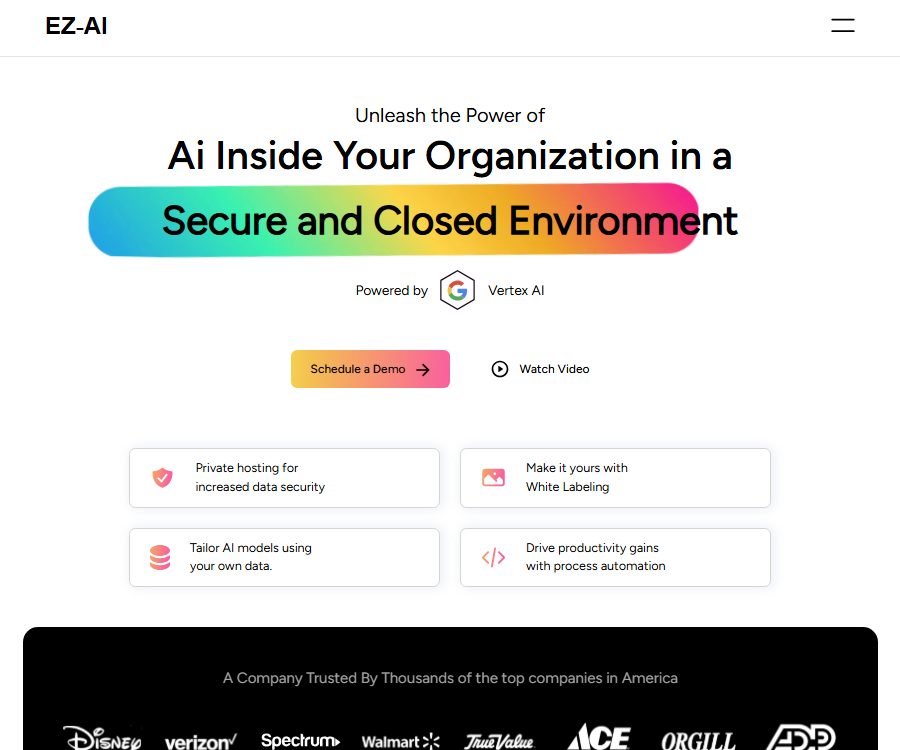
EZAI, also known as EZ-AI, is a platform designed for data integration within organizations, as well as for providing enterprise-level AI assistance and process automation. It falls under the EZ-AD business portfolio; private files are handled under both the EZ-AD Inc. and EZ-AI, Inc. names. It is necessary to verify the actual contracting party when entering into a contract with the company.
It is neither a general-purpose graphic design tool nor a simple chatbot for individuals. Its focus is on connecting corporate data within a controlled cloud environment, configuring dedicated AI systems, and deploying assistants into internal processes or integrating them into products under a custom brand.
Core product architecture
| Hierarchy | Key capabilities | Enterprise value |
|---|---|---|
| Dedicated runtime environment | Create an independent Google Cloud environment for customers. | Isolate organizational data and access permissions |
| Data integration | Connect data lakes, files, websites, and custom interfaces | Allow the assistant to utilize the company’s own knowledge. |
| Model configuration | Configure separate AI models by department or task. | Reduce interference between different business objectives |
| Automation assistant | Break down and execute multi-step business tasks | Handle repetitive operational and informational tasks |
| White-label deployment | Provide interfaces and capabilities using the customer’s brand. | Integrated into internal systems or as external products |
| Governance monitoring | Access levels, security controls, and operational monitoring | In line with corporate policies and compliance requirements |
Main functions
Dedicated private cloud environment
EZAI sets up dedicated Google Cloud servers for enterprises, allowing data and AI systems to operate within an environment tailored to that organization. Authorized users, network boundaries, backup procedures, and administrator permissions need to be defined during the implementation phase.
\"Private\" does not mean that the service is deployed in the customer’s own data center; this page focuses on dedicated cloud servers. If local deployment, deployment in a specific region, or use of the customer’s own cloud account is required, technical confirmation must be obtained prior to making a purchase.
Enterprise data integration
The platform can connect an organization’s data lakes and business data to AI systems, and retrieve dynamic data through custom interfaces. This enables the assistant to answer questions related to products, processes, customers, and internal policies.
- Static data can be used to create corporate knowledge bases and FAQ sections for operation manuals.
- Dynamic interfaces allow querying inventory, orders, customers, or other real-time business statuses.
- Access rights for different types of data should be set according to department, role, and sensitivity level.
- Before going live, it is necessary to process data that is duplicate, expired, contradictory, or lacks permission tags.
Configure separate models according to their purpose.
Companies can configure separate models for tasks such as customer support, code review, marketing, or internal knowledge management. Each assistant can have its own objectives, working rules, and access levels, which helps to prevent one model from having unrestricted access to all of the company’s content.
The product also allows for continuous adjustments to the quality of responses based on feedback from enterprises, but this does not mean that the system can automatically ensure accuracy. For critical tasks, version control, evaluation sets, and human approval are still necessary.
Autonomous AI assistant
Autonomous AI Assistants break down complex tasks into sub-tasks and carry them out according to a defined process. They are suitable for repetitive tasks with clear rules, well-defined data permissions, and the possibility to set up approval steps.
- Filter customers with high recent spending on a monthly basis, and then prepare targeted promotional emails for them.
- Check daily whether the newly submitted code meets the organization’s annotation standards, and provide suggestions for improvement.
- Create a FAQ customer service assistant that routes requests to human agents when issues cannot be resolved.
- Answer employees’ questions regarding internal systems, product information, or operation manuals.
White-labeling and embedding
The white-label solution allows AI capabilities to be integrated into a company’s own brand, products, or internal platforms. The elements related to the user interface, logging in, tenant isolation, as well as responsibilities for notifications and support, should be determined based on the scope of implementation.
Interfaces and real-time retrieval
EZAI mentions that business systems can be connected through custom APIs, allowing the models to retrieve real-time information as needed. At present, there are no public documentation materials for self-service development; therefore, matters such as authentication, request formats, data transfer rates, error handling, and costs must be confirmed with the technical team.
Typical use cases
- Corporate Knowledge Assistant: Answers internal questions based on policies, products, and training materials.
- Customer Service: Handles common inquiries and escalates cases to human agents based on confidence levels or rules.
- Marketing automation: Generates customer segments, campaigns, and content drafts based on business data.
- Research and development governance: Review code documentation, standards, and issues of repetition, and provide suggestions to developers.
- Operational analysis: Links order, product, and customer data to generate periodic summaries.
- Software manufacturers: Incorporate enterprise AI capabilities into their products under their own brand.
- Multi-departmental organization: Create dedicated assistants with distinct permissions and purposes for different teams.
Deployment process
- Schedule a product demonstration and specify the business objectives, number of users, data types, region, and compliance requirements.
- Classify data that must be accessed, can be accessed, and should not be accessed, and identify the persons responsible for such data.
- Choose between dedicated cloud, the customer’s own cloud, or other available deployment options, and determine the location where the data will be stored.
- Configure authentication, roles, administrators, multi-factor authentication, and the principle of least privilege.
- Establish connections to files, databases, and business interfaces, and record the synchronization intervals as well as any fallback actions in case of failures.
- Configure assistants and system rules separately for purposes such as customer support, marketing, and research and development.
- A real but anonymized evaluation set is used to test accuracy, privilege escalation, prompt attacks, and sensitive information leakage.
- First, conduct a trial run with a limited number of users, including features such as access logging, alerts, manual approval, and issue escalation.
- After acceptance, the scope is expanded, and knowledge, permissions, evaluation sets, and risk lists are continuously updated.
Methods for building corporate knowledge bases
- Create a document directory, and assign for each document the person in charge, version, expiration date, and sensitivity level.
- Remove duplicate files, personal drafts, obsolete policies, and unauthorized third-party content.
- Connect structured data through interfaces, and organize unstructured files by topic.
- Define searchable ranges for each type of user, to avoid relying solely on response prompts to control permissions.
- Establish standard questions, correct answers, and rejected response samples for evaluation before and after deployment.
- Establish synchronization and expiration mechanisms for information that is prone to change, such as prices, policies, and inventory levels.
- It is required that the answers include the underlying rationale or a timestamp, to facilitate verification by employees.
Input, Output, and Integration
| object | Capabilities confirmed | Pending project confirmation |
|---|---|---|
| Corporate documents and knowledge | Access to organizational data and knowledge bases | Full file format, single file size, and total capacity |
| Websites and online materials | The older version of the guide mentioned websites, YouTube, and Google Docs. | Current list of connectors and synchronization frequency |
| Business system | Custom APIs and dynamic data connections | Ready-made connectors, speeds, and authentication methods |
| User interaction | Chat, Q&A, and task instructions | Current scope of voice, attachments, and multilingual support |
| System output | Answers, draft content, suggestions, and process actions | Structured format, audit fields, and export methods |
The early product guides mentioned text or voice-based conversations as well as various online resources, but the current company page does not provide complete technical specifications. Purchasers should not consider the connection methods outlined in the historical tutorials as part of the commitments set out in the current contract.
Which organizations are suitable?
- Large and medium-sized enterprises that possess a large number of internal documents and need a unified source for accessing knowledge.
- Companies that wish to integrate AI assistants into their own software or customer portals.
- Organizations with multiple teams that require data, models, and access levels to be isolated by department.
- Companies that have repetitive inspection processes for customer service, operations, marketing, or R&D.
- A regulated team with resources for security, legal affairs, data governance, and implementation.
- Customers who request customized interfaces, brands, and workflows, rather than purchasing standard individual subscriptions.
Price and procurement methods
EZAI does not currently have any publicly available information regarding standard prices, free usage quotas, trial periods, seat fees, usage-based charges, or refund policies. The product offers scheduled demonstrations and customized quotes; the final cost is determined based on the written quote and contract.
| Package or version | Price | Billing cycle | Core benefits or quota | Suitable for users |
|---|---|---|---|---|
| Customized enterprise solutions | Contact sales | Custom quote | The dedicated environment, data integration, model configuration, automation, and white-labeling options are determined based on each project. | Companies and software vendors |
Items to be confirmed when providing a quote
- Are the implementation fees, platform fees, user seats, and model invocation costs calculated separately?
- The costs associated with dedicated servers, storage, backup, networking, and deployment in different regions.
- File size, number of synchronization attempts, API calls, number of models, and concurrent usage limit.
- Are white labeling, single sign-on, audit logs, and custom development considered additional features?
- Supports time targets, issue response times, availability goals, and disaster recovery commitments.
- Contract duration, automatic renewal, price adjustments, exit assistance, and early termination fees.
Security and compliance capabilities
EZAI states that it uses TLS 1.3 for data transmission, AES-256 for encrypted storage, and implements role-based access control as well as multi-factor authentication for its employees. The platform also conducts quarterly penetration tests, annual SOC 2 Type II audits, and daily encrypted offsite backups.
- Companies should request current and valid audit reports, as well as information on the scope of coverage and any exceptions, rather than relying solely on marketing claims.
- For dedicated environments, it is still necessary to confirm the ownership of the cloud account, encryption key management, administrator access, and sub-processors.
- Different assistants should be granted the minimum level of permissions, and manual approval should be required for high-risk actions.
- The log must record the search content, the model’s response, the tool calls, the approver, and the final execution result.
- Backup encryption does not mean immediate deletion; a schedule for clearing backups should be established when exiting the project.
Privacy and data processing
The privacy policy applies to the digital signage, e-commerce, and SMS tools part of the EZAI and EZ-AD systems; therefore, not all of its provisions may be applicable to a single EZAI project. At the time of signing, the specific services, types of data, and purposes for processing should be specified in the data processing agreement.
- The platform may handle names, contact information, account verification, payments, content uploaded by businesses, devices, usage records, as well as marketing and support information.
- The main servers are located in the United States; data transfers within the European Economic Area and the United Kingdom are possible under standard contract terms, adequacy decisions, or specific approvals.
- Corporate content may include customer information, employee data, and trade secrets; it is necessary to establish a legal basis and fulfill notification obligations before uploading such content.
- Users can edit their information in the account settings, request the download of data, and can ask for it to be deleted, restricted, or processed against their wishes.
- The policy states that significant changes will be notified 30 days in advance via banners or emails.
- In the event of a data breach involving risks, the regulatory authorities and affected individuals will be notified in accordance with the applicable rules.
- The service is not available for individuals in the European Economic Area and the United Kingdom who are under 16 years old, nor for children in the United States who are under 13 years old.
Content ownership and commercial use
The terms state that the content created as a result of interactions between users and the EZAI model belongs to the users, and can be used for personal or commercial purposes; however, it is still necessary to comply with laws, ethical principles, privacy regulations, and the rights of third parties. Companies should retain proof of the input data and review the output generated.
- The EZAI services, interface, and related intellectual property rights remain owned by the operator.
- Users are not allowed to mirror the service without permission, download content on a systematic basis, scrape data, or bypass access restrictions.
- The generated content may be incorrect, outdated, or infringe on third-party rights; the indication of ownership does not constitute a guarantee of no risks.
- Customer data, employee information, and third-party content must be used solely for the purposes specified in the contract, and any improvements to them are allowed only within the limits set out therein.
- Automatic content intended for external customers requires brand, compliance, and fact-checking.
API, SDK, and open-source status
| Project | Current status | Explanation |
|---|---|---|
| Custom API integration | Confirmed | The project team connects corporate dynamic data with business systems. |
| Public self-service API | Not yet made public | There are no public API documentation, key application processes, or information regarding rates and prices. |
| SDK | Not yet made public | No downloadable software development kits were found. |
| Expansion and Integration | The terms are mentioned. | The specific products and channels available depend on confirmation by the sales team. |
| Official GitHub | Not confirmed yet | No code organization explicitly associated with the product page was found. |
| EZAI platform | Proprietary services | It has not been released as open-source code or model weights. |
| Google Vertex AI | Underlying cloud services | Using this platform does not mean that the EZAI products are open source. |
Product advantages
- It covers the entire enterprise implementation process, from dedicated environments and data integration to assistant deployment.
- Independent models and access levels are created based on tasks, which is suitable for isolating different departments.
- The white-label capability enables software manufacturers to integrate AI into their existing products.
- Autonomous assistants can link knowledge-based Q&A with business actions, rather than merely generating text.
- Multiple security controls and privacy rights interfaces have been made available, to facilitate further review by enterprises.
Capacity limits and risks
- There are no public prices or standard technical limits; costs and timelines must be assessed during the pre-sale phase.
- The dedicated cloud environment still relies on Google Cloud and project configurations; this does not mean that the data never leaves the designated boundaries.
- When corporate knowledge contains errors or is outdated, the assistant will highlight those errors rather than automatically fixing the issues.
- Autonomous execution may lead to incorrect emails, data modifications, or unauthorized access; therefore, approval processes and rollback mechanisms should be in place.
- There are no public, universal API documents available; the speed of integration depends on the extent of customization and the resources of both parties.
- The terms permit the modification, suspension, or termination of certain services; the contract should specify requirements regarding business continuity and data exit.
- The fact that content is generated does not imply that it is accurate, compliant, or free from infringement of third-party rights.
Selection and Acceptance Checklist
- Define success criteria using three quantifiable business scenarios, rather than starting with a broad goal such as \"AI across the entire company.\"
- Confirm the contract parties, processor roles, data location, sub-processors, and cross-border mechanisms.
- Request information on the scope of the security audit, a summary of the penetration testing, and details regarding backup and disaster recovery.
- List the connector, file format, capacity, synchronization delay, interface speed, and failure handling.
- Create a permission matrix to test whether the assistant can reject sensitive requests from users without the appropriate permissions.
- Validation is carried out using standard answers, out-of-scope questions, and hint attacks, with the accuracy rate and rejection rate being recorded.
- Add approval, limits, and cancellation mechanisms for actions such as sending messages, modifying data, and calling external systems.
- The quote breaks down the costs related to implementation, cloud resources, model usage, seats, support, and customization.
- The format for exporting data after the agreed termination, knowledge transfer, key revocation, and deletion of backups.
Frequently Asked Questions
Is EZAI an ordinary chatbot?
It includes enterprise chat and Q&A functions, but its scope is broader at present, covering dedicated cloud environments, enterprise data connectivity, standalone models, automated assistants, and white-label deployment.
Can EZAI be deployed within an enterprise?
Currently, a dedicated Google Cloud environment is explicitly provided; support for the customer’s own data center, the customer’s own cloud infrastructure, or specific locations requires confirmation from the sales and technical teams on a case-by-case basis.
Is there a public version or a free version of EZAI?
No public pricing, free quotas, or standard trial versions have been identified. Companies need to schedule a demonstration in order to receive a customized quote that includes details regarding implementation, cloud resources, model usage, and the scope of support provided.
Does it support companies’ own data?
Supported. The platform is designed to connect organizational data lakes, files, and dynamic business interfaces. The actual file formats, connectors, capacity, and synchronization frequency should be specified in the implementation plan.
Can an autonomous assistant carry out actions directly?
Platform use cases include processes such as sending emails, reviewing code, and seeking customer service support; however, enterprises should implement approval mechanisms, limits, logging, and rollback procedures for external communications and data changes.
Does EZAI provide public APIs?
It has been confirmed that project-specific custom interface integration is available; however, no public APIs that can be registered independently, any unified documentation, or standard pricing for calls have been identified yet.
Is EZAI an open-source product?
No, it is currently delivered as a proprietary enterprise service, and no official open-source repository has been identified. The use of Google Vertex AI and Google Cloud does not change the open-source nature of EZAI itself.
Can the generated content be used for commercial purposes?
The terms allow users to use the model’s interactive outputs for personal and commercial purposes, but they remain responsible for verifying facts, privacy issues, copyright rights, and other third-party rights.
Summary
EZAI is suitable for organizations that need a dedicated environment, access to corporate knowledge, isolation of various assistants, and the ability for brand customization; it is particularly useful for knowledge services and controlled process automation.
Since prices, technical constraints, and deployment details are all project-specific, the focus of procurement should be on the contractual terms, data boundaries, permissions, audit evidence, total cost, and exit mechanisms.
Tools similar to EZ-AI



 Guigong Network Security Registration No. 45132202000164