






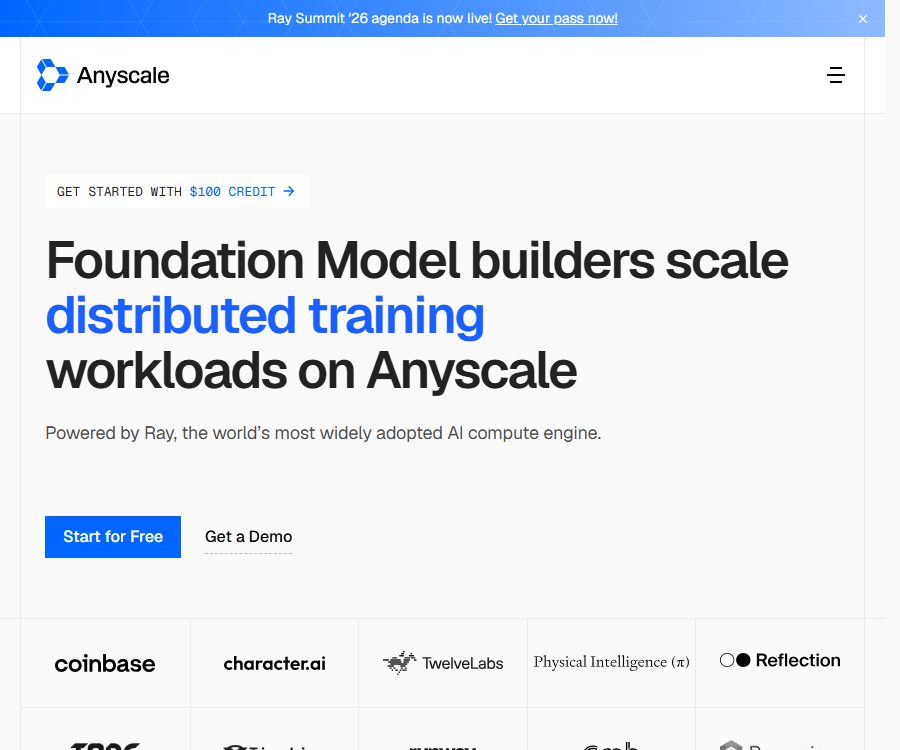
Anyscale
Anyscale makes AI-driven design work more efficient and simpler.
Tags:AI design toolsWhat is Anyscale?
Anyscale is a unified AI and machine learning computing platform created by the founding team of Ray, designed for developers and enterprises that need to run large-scale Ray workloads. It builds upon the open-source Ray by adding managed infrastructure, optimized runtimes, observability capabilities, governance tools, and development utilities.
The platform can extend from interactive development to data processing, model training, batch inference, and online services. Users can either take advantage of the resources provided by Anyscale quickly, or deploy their data infrastructure in their own cloud or Kubernetes environment.
The relationship between Anyscale and Ray
Ray is an open-source distributed computing framework that handles task scheduling, Actors, fault tolerance, automatic scaling, as well as libraries such as Ray Data, Ray Train, and Ray Serve. Developers can install and manage Ray on their own.
Anyscale is a commercial hosting platform that uses an optimized version of the Anyscale Runtime to run Ray workloads, and it is responsible for managing the lifecycle of clusters, caching images, monitoring, as well as production operations. Existing Ray code can generally be migrated with minimal changes, but the platform services are not equivalent to the open-source version of Ray itself.
Main functions of Anyscale
Interactive development of workspaces
Workspaces offer hosted versions of VS Code, JupyterLab, and web terminals, allowing developers to connect directly to Ray clusters for conducting experiments. It is also possible to access these workspaces from local VS Code or Cursor installations.
Jobs production tasks
Anyscale Jobs is used to submit Ray-based applications for data processing, model training, and batch inference. The platform is responsible for creating clusters, monitoring tasks, and saving logs; it also provides support for error handling, retries, queuing, and scheduled execution.
Services Online Services
Anyscale Services, built on the Ray Serve hosting model and Python applications, offers high availability as well as the ability to perform upgrades without any downtime. Multiple models can share the same infrastructure and scale up or down according to request volume.
Automatic scaling
The platform allows for the addition or release of CPU and GPU resources depending on the type of workload nodes, and it supports instance types such as on-demand, Spot, and reserved instances. By setting appropriate minimum and maximum numbers of replicas, it is possible to balance availability and costs.
Unified scheduling and queues
The Anyscale scheduler allocates computing resources among Jobs, Services, and Workspaces, and it uses priorities and queues to manage expensive accelerators. Administrators can arrange fallback strategies across reserved, Spot, on-demand, and partial cloud environments.
Container and dependency management
Users define the workload environment using container images and computing configurations, while the platform creates and caches optimized images. This caching accelerates the startup of new nodes, enabling the cluster to scale more efficiently.
Monitoring and debugging
The console provides logs, metrics, and dashboards for workspaces, tasks, services, and Ray clusters. Users can also define their own metrics or connect data to existing observability systems.
Cost tracking
Organization administrators can view estimated usage by cloud, project, user, instance type, and cluster, and download the details. The budgeting feature provides daily or monthly alerts, but these are merely soft limits – they do not stop the cluster from running automatically.
CLI, SDK, and API
Developers can use the command line, the Python SDK, and APIs to submit tasks, manage clusters, and integrate with CI/CD systems. Automated credentials should be stored in a key management system, following the principle of least privilege.
Generative AI capabilities
LLM online inference
Anyscale combines Ray Serve with vLLM to offer services based on large language models, with a focus on optimizing throughput, latency, and GPU utilization. For production deployment, it is still necessary to conduct tests using real traffic and to plan for appropriate capacity.
Fine-tuning and distributed training
Ray Train and cluster resources can be used for training and fine-tuning multi-GPU models. Teams should first validate the code, as well as the checkpointing and recovery processes, using small datasets, before scaling up the resources.
Batch inference and multimodal data
Ray Data can process text, images, and other types of data in parallel, and is suitable for large-scale embedding, offline prediction, and data organization. The pipeline should keep track of the input version, the model version, and any data that fails to be processed.
RAG process
The platform can use Ray Data to perform document segmentation, embedding, and writing to vector databases, and then Services can be used to deploy components for online retrieval and generation. The offline indexing and online services can be scaled independently.
AI agents and MCP
Developers can orchestrate single-agent or multi-agent workflows on Ray, and deploy MCP servers as Ray Serve. Each tool service can be scaled independently, with load balancing and fault tolerance capabilities.
Anyscale usage tutorial
- Create an organization to obtain the available trial quota.
- Choose Hosted or BYOC based on the data location and network requirements.
- Create Cloud and Project to define team and environment boundaries.
- Prepare the container image, Python dependencies, and environment variables.
- Define CPU, GPU, node types, and maximum limits for auto-scaling.
- Run small-scale Ray applications in the Workspace and view the logs.
- Submit the stable code as a Job, and configure retries, queues, or scheduled tasks.
- When online inference is required, deploy the application as a Service and configure replicas.
- Integration with monitoring, alerting, identity and access control, as well as CI/CD processes.
- Monitor costs continuously through the usage dashboard and shut down unused resources in a timely manner.
Supported deployment methods
| Project | Hosted | Bring Your Own Cloud |
|---|---|---|
| Infrastructure | Anyscale hosting | Customer cloud or on-premises environment |
| Deployment scope | Limited areas, virtual machines | Cloudy, multi-region, and local; supports virtual machines or Kubernetes. |
| Data location | Anyscale managed infrastructure | Customer VPC and data plane |
| Computing resources | Anyscale managed computing | Existing GPUs can be reserved for use. |
| Settlement | Monthly credit card statement | Anyscale or AWS, Azure, GCP market billing |
| Support | Worktime support is available; 5 cases can be submitted. | It offers enterprise SLAs, 24/7 support, and an unlimited number of cases. |
Which users are it suitable for
- AI researchers and data scientists: expanding experiments and model training.
- Machine Learning Engineer: Moves Ray applications from development to production.
- Data engineering team: Handles large-scale data processing and batch inference.
- MLOps and DevOps teams: unify computing, permissions, monitoring, and deployment processes.
- Generative AI team: Deploying LLMs, RAG, agents, and multimodal pipelines.
- Enterprise platform teams that have cloud-based or Kubernetes infrastructure.
Product advantages
- Developed by Ray’s founding team, it offers deep optimization for Ray workloads.
- Workspaces, Jobs, and Services share similar configurations, enabling a smoother transition from development to production.
- It supports hybrid clusters of CPUs and various types of GPUs, as well as Spot fallback and automatic scaling.
- Hosted is suitable for quick getting started, while BYOC meets the requirements regarding data location and corporate networks.
- Built-in logging, metrics, cost allocation, and organization-level permission management.
Usage restrictions and precautions
- Anyscale is primarily aimed at technical teams familiar with Python, containers, cloud resources, and Ray.
- Charging based on usage can increase rapidly as the cluster scales up or down; therefore, it is necessary to set resource limits and cost alerts.
- The budget represents a soft constraint; exceeding the threshold does not automatically terminate the cluster or services.
- The Anyscale Credits shown on the pricing page and the final dollar amount due can vary depending on the contract terms and the method of deployment.
- With BYOC, customers still need to configure cloud permissions, networking, Kubernetes, and handle security responsibilities.
- Production services should be configured with multiple replicas, across different failure domains, and include load testing; reliance on default parameters alone is not sufficient.
- Before customer codes, models, and data are introduced into the platform, the contract, DPA, and data security appendix should be reviewed.
Anyscale prices
As of August 26, 2026, Anyscale offers a pay-as-you-go model or a commitment contract model, with no fixed monthly fee. The new account page indicates that 100 dollars in Anyscale Credits are available; the eligibility criteria and validity period are specified on the registration page.
| Resources contained in a hosted instance | Reference rates on the official website |
|---|---|
| Only CPU | AC 0.0135/hour |
| NVIDIA T4 | AC 0.5682/hour |
| NVIDIA L4 | AC 0.9542/hour |
| NVIDIA A10G | AC 1.3635/hour |
| NVIDIA A100 | AC 4.9591/hour |
| NVIDIA H, B, or GB series | Contact sales |
These are the reference rates for Anyscale Credits as displayed on the official website; they should not be considered as the total cost of a project. The actual bill is also influenced by factors such as the number of nodes, duration of operation, deployment method, cloud resources, storage, networking, discounts, and the contract terms.
Pay-as-you-go and committed contracts
- Pay-as-you-go: Pricing is based on actual usage, making it suitable for testing and workload with fluctuations.
- Commitment contract: For stable or high usage levels, scale discounts and additional benefits can be obtained.
- Hosted: Anyscale provides the computing resources as well as monthly credit card billing.
- BYOC: Use the customer’s own cloud resources; payment can also be made through the cloud market or Anyscale.
Security and data location
Anyscale adopts a two-plane architecture that separates the control plane from the customer’s data plane. In the BYOC model, the Ray clusters run within the customer’s cloud account or Kubernetes cluster, and the data can be stored in the selected region.
The official documentation states that the platform meets SOC 2 Type 2 standards, and the Trust Center also lists an ISO 27001 certification. However, such certifications cannot replace the customer’s own configurations for IAM, networking, keys, logging, and data classification.
Open-source status
Ray is an open-source framework, whereas the Anyscale platform and its optimized runtime are commercial products; the two should not be confused. Choosing Anyscale does not mean that all of its components can be deployed on one’s own.
Anyscale’s official GitHub repository offers tutorials, templates, Terraform modules, Helm charts, and some integration projects. These public repositories are subject to their own licensing terms, but they do not represent the full open-source nature of the Anyscale platform.
Frequently Asked Questions
Can Anyscale be tried out for free?
Yes. The official website offers 100 dollars worth of Anyscale Credits for getting started; the specific eligibility requirements, validity period, and available resources depend on the account registered.
What is the difference between Anyscale and Ray?
Ray is an open-source distributed computing framework; Anyscale is a commercial platform that builds on Ray to provide managed clusters, optimized runtimes, monitoring, governance, and production tools.
Can it be deployed in one’s own cloud?
Yes. BYOC supports customers’ cloud or on-premises Kubernetes environments, and it is possible to use AWS, Azure, Google Cloud sowie various other cloud service providers for billing purposes.
Which AI workloads is Anyscale capable of supporting?
It supports Ray workloads such as data processing, distributed training, batch inference, online model services, LLMs, RAG, multimodal processing, AI agents, and MCP services.
How does Anyscale charge?
A pay-as-you-go model or commitment contracts are used, with no fixed monthly fee. The actual cost depends on the type of resources, the number of nodes, the duration, the method of deployment, cloud costs, and any contract discounts.
Is Anyscale an open-source platform?
It is not a fully open-source platform. What is open source are Ray, along with some of the official tutorials and integration repositories; the Anyscale platform and its optimized runtime constitute commercial products.
Tools similar to Anyscale


 Guigong Network Security Registration No. 45132202000164