






AI Story Builders
AI Story Builders – making AI-driven design work more efficient and simpler
Tags:AI design toolsWhat is AI Story Builders?
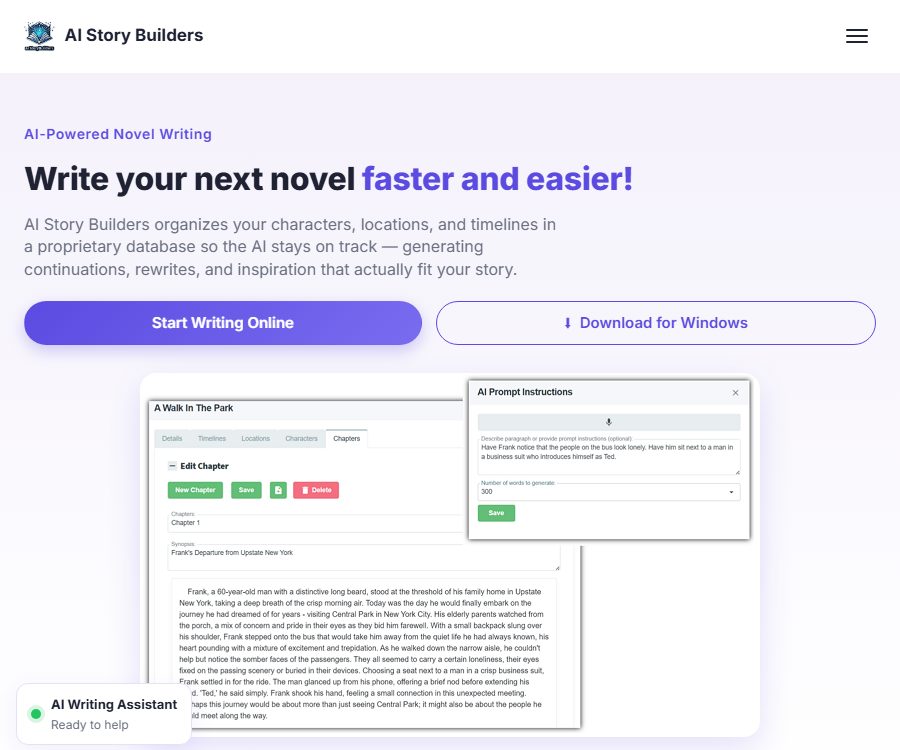
AI Story Builders is a free, open-source software designed for creating full-length novels. It organizes characters, locations, timelines, chapters, and paragraphs into a structured story database, after which relevant background information is provided to the AI to generate or modify the content.
Unlike writing tools that rely solely on chat history, it places more emphasis on the continuous management of the novel’s settings and the relationships between its events. Users can use the online web version or install the desktop version on Windows devices.
Core functions
Structured story management
- Record the story’s title, type, summary, and long-term system instructions.
- Manage roles, locations, timelines, and attribute changes separately.
- Split each chapter into multiple paragraphs, and associate the characters, locations, and timeline with them.
- Flashbacks, character ages, and different settings across various stages are handled through timeline attributes.
AI continuation and rewriting
When editing a paragraph, one can ask the AI to continue writing based on the preceding text, chapter summaries, as well as information about characters and locations; it is also possible to use natural language to request that an existing paragraph be rewritten. The generated text is usually presented in short paragraphs, which makes it easier for the author to review and make adjustments step by step.
Context and semantic retrieval
The software creates a Master Story context from the story database, which includes system instructions, previous text, the current paragraph, and related historical paragraphs. Vector retrieval helps the AI locate relevant events in earlier chapters, thereby reducing the problem of forgetting settings in long-form compositions.
Story Perception Chat
The new version of Chat will create a knowledge graph for stories, enabling it to understand the relationships between characters, locations, timelines, chapters, and paragraphs. Users can ask about the experiences of characters, identify inconsistencies in the setting, discuss the plot, and they can also add, rename, update, or delete story elements through dialogue.
Import and export of existing works
- Import existing novels so that the AI can continue working based on the original manuscripts.
- Save the complete story as a Microsoft Word document.
- Export the AI Story Builders project files for backup and re-import.
- Check the logs to examine the content sent to the model and the resulting output.
Writing style and fine-tuning
The author can set the Writing Style and various long-term instructions to control the tone, rhythm, and style of description. The platform also provides tools for organizing training data and fine-tuning models; however, the costs associated with fine-tuning, data rights, and model limitations are determined by the respective service providers.
Supported platforms and versions
| Version | Usage method | Main features | Suitable for users |
|---|---|---|---|
| Online version | Desktop browser | No installation is required; version 3.0 supports importing models from Google and Anthropic, as well as the new Chat version. | Cross-device or quick experience |
| Windows version | Installation from Microsoft Store | Desktop applications, local project management, and a complete writing workflow | Created mainly on Windows. |
| Open-source code | Obtained from the official GitHub | It is possible to review and modify the project code; a development environment is required. | Developers and self-hosted research |
The official website does not offer versions for macOS or native mobile applications, and phones and tablets are not the editing environments that are officially supported. For details regarding specific versions and compatibility, please refer to the download page and the repository instructions.
Installation and Usage Instructions
- Choose the online version or install the Windows version from the Microsoft Store.
- Create an API key at the model service provider, and verify that there is an available credit limit for the account as well as any budget constraints.
- In the settings, select OpenAI, Azure OpenAI, or other models supported by the current version, and save the credentials.
- Fill in the title and summary using the new story wizard, and create characters, locations, and a timeline either automatically or manually.
- Write section by section within the chapter, and assign the appropriate characters, locations, and timeline to each paragraph.
- Use AI to continue or rewrite the plot, or discuss it via chat; review each section before saving it as the final version.
- Export project files and Word documents on a regular basis to keep backups from different dates.
Prices and model costs
The information below was verified on August 25, 2026. The AI Story Builders software is free of charge; there is no fixed subscription fee required. However, to generate content using AI, it is necessary to have one’s own model API account.
| Cost items | Software price | Additional fees | Explanation |
|---|---|---|---|
| Online version | Free | Model API is billed on a pay-as-you-go basis | You need to provide your own key for compatible services. |
| Windows version | Free | Model API is billed on a pay-as-you-go basis | Install through the Microsoft Store |
| Source code | MIT License | Development, deployment, and model costs are to be borne by the user. | Code can be reviewed and modified. |
The official website estimates that the cost of using APIs for general writing tasks is usually between $1 and $5 per month; older documents also mention that it can be less than $1 per hour for intensive use. These are just examples, as there is no fixed price – the actual cost depends on the model used, the length of the context, the amount of output generated, embedding processes, fine-tuning requirements, and the current prices set by the service provider.
Why longer texts may increase costs
- Each time it is generated, the story background, preceding text, and relevant historical passages are sent.
- The longer the novel, the more tokens there may be to search for, embed, and input.
- High-end models, long outputs, and frequent rewrites incur higher one-time costs.
- Knowledge graphs, Chat, and fine-tuning may generate additional requests.
Model support
The classic setup documentation focuses on OpenAI and Azure OpenAI, and it is necessary to incorporate models in order to create a story index. The online version 3.0 update of 2026 added Google and Anthropic models as well; the official guidance recommends using the powerful Claude model for story-aware chat.
The available models may vary across different versions, and the names of these models can change as the service providers update their offerings. Do not consider the subjective model recommendations provided by the website’s authors as objective conclusions for all contexts; it is better to compare them directly within the same paragraph.
Open-source status
The main repository of AI Story Builders is available on the official GitHub site, under the MIT license; it contains the code for desktop applications, documentation, and related resources. There is also a separate official repository for the online version. Therefore, this tool can be considered open source.
The open-source license applies only to the code in the repository; it does not cover the models, API quotas, and services provided by OpenAI, Azure, Google, or Anthropic. The “proprietary story database” mentioned in the software interface refers to the way in which the product’s data is organized, and it does not imply that the source code is closed-source.
Privacy and data security
The privacy policy of online websites states that names, email addresses, addresses, phone numbers, device information, IP addresses, browser details, and access data may be collected, and cookies are used as well. Users should not post sensitive personal information on public forums or communication areas.
The content of the novel, the character designs, and the relevant instructions are sent to the selected AI service provider for processing; the rules regarding storage, training, and retention are governed by the policies of the model account and the service provider. API keys should be stored only within the application settings, and must not be uploaded to public repositories, saved in screenshots, or shared in projects.
Which users are it suitable for
- To write a novel, an author needs to manage a large number of characters and locations.
- The story features flashbacks, multiple timelines, and changes in the characters’ attributes.
- Users who already have manuscripts and wish to continue organizing and expanding them after importing them.
- Creators who wish to identify missing elements in the setting, isolated characters, and narrative inconsistencies through questions and answers.
- Developers who wish to review the source code or customize the writing process on their own.
Product advantages
- Structured contexts are designed for long-form stories, rather than relying on a single conversation.
- Characters, locations, and timelines can be linked to specific paragraphs within a chapter.
- It supports continuing to write, rewriting, asking questions about stories, and directly modifying the story structure.
- The software is free and open-source; users can choose and pay for model services on their own.
- It offers a web version, a Windows version, export to Word, and project backup.
Usage restrictions and precautions
- AI may still create preset scenarios or repetitive plots, or produce factual and logical errors; knowledge graphs cannot guarantee complete accuracy.
- Long contexts increase the cost of the model; it is therefore necessary to set API budget limits and billing alerts.
- The availability of model support and new features for the online version and the desktop version may differ.
- Third-party models may reject certain topics based on content policies, and authors must comply with the relevant service terms.
- Importing unauthorized works, imitating living authors, or directly publishing AI-generated content can pose copyright and ethical risks.
- Deletion, modification of dialogues, and automatic import can affect various elements of a story; it is advisable to export a backup of the project before carrying out such operations.
Frequently Asked Questions
Is AI Story Builders free?
The software itself is free; there is no fixed subscription fee for the online version, the Windows version, or the open-source code. To generate content, it is necessary to use model APIs provided by third parties and to pay for the amount of usage.
Is it possible to import a novel that has already been written?
Yes, the new version allows for story import. After importing, it is still necessary to check whether the characters, locations, chapters, and timeline have been identified correctly.
Which systems are supported?
The official version is available as a web-based desktop browser and as a Windows application; native versions for macOS, iOS, or Android have not been confirmed.
Will it automatically write the entire book?
It is more suitable for collaborative writing on a section-by-section basis. The author still needs to decide on the plot, review the style of writing, make revisions to the content, and address issues related to structure and copyright.
Is it truly open source?
Yes, the official main repository is licensed under the MIT license, and there is also a public repository for the online version. However, the third-party models and cloud services that are used are not therefore open source or free of charge.
Summary
AI Story Builders is suitable for writers of longer works who place importance on consistency in characters, locations, and timelines; it provides the AI with relevant context through structured databases and semantic search. The software is available freely as open source, but users are responsible for managing their API keys, model billing, story privacy, and the quality of their creations.
Tools similar to AI Story Builders



 Guigong Network Security Registration No. 45132202000164