






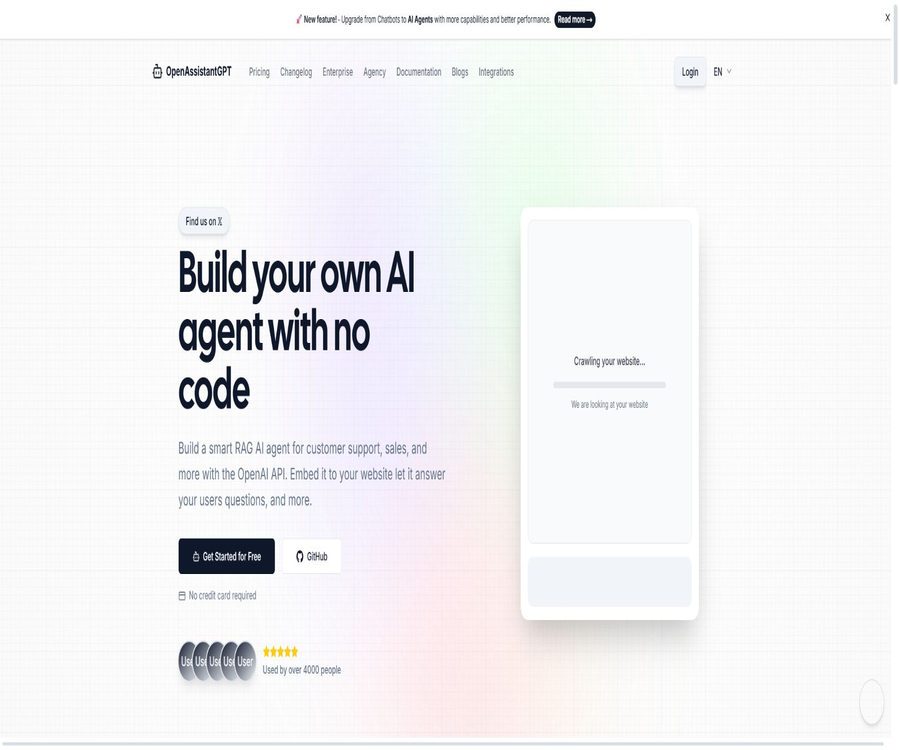
OpenAssistantGPT
OpenAssistantGPT, an intelligent tool focused on AI design.
Tags:AI design toolsTool Introduction
OpenAssistantGPT is an open-source platform for creating website chat bots based on the capabilities of OpenAI assistants; it also offers managed services that require no maintenance.
Users can create a knowledge base using files and web content, and then integrate robots into websites to handle customer service, answer product-related questions, provide access to internal information, and collect data on visitors.
Main functions
Knowledge base and web scraping
The platform allows for the uploading of files, as well as the extraction of content from specified websites using crawlers; the processed data is then used to enable robots to provide responses.
- Free plans and various paid plans impose limits on the number of robots, crawlers, and files respectively.
- After the website content changes, it is necessary to re-crawl or update the files; otherwise, the responses may continue to use outdated information.
- Search enhancement can only improve relevance; it cannot guarantee that the answers will always be accurate.
Robot configuration and website embedding
Users can set the name, welcome message, default prompt, model, and interface appearance, and insert the generated embed code into websites that support custom code.
- It is suitable for platforms such as WordPress, Shopify, Wix, Webflow, and others that allow the insertion of embedding frameworks or custom code.
- Basic offers basic customization options for the appearance and a visitor inquiry form, while Pro allows the removal of brand identifiers and the use of a custom domain name.
- Pro allows the attachment of files during conversations, making it suitable for scenarios where it is necessary to analyze data uploaded by users.
Clues, operations, and automation
Visitors can submit their email addresses and questions; the system notifies the operators via email or a callback, and can also send the full context of the conversation to external systems.
- Callbacks can be connected to ticketing systems, customer relationship management systems, and custom workflows, and they support key sharing for verification.
- AI Agent Actions allow querying external interfaces, enabling robots to provide responses based on real-time data or to trigger specific business actions.
- The client prompt parameters do not possess authentication capabilities, and therefore cannot be used to protect sensitive content.
Usage tutorial
- Register accounts for OpenAssistantGPT and the OpenAI platform, and create interface keys for distinct purposes.
- Configure the required keys separately in the global settings and for each individual robot, to prevent all robots from using the same credentials.
- Upload the organized documents or create a web crawler, then develop a robot and set parameters for the scope of responses, the tone to be used, and default rules.
- Test common questions, unanswered questions, and malicious prompts in the preview area, and correct the relevant materials and system messages.
- Copy the embedded code and insert it on your website, then check that the desktop version, mobile version, and privacy notices are functioning properly.
- After going live, check the conversations and clues, regularly update the knowledge base, rotate keys, and monitor OpenAI usage.
Which users are it suitable for
- Small teams that wish to quickly deploy website customer service or product Q&A robots.
- Agencies and companies that need multiple robots, custom domain names, and the collection of visitor leads.
- Developers and open-source teams who are willing to maintain the code, databases, and cloud services on their own.
- Technical teams need to read robot and session data through APIs, or use SDKs to customize the front-end and back-end components.
Prices and packages
| Package | Monthly price | Main limit | Main functions |
|---|---|---|---|
| Free | 0 dollars | 1 robot, 1 crawler, 3 files, 10 messages per month | Basic experience, without customization, lead forms, and attachments |
| Basic | 18 dollars | 9 robots, 9 crawlers, 27 files, unlimited messages | Basic customization, visitor inquiries, and advanced support |
| Pro | 54 dollars | 27 robots, 27 crawlers, 81 files, unlimited messages | Remove brand, chat attachments, custom domain names, and advanced support |
| Enterprise | Contact the team | Negotiate as needed | Includes additional package features and offers enterprise-level customization. |
The current pricing document states that the number of free messages is 10 per month, while some older articles on the site still indicate 500 messages; there is a discrepancy in these figures, and it is the information displayed in the account dashboard and on the billing page that should be taken as reference.
The subscription fee mentioned above is not equal to the total cost of the model. The hosted version uses the user’s own OpenAI API key, and calls to the model are billed separately by OpenAI; the official party does not disclose the annual pricing or any uniform rules for refunds.
Product advantages
- The managed version is suitable for low-code deployment, while the open-source version allows code review and self-deployment.
- File and web scraping, clue collection, callbacks, and external operations cover the common needs of website customer service.
- The cost of the model is charged directly to the user’s account, allowing for easy tracking of expenses based on the actual amount of usage.
Usage restrictions and precautions
- “Unlimited messages” means that the platform plan no longer imposes limits on the number of messages, but it does not exempt users from the costs associated with calling the OpenAI models or from any rate limits.
- Before web crawling and file uploading, it is necessary to verify the copyright of the content, as well as personal information and access rights, in order to prevent sensitive data from being included in public robots.
- Models may produce errors or give responses that go beyond their scope of competence; therefore, operational permissions should be restricted, and manual routing should be established for high-risk issues such as refunds, medical matters, and legal concerns.
- Interface keys must not be included in front-end code or stored in public repositories; if they are leaked, they should be revoked immediately and regenerated.
APIs, SDKs, and open-source status
The hosting service offers data APIs that use Bearer token authentication; it allows access to robots and session threads, with a public rate limit of 60 requests per minute per key.
The official team also provides a chatbot-sdk based on Next.js, licensed under the Apache-2.0 license; the code repository for the main platform is licensed under AGPL-3.0, allowing it to be hosted privately provided that the corresponding open-source requirements are met.
Platform and deployment methods
- The management console and chat components are accessed via a web page, and bots can be integrated into websites that support custom code.
- Self-hosted projects use technologies such as Next.js, TypeScript, and Supabase; their deployment and upgrading require development and operations expertise.
- The official documentation is mainly in English, while the language used in robot responses depends on the model, the prompts provided, and the content of the knowledge base.
Frequently Asked Questions
Is OpenAssistantGPT free?
It is possible to create a basic robot for free, but the amount of free messages available is quite limited; in addition, there may be separate costs associated with invoking the model.
Are both the product and the SDK open source?
Yes, but the licenses are different: the main platform is governed by AGPL-3.0, while the SDK for standalone chatbots is under Apache-2.0. It is necessary to review each set of terms before using them in commercial purposes or for distribution.
Can it be used without knowing how to program?
Creating a managed version requires little code for setting up the knowledge base and embedding processes, but custom domain names, callbacks, external operations, and self-hosting usually necessitate the involvement of technical personnel.
Tools similar to OpenAssistantGPT



 Guigong Network Security Registration No. 45132202000164