






MindPal
MindPal, an intelligent tool focused on AI-driven design
Tags:AI design toolsWhat is MindPal?
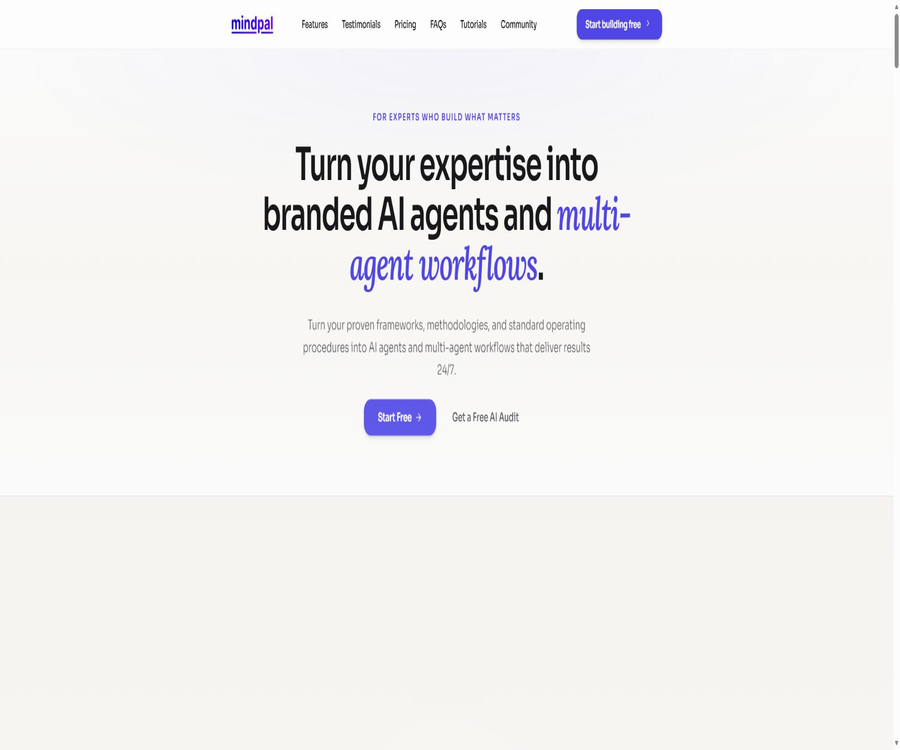
MindPal is a platform used for creating AI agents and multi-agent workflows, with a focus on transforming corporate frameworks, methods, SOPs, and training materials into automated services that can be executed repeatedly. Users do not need to develop models from scratch; they can configure roles, knowledge, tools, and steps, and then deliver these through links, embedded components, or a brand portal.
It can be used to create consultation assistants for customers, as well as to organize market research, content creation, sales support, and internal operational processes. The product itself is a proprietary hosted service; it cannot be considered an open-source platform just because it supports APIs, MCP, or third-party connections.
Main functions
- Creation of AI agents: It is possible to use natural language to describe the desired objectives so that the system can generate an initial draft; alternatively, it is possible to start from templates or a blank configuration. Users need to provide instructions for the system, as well as details regarding the working style, models, knowledge, and tools to be used. The quality of the output depends on how clearly these elements are defined.
- Knowledge base: Upload frameworks, SOPs, training materials, and business documents so that the agent can answer questions or carry out tasks within the scope of these materials. The knowledge materials should have clear versions, and it is important to avoid including any outdated, conflicting, or inappropriate content.
- Multiple model selection: You can choose models from providers such as OpenAI, Anthropic, Google, and DeepSeek depending on the task at hand. The free version only lists GPT-4o mini, while the paid version provides more advanced models; the specific models available may change over time.
- Multi-agent workflow: It connects multiple specialized agents together, with different roles responsible for research, analysis, creation, review, or revision. Variables can be passed between nodes, which makes it possible to break down complex processes into manageable stages.
- Orchestration nodes: Workflows can utilize nodes such as manual input, information, agents, evaluation and optimization, loops, orchestrators and executors, sub-processes, and chat. Different nodes are suitable for carrying out fixed steps, enabling iterative improvements, or breaking down tasks dynamically.
- Evaluation and optimization: The evaluation node uses the results of the standard checks to provide feedback to the generation node for further iteration. This approach helps improve consistency, but it does not guarantee the accuracy of the information; important results should still be reviewed by the responsible persons.
- Manual checkpoints: They are required at certain points in a process to prompt users to provide additional information, confirm their choices, or approve actions, thereby preventing automated processes from continuing without the necessary context. They are especially essential when it comes to publishing content, making payments, handling customer data, or performing irreversible actions.
- Web search, code interpretation, and web scraping: Plans at the Pro level and above provide tools that can be used by agents to obtain public information, process data, or extract content from pages. Users still need to comply with the rules of the target websites, as well as pay attention to requirements regarding timeliness, copyright, and citation.
- Batch execution: The same process can accept multiple sets of inputs and generate results with a consistent structure in batches. Batch processing consumes more credits; before starting it, it is advisable to use a small number of samples to check field mapping and error handling.
- Publication and embedding: The paid plan allows for an unlimited number of agents and workflows to be published, which can be made available to users through public links, embedding tools, or a branded interface. Custom domain names are charged as part of a package or as an additional service.
- Team collaboration: Advanced offers editor and user seats, workspace branding, and collaboration features, while Ultra provides an unlimited number of user seats. Editing rights are different from the actual user seats, and these should be calculated separately when making a purchase.
- Managed build service: Teams can opt to purchase one-time or monthly building services, with the service providers handling the configuration, integration, and subsequent maintenance. Whether a platform subscription is included in the service depends on the managed solution chosen.
Input, processing, and output
| Stage | Supported content | Typical uses | Precautions |
|---|---|---|---|
| Enter | Text, files, images, links, and form fields | Collect customer requirements, information, and task parameters | The file type and size are subject to the limits set by the account. |
| Knowledge | Frameworks, SOPs, courses, and corporate materials | Define the context of the response and the methods for its execution | Management permissions, versions, and sensitive information are required. |
| Processing | Agents, loops, evaluations, sub-processes, and human nodes | Research, generation, review, and decision support | There is uncertainty in the model results. |
| Output | Dialogs, text, structured results, and process status | Reports, content, recommendations, and internal deliveries | Review the facts and rights before using it externally. |
| Delivery | Share links, web embedding, and brand portals | Customer tools, course assistants, and internal applications | Brand and domain name capabilities are available as part of various packages. |
The process from concept to deployment in use
- Select a process that already has established methods and success criteria, and identify the required inputs, knowledge materials, expected outcomes, and the responsible personnel.
- Create an agent by describing its role, tasks, prohibited actions, expression methods, and output format, then select an appropriate model.
- Upload authorized knowledge files, and use boundary cases to test whether the agent will deviate from the available information or mix up different versions.
- Let the system generate draft workflows based on natural language, or manually add agent, evaluation, loop, manual input, and subprocess nodes.
- Set node variables and data transmission, and define failure conditions, null values, timeouts, the number of iterations, and the termination criteria.
- To connect to external systems, configure Webhooks, Public APIs, or MCP, and grant only the minimum permissions required for the task.
- Run tests with normal, missing, conflicting, and abnormal samples to examine integral consumption, latency, model errors, and the points at which manual intervention is required.
- After confirming privacy, copyright, and user guidelines, it is released on a limited scale through links, embeds, or a brand portal, with continuous improvements made based on the logs.
Typical users and scenarios
- Consultants and coaches: Transform their diagnostic frameworks, questioning processes, and delivery methods into self-service intelligent agents for clients.
- Marketing team: Enables research, positioning, writing, and review bots to work together to create draft campaigns, which are then approved for publication by human staff.
- Sales and Customer Success Team: Collects information on potential clients, prepares communication materials, summarizes their requirements, and forms recommendations for follow-up actions.
- Training and knowledge team: Convert courses, manuals, and SOPs into Q&A assistants or step-by-step practice tools.
- Operations team: Handles the collection, classification, analysis, approval, and delivery of information, thereby reducing the need for repeated copying and pasting.
- Development and automation specialists: Integrate workflows into existing systems using Public APIs, Webhooks, and MCP.
- It is not suitable to replace professional judgments in high-risk fields such as medicine, law, and finance, nor should it be used to carry out irreversible actions without supervision.
Prices and packages
| Package or version | Price | Billing cycle | Core benefits or quota | Suitable for users |
|---|---|---|---|---|
| Free | 0 dollars | Free for a long time | Initially, 100 AI credits, 50 MB of knowledge space, 1 agent, 1 workflow, and GPT-4o mini. | Personal experiences and prototypes |
| Pro | 39 dollars per month | Pay $468 per year | 6,000 points per month, 5,000 MB, 1 editor, advanced models, unlimited number of agents and workflows for deployment | Individual creators and small businesses |
| Advanced | 149 dollars per month | Pay $1,788 per year | 30,000 points per month, 25,000 MB, 5 editors, 20 user accounts, Public API and collaboration features | Growth-oriented team |
| Ultra | 374 dollars per month | Pay $4,488 per year | 100,000 points per month, 100,000 MB, unlimited user accounts, and a custom domain name | Large-scale operation team |
The pricing shown in the table represents the average monthly amount when billing on an annual basis for this page; the monthly payment amount, any promotions, and actual taxes may vary. Additional purchases might be required if the usage of models, storage, seats, or domain names exceeds the limits set by the package – the details should be checked on the account billing page.
Additional usage and services
| Project | Price | Billing cycle | Content |
|---|---|---|---|
| Additional AI credits | 9 dollars | Monthly | 1,000 points are added each month. |
| Additional storage | 1 dollar | Monthly | Increase by 1 GB |
| Custom domain name | 9 dollars | Per domain per month | Used for branded delivery |
| Editorial seat | 29 dollars | Per seat per month | Add functions for creating and editing members |
| User seats | 5 dollars | Per seat per month | Increase end users in the workspace |
Managed Build Service
| Plan | Price | Billing cycle | Core rights and interests | Suitable for users |
|---|---|---|---|---|
| Pay Per Build | 500 dollars | Single time | 1 complete build, 1 to 3 business days, 1 week for revisions, integration and maintenance; platform subscription is available separately. | Teams with a single, clear process |
| Unlimited Builds | 2000 dollars | Monthly | Advance one build at a time, enable consistent submission of requests, including platform setup, integration, and maintenance. | Continuously build an automated team |
The self-service package includes a 14-day refund guarantee and can be canceled at any time; the subscription ends at the end of the current cycle. Refunds for managed services are also dependent on factors such as whether an automated solution can be provided within 14 days, and it is necessary to review the details of the order and the written rules before making a purchase.
API, MCP, and open-source status
- Advanced and Ultra offer Public APIs that allow workflows to be triggered from Zapier, Make, or custom applications. The authentication procedures, rate limits, response formats, and error handling for these public APIs are specified in the account documentation.
- A Webhook node can send data or commands to external services, and is suitable for event notification and system integration. In a production environment, signature verification, retry mechanisms, idempotency, and secret rotation are necessary.
- The MCP functionality enables agents to connect to compatible servers and to use over a thousand different applications via tools such as Zapier and Composio. When MCP is still marked as a testing feature, it is necessary to first check its stability, permissions, and the availability of relevant packages.
- It has not been confirmed that there is an official open-source repository or open-source license for the MindPal core platform; the compatibility of APIs, MCPs, and plugins, along with the example code, does not mean that the product itself is open-source.
Privacy, security, and content rights
- The service handles account information, prompts, files, agent configurations, workflows, outputs, execution logs, feedback, and integration data; teams should upload only the minimum amount of content necessary for their specific purposes.
- By default, policy statements prohibit the use of customer content to train third-party base models, unless the user makes a separate and explicit choice to do so. When a different model provider is selected, the data is sent to the corresponding processing party.
- The customer retains ownership of the content uploaded by them, and grants a limited license for processing that is necessary to operate the service. Paid users can obtain unique results in accordance with the terms, though these results may not be unique; the customer remains responsible for any copyright and commercial aspects related to such results.
- Customer content is typically retained for 90 days after it is created, or until the user deletes it; execution logs are kept for 180 days, while backups are updated on a rolling basis every 35 days. Accounts, bills, security logs, and other similar categories have longer statutory or operational retention periods.
- The security measures include AWS hosting, encryption during transmission, static encryption, access control, and multi-factor authentication; however, no specific scope for independent security certification has been disclosed in this case.
- When connecting to services such as Google, Slack, Teams, or GitHub, only the necessary permissions should be granted, and these permissions can be revoked in the account or third-party settings.
- The terms of service allow for pre-payment on a monthly or annual basis with automatic renewal; any changes in prices are usually notified in advance and take effect upon the subsequent renewal. For corporate purchases, it is necessary to verify the data areas, sub-processors, deletion mechanisms, and contract priorities separately.
Advantages and limitations
- Advantages: It combines knowledge, agents, workflows, and customer-facing delivery in a single product, making it suitable for turning mature methods into commercial products.
- Advantages: Evaluation and optimization, loops, as well as orchestrators and human nodes enable the representation of more complete processes than a single prompt.
- Advantages: The free version allows for the creation of small prototypes, while the paid versions offer additional tools, models, collaboration features, APIs, and branding capabilities.
- Restrictions: Billing is based on points, and complex models, multi-agent iterations, batch executions, and web tools will consume more of these points more quickly.
- Limitations: Third-party models and connectors introduce additional data paths, rate limits, failures, and dependency on specific terms.
- Limitations: AI-generated results may omit facts or fail to comply with business rules, and evaluation nodes cannot replace manual verification.
- Restrictions: The monthly pricing, regional taxes, specific API restrictions, and the availability of certain testing features need to be checked within the account.
Summary
MindPal is more suitable for teams that already possess clear knowledge assets and standard methods, and that wish to develop intelligent agent services or achieve automation across different roles swiftly. Before going live, it is necessary to use representative samples to verify the boundaries of the knowledge base, the way data is transmitted between nodes, the processes for manual approval, the costs associated with points, data access rights, and the responsibilities related to outputs.
Tools similar to MindPal



 Guigong Network Security Registration No. 45132202000164